A dairy manufacturer in the Midwest shipped 14,000 cases of flavoured yogurt cups to retailers across six states. Three weeks later, a consumer reported finding a plastic fragment inside a sealed cup. The root cause: a degraded gasket on a filling machine had been shedding micro-fragments for 11 days before anyone noticed. By the time the recall was issued, product had reached 2,200 retail locations. The manufacturer spent $8.4 million on retrieval, disposal, legal fees, and crisis communications. Two national grocery chains delisted the brand for 18 months. An AI-powered visual inspection system operating on that filling line would have flagged the gasket degradation pattern on day one — and a digital traceability system would have narrowed the recall to 3 days of production instead of 11, cutting the affected scope by 73%.
$10M
Average direct cost per food recall event — excluding lawsuits, brand damage, and lost retail contracts (GMA/FMI)
422
FDA food recall events recorded in 2024 — with 45.5% caused by labelling errors and undeclared allergens alone
24 Hrs
Maximum response time under FSMA 204 traceability rule — you must produce complete chain-of-custody records on demand
Food recalls are accelerating, not declining. FDA recall volumes surged 75.8% in Q3 2025 compared to Q2, reaching the second-highest quarterly total since 2020. Hospitalizations from recalled food more than doubled in 2024 compared to the prior year. And the FSMA 204 Food Traceability Rule — with a compliance deadline approaching in 2028 — will require 24-hour record production for high-risk foods, making manual traceability systems a liability. AI-driven quality monitoring and digital traceability don't just detect problems faster — they prevent recalls from happening in the first place. Manufacturers ready to close their quality and traceability gaps can start building their AI-powered quality system today.
Oxmaint's CMMS integrates AI inspection alerts, equipment maintenance records, and batch traceability into a single audit-ready platform — so when an anomaly is detected, the work order, root cause, and affected lot codes are already connected. Plants still managing quality with paper logs and spreadsheets can sign up free to digitize their quality and traceability program.
The Five Root Causes Behind Food Product Recalls
Understanding why recalls happen reveals where AI and digital systems deliver the highest prevention value. Each category represents a distinct failure mode with specific technology solutions that eliminate or dramatically reduce risk.
45.5% of FDA Recalls
$1.92B Cost in 2024
Consumer Fatalities
The single largest recall category. Wrong labels applied to products, allergens not declared due to cross-contact, or formula changes not reflected on packaging. AI vision systems verify every label against the production batch in real time.
39% of All Recalls
Listeria / Salmonella / E. coli
Mass Hospitalization
Listeria alone triggered 23 FDA recalls in Q3 2025. Contamination often traces to sanitation failures, temperature excursions, or cross-contamination between raw and ready-to-eat lines. AI-monitored CCP sensors catch deviations before product ships.
11.6% of Recalls
Metal / Plastic / Glass / Wood
Equipment Degradation
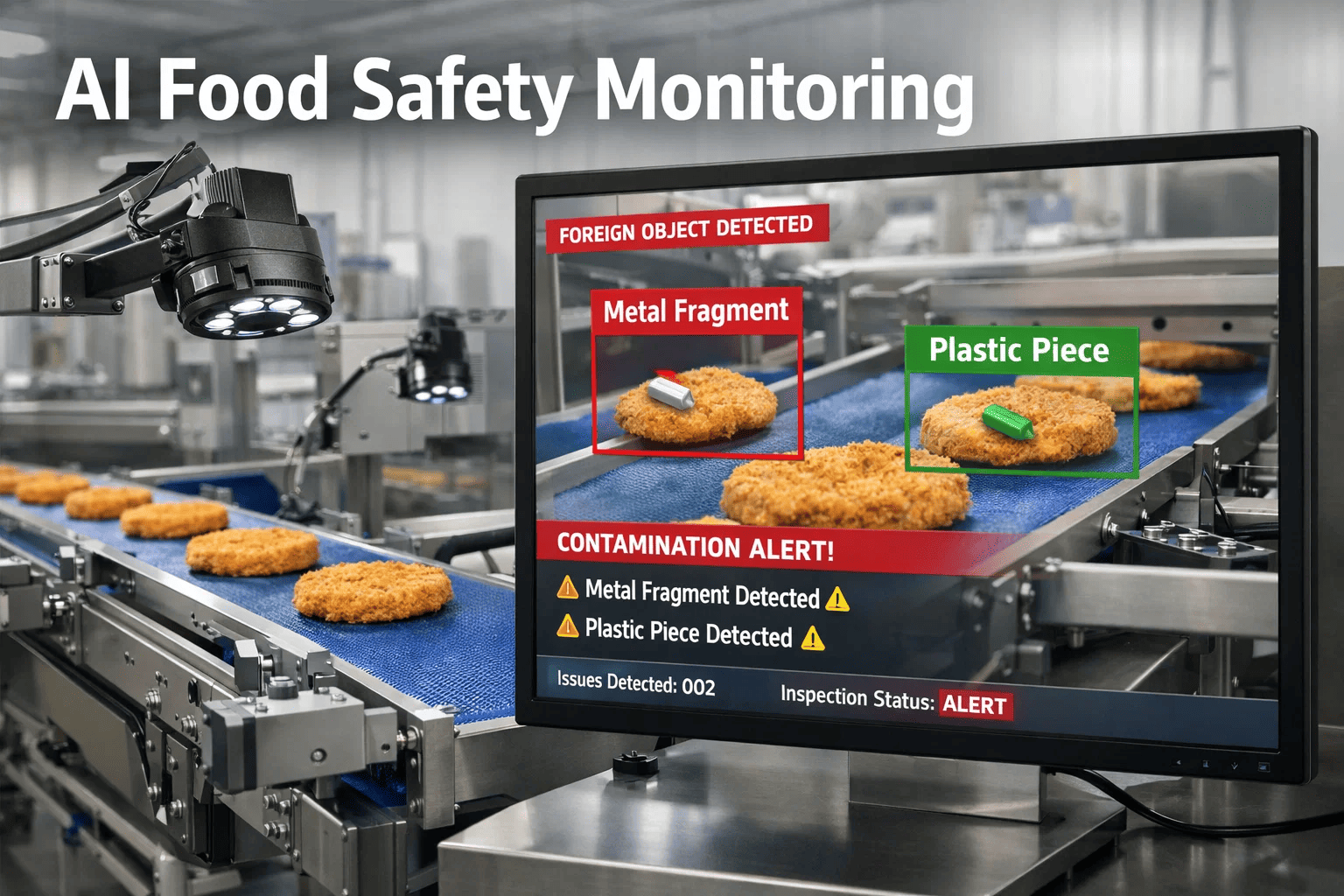
A single FSIS recall in Q3 2025 involved 58 million pounds of corn dogs contaminated with wood fragments. Foreign objects almost always originate from equipment wear — worn gaskets, broken screens, degraded conveyor belts — detectable by predictive maintenance AI.
Wider Recall Scope
Slow Response
FSMA 204 Violation
When you can't trace which lots used which ingredients from which suppliers, every recall becomes a full-production recall. Poor traceability turned a 3-day cucumber contamination into a 2-month consumer illness event in 2024 because affected product couldn't be isolated quickly enough.
Root Cause Analysis: Why Recalls Still Happen Despite HACCP
Most food manufacturers have HACCP plans, trained staff, and good intentions. Yet recalls persist because the underlying systems are reactive, manual, and fragile. The 5-Why analysis reveals why traditional food safety programs fail to prevent the incidents they're designed to catch.
| Problem |
Recall issued for plastic fragments found in packaged product — 14,000 cases across 6 states |
| Why 1 |
A degraded gasket on the filling machine shed micro-fragments into product for 11 days |
| Why 2 |
Visual inspection didn't detect fragments — they were sub-millimetre and embedded during filling |
| Why 3 |
Preventive maintenance schedule only replaced gaskets every 90 days — this one failed at 67 days |
| Why 4 |
No condition-based monitoring existed — maintenance was time-based, not data-driven |
| Root Cause |
No predictive maintenance AI to detect early-stage material degradation, and no AI vision inspection to catch foreign objects at line speed — equipment condition and product quality were both blind spots |
The root cause is always the same: reactive systems waiting for failures instead of predictive systems preventing them. AI-powered inspection catches what human eyes miss, and predictive maintenance replaces parts before they contaminate product. Together, integrated with a CMMS that links equipment health to production quality, they close the gap between HACCP theory and operational reality — book a demo to see how Oxmaint connects AI alerts to maintenance workflows and traceability records automatically.
Stop Reacting to Recalls. Start Preventing Them.
Oxmaint connects AI quality inspection, predictive maintenance, and digital traceability in one platform — so contamination is caught before it ships, equipment is fixed before it fails, and every lot is traceable within minutes, not days.
Where AI Prevents Recalls: The Complete Intervention Map
AI doesn't replace your food safety program — it eliminates the blind spots your program can't cover. The Ishikawa framework maps the six domains where AI and digital systems intervene to prevent each category of recall before product leaves the facility.
Vision Inspection
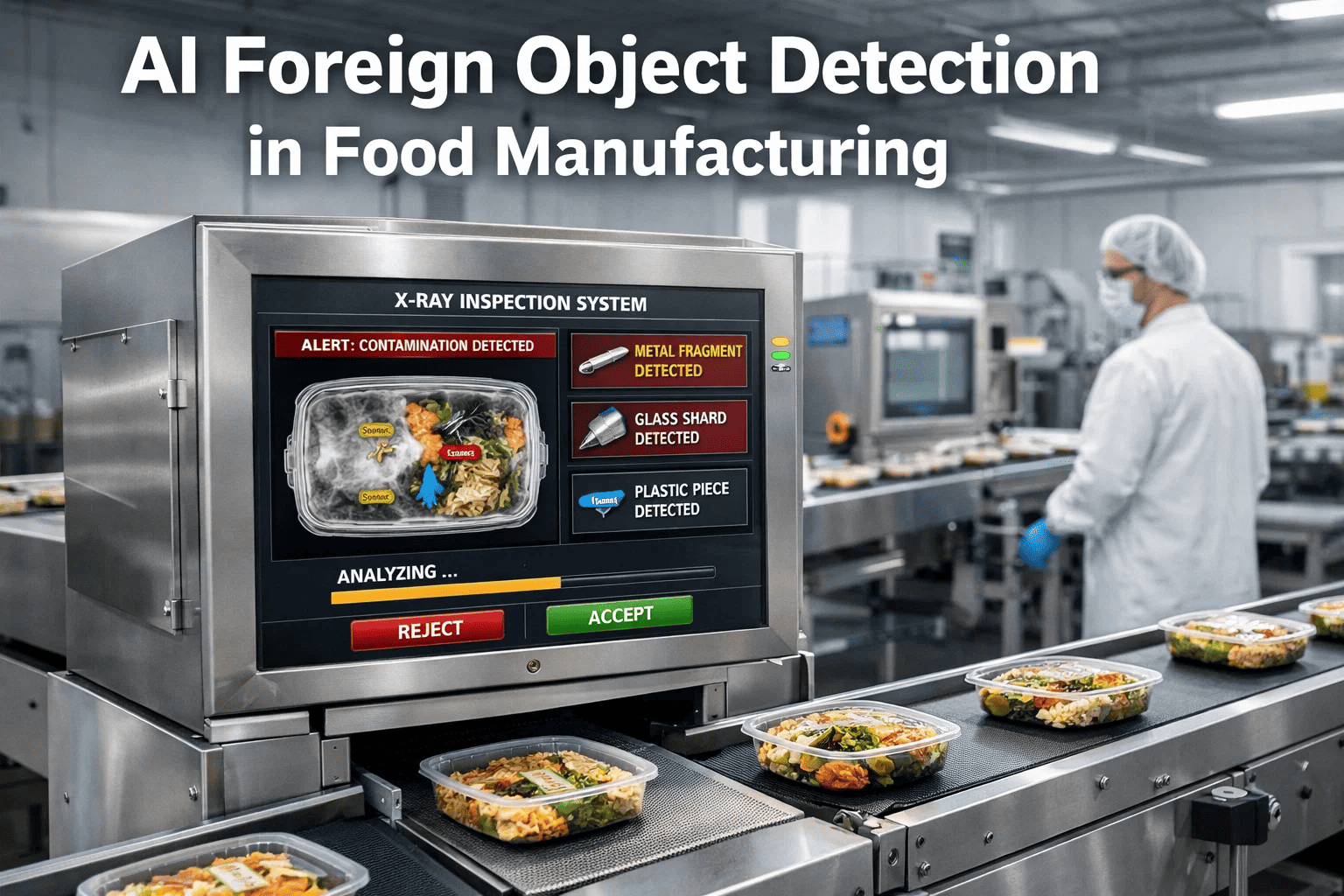
Foreign object detection at line speed (metal, plastic, glass, bone)
Label verification — correct SKU, allergen declarations, lot codes
Fill level, seal integrity, and packaging defect detection
Surface defect and discolouration analysis in raw ingredients
Predictive Maintenance
Gasket, seal, and screen wear prediction before shedding occurs
Vibration analysis for mixer, conveyor, and filling equipment
Motor and bearing failure forecasting 24-72 hours ahead
Sanitation equipment effectiveness monitoring
CCP Monitoring
Real-time temperature, pressure, pH, and flow rate tracking
Automated deviation alerts when CCP limits approach thresholds
Cooking/pasteurisation time-temperature validation
Metal detector and X-ray system performance verification
Traceability
Lot-level ingredient tracking from receiving to finished goods
FSMA 204 CTE/KDE capture at every critical tracking event
Supplier certification and COA linkage to production batches
24-hour recall readiness with one-click affected-lot identification
Environmental Monitoring
AI-analysed environmental swab trend data for pathogen risk
Cold chain monitoring with predictive spoilage modelling
Sanitation verification through ATP and allergen residue tracking
Air quality and humidity monitoring in processing zones
Compliance Documentation
Automated HACCP log generation from sensor data
Digital corrective action records linked to specific deviations
Audit-ready reports for FDA, SQF, BRC, FSSC 22000
Staff training tracking and competency verification
AI Quality Monitoring — Technology Capabilities by Recall Type
Each recall category has specific AI and sensor technologies that target its root cause. This reference maps the technology stack to the problem — showing exactly what to deploy and what detection performance to expect.
Corrective Actions: Building an AI-Powered Recall Prevention Program
Transitioning from reactive food safety to AI-driven prevention requires systematic implementation across three domains. Each domain addresses a specific failure mode and delivers measurable recall risk reduction.
Deploy computer vision cameras on every packaging line for label verification and foreign object detection
Install X-ray or AI-enhanced metal detection with automatic reject on every finished-product conveyor
Configure AI models trained on your specific products, packaging, and defect types
Integrate inspection alerts directly into CMMS for automatic work order generation
Establish weekly calibration and quarterly model retraining cycles
Instrument critical food-contact equipment with vibration, temperature, and wear sensors
Build AI models that correlate equipment condition with product quality deviations
Replace time-based PM schedules with condition-based triggers in Oxmaint CMMS
Create automated alerts when sensor patterns match known contamination precursors
Link every equipment work order to the production lots running during the maintenance window
Digitize lot tracking for every ingredient from receiving through finished goods shipment
Capture all FSMA 204 Critical Tracking Events and Key Data Elements electronically
Build one-click mock recall capability — target: full trace in under 4 hours
Connect supplier COAs, environmental monitoring, and CCP data to production lot records
Run quarterly mock recalls and measure scope reduction vs. pre-AI baseline
Once these three pillars are operational, the CMMS becomes the central nervous system — linking inspection data, equipment health, and traceability records into a single audit-ready platform. Manufacturers ready to build this integrated system can create a free Oxmaint account to get started.
ROI of AI-Driven Recall Prevention
The financial case for AI quality and traceability systems is built on three pillars: recalls avoided, scope reduced when recalls do occur, and operational efficiency gained from automation. Here's what a typical mid-size food manufacturer (3-5 production lines, $50M-200M revenue) can expect:
Recall Avoidance: $2M-10M+ per prevented event
With average recall costs at $10M per incident — and AI vision catching defects that escape manual inspection — even one prevented recall per decade justifies the entire system investment. AI inspection trials show 30% recall rate reduction from automated visual quality checks alone.
Recall Scope Reduction: 60-80% smaller when recalls occur
Digital traceability narrows affected product from "all production this month" to "lots 4471-4483 on Line 2, March 7-9." The difference between recalling 14,000 cases and 2,100 cases is $6M+ in direct costs, plus preserved retailer relationships.
Downtime Reduction: $300K-1.5M/year saved
Predictive maintenance catches equipment degradation before it causes contamination events. Every prevented contamination shutdown saves $50K-$200K in lost production, emergency sanitation, and expedited testing — plus the product that would have been destroyed.
Audit & Compliance Efficiency: $100K-400K/year saved
Automated HACCP logging, digital corrective actions, and instant traceability reports cut audit preparation from weeks to hours. FSMA 204 24-hour response requirement becomes a 20-minute query instead of an all-hands data scramble.
One Prevented Recall Pays for a Decade of AI Quality Systems
Oxmaint connects AI inspection, predictive maintenance, and digital traceability into a single platform — giving your food safety team the tools to catch contamination before it ships, trace affected product in minutes, and prove compliance on demand.
Frequently Asked Questions
How does AI vision inspection actually prevent food recalls?
AI vision systems use high-resolution cameras and deep learning models to inspect every unit on the production line at full speed — typically 500-1,000+ units per minute. They verify label accuracy (correct SKU, allergen declarations, lot codes, expiry dates), detect foreign objects (metal, plastic, glass fragments), check fill levels and seal integrity, and flag packaging defects. Unlike human inspectors who fatigue after 30-60 minutes and catch 60-80% of defects, AI systems maintain 99%+ detection rates 24/7. When a defect is detected, the system automatically rejects the product and triggers an alert in the
Oxmaint Sign-up, linking the detection to the specific equipment, production line, and batch — enabling immediate corrective action before more product is affected.
What does FSMA 204 require and how does digital traceability help?
FSMA Section 204 (the Food Traceability Rule) requires businesses handling foods on the FDA's Food Traceability List to capture and maintain specific Key Data Elements at Critical Tracking Events — from harvesting and receiving through processing and shipping. Records must be producible within
24 hours of an FDA request during an outbreak investigation. The compliance deadline has been extended to July 2028. Digital traceability systems automate CTE/KDE capture, eliminating manual recording errors and enabling instant lot-level trace-back. Instead of pulling paper records from filing cabinets during a crisis, your team runs a single query that maps every ingredient, supplier, production lot, and shipment destination in minutes.
Book a demo to see how Oxmaint handles FSMA 204 traceability.
How does predictive maintenance prevent contamination events?
The majority of foreign object contamination traces back to equipment wear: degraded gaskets, worn screens, cracked conveyor belts, corroded fittings. Traditional time-based maintenance replaces these parts on a fixed schedule — but materials fail unpredictably. Predictive maintenance AI analyses vibration, temperature, pressure, and motor current data from food-contact equipment to detect early-stage degradation 24-72 hours before failure. When the AI identifies a wear pattern that historically precedes material shedding, it automatically generates a work order in the CMMS. The part gets replaced during planned downtime — not after it has contaminated 11 days of production.
Can AI help with undeclared allergen recalls specifically?
Undeclared allergens caused 45.5% of FDA food recalls in 2024 — costing the industry an estimated $1.92 billion. AI addresses this through multiple layers:
label verification (computer vision with OCR confirms every label matches the production batch's recipe and allergen profile),
production scheduling analysis (AI flags changeover sequences where allergen cross-contact risk is elevated), and
sanitation verification (automated documentation of allergen cleaning procedures between product runs). When combined with digital batch records in the CMMS, the system creates an end-to-end allergen control chain — from ingredient receiving through final label verification — that catches errors before product reaches consumers.
Sign up free to explore allergen management features.
What ROI timeline should we expect from AI quality systems?
Most food manufacturers see measurable returns within the first 6-12 months of deployment. The immediate wins come from: reduced quality holds and false rejects (AI is more accurate than manual inspection), fewer customer complaints (catching defects before shipment), and labour reallocation from manual inspection to higher-value quality engineering. The transformative ROI comes from recall prevention and scope reduction — a single avoided $10M recall justifies 5-10 years of system investment. For a mid-size plant (3-5 lines), typical all-in deployment costs range from $150K-$500K for AI vision, sensor instrumentation, and CMMS integration. Payback period: 4-12 months from operational savings alone, with recall prevention as pure upside.
Request a demo to get a customised ROI assessment.




.png)

