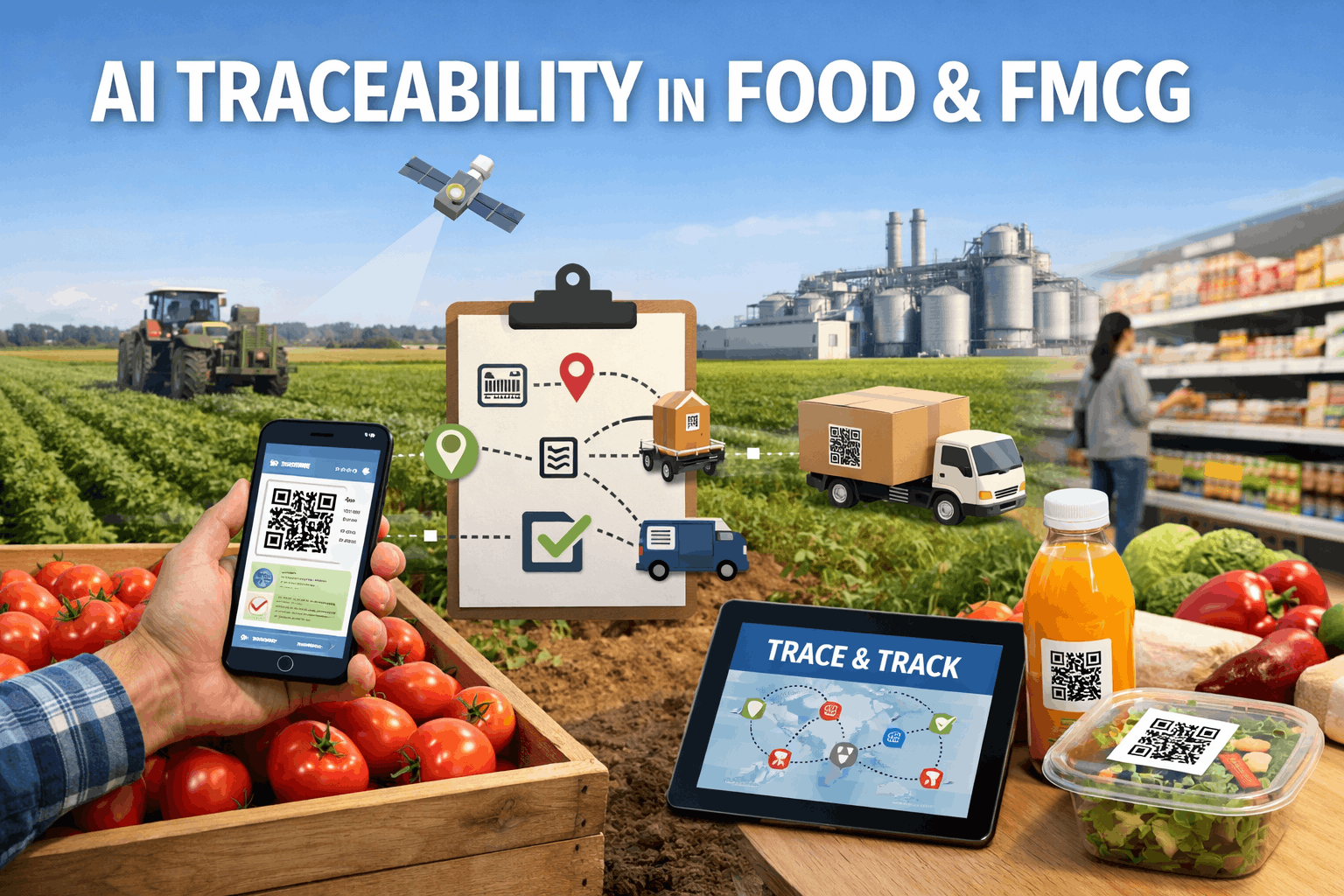
Blockchain for FMCG Traceability: End-to-End Supply Chain Transparency
By Jason on March 9, 2026
A single contaminated ingredient entering an FMCG supply chain can trigger a product recall affecting millions of units across dozens of markets — and the speed at which the contamination source is identified determines whether the recall costs $500,000 or $50 million. In 2023, the average food recall in the United States took 57 days from detection to resolution. With blockchain-enabled traceability, that timeline compresses to hours. The FDA's FSMA 204 rule, fully enforceable from 2026, requires end-to-end traceability for high-risk foods — and blockchain is the only technology architecture that delivers immutable, tamper-proof records across every node in a multi-party supply chain without requiring participants to trust each other or share a common IT system. For FMCG manufacturers running complex supply chains with dozens of raw material suppliers, co-packers, distribution partners, and retail customers, blockchain traceability is no longer a technology experiment — it is an operational necessity that directly impacts food safety outcomes, recall efficiency, regulatory compliance, and consumer trust. Oxmaint's blockchain integration and traceability features connect supply chain transparency with maintenance and asset data. Book a demo to see how traceability works alongside your maintenance operations.
Oxmaint connects blockchain traceability with equipment maintenance records — linking product quality to the exact machine conditions at the time of production.
Average Time from Food Safety Detection to Recall Resolution — Without Blockchain
2.2 sec
Time to Trace a Product from Store Shelf to Farm of Origin — With Blockchain
$10M+
Average Cost of a Major FMCG Food Recall — Direct and Indirect Combined
2026
FDA FSMA 204 Full Enforcement — End-to-End Traceability Required for High-Risk Foods
Why Traditional Traceability Systems Fail in FMCG Supply Chains
FMCG supply chains are uniquely hostile to traditional traceability approaches. A single finished product — a ready-to-eat salad, a protein bar, an infant formula — may contain ingredients from 15 different suppliers across 6 countries, processed through 3 intermediate facilities, packed by a co-manufacturer, and distributed through 4 regional distribution centres before reaching a retail shelf. Each participant in this chain maintains their own records in their own systems — spreadsheets, ERPs, paper logs, proprietary databases — with no standardised format, no shared timeline, and no mechanism to verify that the records have not been altered after the fact.
When a food safety incident occurs, the investigation team must manually request records from every participant in the chain, reconcile conflicting data formats, resolve discrepancies between systems that were never designed to interoperate, and attempt to reconstruct a timeline from fragmented evidence. This process takes weeks — during which contaminated products remain on shelves, consumers continue to be exposed, and the financial and reputational damage compounds daily. The fundamental problem is not data collection — most participants collect adequate data. The problem is data architecture: centralised, siloed, mutable records that cannot be trusted across organisational boundaries.
How Blockchain Solves the FMCG Traceability Problem
Blockchain technology addresses the three structural failures of traditional traceability — data silos, mutability, and trust — with a single architectural solution. A distributed ledger creates a shared, immutable record of every transaction in the supply chain that all participants can read but no single participant can alter. When a supplier ships a batch of ingredients, the shipment details are recorded on the blockchain. When a manufacturer receives, processes, and ships a finished product, each step is recorded. When a distributor receives and delivers to retail, those transactions are recorded. The result is a complete, tamper-proof chain of custody from raw material origin to consumer purchase — reconstructable in seconds rather than weeks.
Four Blockchain Properties That Enable FMCG Traceability
Immutability
Records Cannot Be Altered
Once a transaction is recorded on the blockchain, it cannot be modified or deleted — by any participant, including the party that created it. This eliminates the risk of retroactive record manipulation that undermines traditional traceability during recall investigations. Auditors and regulators can trust that the data they see is the data that was originally recorded.
Decentralisation
No Single Point of Control
No single organisation owns or controls the traceability data. Every participant maintains a copy of the ledger, and consensus mechanisms ensure all copies remain synchronised. This eliminates the single-point-of-failure risk inherent in centralised traceability databases — and removes the requirement for supply chain partners to trust a single data custodian.
Transparency
All Parties See the Same Data
Permissioned blockchain networks allow all authorised supply chain participants to view relevant transaction data in real time. A manufacturer can verify supplier certifications, a retailer can confirm cold chain compliance, and a regulator can audit the complete chain of custody — all from the same shared data source without requesting records from individual parties.
Smart Contracts
Automated Compliance Verification
Self-executing contracts automatically verify that predefined conditions are met at each supply chain node — temperature stayed within range during transport, certificates of analysis match specifications, receiving timestamps fall within acceptable windows. Non-compliance triggers automatic alerts without human monitoring, closing the gap between data collection and action.
Six FMCG Use Cases for Blockchain Traceability
Blockchain traceability delivers measurable value across six operational domains in FMCG manufacturing and distribution. Each use case addresses a specific business problem that traditional systems cannot solve — and each one becomes more valuable as more supply chain participants join the network.
Six High-Value Blockchain Traceability Use Cases in FMCG
Rapid Recall Execution
Food Safety
Trace contaminated ingredients to every finished product, every distribution point, and every retail location in seconds — not weeks. Surgical recalls target only affected batches, reducing recall scope by up to 95% and protecting brand reputation.
Cold Chain Verification
Quality Assurance
IoT temperature sensors write continuous cold chain data directly to the blockchain during transport and storage. Any temperature excursion is recorded immutably — providing proof of cold chain compliance or evidence of breach that cannot be disputed by any party.
Supplier Certification Management
Compliance
Supplier certifications (FSSC 22000, organic, non-GMO, halal, kosher) are recorded on the blockchain with expiration dates and audit results. Smart contracts automatically flag expired certifications and block non-certified ingredients from entering the production pipeline.
Anti-Counterfeiting
Brand Protection
Every unit of finished product receives a unique blockchain-verified identifier that consumers can scan to verify authenticity and origin. Particularly critical for premium FMCG brands, infant nutrition, and products sold in markets with high counterfeiting rates — where fake products threaten both consumer safety and brand value.
Regulatory Compliance (FSMA 204)
Regulatory
FDA's FSMA 204 requires traceability records for high-risk foods at every critical tracking event — from harvesting through retail. Blockchain provides the exact data structure FSMA 204 mandates: Key Data Elements recorded at each Critical Tracking Event, accessible within 24 hours of an FDA request.
Consumer Transparency
Brand Value
QR codes on packaging link consumers directly to the blockchain record for their specific product — showing ingredient origins, processing dates, quality test results, and sustainability certifications. Builds measurable consumer trust and supports premium pricing for brands that can prove their sourcing and quality claims.
Blockchain Architecture for FMCG Supply Chains
FMCG blockchain traceability implementations use permissioned (private) blockchain networks — not the public blockchains associated with cryptocurrency. Permissioned networks restrict participation to verified supply chain partners, control which data each participant can access, and deliver the transaction throughput required for high-volume FMCG operations. The architectural choices made at the network design stage determine whether the system will scale to production volumes or stall at pilot stage.
The dominant platforms for FMCG traceability are Hyperledger Fabric and enterprise Ethereum variants, both of which support the permissioned, high-throughput, smart-contract-capable architecture that FMCG supply chains require. The choice between platforms is less important than the integration architecture — specifically, how supply chain events are captured and written to the blockchain. Manual data entry defeats the purpose of immutable records (because the human can enter incorrect data before it becomes immutable). The highest-integrity implementations use automated data capture: IoT sensors for environmental conditions, barcode/RFID scans for product movement, PLC data for production events, and ERP integrations for commercial transactions.
Public Blockchain vs Permissioned Blockchain for FMCG Traceability
Why FMCG supply chains require permissioned networks — not public cryptocurrency blockchains
Public Blockchain
Access Control
Open to anyone — no control over who reads supply chain data
Transaction Speed
7–30 transactions/second — insufficient for FMCG production volumes
Data Privacy
All data visible to all participants — supplier pricing and volumes exposed
Transaction Cost
Gas fees per transaction — unpredictable cost at high volumes
Permissioned Blockchain
Access Control
Verified participants only — role-based data visibility per supply chain partner
Transaction Speed
3,000+ transactions/second — handles full FMCG production line throughput
Data Privacy
Channel-based privacy — each partner sees only data relevant to their role
FMCG Requirement: Permissioned blockchain with automated data capture — not public ledger with manual entry
The Maintenance–Traceability Connection
One of the most overlooked dimensions of FMCG traceability is the link between equipment maintenance and product quality. When a filling machine operates with a degraded seal, the products it fills may be compromised — but if the maintenance record is disconnected from the production record, the traceability system cannot identify which products were produced during the period of equipment degradation. Blockchain traceability that integrates with the CMMS creates a closed loop: equipment condition data from maintenance records is linked to the production batches processed on that equipment, and both records are immutable.
This integration transforms recall investigations. Instead of asking "Which products did this machine produce this week?" and manually correlating maintenance logs with production records, the blockchain provides the answer instantly: "This filling machine processed batches X, Y, and Z between maintenance event A and maintenance event B — and here are the exact equipment conditions, calibration status, and maintenance actions during that production window." For facilities using Oxmaint, maintenance records are structured to support this traceability linkage — connecting asset health data directly to production quality outcomes.
Oxmaint links maintenance records to production traceability — so recall investigations can correlate product quality with equipment condition data instantly.
Four-Phase Implementation Strategy for FMCG Blockchain Traceability
Blockchain traceability implementations fail when organisations attempt to onboard the entire supply chain simultaneously. Successful deployments follow a phased approach that delivers measurable value at each stage and progressively expands the network as the value proposition is proven with real data.
Four-Phase Blockchain Traceability Implementation for FMCG
Internal Traceability Pilot
Months 1–3
Deploy blockchain within a single facility — linking receiving, production, and shipping events for one product line. Integrate with existing ERP, MES, and CMMS systems. Validate data capture accuracy and query performance. Build internal capability before engaging external partners.
Tier 1 Supplier Onboarding
Months 4–8
Extend the blockchain network to 5–10 direct material suppliers for the pilot product line. Implement automated data capture at supplier shipping points. Validate end-to-end traceability from supplier origin to factory receiving. Demonstrate recall time reduction with real data.
Distribution & Retail Extension
Months 9–14
Onboard distribution partners and key retail customers. Extend traceability through the downstream supply chain to point of sale. Enable consumer-facing product verification via QR code scanning. Achieve full farm-to-fork traceability for the pilot product line.
Full Portfolio Rollout
Month 15+
Expand blockchain traceability to all product lines, all suppliers, and all distribution channels. Deploy smart contracts for automated compliance verification. Integrate maintenance data from CMMS for equipment-to-product traceability. Achieve full FSMA 204 compliance across the portfolio.
Six Barriers to Blockchain Adoption in FMCG
Despite compelling use cases and proven technology, blockchain traceability adoption in FMCG remains slower than the technology's capabilities warrant. These six barriers appear repeatedly in organisations that have evaluated or attempted blockchain traceability — and understanding them is essential for designing an implementation strategy that succeeds. Book a demo to see how Oxmaint's traceability integration helps bridge the gap between blockchain data and operational maintenance records.
Six Barriers to Blockchain Traceability Adoption in FMCG
Supplier Technology Readiness
Adoption Barrier
Many Tier 2 and Tier 3 FMCG suppliers — particularly agricultural producers and small ingredient manufacturers — lack the digital infrastructure to participate in a blockchain network. Successful implementations provide low-cost onboarding pathways: mobile apps for basic data capture, pre-configured IoT sensors for automated recording, and API integrations for suppliers with existing digital systems.
Interoperability Between Networks
Adoption Barrier
Multiple competing blockchain platforms and traceability standards create fragmentation. A supplier participating in one retailer's blockchain network may need to join a completely different network for another retailer. Industry consortia like GS1 are developing interoperability standards, but cross-network data exchange remains a practical challenge for multi-customer suppliers.
Data Quality at Source
Adoption Barrier
Blockchain guarantees immutability — but it cannot guarantee accuracy. If a supplier manually enters an incorrect batch number or a sensor is miscalibrated, the incorrect data becomes permanently recorded. The integrity of blockchain traceability depends entirely on the quality of automated data capture at each node. Manual entry must be minimised or eliminated.
Cost–Benefit Justification
Adoption Barrier
Blockchain infrastructure costs are front-loaded — network setup, integration development, and supplier onboarding — while benefits accrue gradually as network participation grows. The ROI is disproportionately concentrated in avoided recall costs (which are probabilistic, not guaranteed) and regulatory compliance (which is a cost of doing business, not a revenue driver). Executive sponsorship requires framing the investment as risk mitigation, not revenue generation.
Competitive Data Sensitivity
Adoption Barrier
Suppliers resist joining blockchain networks because they fear exposing pricing, volumes, and customer relationships to competitors who may participate in the same network. Permissioned blockchain with channel-based data isolation addresses this technically — but organisational trust must be established through governance agreements that contractually guarantee data compartmentalisation before suppliers will participate.
Legacy System Integration
Adoption Barrier
FMCG manufacturers run complex IT landscapes — ERP, MES, WMS, CMMS, SCADA, and quality management systems — most of which were not designed for blockchain integration. API-based middleware that bridges existing systems to the blockchain layer without requiring replacement or major modification of legacy platforms is essential for practical implementation.
ROI of Blockchain Traceability for FMCG Manufacturers
The financial case for blockchain traceability is dominated by one category: recall cost avoidance. A single major food recall can exceed $10 million in direct costs — and the indirect costs (brand damage, lost distribution, regulatory scrutiny, litigation) can be multiples of that figure. Blockchain traceability does not eliminate recalls — but it transforms them from broad, slow, expensive operations into targeted, rapid, cost-contained responses. The secondary ROI drivers — operational efficiency, compliance cost reduction, and consumer trust — compound the value over time. Start your free trial to see how Oxmaint's traceability features connect to your maintenance and asset data.
Annual ROI of Blockchain Traceability — FMCG Manufacturer
Mid-size manufacturer — 200+ SKUs — multi-supplier — national distribution
Recall Cost Reduction
Targeted recalls reduce scope by 80–95% — average saving of $8M–$12M per major recall event vs broad recall
$1.6M–$2.4M/yr
Recall Speed Improvement
Investigation time from 57 days to hours — reduced consumer exposure, lower litigation risk, faster shelf restocking
$500K–$800K/yr
FSMA 204 Compliance
Automated traceability record generation eliminates manual documentation labour — 2–4 FTE equivalent redirected
$180K–$360K/yr
Consumer Trust & Premium Pricing
Verified origin and quality claims support 3–8% price premium on transparency-positioned product lines
$400K–$1.2M/yr
Supplier Quality Improvement
Transparent supply chain data drives supplier accountability — 15–25% reduction in incoming quality non-conformances
Net Annual Value of Blockchain Traceability Programme
$2.9M+ 6–12x ROI by Year 3
The ROI is heavily weighted toward recall cost avoidance — which makes the financial case probabilistic rather than deterministic. For organisations that experience a major recall event, the blockchain investment pays back immediately. For organisations that do not, the value accrues through operational efficiency, compliance cost reduction, and consumer trust. The regulatory requirement under FSMA 204 removes the optional nature of the investment for manufacturers of high-risk foods.
Frequently Asked Questions
Does blockchain replace existing ERP and traceability systems?
No — blockchain complements existing systems rather than replacing them. ERP, MES, WMS, and quality management systems continue to manage internal operations. The blockchain layer sits above these systems, ingesting data via API integrations and creating a shared, immutable record that extends traceability across organisational boundaries. Think of blockchain as the trust layer that connects existing internal systems into a multi-party traceability network. The investment protects existing IT infrastructure while adding cross-supply-chain visibility that no single internal system can provide.
How does FSMA 204 affect FMCG traceability requirements?
FDA's FSMA Section 204 requires additional traceability records for foods on the Food Traceability List — including leafy greens, fresh-cut fruits, soft cheeses, nut butters, and many other high-risk categories. Covered entities must record Key Data Elements at each Critical Tracking Event (receiving, transforming, creating, shipping) and provide these records to the FDA within 24 hours of request. While FSMA 204 does not mandate blockchain specifically, blockchain is the most efficient technology for meeting these requirements across multi-party supply chains because it creates the exact data structure the regulation requires — immutable records at each critical event, accessible on demand.
What data is recorded on the blockchain for FMCG traceability?
The blockchain records supply chain events — not the products themselves. Typical data elements include: lot/batch numbers, origin information (farm, facility, region), timestamps for receiving, processing, and shipping, temperature and environmental condition logs, certificates of analysis and supplier certifications, transformation records (which input lots became which output lots), and chain of custody transfers between parties. Sensitive commercial data (pricing, contract terms, volumes) is not recorded on the shared ledger — only the traceability data required for food safety and regulatory compliance.
How long does it take to deploy blockchain traceability in an FMCG operation?
An internal pilot covering a single product line at a single facility typically takes 2–3 months to deploy and validate. Extending the network to include Tier 1 suppliers adds 4–6 months. Achieving full farm-to-fork traceability with distribution and retail partners typically requires 12–18 months from project initiation. The phased approach is critical — organisations that attempt to deploy full supply chain traceability from day one consistently fail due to the complexity of multi-party onboarding and integration. Start with a narrow, high-value product line and expand based on proven results.
How does blockchain traceability connect to maintenance and CMMS data?
The connection between maintenance and traceability closes a critical gap in food safety investigations. When a quality issue is detected, investigators need to know not just which ingredients were used but what equipment condition existed during production. By integrating CMMS data with the blockchain traceability layer, every production batch can be linked to the maintenance status, calibration records, and equipment condition of every machine that processed it. Oxmaint structures maintenance records to support this traceability linkage — so recall investigations can correlate product quality with equipment health data.
How does Oxmaint support blockchain-enabled traceability for FMCG?
Oxmaint provides the maintenance and asset management data layer that complements blockchain traceability. Equipment maintenance records, calibration histories, cleaning verification logs, and LOTO completion records are structured with batch-level traceability in mind — linking maintenance events to the production periods they span. This means blockchain traceability records can reference specific equipment conditions from Oxmaint, creating a complete picture that covers both supply chain provenance and production equipment integrity. Book a demo to see how maintenance traceability integrates with your supply chain transparency programme.
Traceability Meets Maintenance
Every Product. Every Machine. Every Maintenance Record. Connected.
Oxmaint bridges the gap between supply chain traceability and equipment maintenance — linking production quality to machine condition data so recall investigations, audits, and compliance reviews have the complete picture from ingredient origin through production equipment to finished product.
Maintenance Records Structured for Batch-Level Production Traceability
Equipment Condition Data Linked to Production Quality Outcomes
Calibration and Cleaning Verification Records with Timestamp Audit Trail
Open API for Integration with Blockchain Traceability Platforms
FSMA 204 Compliance Support Through Equipment-Level Traceability Data
On-Demand Audit Evidence Packages Linking Maintenance to Production Batches