Allergen Cross-Contamination Prevention: Equipment & Robot Maintenance Protocols for FMCG
By Jacob on March 7, 2026
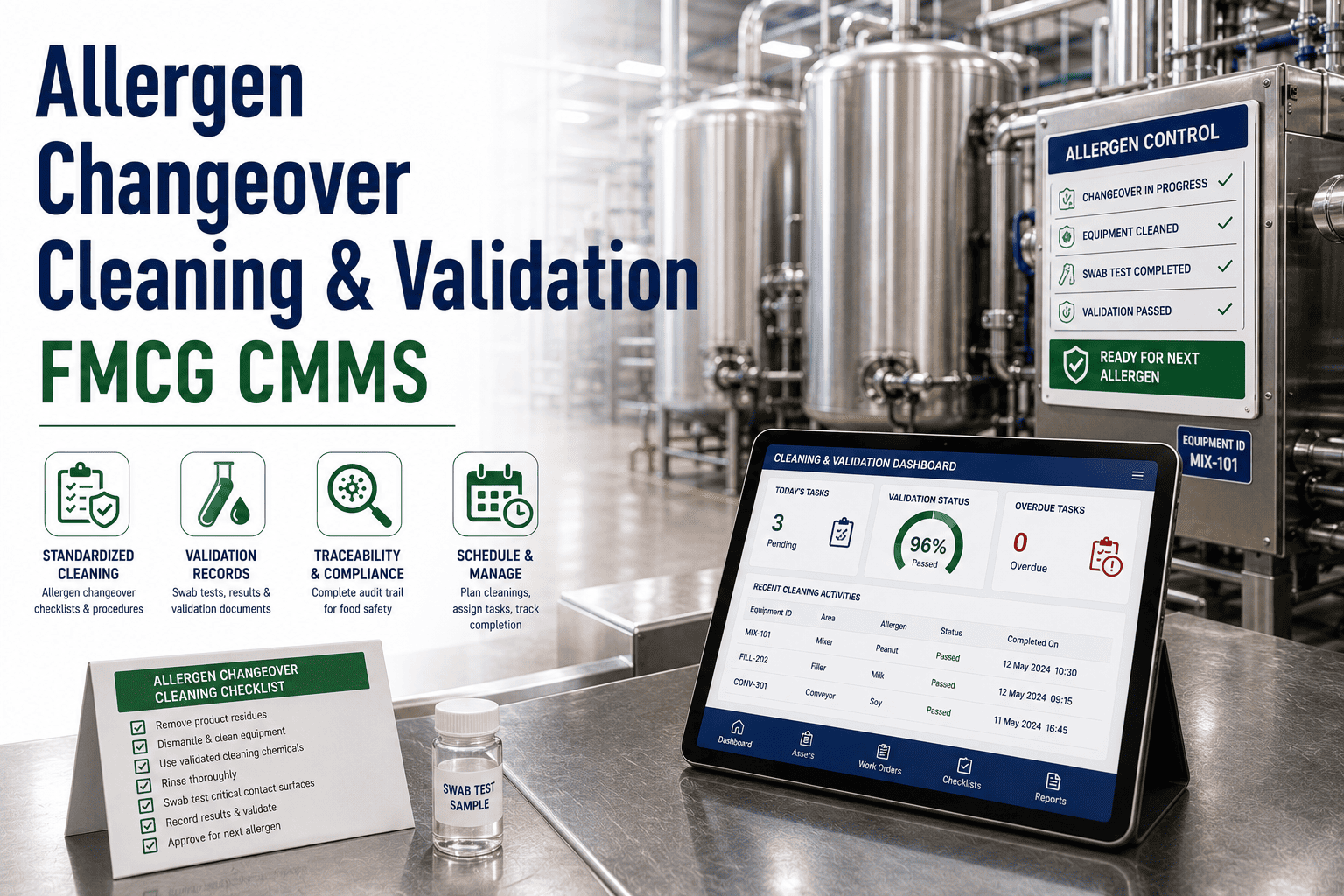
A confectionery manufacturer in Illinois recalled 28,000 units of a "peanut-free" chocolate bar after a consumer with a severe peanut allergy was hospitalised. The root cause: a robotic pick-and-place arm on a shared packaging line had not been cleaned between a peanut-containing SKU and the peanut-free variant. Residual peanut protein — invisible to the naked eye — transferred from the gripper pads to the product packaging at concentrations of 42 ppm, well above the 10 ppm threshold that triggers allergic reactions. The recall cost $1.8 million. The FDA warning letter cost the brand two major retail partnerships. The maintenance team had no documented changeover cleaning protocol for robotic end-effectors, no allergen validation records, and no CMMS tracking of which SKU ran on which equipment. 38% of allergen recalls in FMCG trace back to inadequate equipment cleaning during changeovers — not ingredient errors. Start your free trial today or schedule a 30-minute demo to see how Oxmaint automates allergen changeover tracking and cleaning validation.
Manual vs. CMMS-Driven Allergen Changeover Management
How systematic changeover tracking transforms allergen safety from guesswork to verified compliance
Manual / Paper-Based
Changeover Cleaning Verification
Visual Inspection Only — No Residue Testing
Allergen Run Sequence Tracking
Whiteboard or Memory-Based
Cleaning Validation Records
58–70% Complete — Paper Logs Missing
Allergen-Related Recalls per 5 Years
1.2–2.8 Events (Industry Average)
Automated with Oxmaint
Changeover Cleaning Verification
ATP/Lateral Flow + Digital Sign-Off
Allergen Run Sequence Tracking
CMMS-Enforced — System Blocks Violations
Cleaning Validation Records
99% Complete — Mandatory Fields Enforced
Allergen-Related Recalls per 5 Years
0 Events (Validated Programme)
Average Cost of a Single Allergen Recall in FMCG: $1.2M–$3.6M
Why Equipment Maintenance Is the Frontline of Allergen Prevention
Ingredient control gets the most attention in allergen management, but equipment is where cross-contamination actually happens. Residual allergen proteins survive in gaskets, seals, conveyor belt surfaces, filler nozzles, robotic grippers, and dead legs of piping systems — persisting through standard rinse cycles that remove visible soil but leave microscopic protein deposits at levels that trigger anaphylaxis. 38% of allergen recalls trace to equipment cleaning failures during product changeovers. Plants using Oxmaint track every changeover, enforce allergen-specific cleaning protocols, and validate residue levels before production restart.
Six Equipment Zones Where Allergen Cross-Contamination Occurs
Filler Nozzles & Valves
32%
Of cross-contamination events — protein trapped in O-rings, seat seals, and dead legs between changeovers
Conveyor Belts & Surfaces
24%
Porous belt materials absorb allergen proteins — standard wash removes visible soil but not embedded residue
Robotic Grippers & End-Effectors
18%
Silicone pads, vacuum cups, and gripper fingers retain protein residue — often excluded from COP/CIP schedules
CIP/COP System Dead Legs
14%
Piping branches, T-junctions, and sample ports where cleaning solution doesn't reach full velocity
Mixers & Blending Vessels
8%
Agitator shafts, baffles, and vessel walls retain protein in micro-scratches and weld seams
Shared Utensils & Tooling
4%
Scrapers, spatulas, changeover parts, and format tools shared between allergen and non-allergen lines
How Allergen Cross-Contamination Happens During Changeovers
Understanding the contamination mechanism is essential to building effective cleaning protocols. Allergen proteins are not removed by water alone — they require specific detergent chemistry, contact time, temperature, and mechanical action. A changeover that looks clean can still carry 50–200 ppm of allergenic protein.
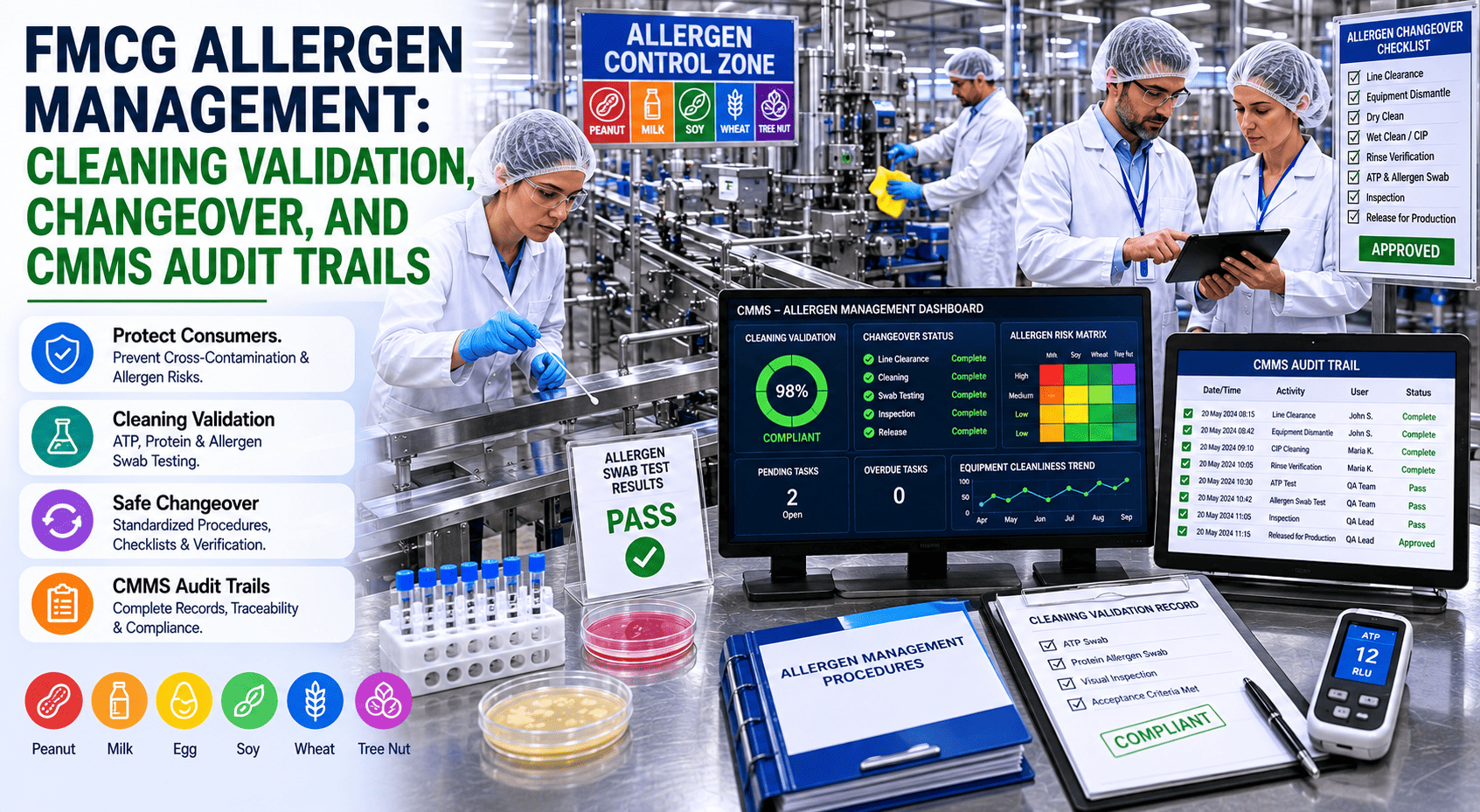
Four-Stage Allergen Changeover Protocol
01
Dry Clean & Remove
Remove all product, packaging, and raw materials
Dry scrape all food-contact surfaces
Disassemble robotic end-effectors and filler heads
Removes: 80% Visible Residue
02
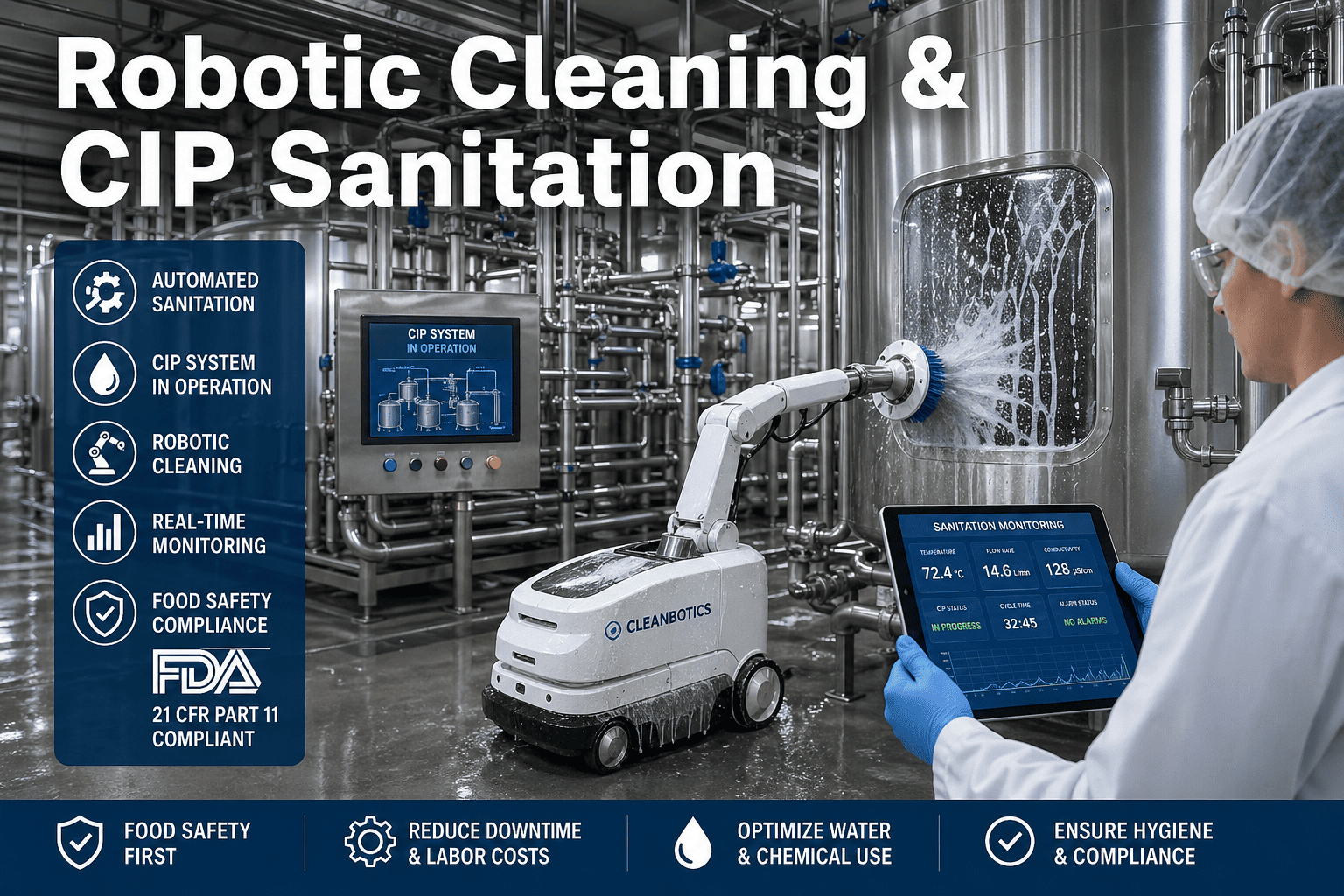
Wet Clean & Sanitise
Alkaline detergent at 60–80°C for protein removal
CIP circuits at validated flow velocity (≥1.5 m/s)
Manual scrub on dead legs, gaskets, and seals
Removes: 95–99% Protein
03
Validate & Test
ATP swab for general cleanliness (≤10 RLU)
Allergen-specific lateral flow test (≤10 ppm)
Log results with photo evidence in CMMS
Confirms: ≤10 ppm Allergen
04
Authorise & Release
QA sign-off with digital signature in CMMS
Production blocked until validation complete
Full audit trail: who cleaned, who verified, when
Enables: Safe Production Start
Robot-Specific Allergen Risks Most Plants Miss
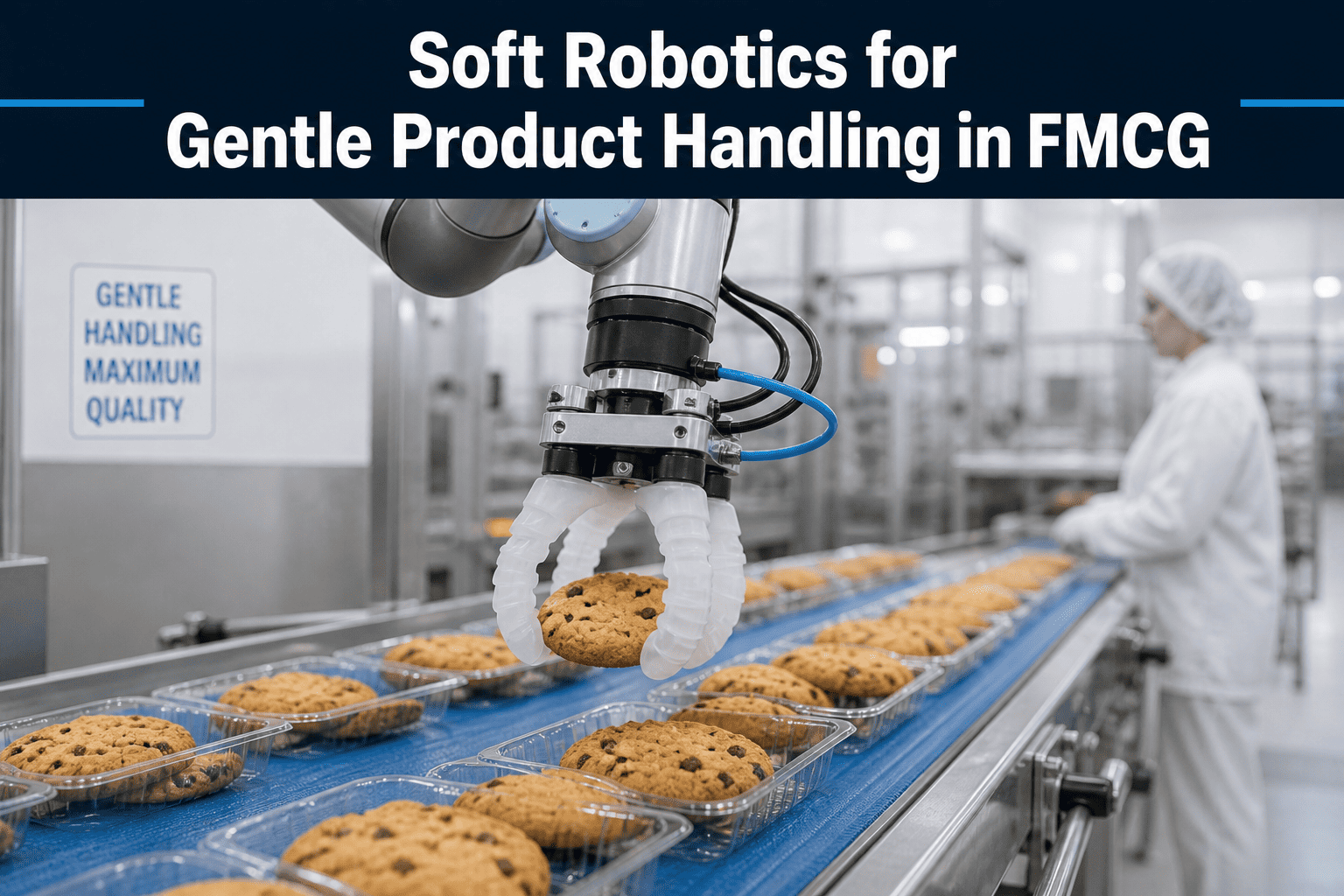
Robotic systems in FMCG — pick-and-place arms, palletisers, cobots, vision-guided handlers — introduce allergen risks that traditional cleaning programmes weren't designed to address. 62% of FMCG plants with robotic food handling have no documented allergen cleaning protocol for robotic end-effectors.
Robotic Allergen Risk Points and Cleaning Requirements
Each robot component requires specific cleaning methods that differ from standard CIP/COP protocols
Silicone Gripper Pads
Porous material absorbs protein — requires soak in alkaline detergent at 65°C for 15 min, then lateral flow test
High Risk
Vacuum Cups & Suction
Internal surfaces trap residue — disassemble, soak, brush clean. Replace cups every 2,000 hrs or at protein detection
High Risk
Vision System Lenses
Protein film on camera lenses degrades detection accuracy — clean with approved solvent, verify image clarity
Medium Risk
Cable Harnesses & Joints
Product dust accumulates in cable runs and joint covers — blow clean with filtered air, wipe external surfaces
Medium Risk
Conveyor Interface Points
Transfer zones between robot and conveyor trap product — clean both sides of interface during every changeover
High Risk
Tool Change Mechanisms
Quick-change couplings harbour residue in mating surfaces — disassemble, clean, and validate at each allergen change
High Risk
FMCG Plants with No Robotic Allergen Protocol
62%
Every robotic component that contacts product or product packaging is a potential allergen transfer point. If it's not in your cleaning validation programme, it's an uncontrolled risk.
Your Robots Touch Your Product. Are They in Your Allergen Programme?
Oxmaint tracks every robotic end-effector as a food-contact asset with allergen-specific cleaning validation built in.
An allergen CMMS programme costs $12,000–$30,000/year. One prevented recall pays for 73–183 years of platform cost. The ROI is not a question — it's arithmetic.
How Oxmaint Automates Allergen Changeover Management
Six capabilities that close the gaps between your allergen plan on paper and what actually happens on the production floor.
Six Core Allergen Management Capabilities
Allergen Asset Classification
Full Registry
Every food-contact asset tagged with allergen exposure profile — which allergens, which products, which lines
ATP and allergen test results logged with photo evidence — production blocked until QA digital sign-off
Run Sequence Enforcement
Auto-Block
System enforces allergen-safe run order — allergen-free SKUs first, allergen-containing last, or full clean required
Mobile Cleaning Checklists
Field-Ready
Technicians follow guided checklists on phone — photo capture, test results, timestamps, digital signatures
Audit-Ready Reports
Instant Export
Complete allergen changeover history per line, per product, per date — exportable in seconds for any auditor
Allergen Cleaning Validation: What Auditors Expect
FSSC 22000, BRC, and SQF auditors evaluate allergen cleaning validation as a critical food safety control. Missing or incomplete records trigger major nonconformities that can suspend certification.
With Oxmaint, every item on this checklist is generated automatically from daily changeover operations. Export time: under 5 minutes.
90-Day Path to Validated Allergen Changeover Management
Build audit-ready allergen changeover documentation from the ground up in 90 days. Schedule a demo to map this to your specific product and allergen portfolio.
Phased Allergen Programme Implementation
01
Days 1–20: Map
Classify all assets by allergen contact level
Map product-to-line allergen matrix
Identify robot end-effectors as food-contact
Output: Allergen Risk Register
02
Days 21–45: Validate
Conduct cleaning validation studies per line
Establish pass/fail criteria (ATP + lateral flow)
Configure CMMS with enforced changeover workflows
Output: Validated Protocols
03
Days 46–70: Execute
Run 4+ allergen changeovers with full digital tracking
Train operators on mobile validation workflow
Build first management review allergen KPI report
Output: Evidence Base Built
04
Days 71–90: Verify
Internal audit of allergen documentation
Test exports against FSSC/BRC/SQF requirements
Pre-audit mock assessment with corrective actions
Output: Audit-Ready
Documented Results from FMCG Plants
Real outcomes from plants that implemented systematic allergen changeover management with CMMS tracking.
Before & After: Allergen Management Automation in FMCG
Documented results from plants that deployed Oxmaint for allergen changeover tracking and validation
Case 1: Confectionery — 4 Shared Lines, 8 Allergens
Changeover Validation Completeness
54% → 100% — Mandatory Workflow Enforced
Allergen Test Failures
8/quarter → 1/quarter — Root Cause Identified Faster
Audit Nonconformities
3 Allergen Findings → 0 in Next BRC Audit
Recall Events in 24 Months
1 Recall → 0 Recalls Since Implementation
Case 2: Snack Foods — Robotic Packaging, Nut Allergens
Robot End-Effector Cleaning
Not Tracked → Every Changeover Validated
Changeover Time Impact
+8 min/changeover — But Validation Now Complete
Consumer Complaints (Allergen)
12/year → 0 in First 18 Months
Annual Value
$1.4M Recall Risk Eliminated
Every Recall Prevented Saves: $1.2M–$3.6M
Frequently Asked Questions
What allergen testing method should we use during changeover validation?
Use a two-tier approach: ATP swabbing first as a general cleanliness indicator (pass threshold: ≤10 RLU), then allergen-specific lateral flow immunoassay strips for the target allergen (pass threshold: ≤10 ppm or below your validated action level). ATP alone is insufficient — it measures organic residue, not specifically allergenic protein. Lateral flow tests take 10–15 minutes and cost $8–$15 per test. For high-risk changeovers (e.g., peanut to peanut-free), ELISA lab testing provides quantitative results but takes 24–48 hours. Oxmaint logs both ATP and allergen test results with photo evidence in the changeover work order.
How do we include robotic end-effectors in our allergen cleaning programme?
Register every robot end-effector as a food-contact asset in your CMMS with its allergen exposure profile. Create dedicated cleaning SOPs for each end-effector type — silicone grippers need soak protocols, vacuum cups need disassembly, vision lenses need approved solvents. Include end-effectors in your changeover workflow so they can't be bypassed. Validate cleaning effectiveness with allergen-specific swabs on gripper surfaces after cleaning. Start a free trial to configure robotic allergen tracking.
Can Oxmaint enforce allergen-safe production run sequences?
Yes. Oxmaint's changeover management engine can enforce allergen-safe run sequencing — requiring allergen-free products to run before allergen-containing products on shared lines, or triggering a mandatory full-clean changeover workflow if the sequence is violated. The system blocks production start until the required cleaning protocol is completed and validated, preventing the scenario where a line runs a peanut SKU followed by a peanut-free SKU without proper cleaning between.
What happens when a changeover allergen validation test fails?
When a lateral flow test returns a positive result (allergen detected above threshold), Oxmaint automatically blocks the line from starting production and triggers a corrective action workflow: re-clean the failed zone, re-test, log root cause (which surface, which allergen, which cleaning step was insufficient), and document the corrective action. If the same failure point recurs 3+ times, the system flags it for cleaning protocol review. All failure data feeds into trending reports that identify systematic cleaning gaps — surfaces, equipment, or procedures that consistently fail validation.
How long does it take to implement allergen changeover tracking in Oxmaint?
Most plants have allergen changeover workflows live within 3–4 weeks. The first 2 weeks cover asset classification (food-contact tagging, allergen exposure profiles) and changeover protocol configuration. Week 3 covers operator training on mobile workflow. Week 4 runs the first validated changeovers with full digital tracking. Cleaning validation studies (proving your cleaning method achieves ≤10 ppm) typically run in parallel over 4–6 weeks. Book a demo to plan implementation around your production schedule.
One Missed Changeover Can Cost $2.2 Million. Don't Guess — Validate.
Oxmaint enforces allergen cleaning protocols, validates every changeover, and blocks production until it's safe.
.png)