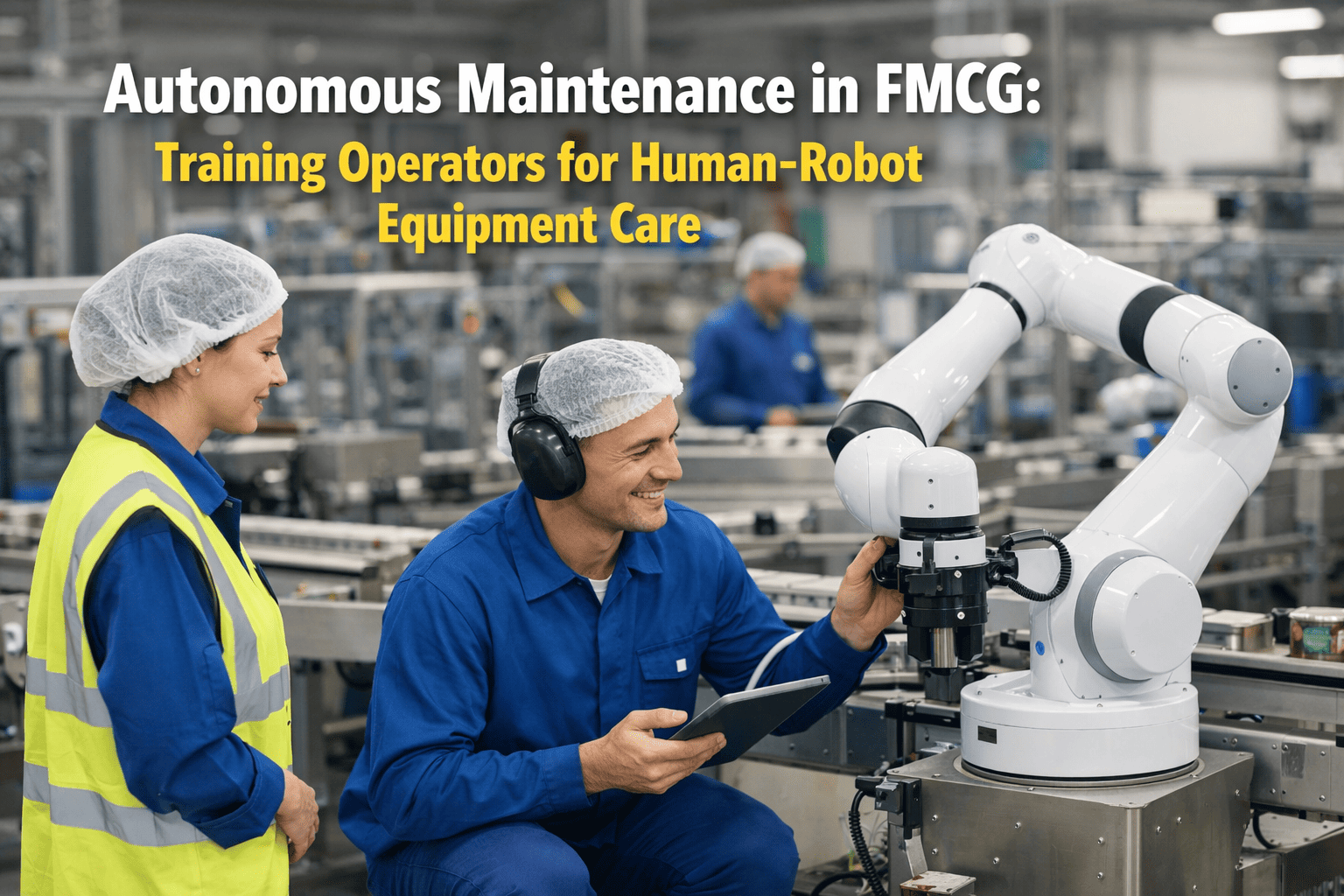
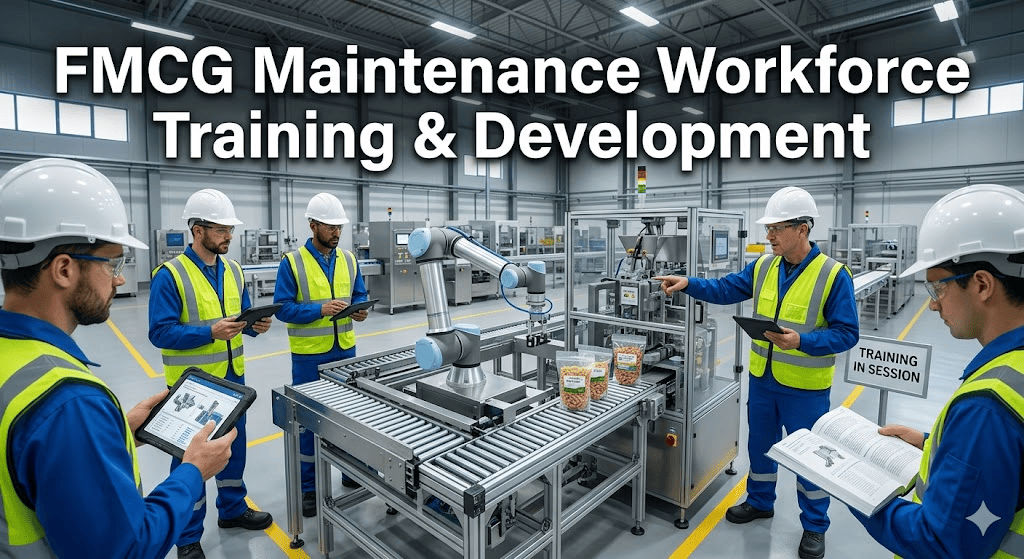
At a dairy processing plant in Rajasthan, a packaging line operator noticed an unusual vibration in the filling carousel during her morning cleaning round — not because a sensor flagged it, but because she had spent three months learning to read that machine through structured autonomous maintenance training. She logged the observation in Oxmaint via her operator checklist, tagged it as abnormality, and the maintenance team confirmed a developing bearing fault before the end of the shift. The repair took 40 minutes. A failure during production would have cost four hours of downtime and ₹18 lakh in lost output. That one detection paid for the entire autonomous maintenance programme implementation. Autonomous maintenance is the most underutilised productivity lever in FMCG manufacturing. Most FMCG plants have between 3 and 8 maintenance technicians managing 200 to 600 assets across 12-hour shifts. The maths is impossible: a technician checking every asset once per week is missing 99% of the operating hours during which equipment deteriorates. Operators are present at their machines for every minute of every shift. Training them to perform basic equipment care — cleaning, inspection, lubrication, and abnormality detection — transforms every production operator into an early-warning system that no sensor network can replicate. Book a demo to see how Oxmaint's operator checklist and training tracking features support AM implementation in FMCG plants.
Autonomous Maintenance — Operator-Led, CMMS-Backed
40% of Failures Prevented — Before They Reach Your Maintenance Team
When operators own equipment care, breakdowns stop being surprises. Oxmaint's operator checklist and training tracking platform gives your AM programme the digital backbone it needs to sustain — from pilot line to plant-wide.
Centralised Maintenance Only
Unplanned Breakdowns
18–28 per line per month
Failure Detection
After breakdown — operator calls maintenance
Technician Time on Reactive Work
55–70% of available hours
Minor Stops per Shift
12–22 operator-cleared stops
OEE — Availability Component
74–82%
Autonomous Maintenance Programme
Unplanned Breakdowns
4–9 per line per month (−68%)
Failure Detection
Operator abnormality detection — before failure
Technician Time on Reactive Work
18–28% of available hours
Minor Stops per Shift
3–6 operator-cleared stops
OEE — Availability Component
91–96%
Autonomous Maintenance Prevents: 40% of All Equipment Failures Before They Cause Downtime
What Autonomous Maintenance Actually Is — and What It Is Not
Autonomous maintenance is one of the eight pillars of Total Productive Maintenance (TPM) and the pillar most frequently misunderstood by FMCG plant managers. It is not about operators replacing maintenance technicians. It is not about cutting the maintenance headcount. And it is not about giving operators technical skills they are not equipped to use. Autonomous maintenance is a structured transfer of basic equipment care activities — cleaning, inspection, lubrication, fastener checks, and abnormality identification — from the maintenance department to the operators who work with the equipment every shift. The maintenance team's role does not shrink under AM; it shifts. Technicians move from reactive fire-fighting to higher-value work: planned overhauls, condition monitoring, reliability improvement projects, and technical coaching of operators. The operator's role expands from "run the machine and call maintenance when it breaks" to "own the baseline condition of this machine and keep it to standard." This role expansion requires structured training, clear standards, the right tools, and leadership support — without all four, AM fails.
The Seven Steps of Autonomous Maintenance — FMCG Implementation Guide
The TPM Institute's seven-step AM methodology is the global standard for implementing autonomous maintenance in manufacturing. Each step builds on the previous one and must be genuinely completed — not administratively ticked off — before the next begins. FMCG plants that rush to Step 5 without completing Steps 1 through 4 invariably see AM collapse within six months. The steps are sequential by design: you cannot sustain a standard you haven't established, and you cannot establish a standard on equipment you haven't restored to baseline condition.
01
Initial Cleaning & Eliminating Contamination Sources
Deep clean the equipment to baseline condition — remove all contamination, product residue, lubrication buildup, and debris. During cleaning, operators physically inspect every surface and tag abnormalities: loose fasteners, worn seals, damaged guards, leaks. Then identify and fix the root causes — leaking seals replaced, spillage guards installed, hard-to-clean areas modified to be easy-to-clean. Goal: restore baseline condition and stop re-creating the problems you just cleaned up. Cleaning time reduced 40–60% through kaizen improvements.
Output: Abnormality Register + Contamination Elimination Log + Baseline Photos
02
Establish Cleaning & Inspection Standards
Document exactly what the equipment should look like, feel like, and sound like when it is in standard condition. Create visual standards — photographs of correct lubrication levels, fastener torque markings, belt tension indicators, and colour-coded gauges. Define the cleaning and inspection frequency, the method, and the acceptance criteria for each check. These standards become the operator's daily reference — a visual that makes the right condition unmistakeable.
Output: Visual Standard Sheets + AM Checklist Version 1
03
General Inspection Training
Train operators in the fundamental principles of how their equipment works — not to become engineers, but to understand why cleaning, lubrication, and fastener torque matter. Operators learn to recognise the early signs of the failure modes most common on their equipment: abnormal vibration, temperature, noise, wear patterns, and fluid conditions. This is where the cobot-assisted inspection programme integrates — operators learn to interpret data from collaborative robot inspection patrols alongside their own physical inspections.
Output: Operator Competency Assessment + Training Records
04
Autonomous Inspection
Operators conduct the full inspection independently — without supervisor oversight for each task. The AM checklist is now the primary driver of daily equipment care. Abnormalities are logged in the CMMS directly by operators, with photos, severity ratings, and recommended actions. Maintenance technicians review logged abnormalities and plan interventions accordingly. The operator-maintenance interface moves from reactive phone calls to structured digital communication through the checklist system.
Output: Operator-Driven CMMS Abnormality Log + Response KPIs
05
Standardisation Across Lines
Extend the AM programme from the pilot line to all production lines using the standards, checklists, and training materials developed in Steps 1–4. The best operators from the pilot become AM coaches for the rollout lines. Visual management systems are standardised across the plant — same colour coding, same abnormality tagging system, same CMMS checklist structure. Goal: create a plant-wide standard of equipment care that survives shift changes, staff turnover, and production pressure.
Output: Plant-Wide AM Standard + Cross-Line Training Completion
06
Full Self-Management
Operators take ownership of continuous improvement for their equipment — identifying opportunities to improve the AM checklist, proposing kaizen projects for cleaning and inspection efficiency, and tracking equipment condition trends over time. The CMMS training tracking system records each operator's qualification status, checklist completion rates, and abnormality detection history. Leadership role shifts to setting improvement targets and removing organisational barriers rather than supervising daily execution.
Output: Operator-Led Kaizen Pipeline + AM Maturity Score
Operator Checklists — Built for All 6 AM Steps
Ready to Start Your AM Programme on the Right Foundation?
Oxmaint's operator checklist module delivers the digital infrastructure for every AM step — from initial abnormality logging in Step 1 to autonomous inspection tracking in Step 5. Start your free trial and build your first AM checklist in under 30 minutes.
Cobot-Assisted Autonomous Maintenance: The Human-Robot Inspection Model
The integration of collaborative robots into FMCG production lines has created a new inspection model that amplifies what autonomous maintenance operators can detect and respond to. Traditional AM relies entirely on the operator's senses and the data captured in their manual checklist. Cobot-assisted AM adds a continuously running sensor layer — vibration, thermal, acoustic, and visual data collected by the cobot on every pass — that the operator interprets and acts on as part of their inspection routine. The operator does not replace the cobot's sensors. The cobot does not replace the operator's judgment. Together they create a detection capability that neither has alone: the cobot catches what the human eye cannot see, and the operator provides the contextual intelligence — recent maintenance history, process changes, unusual events — that the cobot's algorithm cannot access.
Continuous Vibration Monitoring
Always On
Cobot patrol routes collect vibration signatures from bearings and drives on every pass — operator reviews trend alerts as part of their AM checklist, flagging anomalies for maintenance action
Thermal Anomaly Detection
±0.5°C
Infrared thermal imaging identifies overheating motors, hot bearings, and electrical panel anomalies that are invisible to touch inspection but precede failure by days or weeks
Acoustic Emission Sensing
Ultrasonic
Ultrasonic sensors on the cobot detect compressed air leaks, bearing race defects, and valve seat erosion — faults that produce no visual or thermal signature at early stage but generate distinctive acoustic patterns
Visual Inspection Augmentation
HD Camera
High-resolution cobot cameras inspect hard-to-reach areas — conveyor undersides, motor terminal boxes, elevated drive components — that operators physically cannot access during production
Trend Data for AM Training
Learning Tool
Cobot sensor trend graphs are used directly in operator AM training — showing operators the vibration signature of a healthy bearing vs. a degrading one, building diagnostic intuition grounded in real plant data
Automated Checklist Pre-Population
Smart Forms
Cobot inspection data pre-populates the operator's AM checklist in Oxmaint — temperature readings, vibration status, and visual pass/fail populated automatically, operator confirms and adds contextual observations
Operator AM Checklist Design — What Makes a Checklist Operators Actually Use
The AM checklist is the operational heart of autonomous maintenance — and the most common reason AM programmes fail. A checklist that is too long is not completed. A checklist that uses technical language operators do not understand is not completed accurately. A checklist that requires 40 minutes to complete is skipped under production pressure. A checklist that is completed on paper and then transcribed to a computer is completed once and then abandoned. The difference between an AM checklist that sustains for three years and one that is abandoned in three months comes down to five design principles that every FMCG AM implementation must get right from Step 3 of the TPM methodology.
Completion Time
Sustained: 8–15 minutes per shift — designed to fit within the shift start-up routine without cutting into production time
Max 15 Min
Language & Format
Sustained: operator's own language, visual prompts, photo references for "normal" condition — no engineering terminology
Visual-First
Recording Method
Sustained: mobile app with photo capture and one-tap abnormality logging — paper checklists have a 60–80% abandonment rate within 90 days
Digital Only
Abnormality Response Loop
Sustained: operators see logged abnormalities acknowledged and acted on within 48 hours — no response loop = no motivation to log
48-Hr Response
Checklist Items per Machine
Sustained: 8–15 specific, observable checks per machine — not a 40-item engineering inspection form repurposed for operators
8–15 Items
Revision Frequency
Sustained: reviewed quarterly and updated based on operator feedback and new failure mode discoveries — static checklists become irrelevant
Quarterly Review
The most common AM implementation mistake is designing the checklist for the maintenance engineer who created it, not for the operator who must complete it twice a day under production pressure. An operator-designed checklist — built with the operators who will use it, in their language, at their pace — sustains at 85–95% completion rates. An engineer-designed checklist thrust at operators sustains at 20–40% within three months.
AM Training Tracking: How to Know Your Programme Is Actually Working
The most dangerous phase of any autonomous maintenance programme is between Step 3 and Step 5 — when operators have received initial training but the programme has not yet embedded into daily habit. During this phase, completion rates look acceptable on the surface (operators know they are being watched) but the quality of observations is low, abnormalities are missed, and the programme is one production pressure spike away from collapsing. The only way to know whether your AM programme is genuinely working is to track the right leading indicators — not just checklist completion rates, but the metrics that reveal whether operators are developing genuine equipment knowledge and detection capability.
Competency Tracking
Individual Operator Level
Every operator's AM training status recorded against each equipment type and each AM step — not binary pass/fail but a five-level competency scale from "trained" to "can train others." Oxmaint training records capture training date, trainer identity, assessment result, and next qualification due date. Supervisors see each operator's qualification status at a glance — deployment decisions are based on verified competency, not assumed familiarity.
Checklist Quality Metrics
Detection Rate & Accuracy
Completion rate is a lagging indicator. Oxmaint tracks the leading indicators that reveal checklist quality: abnormality detection rate per operator (how many observations per 100 completed checks), false positive rate (observations logged that required no maintenance action), and catch rate (percentage of maintenance-confirmed faults that were first identified by an operator checklist). Rising catch rate over 90 days is the definitive evidence of AM programme maturity.
Programme Health Dashboard
Line & Plant Level
Plant-level view of AM programme health across all lines — checklist completion rate, abnormality backlog age, mean time from operator log to maintenance response, and monthly breakdown rate trend correlated with AM activity. When breakdown rate falls as AM activity rises, the correlation is visible in the same dashboard — giving plant management the evidence to sustain investment in the programme and the data to identify lines where AM is underperforming.
Training Tracking — Qualification by Operator, Equipment & Step
See Exactly Who Is Qualified to Do What — Across Every Shift
Oxmaint's training tracking module records every operator's AM qualification status, assessment results, and requalification schedules — so you always know who is authorised to perform which AM tasks on which equipment, and who needs a refresher before next deployment.
What FMCG Equipment Operators Should and Should Not Maintain
One of the most common barriers to AM implementation is the maintenance department's concern that operators will attempt tasks beyond their competency — causing damage or, worse, safety incidents. This concern is legitimate and the response is not to dismiss it but to address it structurally: through explicit scope definition that is documented, trained, and enforced. The AM scope boundary — which tasks operators perform, which tasks require a trained technician, and which tasks require a specialist — must be written down and agreed between production and maintenance leadership before Step 1 begins. Scope boundary disputes during implementation derail more AM programmes than any technical challenge.
Operator (AM Scope)
Cleaning, visual inspection, lubrication top-up to marked levels, tightening accessible fasteners, clearing minor jams, abnormality logging, cobot data review
Daily / Per Shift
Technician (Planned Maintenance)
Bearing replacement, belt and chain adjustment/replacement, seal replacement, electrical fault diagnosis, lubrication system maintenance, responding to operator-logged abnormalities
Scheduled PM
Specialist / OEM (Complex Work)
PLC and drive programming, precision alignment, major overhauls, pressure system certification, safety device testing, cobot safety parameter adjustment
Periodic / On-Call
Never Operator Scope
Electrical panel work, any task requiring isolation and LOTO beyond operator-level, pressure vessel entry, food safety CCP adjustments, safety device bypass
Hard Exclusion
The scope boundary document is not a restriction on operators — it is protection for them. Operators who know exactly what they are authorised to do work confidently within that scope. Operators given vague scope guidance either under-perform (doing less than they are capable of) or over-reach (attempting tasks they are not qualified for). Clear boundaries, documented in the CMMS training system and visible on every AM checklist, eliminate both problems.
Common AM Implementation Failures in FMCG Plants — and How to Prevent Them
Autonomous maintenance has a high failure rate in FMCG plants not because the concept does not work, but because it is consistently implemented without the organisational foundations it requires. The technical steps — cleaning, standardising, checking — are straightforward. The organisational steps — leadership commitment, scope agreement, maintenance department buy-in, sustained training, and closed feedback loops — are where most programmes falter. These are the eight failure modes that derail FMCG AM programmes, and the specific preventive actions that eliminate each one.
Maintenance Department Resistance
Most Common
Technicians fear AM threatens their jobs. Fix: involve maintenance team in designing AM scope — they define what operators do, ensuring operators never cross into skilled technician territory. Show technicians the data: AM reduces their reactive workload and increases their time for higher-skill work.
Production Pressure Overrides AM
Structural
When throughput targets and AM routines conflict, production wins unless leadership has explicitly elevated AM completion to a non-negotiable KPI. Fix: include AM completion rate in the daily production meeting alongside OEE — make skipping it visible and consequential.
No Response to Operator Abnormality Logs
Adoption Killer
Operators who log abnormalities and receive no response within 48–72 hours stop logging within three weeks. Fix: assign a named technician to review and respond to every operator-logged abnormality — not just close the ticket, but provide a one-line status update visible to the operator.
Paper-Based Checklists
Execution Failure
Paper checklists are completed at 20–40% sustained rates and generate no actionable data. Fix: deploy digital AM checklists in Oxmaint from Day 1 of Step 3 — mobile, photo-enabled, and integrated with the work order system so abnormalities automatically create follow-up tasks.
Rushing Steps 1–3
Foundation Failure
Management pressure to "get to the results" leads to superficial completion of the first three steps — equipment not genuinely restored, standards not truly established. Fix: define exit criteria for each step and require sign-off from both production and maintenance leadership before advancing. Steps 1–3 typically require 3–6 months on the pilot line.
Training Not Tracked or Verified
Quality Gap
Operators sign attendance sheets and are assumed competent. Fix: use the Oxmaint training tracking module to record each operator's qualification against each equipment type, with assessment results and requalification schedules. Deploy only qualified operators on AM tasks — track deployment against qualification status.
Pilot Stays Permanent
Scale Failure
The pilot line succeeds and the programme stalls there for 18 months while "refining the approach." Fix: define rollout timeline as part of the original AM implementation plan — pilot line must complete Step 4 before rollout begins. Use pilot operators as coaches, not observers.
AM and Planned Maintenance Not Integrated
System Gap
AM runs as a separate programme disconnected from the CMMS — operators log in one system, technicians work in another, nobody sees the full picture. Fix: operator AM checklists and abnormality logs must live in the same CMMS as technician work orders. Integration is not optional — it is what converts operator observations into maintenance actions.
Measuring Autonomous Maintenance Success — The Right KPIs
Most FMCG plants that attempt to measure AM success track only two metrics: checklist completion rate and breakdown frequency. Both are necessary but neither is sufficient. Completion rate tells you whether the programme is being executed — it says nothing about whether it is working. Breakdown frequency is a lagging indicator that moves slowly and is influenced by many factors besides AM activity. A comprehensive AM measurement framework tracks leading indicators of operator knowledge development, abnormality detection capability, and the health of the operator-maintenance interface — alongside the lagging outcome metrics that prove business value to plant leadership.
Checklist Completion Rate
Percentage of scheduled AM checks completed on time — target 92%+ sustained over rolling 4-week period, not a daily figure that masks weekly gaps
Leading
Abnormality Detection Rate
Operator-logged abnormalities per 100 completed checks — rising rate indicates growing operator equipment knowledge; falling rate after initial spike indicates checklist fatigue
Leading
Operator Catch Rate
Percentage of confirmed maintenance faults first identified by operator AM log — target 35–50% by end of Year 1; benchmark for mature AM programmes is 55–65%
Leading
Abnormality Response Time
Mean time from operator abnormality log to maintenance acknowledgement and planned action — target under 48 hours; response time above 72 hours predicts declining log rates within 30 days
Leading
Unplanned Breakdown Rate
Monthly breakdown events per line — the primary lagging outcome metric; target 60–70% reduction within 12 months of full AM implementation across pilot line
Lagging
Technician Reactive Time
Percentage of technician hours spent on reactive vs. planned work — AM success frees technicians from reactive fire-fighting; target shift from 60% reactive to under 25% within 18 months
Lagging
Mature AM Programme — Failure Prevention Rate
40–55% of Breakdowns
The operator catch rate is the single most powerful indicator of AM programme maturity. When operators are genuinely detecting 35–50% of faults before they cause downtime, the maintenance team's reactive burden drops sharply — not because breakdowns magically stop, but because each developing fault is caught earlier, when the intervention is planned, controlled, and far cheaper than an emergency repair during production.
Frequently Asked Questions
How long does it take to implement autonomous maintenance in an FMCG plant?
A full 7-step AM implementation on a pilot line takes 12–18 months when done properly — not because the steps are technically complex, but because Steps 1–4 require genuine behaviour change that cannot be rushed. Steps 1 and 2 (initial cleaning, eliminating contamination sources) typically take 2–4 months on the pilot line. Step 3 (establishing standards) takes 4–6 weeks if done well. Step 4 (general inspection training) takes 6–8 weeks per operator cohort. Plants that complete the full 7 steps on a pilot line within 6 months are almost always skipping the depth required — and the programme typically collapses by month 10. The right question is not "how fast can we implement AM?" but "what results will we have at 12 months?" — plants that answer that question with honest measurement are the ones that sustain AM for five years and beyond.
What equipment types are most suitable for autonomous maintenance in FMCG plants?
The most suitable starting point for AM in FMCG plants is high-frequency, operator-attended production equipment where cleanliness and basic condition directly affect performance: filling machines, packaging lines, conveyor systems, labelling equipment, and VFFS machines. These assets have clear visual standards, are operated by the same operators every shift, and have failure modes that are genuinely detectable through cleaning and inspection — contamination, lubrication loss, loose fasteners, and belt wear. Equipment that is least suitable for initial AM scope includes high-voltage electrical systems, pressure vessels, refrigeration plant, and CIP systems — not because operators could not learn the basics, but because the safety and technical complexity require the AM scope boundary to exclude most meaningful inspection tasks. Start with the highest-frequency, most operator-accessible production assets and expand scope as the programme matures.
How does autonomous maintenance interact with GMP requirements in food manufacturing?
AM and GMP are mutually reinforcing programmes, not competing ones. The cleaning and inspection activities at the core of AM Steps 1 and 2 directly support GMP cleaning requirements for food contact equipment. AM visual standards and operator checklists, when designed to include GMP-critical inspection points — seal condition, product contact surface integrity, foreign material exclusion, and pest entry point inspection — create a documented GMP compliance record with every completed checklist. In Oxmaint, operator AM checklists generate timestamped, user-attributed electronic records that satisfy GMP documentation requirements. The key integration point is Step 3: when establishing AM standards, GMP requirements must be built into the visual standards and the checklist — not managed as a separate paper-based inspection. Plants that integrate GMP into their AM checklists achieve both programmes simultaneously with no additional operator time.
Do operators need a technical background to participate in autonomous maintenance?
No — and designing AM for the operator who has no technical background is the correct starting assumption. The AM training content at Steps 3 and 4 is built around practical, observable knowledge: what this machine does, why it needs lubrication, what a normal bearing sounds like, what an abnormal belt looks like. The training is delivered on the actual equipment by a technician who can translate technical concepts into practical observations. The most effective AM training uses the cobot inspection data from the plant's own equipment — showing operators the vibration signature of a healthy bearing versus a degrading one on their specific machine, not a generic training video. Operators with no engineering background regularly achieve 40%+ catch rates within 12 months — the ability to detect equipment abnormalities is a function of attention, proximity, and trained observation, not technical qualification.
What role does the CMMS play in supporting autonomous maintenance?
The CMMS is the system of record that makes AM a managed programme rather than an informal habit. Three capabilities are essential: operator checklist delivery and completion tracking (checklists pushed to operators by shift and equipment, completed on mobile, completion rates visible to supervisors in real time); abnormality management (operator-logged abnormalities automatically create follow-up tasks assigned to technicians, with response time tracking that closes the feedback loop); and training records (each operator's qualification status against each AM step and equipment type, with assessment results, training history, and requalification schedules). Oxmaint provides all three capabilities integrated in a single platform — operator checklists, abnormality work orders, and training tracking all connected so the AM programme generates a complete, audit-ready record of equipment care across every shift, every line, and every operator in the plant.
Operator Checklists + Training Tracking — Purpose-Built for AM
Turn Every Operator Into Your First Line of Failure Prevention
Oxmaint's operator checklist module delivers AM checks to every operator's phone by shift and equipment, captures abnormalities with photos, automatically creates follow-up work orders, and tracks each operator's AM training qualification status — giving your programme the system infrastructure it needs to sustain beyond the pilot line.
Mobile AM Checklists — Delivered by Shift & Equipment
Photo Abnormality Logging → Auto Work Order Creation
Operator Training Records — Qualification by Equipment & Step
48-Hour Abnormality Response Tracking
Catch Rate & Detection KPI Dashboard
Cobot Inspection Data Integration — Pre-Populated Checks