Human-Robot Interaction (HRI) in FMCG Manufacturing: Safety & Productivity
By Oxmaint on February 21, 2026
A cereal manufacturer in Ohio deployed six collaborative palletizing robots on its packaging lines in 2023, expecting a straightforward productivity gain. Within four months, two operators had filed injury reports — not from robot contact, but from awkward postures adopted to stay outside unmarked robot work envelopes while still feeding cartons into the shared workspace. A third operator triggered 140 protective stops in a single shift by repeatedly crossing a poorly calibrated safety scanner boundary, reducing line throughput by 31% that day. The robots were mechanically sound. The safety systems functioned as designed. The failure was in the human-robot interaction layer: workspace geometry that forced bad ergonomics, safety zones calibrated without operator workflow input, and zero structured reporting to connect these events to corrective action. When the plant reconfigured shared workspaces using operator motion studies, recalibrated safety zones with production input, and connected every protective stop and near-miss to incident workflows in Oxmaint, protective stops dropped 89%, ergonomic complaints fell to zero, and palletizing throughput exceeded the original target by 17%. Schedule a demo to see how Oxmaint tracks human-robot interactions, safety incidents, and collaborative mode performance across your FMCG floor.
Why Human-Robot Interaction Is the Hidden Variable in FMCG Automation ROI
FMCG manufacturers are deploying collaborative robots faster than any other industrial sector — palletizing, pick-and-place, case packing, machine tending, and inspection tasks now share physical workspace with human operators on thousands of production lines. The technology works. The gap is in how plants manage the interaction between robots and the people working alongside them. Poorly designed shared workspaces, uncalibrated safety systems, and missing incident data turn collaborative automation from a productivity multiplier into a source of downtime, injury risk, and operator resistance that no equipment specification sheet addresses.
89%
reduction in unnecessary protective stops after workspace reconfiguration and safety zone recalibration
34%
of cobot-related injuries in manufacturing stem from ergonomic strain, not robot contact
17%
throughput gain above original target after optimizing human-robot workspace geometry
Your cobots and operators share the same floor — your CMMS should track both. Oxmaint logs every protective stop, near-miss, and collaborative mode event alongside equipment maintenance to give you the full picture.
The Three Failure Modes of Human-Robot Interaction in FMCG
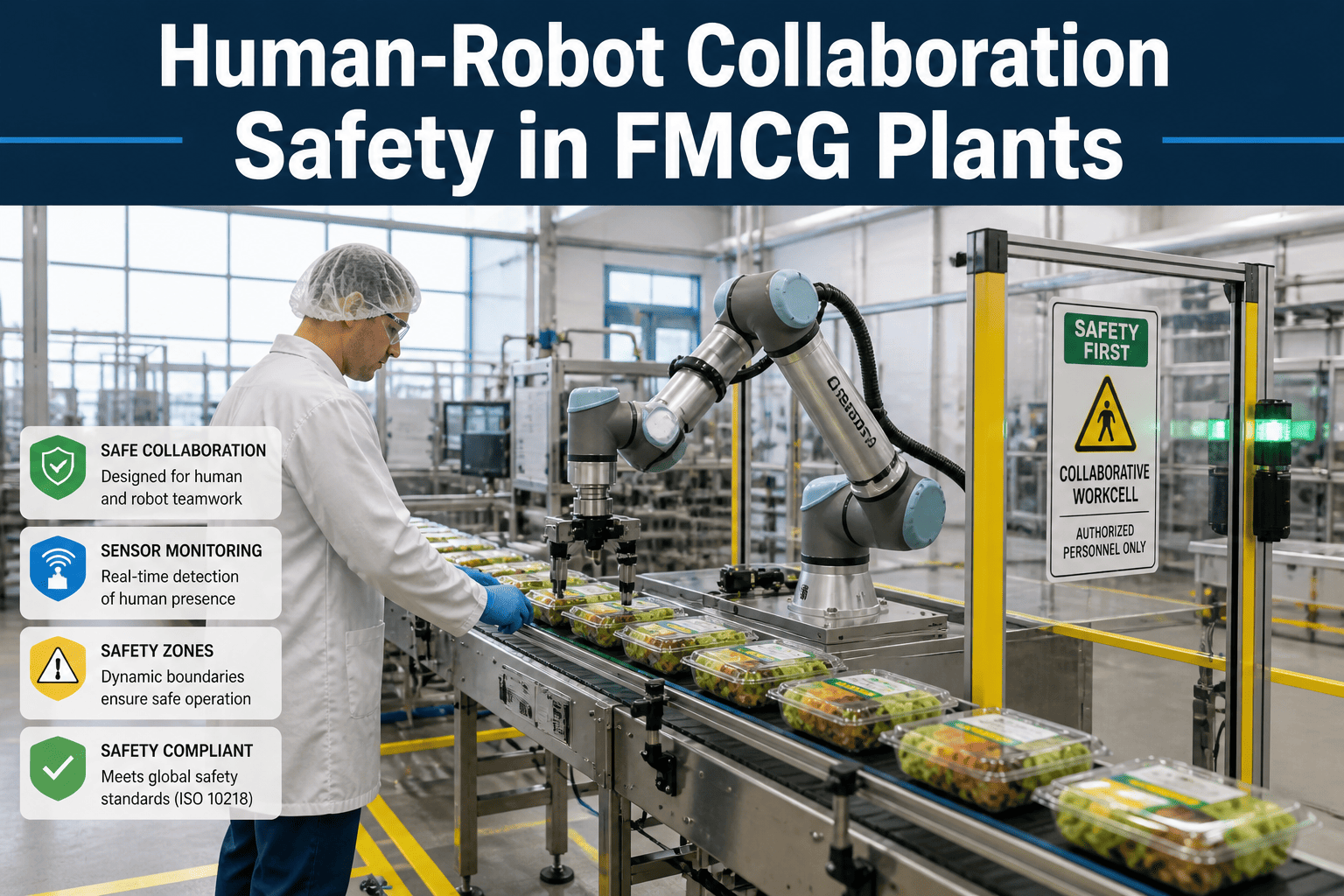
HRI failures in FMCG plants rarely involve a robot striking a person. ISO 10218 and ISO/TS 15066 force-limiting standards have made direct-contact injuries extremely rare with properly configured collaborative robots. The real failures — the ones that erode ROI, create injury claims, and drive operator pushback — fall into three categories that traditional safety programs and robot OEM dashboards do not track.
Ergonomic Strain from Workspace Avoidance
Operators working alongside robots unconsciously adopt awkward postures — reaching around work envelopes, twisting to avoid sweep paths, bending to stay below arm trajectories. These compensatory movements produce repetitive strain injuries that accumulate over weeks and months. Research shows 34% of cobot-related manufacturing injuries are ergonomic, not contact-based — yet most plants track only contact events.
Excessive Protective Stops from Miscalibrated Safety Zones
Safety scanners and light curtains calibrated too conservatively — or without accounting for actual operator workflow paths — trigger constant protective stops that halt production. Each stop costs 15-45 seconds of restart time. At 50+ stops per shift, the cumulative throughput loss can exceed 20%, negating the productivity gain the robot was deployed to deliver.
Operator Resistance and Workaround Behavior
When shared workspaces are poorly designed or safety systems create constant interruptions, operators develop workarounds — disabling safety features, timing movements to avoid triggering stops, or refusing to work near the robot at all. These behaviors are invisible to robot telemetry but create the highest-risk conditions on the plant floor.
Missing Data: The Invisible HRI Gap
Robot OEM dashboards track machine health — joint temperatures, cycle counts, fault codes. They do not track how humans interact with the robot. Protective stop frequency, near-miss proximity events, ergonomic complaint correlation, and safety zone breach patterns require a CMMS layer that connects human factors data to equipment records.
How Oxmaint Tracks the Human-Robot Interface
Managing HRI effectively requires connecting three data streams that typically live in separate silos: robot operational data, safety system event logs, and human incident reports. When these streams feed into a single CMMS platform, every protective stop, near-miss, and ergonomic complaint becomes a trackable, trendable, and actionable maintenance or safety event. Oxmaint unifies robot data and safety incident tracking — Sign Up Free.
1
Protective Stop Logging and Pattern Analysis
Every protective stop — triggered by safety scanner, light curtain, force/torque limit, or E-stop — is logged in Oxmaint with timestamp, robot ID, zone location, trigger source, and duration. Pattern analysis identifies which zones, shifts, and operators experience the highest stop frequencies, revealing calibration issues and workflow conflicts that individual events cannot expose.
2
Near-Miss and Safety Incident Reporting
Operators report near-miss events, uncomfortable workspace conditions, and safety concerns through Oxmaint's mobile interface — directly from the production floor in under 60 seconds. Each report links to the specific robot, workstation, and shift. Incident trends by robot cell, shift, and task type surface systemic issues before they become injury claims.
3
Collaborative Mode Performance Tracking
Oxmaint tracks each robot's time in full-speed mode versus reduced-speed collaborative mode versus protective stop. The ratio between these states measures how effectively the shared workspace is designed — a robot spending 40% of cycle time in reduced-speed mode due to operator proximity indicates a workspace layout problem, not a robot problem.
4
Corrective Action and Verification Loop
When protective stop patterns or incident reports trigger a work order — safety zone recalibration, workspace reconfiguration, guard relocation, or operator retraining — Oxmaint tracks the intervention and measures the before-and-after impact on stop frequency, throughput, and incident rates. Every improvement is documented for ISO 45001 and OSHA compliance.
See how protective stop data drives workspace improvements. Our team will walk you through how Oxmaint connects safety system events to corrective action workflows and measures the impact on throughput.
Shared Workspace Safety: What the Standards Require
Collaborative robot safety in FMCG manufacturing is governed by a layered framework of international and national standards. Compliance is not optional — and proving compliance during audits requires documented evidence that most robot OEM dashboards cannot produce. A CMMS provides the structured record-keeping that transforms safety system data into auditable compliance documentation. Oxmaint generates audit-ready HRI compliance records — Book a Demo.
ISO 10218-1/2 — Robot Safety RequirementsDefines safety functions for industrial robots including collaborative operation modes. Requires documented risk assessment for every robot application, periodic safety function verification, and records of all safety-related modifications. Oxmaint tracks verification schedules and stores risk assessment documentation per robot cell.
ISO/TS 15066 — Collaborative Robot Force LimitsSpecifies maximum permissible forces and pressures for each body region during robot-human contact. Requires validation that robot speed, payload, and end-effector geometry stay within limits for each specific application. Oxmaint logs force-limit validation results and triggers recertification work orders when payloads or tooling change.
OSHA General Duty Clause & ANSI/RIA R15.06US employers must ensure workplaces are free from recognized hazards. ANSI/RIA R15.06 provides the specific robot safety standard OSHA references during inspections. Documentation of risk assessments, safety system testing, operator training records, and incident investigation are required evidence. Oxmaint maintains all records in audit-ready format.
ISO 45001 — Occupational Health & Safety ManagementRequires organizations to identify hazards, assess risks, and implement controls for all workplace activities — including human-robot shared workspaces. The standard demands documented evidence of hazard identification, risk treatment, incident investigation, and continuous improvement. Oxmaint's incident tracking and corrective action workflows provide this evidence chain.
Operator Training Documentation & Competency RecordsEvery operator working in or near a collaborative robot cell must be trained on workspace boundaries, safety system behavior, E-stop locations, and correct interaction procedures. Oxmaint tracks training completion per operator per robot cell, flags overdue recertification, and links training records to the specific robot application and risk assessment.
Human-Robot KPIs That Drive Continuous Improvement
Most FMCG plants track robot uptime and cycle time. Almost none track the human side of the equation. These KPIs measure the quality of the human-robot interaction — the variable that determines whether collaborative automation delivers its promised ROI or creates a new category of operational problems.
<5/shift
Protective Stops
Target for well-calibrated shared workspaces — above 15/shift indicates safety zone or workflow design problem
85%+
Full-Speed Ratio
Percentage of cycle time robot operates at full speed vs. reduced collaborative speed — measures workspace effectiveness
0
Ergonomic Incidents
Repetitive strain and posture-related complaints from operators in shared workspaces — the leading cobot injury category
100%
Training Current
All operators in robot cells certified on current workspace layout, safety procedures, and E-stop locations
<30 sec
Restart Time
Average time from protective stop to full-speed resume — longer times indicate recovery procedure or confidence issues
Quarterly
Risk Assessment Review
Frequency of documented risk assessment updates incorporating protective stop trends and incident data
Start tracking the KPIs your robot OEM dashboard cannot. Register every cobot cell, configure protective stop logging, and build HRI performance dashboards in minutes.
Reactive Safety vs. CMMS-Integrated HRI Management
The difference between managing human-robot safety reactively and managing it through structured CMMS workflows is the difference between investigating injuries after they happen and engineering them out of the workspace before they occur.
Reactive / Untracked HRI
Protective stops counted only when production complains about throughput loss
Near-miss events unreported — no structured capture mechanism on the floor
Ergonomic complaints treated as HR issues, disconnected from robot workspace design
Safety zone calibration set once at install and never revisited
Training records in binders — no link to specific robot cells or risk assessments
50+ stops/shift with 20%+ throughput loss
CMMS-Integrated HRI + Oxmaint
Every protective stop auto-logged with zone, trigger source, and duration for pattern analysis
Mobile near-miss reporting in under 60 seconds — linked to robot cell and shift
Ergonomic complaints correlated with workspace geometry and robot task assignments
Safety zone recalibration triggered by stop frequency data with documented results
Training tracked per operator per cell with automated recertification alerts
<5 stops/shift with 17%+ throughput gain
Make Every Human-Robot Interaction Safer and More Productive
Oxmaint connects collaborative robot operational data with safety incident reporting, protective stop analysis, operator training records, and compliance documentation — giving your safety and engineering teams the data to continuously improve shared workspace design.
Most FMCG plants can deploy a structured HRI management program across existing collaborative robot cells within 6-10 weeks — without modifying robot hardware or safety systems. The work is in connecting data streams, establishing reporting workflows, and calibrating KPI targets. Oxmaint deploys in minutes — Sign Up Free and our team will help configure your HRI tracking program.
Weeks 1-2
HRI Baseline Assessment
Audit every collaborative robot cell: document workspace geometry, safety zone configurations, operator workflow paths, current protective stop frequency, and existing incident records. Identify the highest-priority cells based on stop frequency and complaint history.
Weeks 3-4
CMMS Configuration & Data Connection
Register every robot cell in Oxmaint with safety system configurations, operator assignments, and training requirements. Connect protective stop data feeds from robot controllers. Configure mobile incident reporting templates for operators.
Weeks 5-7
Workspace Optimization & Recalibration
Use protective stop pattern data and operator feedback to reconfigure workspace layouts, adjust safety zone boundaries, and redesign operator interaction sequences. Document every change with before-and-after protective stop metrics.
Weeks 8-10+
Continuous Monitoring & Expansion
Establish ongoing KPI tracking for protective stops, collaborative mode ratios, incident trends, and training compliance. Build quarterly risk assessment review cycles. Expand HRI tracking to additional robot cells based on priority ranking.
Design Workspaces Around the Operator, Not the Robot
Start with the operator's natural movement path and task sequence, then position the robot to complement that workflow. Plants that design the robot cell first and expect operators to adapt consistently produce ergonomic complaints and excessive protective stops.
02
Calibrate Safety Zones With Production Running
Safety zone boundaries set during commissioning with an empty floor do not reflect real production conditions. Recalibrate scanner fields and light curtain positions while actual operators perform actual tasks at production pace. The difference is typically 15-30 fewer protective stops per shift.
03
Track Protective Stops as a Maintenance KPI
Protective stops are not just safety events — they are throughput events. Log every stop in your CMMS with the same rigor you apply to equipment faults. A robot cell averaging 40 protective stops per shift has a design problem that maintenance engineering should own and solve.
04
Make Near-Miss Reporting Frictionless
If reporting a near-miss takes more than 60 seconds on a mobile device, operators will not do it. Oxmaint's mobile interface allows operators to log incidents with pre-populated robot cell, shift, and task fields — two taps and a comment. The data that flows from frictionless reporting is worth more than any safety audit.
We spent six months blaming the robots for low throughput on our collaborative palletizing lines. When we finally started logging protective stops and correlating them with operator workflow, we discovered the problem was a 14-inch misalignment between the safety scanner boundary and the operator's natural reach path. A two-hour recalibration eliminated 85% of the stops. The data was always there — we just were not collecting it in a way that connected the human side to the equipment side.
— Automation Engineering Manager, Top 20 North American FMCG Manufacturer
Your Robots Work. Your Operators Adapt. Your CMMS Should Connect Both.
Oxmaint bridges the gap between robot operational data and human safety data — logging protective stops, tracking operator training, managing safety zone calibration, and building the compliance documentation that ISO 10218, OSHA, and ISO 45001 auditors require. One platform for the full human-robot interaction picture.
Does Oxmaint replace our robot OEM's fleet management dashboard?
No. Robot OEM dashboards — from Universal Robots, FANUC, ABB, KUKA, or others — manage robot health: joint temperatures, cycle counts, fault codes, and program status. Oxmaint adds the maintenance and human interaction layer that OEM dashboards lack: structured protective stop analysis, operator incident reporting, safety zone calibration tracking, training records, compliance documentation, and corrective action workflows. The two systems complement each other, with Oxmaint receiving data from the OEM platform via API and adding the CMMS context that turns robot telemetry into actionable maintenance and safety intelligence.
How do you measure whether a shared workspace is well-designed?
Three metrics tell you the story. First, protective stop frequency: well-designed workspaces average fewer than 5 protective stops per shift, while poorly designed ones exceed 30-50. Second, full-speed ratio: the percentage of cycle time the robot operates at full speed versus reduced collaborative speed — target 85% or higher. Third, ergonomic incident rate among operators assigned to robot cells versus non-robot workstations. If any of these metrics deviate from targets, the workspace needs redesign, and the data tells you exactly where to focus.
What training do operators need for collaborative robot workstations?
At minimum, operators require training on workspace boundaries and permitted entry zones, safety system behavior (what triggers a stop, what triggers speed reduction), E-stop locations and activation procedure, correct hand-guiding procedures if applicable, and incident reporting process. ANSI/RIA R15.06 requires this training be documented and refreshed when workspace configurations change. Oxmaint tracks training completion per operator per robot cell and auto-generates recertification alerts when configurations are modified or when annual refresher deadlines approach.
Can protective stop data really improve throughput by 17% or more?
Yes — when the root cause of the stops is workspace design or safety zone miscalibration rather than genuine safety events. A robot cell experiencing 50 protective stops per shift at 30 seconds of lost time per stop loses 25 minutes of production per shift. Reducing stops by 89% through workspace optimization recovers most of that time. The 17% throughput gain in the case study included both recovered stop time and improved operator confidence that reduced hesitation and manual intervention near the robot cell.
How quickly can we see results from an HRI management program?
Most plants see measurable improvement within 4-6 weeks of activating structured protective stop tracking and operator incident reporting. The data typically reveals 2-3 high-impact workspace or calibration issues within the first two weeks that, once corrected, produce immediate and significant stop frequency reductions. The full optimization cycle — including workspace redesign, safety zone recalibration, and operator retraining — typically completes within 8-10 weeks for existing collaborative robot installations.