Workplace Safety in FMCG Plants: Human-Robot Collaboration & OSHA Compliance
By Jacob on March 7, 2026
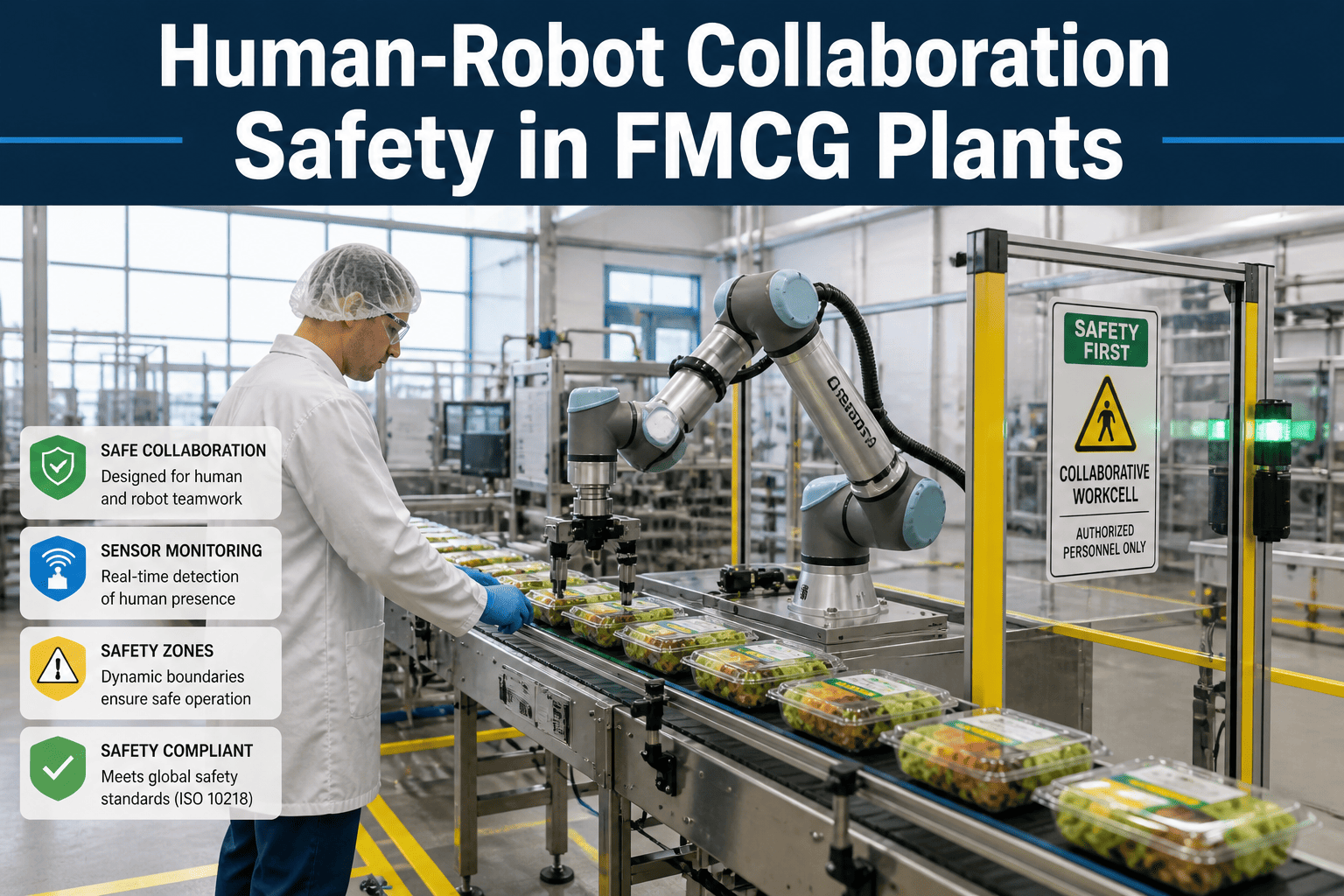
A confectionery plant in Pennsylvania received an OSHA citation and $156,000 in penalties after a packaging operator's hand entered the safety zone of a collaborative robot during a product changeover. The cobot was operating in reduced-speed mode — compliant with ISO/TS 15066 force limits — but the plant had no documented risk assessment for the specific human-robot interaction during changeovers, no updated lockout/tagout procedure for the robotic cell, and no CMMS record showing the safety sensor had been tested since installation 14 months earlier. The operator sustained minor bruising. The penalties were for documentation failures, not the injury itself. OSHA's 2024 enforcement data shows robot-related citations in food manufacturing increased 38% year-over-year, with 72% of citations targeting documentation gaps — missing risk assessments, untested safety devices, and incomplete LOTO procedures — rather than actual injuries. Start your free trial today or schedule a 30-minute demo to see how Oxmaint automates safety compliance for human-robot FMCG environments.
Manual vs. CMMS-Driven Safety Compliance in Human-Robot FMCG Plants
How systematic safety management transforms OSHA readiness from reactive documentation to continuous compliance
Manual / Paper-Based Safety
Safety Device Testing Compliance
54–68% of Required Intervals Met
Risk Assessment Currency
Updated Annually or After Incidents Only
LOTO Procedure Accuracy
62% Match Current Equipment Config
OSHA Citation Risk
4–8 Findings per Inspection
Automated with Oxmaint
Safety Device Testing Compliance
97–100% — Auto-Scheduled with Alerts
Risk Assessment Currency
Updated with Every Equipment or Process Change
LOTO Procedure Accuracy
100% — Linked to Asset Config in CMMS
OSHA Citation Risk
0–1 Findings per Inspection
Average Cost of a Single OSHA Robot-Related Citation in FMCG: $42,000–$156,000
Why Human-Robot Collaboration Changes Everything About Plant Safety
Traditional FMCG safety programmes were designed for environments where machines and humans occupy separate spaces — guarded by physical barriers, interlocks, and light curtains. Collaborative robots eliminate those barriers by design. Cobots work alongside operators in shared spaces, during changeovers, and on packaging lines where human dexterity and robotic speed combine. This creates safety challenges that existing programmes don't address: dynamic safety zones that change with robot task, force-limiting requirements that need periodic verification, and human-robot interaction scenarios that require documented risk assessments OSHA had never previously required. Plants using Oxmaint manage every safety inspection, LOTO procedure, and incident report through automated scheduling with full audit trails.
Six Human-Robot Safety Risks OSHA Now Targets in FMCG
Cobot Safety Zone Violations
34%
Of OSHA robot citations — safety-rated monitored stop or speed/separation not properly configured or tested
Missing Risk Assessments
28%
No documented risk assessment for specific human-robot interaction tasks — changeovers, cleaning, material loading
LOTO Procedure Gaps
22%
Lockout/tagout procedures not updated for robotic cells — multi-energy source isolation not documented
Untested Safety Devices
18%
Safety sensors, e-stops, light curtains, force limiters — installed but not tested at required intervals
Insufficient Training Records
14%
Operators working near cobots without documented robot safety training — competency evidence missing
No Incident Trend Analysis
4%
Near-misses and hazards not tracked or trended — incidents repeat because root causes aren't systematically addressed
OSHA & ISO Safety Standards for Human-Robot FMCG Environments
Four overlapping standards govern human-robot safety in FMCG plants. Compliance requires documented evidence across all four — a gap in any one creates citation exposure. Understanding what each standard demands helps your safety team build a programme that satisfies all requirements simultaneously.
Four Regulatory Frameworks for Human-Robot Safety
01
OSHA 29 CFR 1910
General Duty Clause — hazard-free workplace
1910.147 — LOTO for robotic cells
1910.212 — Machine guarding requirements
Penalty: Up to $156K/Violation
02
ISO 10218-1/2
Robot safety design requirements
Safety-rated monitored stop protocols
Cell layout and integration standards
Scope: Industrial Robots
03
ISO/TS 15066
Collaborative robot force/pressure limits
Speed and separation monitoring thresholds
Body-region specific contact force tables
Scope: Cobots Specifically
04
ANSI/RIA 15.06
Risk assessment methodology for robot cells
Safeguarding selection hierarchy
Periodic inspection and testing requirements
Scope: US-Specific
Safety Inspection & Testing Requirements for Robotic FMCG Cells
Every safety device in a human-robot cell requires periodic testing at documented intervals. Missing a single test creates OSHA citation exposure — and 54% of FMCG plants with cobots are behind on at least one safety device test.
Safety Device Testing Schedule for Human-Robot FMCG Cells
Required inspection frequencies per device type — each requires documented results with pass/fail and corrective actions
Emergency Stop (E-Stop)
Verify all e-stops on robotic cell halt robot motion within required time — test from each access point
Monthly
Safety-Rated Monitored Stop
Confirm robot stops within defined zone when operator enters — verify sensor coverage, response time
Monthly
Force/Pressure Limiting
Measure actual contact force against ISO/TS 15066 body-region limits using calibrated force gauge
Quarterly
Light Curtains & Area Scanners
Verify detection coverage, response time, and alignment — test with standard test piece per manufacturer spec
Monthly
Safety Interlock Switches
Test each interlock on access doors, gates, and guards — confirm robot motion halts when interlock opens
Monthly
Speed & Separation Monitoring
Verify robot reduces speed at correct distance thresholds — measure actual vs. programmed separation values
Quarterly
LOTO Device Verification
Confirm all energy sources documented, isolation points functional, and procedures current for each cell
Annually
Risk Assessment Review
Review and update risk assessment for each human-robot task — especially after any process or equipment change
Annually+
Total Safety Tests per Robotic Cell per Year
80+
Managing 80+ safety tests per cell manually with paper logs is how 54% of FMCG plants fall behind on compliance. A CMMS auto-schedules every test, sends mobile notifications, and flags overdue items before they become citations.
72% of OSHA Robot Citations Target Documentation, Not Injuries. Fix Your Records.
Oxmaint auto-schedules every safety test, tracks every LOTO procedure, and logs every incident — audit-ready always.
The True Cost of Safety Compliance Failures in FMCG
OSHA penalties are only the beginning. Workers' compensation, production shutdowns, increased insurance premiums, and reputational damage compound into six-figure events from a single citation.
Annual Cost of Reactive Safety Management in FMCG
Mid-size FMCG plant — 4 production lines — 6 robotic cells — 85 production staff
OSHA Penalties (Avg Citation)
2 citations/yr at avg $48,000 per serious violation — documentation and device testing gaps
$96,000
Workers' Compensation
3 recordable incidents/yr x $28,000 avg direct cost — medical + lost time + modified duty
$84,000
Production Shutdown (Investigation)
OSHA investigation halts affected line for 2–5 days x $1,800/hr lost production
$72,000
Insurance Premium Increase
EMR increase from recordable incidents — 15–25% premium rise sustained for 3 years
Safety manager + plant manager + legal — 400+ hours/yr on reactive incident response and OSHA correspondence
$52,000
Total Annual Cost of Reactive Safety Management
$387,000
A CMMS-driven safety programme costs $15,000–$30,000/year. Net savings: $357,000–$372,000. ROI: 12–25x. One prevented OSHA citation pays for 2–5 years of platform cost.
How Oxmaint Automates Human-Robot Safety Compliance
Six capabilities that close the gap between your safety programme on paper and what actually gets tested, documented, and verified on the production floor.
Six Core Safety Compliance Capabilities
Safety Device Registry
Full Coverage
Every e-stop, light curtain, interlock, area scanner, and force limiter registered with test frequency and owner
Auto-Scheduled Testing
97–100%
Safety tests triggered by calendar, runtime, or event — mobile notifications with escalation for overdue items
Digital LOTO Procedures
Always Current
LOTO procedures linked to asset config — auto-updated when equipment changes, accessible on mobile at point of work
Incident & Near-Miss Tracking
Full Pipeline
Report → investigate → root cause → corrective action → verification — with trending and pattern detection
Mobile Safety Checklists
Field-Ready
Operators and technicians complete safety inspections from phone — photos, readings, pass/fail, digital signatures
OSHA-Ready Reports
Instant Export
Safety device test history, incident logs, LOTO records, training evidence — exportable in seconds for any inspector
LOTO for Robotic Cells: What Most Plants Get Wrong
Traditional LOTO procedures cover electrical and pneumatic energy. Robotic cells add stored mechanical energy in joints, gravity-loaded axes, capacitive charge in servo drives, and software-controlled motion that can restart unexpectedly. 62% of FMCG plants with robots have LOTO procedures that don't address all energy sources in robotic cells.
Complete Energy Source Identification for Robotic Cell LOTO
Every energy source must be identified, documented, and isolatable — missing any one creates OSHA 1910.147 exposure
Electrical — Main Power
Robot controller, servo drives, teach pendant — lockable disconnect with verification of zero energy state
Standard
Pneumatic — Air Supply
Gripper actuators, vacuum generators, blow-off devices — isolate supply, bleed residual pressure to zero
Standard
Stored Mechanical — Gravity
Vertical robot axes that can drop under gravity when power removed — requires mechanical blocking or support
Often Missed
Stored Electrical — Capacitors
Servo drive capacitors retain charge after power-off — wait 5–10 minutes or verify with meter before contact
Often Missed
Spring Energy — Counterbalance
Counterbalance springs on vertical axes store mechanical energy — can release unexpectedly if not secured
Often Missed
Software — Restart Prevention
Robot controller software can initiate motion from remote commands, scheduled programs, or sensor triggers
Often Missed
FMCG Plants with Incomplete Robotic Cell LOTO
62%
Oxmaint links LOTO procedures directly to each robotic cell's asset configuration. When equipment is modified — new end-effector, additional axis, pneumatic gripper added — the LOTO procedure auto-flags for update.
90-Day Path to Human-Robot Safety Compliance
Build OSHA-ready safety documentation for every robotic cell in 90 days. Schedule a demo to map this to your specific robotic installation.
Phased Safety Compliance Implementation
01
Days 1–20: Assess
Risk assessment for each human-robot task
Inventory all safety devices per cell
Audit LOTO procedures against actual config
Output: Safety Gap Register
02
Days 21–45: Systematise
Deploy CMMS with safety test schedules
Load LOTO procedures linked to asset config
Configure incident reporting workflow
Output: System Live
03
Days 46–70: Execute
Complete first full cycle of all safety tests
Train operators on mobile safety checklists
Run first near-miss reporting campaign
Output: Evidence Base Built
04
Days 71–90: Verify
Internal safety audit of all documentation
Mock OSHA inspection with corrective actions
Present safety KPIs to plant leadership
Output: OSHA-Ready
Documented Results from FMCG Plants
Real outcomes from plants that implemented systematic safety compliance for human-robot operations.
Before & After: Safety Compliance Automation in FMCG
Documented results from plants that deployed Oxmaint for human-robot safety management
Case 1: Confectionery — 8 Cobot Cells, 120 Staff
Safety Device Test Compliance
58% → 100% — Auto-Scheduled, Zero Overdue
OSHA Citations
3 Citations ($142K) → 0 in Next Inspection
Recordable Incident Rate
4.2 → 1.1 — 74% Reduction in 18 Months
Annual Savings
$312,000 (Penalties + WC + Insurance + Downtime)
Case 2: Beverage Plant — 4 Robotic Lines, 85 Staff
LOTO Procedure Accuracy
64% → 100% — All Robotic Energy Sources Mapped
Near-Miss Reporting
2/month → 14/month — Culture Shift Achieved
Safety Audit Prep Time
3 Weeks → Same-Day Export
Annual Savings
$186,000 (Citations Avoided + Productivity)
Average OSHA-Related Savings from Safety Automation: $180,000–$320,000/Year
Frequently Asked Questions
What OSHA standards specifically apply to collaborative robots in FMCG?
OSHA doesn't have a robot-specific standard — it enforces the General Duty Clause (Section 5(a)(1)) and existing standards including 29 CFR 1910.212 (machine guarding), 29 CFR 1910.147 (LOTO), and 29 CFR 1910.303 (electrical safety). OSHA references ANSI/RIA 15.06, ISO 10218, and ISO/TS 15066 as recognized consensus standards. In practice, this means OSHA expects documented risk assessments per ISO methodology, safety device testing at manufacturer-specified intervals, LOTO procedures covering all energy sources including stored mechanical and capacitive, and operator training records. Oxmaint templates are pre-configured for all four standards.
How often should cobot force-limiting be tested?
ISO/TS 15066 doesn't specify testing frequency — it defines force/pressure limits. Manufacturer recommendations typically call for quarterly force measurement verification using a calibrated force gauge at all potential contact points. Best practice: monthly visual/functional verification (does the robot stop on contact?) plus quarterly quantitative force measurement against the body-region specific limits in ISO/TS 15066 Annex A. Document every test with actual measured values, pass/fail determination, and the calibrated instrument used. Most OSHA inspectors accept quarterly quantitative testing as adequate.
How do we write LOTO procedures for robotic cells with multiple energy sources?
Start with a comprehensive energy source inventory for each cell: electrical (main power, servo drives), pneumatic (grippers, blow-offs), stored mechanical (gravity-loaded axes, counterbalance springs), stored electrical (drive capacitors), and software (remote start, scheduled programs). Each energy source needs a documented isolation method, verification step, and zero-energy-state confirmation. Oxmaint links each LOTO procedure to the specific asset configuration — when a new end-effector or pneumatic device is added, the system flags the LOTO for update. This prevents the most common gap: LOTO written at installation and never updated when equipment changes.
What training records does OSHA require for operators working near cobots?
OSHA expects documented training covering: recognition of hazards specific to the robotic cell, purpose and function of each safety device, proper LOTO procedures for the cell, emergency stop locations and procedures, reporting requirements for incidents and near-misses, and restrictions on entering the robot's workspace. Training must be job-specific (not generic robot safety), refreshed when equipment or processes change, and documented with dates, instructor qualification, content covered, and competency assessment. Oxmaint tracks all training records per employee with auto-renewal alerts when refresher training is due.
How does near-miss reporting improve safety in human-robot environments?
Near-misses outnumber actual injuries by 30–300:1. Every near-miss is a free warning that the current safety controls have a gap. In human-robot environments, common near-misses include: operator entering robot zone during unexpected motion, robot continuing operation during material loading, safety sensor not detecting operator in blind spot, and cobot applying unexpected force during collaborative task. Tracking these through Oxmaint reveals patterns — if the same zone or task generates repeated near-misses, the risk assessment for that interaction needs revision before an injury occurs. Plants that increase near-miss reporting from 2/month to 12+/month typically see recordable injuries drop 50–70% within 12 months. Book a demo to see near-miss trending dashboards.
One OSHA Citation Costs More Than 5 Years of Safety Automation. Don't Wait.
Oxmaint schedules every safety test, tracks every incident, and keeps every LOTO procedure current — automatically.