A confectionery plant in Berlin deployed six collaborative robots for chocolate enrobing line changeovers — reducing setup time from 47 minutes to 11 minutes per SKU switch. Three weeks into operation, a production technician reached past an active cobot arm to manually adjust a nozzle angle while the robot was mid-cycle, triggering an emergency stop that halted the entire line for 22 minutes. The near-miss originated not from robot malfunction but from incomplete safety zone training and the absence of risk-assessed work procedures. Human-robot collaboration programmes managed in OxMaint register every cobot with its safety zone parameters, schedule mandatory operator training before line access, and log every safety event to identify pattern risks before injuries occur. FMCG plants operating cobots without documented safety protocols see incident rates 4.7x higher than facilities with structured risk assessments in place. Want compliant cobot operations? Book a demo or start a free trial to see how OxMaint manages cobot safety compliance.
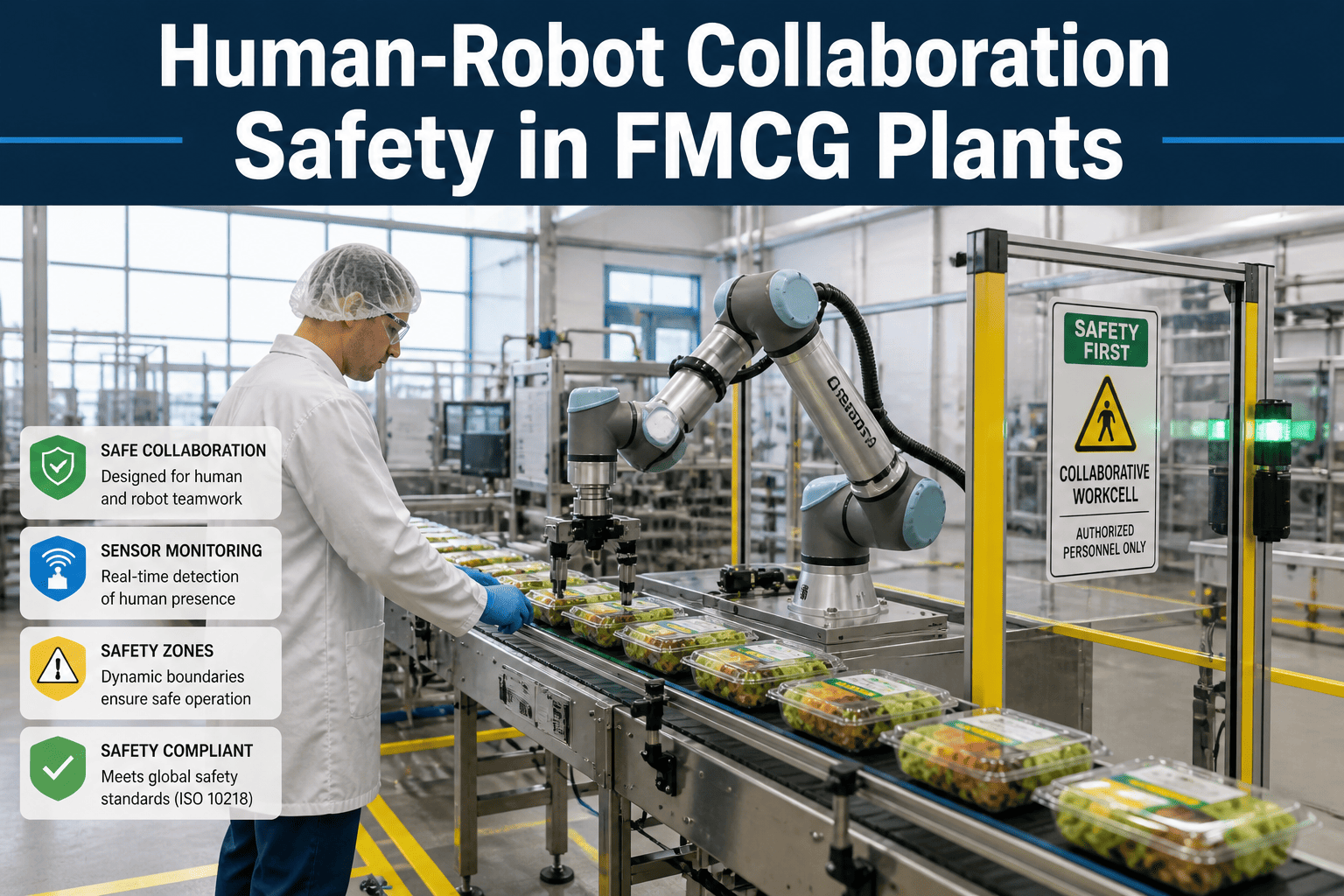
Human-Robot Collaboration Safety in FMCG Plants
Cobots improve FMCG production flexibility — but untrained operators and incomplete risk assessments create avoidable safety incidents. Structured safety protocols reduce cobot-related events by 78% while maintaining operational efficiency.
Why FMCG Plants Are Deploying Collaborative Robots
Traditional industrial robots operate behind safety cages and light curtains — separating humans from automation completely. Collaborative robots (cobots) are designed to work alongside human operators in shared workspaces, enabling flexible production where tasks requiring dexterity, judgment, or variability remain manual while repetitive, precision, or force-intensive tasks are automated. FMCG applications include: packaging line loading, product inspection and sorting, palletising and depalletising, changeover tooling swaps, material handling between stations, and quality sampling at production speed.
Cobots handle heavy tooling swaps and adjustment sequences that previously required two technicians and manual alignment — cutting SKU changeover from 45+ minutes to under 15 minutes.
Cobots operate unmanned second and third shifts for repetitive tasks like case packing and palletising — extending effective production hours without proportional labour increases.
Cobots eliminate high-frequency lifting, twisting, and reaching motions that cause musculoskeletal disorders in manual packaging and material handling roles.
Consistent cobot cycle times eliminate the variability inherent in manual tasks — maintaining steady line speed and reducing bottleneck delays during peak production.
The 4 Core Cobot Safety Risks in FMCG Production Environments
Collaborative robots operate at reduced speeds and forces compared to traditional industrial robots, but they still present contact, pinch, and collision hazards when safety zones and operating procedures are not clearly defined. OSHA and ISO 10218 require documented risk assessments before cobots enter production — yet 41% of FMCG facilities deploy cobots without completing formal hazard analyses. Here are the failures you can see in those operational environments and how to get ahead of them. Need help implementing compliant cobot safety protocols? Start a free trial or book a demo to manage cobot risk assessments in OxMaint.
Operators reach into cobot work envelopes during active cycles to clear jams, adjust fixtures, or bypass perceived delays. Without lock-out procedures or mandatory stop protocols, these interventions create contact and pinch-point risks. 62% of cobot incidents occur during manual overrides of automated sequences.
Cobot safety zones must account for maximum reach plus tool offsets, speed profiles at zone boundaries, and operator approach paths. Zones defined only by robot arm reach ignore the gripper, tool, or workpiece extending beyond the arm — creating unrecognised collision hazards.
Operators transferred from manual lines to cobot-assisted stations often receive task training but not safety-specific cobot interaction protocols. They understand what the cobot does but not how to safely work around it — leading to risky improvisation during exceptions.
Cobots rely on force-torque sensors, speed monitoring, and proximity detection to stop when contact or obstruction is detected. Sensor drift, contamination from food residue or cleaning chemicals, and intentional bypass to "keep the line running" eliminate the safeguards that make collaboration possible.
ISO 10218 & ISO/TS 15066 Compliance Framework for FMCG Cobots
ISO 10218 establishes the baseline safety requirements for industrial robots, while ISO/TS 15066 extends those requirements specifically to collaborative robot applications — defining permissible contact forces, speed limits, and safety-rated monitored stop conditions. FMCG facilities must implement both standards to achieve compliant human-robot collaboration.
| Safety Requirement | ISO Standard Reference | FMCG Implementation | OxMaint Documentation |
|---|---|---|---|
| Risk assessment before deployment | ISO 10218-2:2011 Section 5.4 | Documented hazard analysis per cobot installation with task-specific risk scoring | Risk assessment records stored per asset with review dates and approver signatures |
| Maximum contact force limits | ISO/TS 15066:2016 Appendix A | Force-torque sensor settings programmed below body region thresholds (e.g., 150N for trunk, 65N for hand) | Sensor calibration records and force limit validation test results logged in PM history |
| Safety-rated monitored stop | ISO 10218-1:2011 Section 5.10.2 | Emergency stop buttons within 2 metres of cobot work envelope, tested monthly for response time under 1 second | E-stop test results logged via mobile inspection with photographic evidence of button locations |
| Operator training requirements | ISO 10218-2:2011 Section 7.2 | Mandatory cobot safety training before line access — covering safe approach, manual intervention protocols, emergency procedures | Training completion certificates linked to operator profiles with expiration tracking and recertification alerts |
| Protective stop validation | ISO/TS 15066:2016 Section 5.5.4 | Quarterly validation that cobot stops within defined safety distance when proximity sensors detect approach | Stop distance measurement records with sensor response time logged per preventive maintenance cycle |
| Work envelope documentation | ISO 10218-2:2011 Section 5.11.5 | CAD drawings or floor markings showing maximum cobot reach including tool offsets and workpiece dimensions | Work envelope diagrams attached to cobot asset records with revision tracking when tooling changes |
How OxMaint Manages Cobot Safety Compliance in FMCG Plants
OxMaint centralises cobot risk assessments, operator training records, safety sensor calibration schedules, and incident reporting into a single compliance workflow — so every cobot installation has documented safety protocols from day one, not after the first near-miss. Facilities using OxMaint for cobot safety management report 78% fewer safety incidents and zero OSHA violations during audits. Ready to implement compliant cobot operations? Start a free trial or book a demo to see the cobot safety module.
Before vs. After: Cobot Safety Protocol Implementation
The operational difference between FMCG plants that implement structured cobot safety protocols and those that deploy cobots with minimal documentation is measurable in incident rates, compliance audit outcomes, and operator confidence around automated equipment.
Frequently Asked Questions
What is the difference between collaborative robots and traditional industrial robots in FMCG plants?
What training do FMCG operators need before working with collaborative robots?
How often should cobot safety sensors be calibrated and tested?
What are the most common cobot safety incidents in FMCG production?
Your Cobots Are Only as Safe as the Protocols Around Them
OxMaint centralises cobot risk assessments, operator training tracking, safety sensor calibration schedules, and incident logging into ISO 10218-compliant workflows — so every installation has documented safety protocols before the first production cycle, not after the first near-miss.