X-Ray Inspection System Maintenance for FMCG: Calibration, Test Pieces, and PM
By Jack Edwards on May 16, 2026
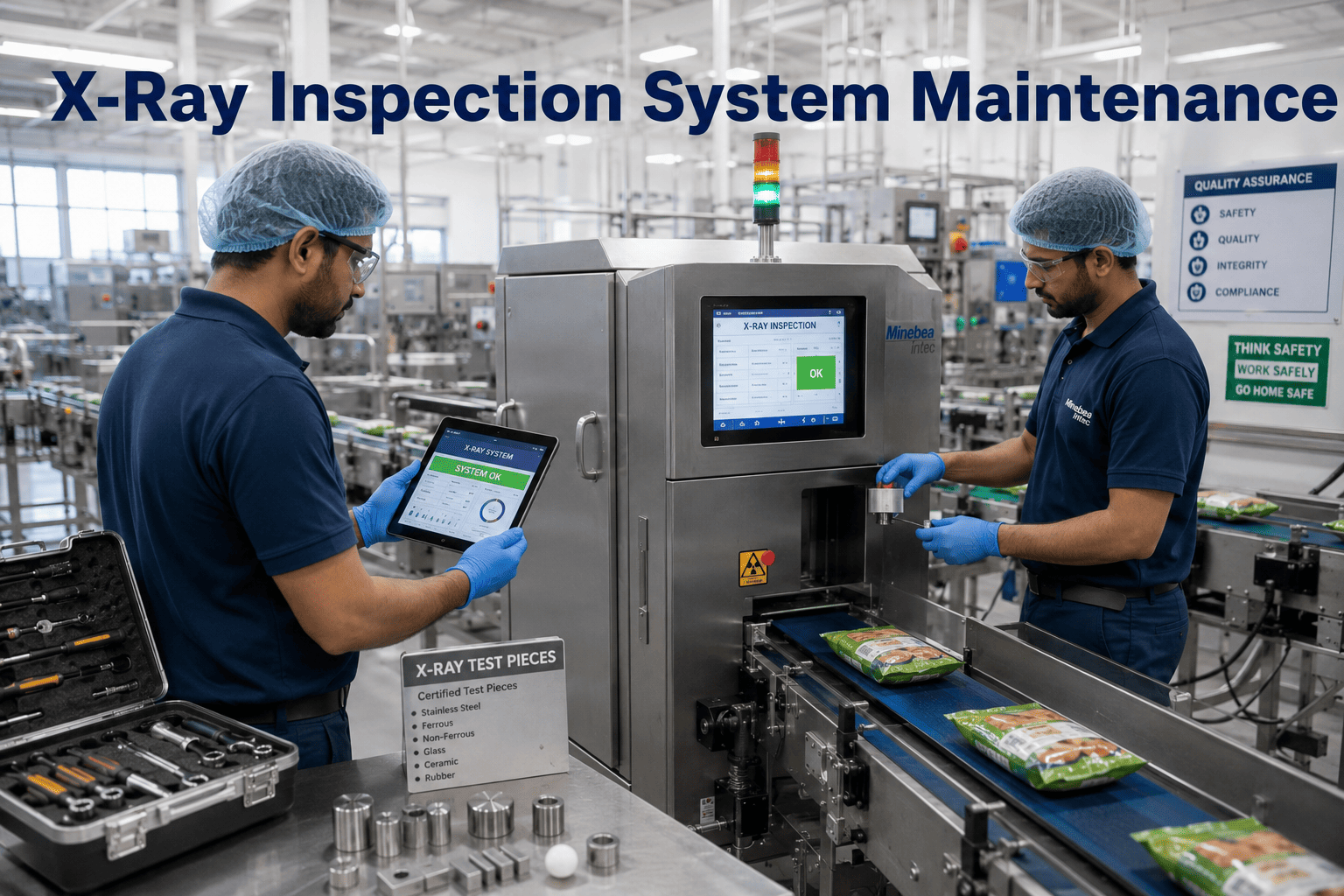
X-ray inspection systems detect contaminants that metal detectors cannot — glass, calcified bone, dense plastic, and rubber — making them essential in FMCG lines producing high-risk products such as ready meals, baby food, pet food, and canned goods. But unlike simpler inspection tools, X-ray systems carry a unique maintenance challenge: the X-ray generator has a finite operational life, calibration drift is invisible without test pieces, and regulatory classification as radiation-emitting equipment adds a compliance layer that most CMMS programs ignore entirely. Start a free OxMaint trial and build a structured X-ray inspection PM program — or book a demo to see how OxMaint manages radiation equipment PM schedules.
FMCG Quality Assurance · X-Ray Inspection Systems
X-Ray Inspection System Maintenance for FMCG: Calibration, Test Pieces, and PM Schedules
X-ray inspection systems catch contaminants metal detectors miss — but only when properly calibrated. Discover the PM, generator, and test piece schedule that protects FMCG HACCP compliance.
Glass detection limit achievable by modern FMCG X-ray systems with correct calibration and shielding integrity
5 yrs
Typical X-ray generator operational life — beyond this, output degrades and detection limits cannot be maintained
45%
Of FMCG physical contamination recalls involve contaminants X-ray detects but metal detectors cannot (USDA 2023)
Annual
Radiation safety inspection requirement under FDA 21 CFR 1020 and equivalent UK and EU radiation regulations
What Is X-Ray Inspection System Maintenance and Why HACCP Demands More Than Metal Detection
An X-ray inspection system generates a beam of X-radiation that passes through the product on a conveyor. Contaminants denser than the surrounding food — glass, ceramic, metal, bone, stone, and high-density plastic — absorb more radiation and appear as darker areas in the real-time X-ray image. Detection algorithms compare the image against a product baseline and trigger a reject signal when a contaminant signature exceeds the sensitivity threshold.
Unlike metal detectors, X-ray systems detect on density — not conductivity — making them the only practical in-line method for detecting glass, ceramite, and calcified bone in packaged FMCG products. This capability places them at the apex of FMCG HACCP plans for physical hazard control, particularly for products in metal-foil packaging or products where metal detection cannot achieve required sensitivity due to product effect.
The maintenance obligation is correspondingly demanding: generator output must be stable, detector panel calibration must be current, test pieces must be certified and routinely verified, radiation shielding must be intact, and all records must satisfy both food safety and radiation safety regulatory requirements simultaneously. FMCG teams managing X-ray PM in a CMMS close that compliance gap before auditors find it — start a free trial to see how OxMaint structures X-ray inspection PM records, or book a demo to review a sample X-ray maintenance workflow.
Eight Core Concepts in X-Ray Inspection System Maintenance
Effective X-ray inspection PM requires understanding these eight technical and regulatory concepts that govern system performance and compliance across the full equipment lifecycle.
01
X-Ray Generator Life Management
The X-ray tube has a finite emission life — typically 5 years or 20,000 operating hours. As the tube ages, output voltage stability decreases and detection limits drift upward. Generator hour tracking in a CMMS enables planned replacement before performance falls below validated thresholds rather than discovering failure at an audit.
02
Detector Panel Calibration
The linear detector array must be calibrated with the system running at operating temperature, using a reference object of known density and dimension. Calibration drift — caused by temperature cycling, pixel degradation, or electronic component aging — produces progressive image quality loss that reduces detection sensitivity without triggering any system alarm.
03
Test Piece Programs
FMCG X-ray test pieces contain certified reference standards — a glass sphere, a wire of stainless steel, and a ceramic chip — embedded in a food-safe medium at the validated detection limit. Test pieces must be passed through the system at defined intervals (start of shift, every 2 hours, after changeover) and the result recorded as a CCP verification activity.
04
Radiation Shielding Integrity
Radiation shielding — lead curtains, interlocked covers, and beam stops — must be inspected at defined intervals to confirm that radiation leakage does not exceed regulatory limits. Damaged curtains, worn seals, and missing interlocks are radiation safety non-compliances that can trigger regulatory action independent of food safety status.
05
Product Algorithm Validation
X-ray detection algorithms are trained on product-specific image profiles. When a product changes — new packaging material, different fill weight, or reformulated recipe — the algorithm must be re-validated with new test pieces at the required detection limit. Running an old algorithm on a changed product is a HACCP validation gap.
06
Conveyor and Reject System PM
The conveyor belt must be free of splices, debris, and density irregularities that could trigger false rejects or mask contaminant signatures. Reject mechanisms — air blast or pusher — must be verified functional at each shift start. Belt replacement interval should be based on throughput and environmental conditions, not calendar time alone.
07
Regulatory Compliance Dual Track
X-ray inspection systems are regulated as radiation-emitting equipment under FDA 21 CFR 1020 in the USA, the Ionising Radiations Regulations 2017 in the UK, and similar frameworks in Canada, Australia, the EU, and the UAE. Annual radiation safety inspections by a Radiation Protection Supervisor are required alongside HACCP food safety verification — two compliance tracks, one asset.
08
Image Archive and Record Retention
Modern X-ray systems store contaminant detection images digitally. BRCGS Issue 9 and SQF Edition 9 both require that reject event records — including image captures — are retained for the full audit cycle (minimum 12 months). Image archive settings must be verified as part of the periodic PM to confirm storage is not overwriting records before the retention period expires.
The X-Ray Inspection Pain Points That Ground FMCG Lines
X-ray system failures follow a pattern distinct from other inspection equipment: performance degrades invisibly, discoveries are sudden and expensive, and the regulatory consequences span both food safety and radiation safety authorities. These four pain points are the most costly for FMCG operations teams without structured PM programs.
Generator Degradation Discovered at HACCP Audit
An aging X-ray tube produces progressively lower output and image contrast. The system continues to run and pass basic function tests, while the actual contaminant detection limit drifts from 0.8mm glass to 1.4mm glass over 18 months. The degradation is discovered when an annual HACCP validation test piece fails — triggering immediate line shutdown and investigation of all product shipped under the degraded system.
A worn lead curtain or damaged interlock creates a radiation leakage condition that simultaneously triggers investigation by the radiation safety regulator and questions from the food safety auditor about maintenance record completeness. Radiation leakage findings can result in immediate equipment seizure — not just production suspension — under FDA and HSE enforcement powers.
Product Algorithm Not Re-Validated After Recipe Change
When a product recipe changes — a denser packaging layer, different fill weight, or new ingredient — the X-ray image profile changes. Running the original detection algorithm on the changed product creates a HACCP validation gap. The system may appear to function normally while actually operating outside its validated parameters, a finding that exposes the entire HACCP plan to challenge during an audit.
Image Archive Overwriting Records Before Audit Cycle Completes
If archive storage settings are not managed actively, reject event image records are overwritten when disk capacity is reached. An auditor requesting 12 months of X-ray reject images — a standard BRCGS or SQF verification activity — may receive only three months of data, creating an apparent record gap that triggers a major non-conformance regardless of actual system performance during the missing period.
X-ray system failures span two regulators simultaneously — food safety and radiation safety. One PM program must satisfy both.
How OxMaint Manages X-Ray Inspection System PM
OxMaint connects X-ray generator life tracking, daily test piece verification, radiation shielding inspection, algorithm re-validation events, and annual radiation safety compliance into a single maintenance record — eliminating the cross-regulatory documentation gap that costs FMCG facilities their certifications.
Generator Hour Tracking and Replacement Planning
Each X-ray generator is tracked as an asset component with accumulated operating hours logged against the rated life. OxMaint generates a planned replacement work order when the generator approaches 80% of rated life — giving procurement time to source the replacement tube before performance degrades, rather than discovering failure during an audit.
Shift-Start and 2-Hour Test Piece Checklists
Digital test piece verification checklists trigger at shift start and every two hours during production. Operators confirm glass, ceramic, and stainless test piece pass results, reject system function, and image archive status — timestamped and signed on mobile. No paper gaps. Every CCP verification is recorded the moment it is completed.
Radiation Shielding Quarterly Inspection Schedule
Quarterly PM work orders for radiation shielding inspection cover lead curtain condition, interlock function, beam stop integrity, and external leakage check results. Work orders capture the name of the Radiation Protection Supervisor performing the check, measurement results, and any corrective actions — satisfying both food safety and radiation safety record requirements from one work order.
Product Changeover Algorithm Validation Tracking
When a product changeover is logged in OxMaint, a conditional check asks whether the product's X-ray algorithm has been validated for the current recipe and packaging. If not, an algorithm validation work order is generated before production resumes — preventing the HACCP validation gap that occurs when changed products run under old detection parameters.
Annual Radiation Safety Compliance Record
Annual radiation safety inspections required under FDA 21 CFR 1020, UK IRR 2017, and equivalent frameworks are scheduled as annual PM work orders in OxMaint — assigned to the certified Radiation Protection Supervisor or third-party radiation safety contractor. Inspection reports, leakage measurement results, and compliance certificates are stored in the asset record alongside HACCP CCP records.
Dual-Compliance Audit Export
When a BRCGS auditor requests X-ray CCP records and a radiation safety inspector requests equipment compliance history simultaneously, OxMaint generates both exports from the same asset record — CCP test piece logs, algorithm validation records, shielding inspection results, and radiation safety certificates — filtered by date and delivered in minutes.
Reactive vs. Planned: X-Ray Inspection PM Comparison
PM Requirement
Reactive Approach
OxMaint Planned Program
Generator life tracking
Unknown hours — replaced after detection failure
Hour-tracked asset — replacement planned at 80% life
Test piece verification
Shift-start only — gaps during production
Shift-start and 2-hourly — digital, timestamped
Radiation shielding inspection
Checked only after equipment damage reports
Quarterly PM work order — RPS-signed results recorded
Product algorithm validation
Not re-validated after recipe or packaging changes
Changeover work order triggers validation check
Annual radiation safety inspection
Scheduled when inspector contacts the facility
Annual PM pre-scheduled — contractor assigned in advance
Image archive management
Overwriting occurs when storage fills — discovered at audit
Archive status checked in every shift-start checklist
Detector panel calibration
Calibrated at annual service only
Monthly calibration verification PM work order
Dual-compliance record retrieval
Two separate manual searches across food safety and radiation files
Single asset record — both compliance tracks exported together
Of physical contamination recalls detectable only by X-ray
Glass, ceramic, calcified bone, and dense plastic — invisible to metal detectors but visible to properly calibrated X-ray systems
30%
Generator life extension through planned maintenance
Condition-based monitoring and planned replacement avoids the 40-50% cost premium of emergency tube replacement under production pressure
5 min
Dual-compliance export for food safety and radiation audit
vs. hours of manual file assembly across two separate regulatory compliance systems
Zero
HACCP validation gaps on algorithm changes
Changeover-triggered validation checklists prevent the recipe-change gap that auditors target in GFSI scheme reviews
Frequently Asked Questions
How often should X-ray inspection systems be calibrated in FMCG production?
Detector panel calibration should be performed at a minimum of monthly intervals under normal operating conditions, with additional calibration required after any maintenance event that could affect the detection system — generator replacement, detector panel service, or physical relocation of the unit. Test piece verification must occur at shift start and every two hours during production. Annual full system validation by the manufacturer or certified service engineer is required for HACCP CCP validation and for most GFSI scheme certification programs. Radiation safety inspection under FDA 21 CFR 1020 or equivalent national framework is also required annually and must be recorded separately.
What test pieces are required for FMCG X-ray inspection CCP verification?
FMCG X-ray test piece programs require certified reference pieces for each contaminant category the system is validated to detect. Typically this includes: a glass sphere at the validated glass detection limit (typically 0.8–1.5mm depending on product density), a stainless steel wire at the validated metal detection limit, a ceramic or mineral chip at the validated mineral detection limit, and for bone detection applications, a calcified bone standard at the validated bone detection limit. Test pieces must be physically embedded in a food-safe matrix that mimics the product density profile, and must be certified and traceable to national measurement standards. Test piece sets should be replaced when worn, damaged, or when their certification expires.
What radiation safety regulations apply to FMCG X-ray inspection equipment?
In the USA, X-ray inspection systems used in food manufacturing are regulated under FDA 21 CFR Part 1020 — Electronic Product Performance Standards. Manufacturers must register equipment and submit performance data. Facilities must appoint a Radiation Safety Officer and conduct annual leakage surveys. In the UK, X-ray inspection systems are regulated under the Ionising Radiations Regulations 2017 (IRR17), which requires appointment of a Radiation Protection Supervisor, written Local Rules, and annual inspection. Similar frameworks apply in Canada (Radiation Emitting Devices Act), Australia (state-level radiation safety legislation), and the EU (BSS Directive 2013/59/Euratom). Compliance with both food safety and radiation safety regulations must be maintained simultaneously and documented separately.
How does OxMaint track X-ray generator life and schedule planned replacement?
In OxMaint, the X-ray generator is registered as a component asset within the inspection system asset record — with rated life in hours, installation date, and accumulated hours recorded. Operating hours can be logged manually from the system hour meter during PM visits, or updated automatically where the system supports maintenance record export. When accumulated hours reach the defined replacement threshold (typically 80% of rated life), OxMaint generates a replacement planning work order — assigned to procurement and the maintenance team, with the manufacturer's tube specification attached. This approach ensures replacement is planned and budgeted before performance degradation occurs, rather than triggered by a detection failure during production or audit.
Catch Every Contaminant. Satisfy Every Auditor.
Stop Managing X-Ray Inspection Compliance Across Disconnected Systems — Build One Program with OxMaint
Generator life tracking. Shift-start and 2-hourly test piece checklists. Radiation shielding inspection schedules. Algorithm validation at changeover. Annual radiation safety compliance records. Dual-compliance audit export in minutes. OxMaint connects every X-ray inspection PM task to a complete, traceable record that satisfies food safety and radiation safety regulators simultaneously.
Generator life tracked — planned replacement before performance drifts
Food safety and radiation compliance in one asset record
Dual-compliance audit export ready in under 5 minutes
Used by FMCG quality teams managing X-ray inspection CCPs across multi-line, multi-site operations. Live in days, not months.