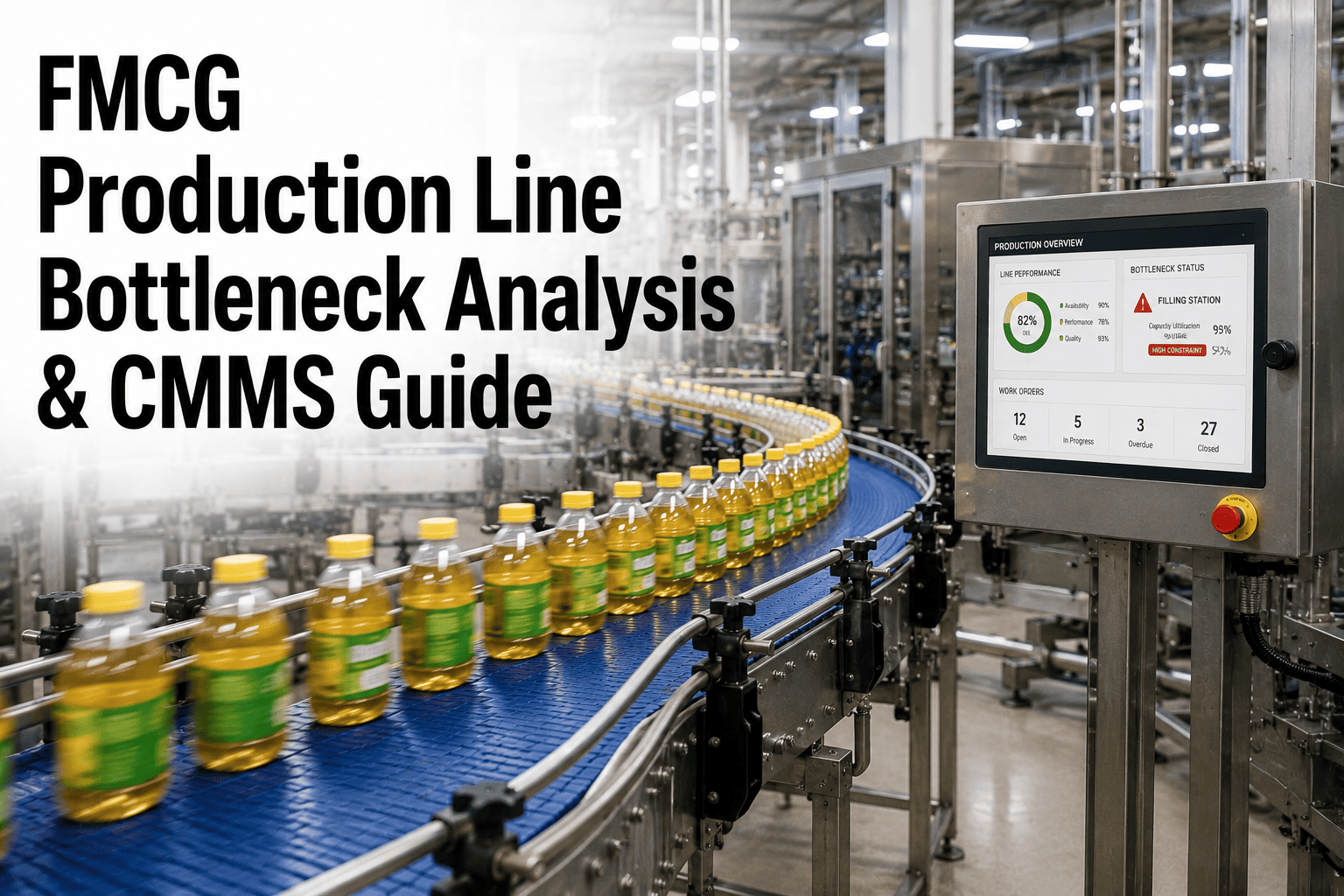
Beverage manufacturing sits at the intersection of the most demanding maintenance requirements in FMCG — food-grade precision, high-speed mechanical complexity, temperature-critical processes, and regulatory pressure that treats every equipment failure as a potential product safety incident. A pasteuriser that misses its hold temperature for 12 seconds does not just cause a maintenance problem; it invalidates an entire production batch and triggers a regulatory reporting event. A filler valve that wears beyond tolerance does not just cause fill variation; it creates an allergen cross-contamination pathway if the previous run contained a declarable allergen. A carbonation system pressure drop does not just affect product quality; it can signal a CO₂ leak that creates an asphyxiation hazard in enclosed plant areas. This guide covers the specific maintenance requirements for the four major beverage manufacturing categories — brewery, dairy, juice, and soft drinks — with PM schedules, calibration protocols, and the CIP integration that keeps beverage equipment at peak performance across all shift patterns. Start your free trial to build your beverage PM programme in Oxmaint, or book a demo to see Oxmaint's Preventive Maintenance Scheduling on live beverage plant data.
Preventive Maintenance Scheduling — Oxmaint
Every Pasteuriser Hold. Every Filler Calibration. Every CIP Cycle — Scheduled and Tracked.
Oxmaint manages PM schedules for beverage production equipment across all four beverage categories — with automated work order generation, mobile technician checklists, and food safety audit records built in from day one.
$4.2M
average cost of a single beverage product recall — equipment maintenance failure is the leading root cause
12 sec
pasteurisation hold time deviation that can invalidate an entire batch and trigger mandatory regulatory reporting
40%
of beverage line downtime attributed to filler and seamer maintenance issues — the highest-impact single system
6 hrs
average CIP cycle time lost when a filler requires unplanned cleaning due to missed preventive maintenance
The Four Beverage Categories: Different Products, Different Maintenance Priorities
Brewery, dairy, juice, and carbonated soft drink manufacturing share common equipment types — fillers, pasteurisers, CIP systems — but each sector has distinct maintenance priorities driven by the specific product chemistry, regulatory framework, and failure consequences unique to that beverage type.
?
Brewery
Fermentation Critical
Top maintenance priorityFermentation vessel integrity, yeast management systems, CO₂ recovery and handling, bright beer tank pressure
Critical failure consequenceBatch contamination (wild yeast, bacteria) requires full vessel strip and revalidation — 5–10 day production loss minimum
Regulatory driverFSMA for packaged beer, HACCP plans for microbiological control, CO₂ purity standards for carbonation
PM complexityHigh — long fermentation cycles create extended equipment idle periods where corrosion and seal degradation occur undetected
?
Dairy
Pasteurisation Critical
Top maintenance priorityHTST/UHT pasteuriser performance, cold chain refrigeration, homogeniser high-pressure seals, separator bowl balance
Critical failure consequencePasteurisation failure triggers mandatory diversion and batch hold — regulatory notification required within hours in most jurisdictions
Regulatory driverGrade A PMO (US), EC 853/2004 (EU), FSSAI (India) — all mandate continuous pasteurisation monitoring with automated diversion on deviation
PM complexityVery high — pasteurisation equipment requires calibrated temperature and flow monitoring with 100% uptime on safety diversion valves
?
Juice
Extraction and Aseptic
Top maintenance priorityExtractor knife and screen condition, flash pasteuriser performance, aseptic filler sterile barrier integrity, evaporator fouling
Critical failure consequenceAseptic barrier breach requires full sterilisation-in-place requalification — 12–24 hour production loss per filler
Regulatory driverFDA 21 CFR Part 113 for thermally processed low-acid products, NFC and FC labelling compliance requiring Brix accuracy
PM complexityHigh — seasonal raw material variation changes equipment loading; knife and screen wear rates vary significantly with fruit variety
?
Carbonated Soft Drinks
High Speed and Volume
Top maintenance priorityCarbonation system CO₂ ratio and pressure stability, high-speed filler valve condition, bottle washer spray system, labeller applicator
Critical failure consequenceCarbonation ratio drift causes consumer complaint surge — CO₂ loss in distribution triggers retailer returns and shelf presence penalties
Regulatory driverVolume fill declaration compliance, label accuracy requirements, allergen declaration for flavoured beverages
PM complexityModerate-high — very high line speeds (up to 60,000 bph) means component wear rates are high and PM intervals are short
Pasteuriser Maintenance: The Highest-Consequence System in Beverage Production
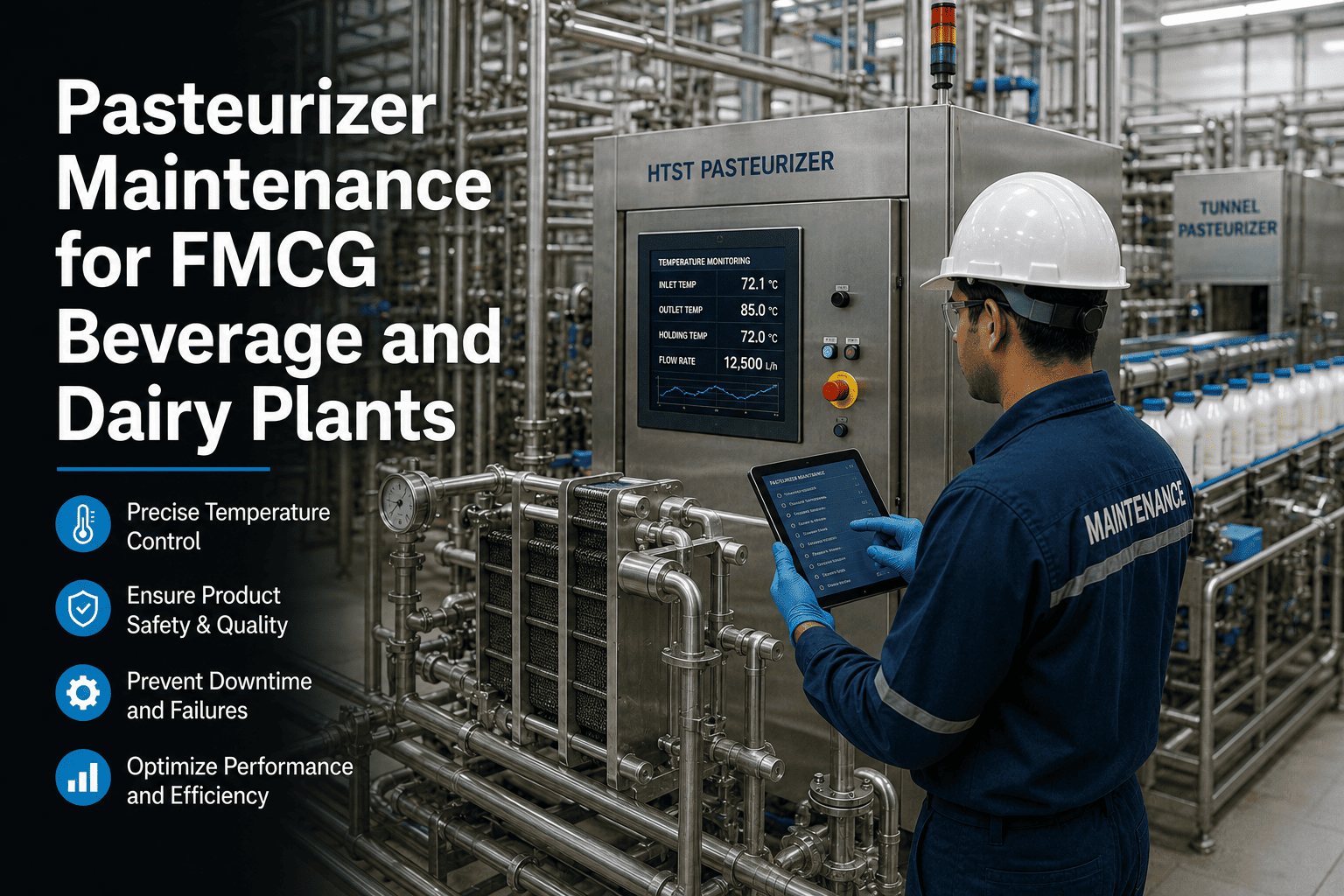
The pasteuriser is the most critical piece of equipment in any beverage facility that processes heat-treated product. Its failure does not just stop production — it creates a product safety incident. The maintenance programme for pasteurisers must be more rigorous, more documented, and more frequently audited than any other system on the line.
Pasteuriser PM Master Schedule — HTST/Flash Pasteuriser
Applies to dairy HTST, juice flash pasteuriser, and tunnel pasteuriser variants — adjust holding tube intervals for UHT
| System / Task |
Interval |
Criticality |
Record Required |
| Temperature sensor calibration — all probes in holding tube and heating section | Weekly | Safety Critical | Calibration cert |
| Flow diversion valve (FDV) function test — confirm forward/divert actuation | Daily | Safety Critical | Function test log |
| Differential pressure controller calibration — raw vs pasteurised pressure | Monthly | Safety Critical | Calibration cert |
| Holding tube integrity check — confirm no bypasses, correct volume | 6 months | Safety Critical | Engineering cert |
| Plate heat exchanger (PHE) gasket inspection and replacement | 6 months | High | PM completion |
| PHE plate inspection for fouling, pitting, and pinhole leaks | Annual | High | Inspection record |
| Pump seal and bearing inspection — feed pump and CIP return | 3 months | High | PM completion |
| Full pasteurisation profile test — product challenge at minimum hold parameters | Annual | Safety Critical | Validation cert |
| Chart recorder / data logger verification against NIST-traceable standard | Monthly | Safety Critical | Calibration cert |
| CIP effectiveness verification — swab programme post-CIP on heat exchanger ports | Weekly | High | ATP/micro results |
Filler and Seamer Maintenance: The Highest-Volume Wear System
The filler is the production constraint on virtually every beverage line — when it stops, the entire line stops. It is also the highest-wear system, because at 20,000–60,000 bottles per hour, every component cycles thousands of times per shift. Filler maintenance is not optional and it is not deferrable — it is the difference between a line that runs at rated speed and one that limps at 70% efficiency while operators manage jams and quality deviations.
Filling Valves
Every 250–500 hrs or 3 months
Inspect valve seat and seal for wear — replace O-rings and seats per OEM schedule
Check snift valve for proper venting — fouled snifts cause fill variation and foaming
Verify fill height calibration — check against target on 10 consecutive bottles
Inspect product contact surfaces for pitting, corrosion, and deposit buildup
Failure impact: Fill variation → consumer complaints + weights and measures non-compliance
Seamer / Capper
Daily setup check + monthly detailed inspection
Seam thickness and overlap measurement — minimum 6 cans per head per shift start
Chuck and roll wear measurement — replace at OEM wear limit, not at failure
Seaming roll clearance check — incorrect clearance causes stuck seams and false opens
Lubrication of all seaming head components — per OEM specification grade
Failure impact: Seam failure → product leaker, retailer returns, potential contamination pathway
Star Wheels and Guides
Weekly inspection + monthly measurement
Measure star wheel pocket wear — worn pockets cause container tipping and jams
Inspect infeed and discharge guides for wear and misalignment
Check all guide rail fastenings — vibration loosening causes sudden misalignment
Verify container handling at design speed — observe for wobble, tipping, and neck damage
Failure impact: Fallen containers → line jam, broken glass/PET contamination, line stop
Rinser System
Weekly inspection + 3-month detailed
Inspect rinse nozzles for blockage — blocked nozzles leave internal contamination in containers
Verify inversion mechanism — containers must be fully inverted for effective rinsing
Check rinse water quality and temperature — microbiological control of rinse water is food safety critical
Inspect gripper pads for wear — worn grippers drop containers inside the rinser housing
Failure impact: Inadequate rinsing → foreign body (glass, dust) inside sealed container
Preventive Maintenance Scheduling — Oxmaint
Filler PM Intervals Based on Actual Bottle Count — Not Just the Calendar.
Oxmaint triggers filler and seamer PM work orders based on production counter data — not just time intervals. At 40,000 bph, a monthly calendar interval means different things depending on how many days the line actually ran. Runtime-based triggers ensure the right maintenance at the right cycle count, every time.
Brewery-Specific Maintenance: Fermentation, CO₂, and Bright Beer
Brewery maintenance has a fundamentally different rhythm from other beverage categories — fermentation cycles create extended periods where equipment is either occupied with live product or standing idle between batches. Both states create specific maintenance challenges that calendar-based PM schedules miss if not properly calibrated to the brewing cycle.
1
Fermentation Vessel Maintenance
Fermentation vessels should be fully inspected, cleaned to microbiological standard, and defect-repaired between every batch — not on a calendar schedule. Key inspection points: weld integrity around CIP spray balls (biofilm harborage if welds are not fully smooth and crevice-free), pressure relief valve function (sticky valves cause pressure excursions during active fermentation), cooling jacket integrity (glycol leak into product is a product safety incident), and manway seal condition. Document vessel condition in Oxmaint as a batch record — each batch of beer is linked to the vessel condition at fill.
Schedule: Between every batch · Document: Per-batch vessel condition record
2
CO₂ Recovery and Handling System
CO₂ recovered from fermentation and used for carbonation and packaging atmosphere must meet food-grade purity standards — contamination with fermentation by-products (acetaldehyde, sulphur compounds) causes off-flavours in finished product. The CO₂ purification system (scrubber, activated carbon filter, compression train) requires regular maintenance and purity testing. CO₂ storage vessels and distribution pipework require pressure vessel inspection certification. CO₂ monitoring in enclosed brewery areas is a safety requirement — sensor calibration must be current before any confined space entry.
CO₂ purity: Monthly test · Pressure vessels: Annual certification · CO₂ monitors: Quarterly calibration
3
Centrifuge and Filtration
Beer centrifuges operate at very high rotational speeds (6,000–10,000 RPM) and require precise balancing and bearing maintenance. Bearing temperature and vibration monitoring is essential — a bearing failure at operating speed causes catastrophic damage and potential safety incident. Filter sheets, DE filter media, or membrane filter elements require replacement on throughput-based schedules, not calendar schedules — the same calendar month can see 2x volume variation based on seasonal demand. Bright beer tank pressure management and dissolved oxygen monitoring are critical quality parameters tied directly to packaging equipment condition.
Centrifuge: Vibration monitoring continuous · Bearings: Quarterly · Filters: Per throughput volume
4
Bottle Washer
For returnable glass bottle operations, the bottle washer is a critical upstream system — bottles that exit the washer with inadequate cleanliness, insufficient rinse, or residual caustic contaminate the filler and potentially the product. PM priorities: spray nozzle condition (blocked nozzles create wash-shadow zones), caustic concentration and temperature management (both require calibrated measurement), label removal system (retained labels block nozzles and contaminate caustic bath), and final rinse water microbiological control (last contact point before filling). Bottle washer failures typically create 2–4 hour line stoppages — they are rarely quick fixes.
Nozzles: Weekly inspect · Caustic conc: Daily check · Rinse micro: Weekly swab
Dairy-Specific Maintenance: Homogeniser, Separator, and Cold Chain
Dairy maintenance is defined by two non-negotiable constraints: pasteurisation must be 100% reliable because milk is a high-risk food product, and cold chain must be unbroken because temperature excursions cause both food safety failures and regulatory violations. Every other maintenance priority in a dairy plant sits below these two.
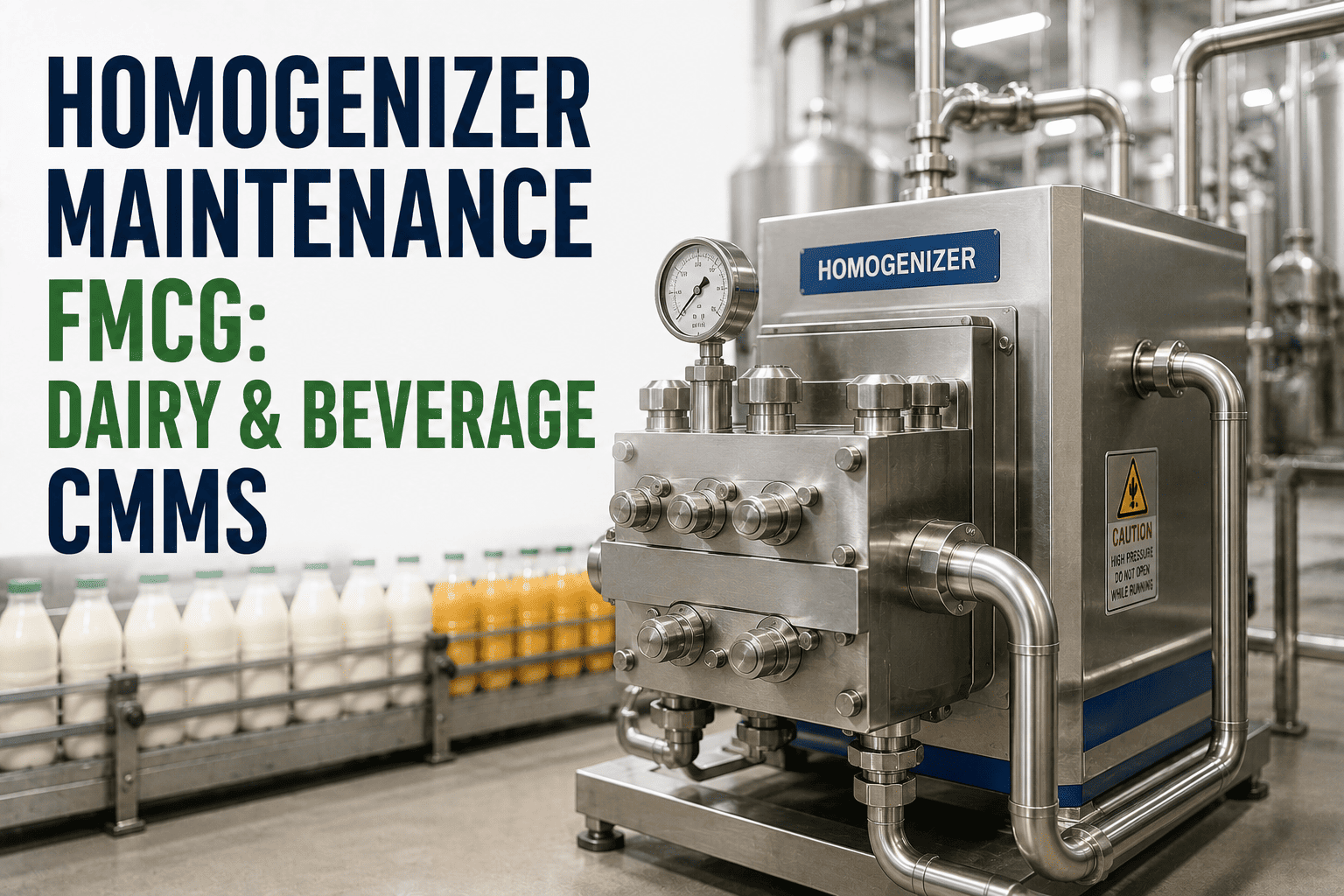
Homogeniser
High-Pressure System
Primary failure: High-pressure seal and valve seat wear — causes pressure drop, fat globule size increase, and product quality failure before any visible symptom
Homogeniser valve and seat inspection every 500 operating hours — measure with gauge, do not estimate visually
High-pressure seal replacement per OEM cycle count — never extend beyond manufacturer specification
Pressure gauge calibration monthly — homogeniser operating pressure is the primary quality control parameter
Crankshaft bearing oil analysis quarterly — high-pressure operation accelerates wear vs standard equipment
Centrifugal Separator
High-Speed Critical
Primary failure: Bowl unbalance from solids accumulation — causes vibration that escalates to bearing failure and catastrophic bowl disintegration at speed
Bowl desludging on automated cycle — verify desludge actuation and discharge volume every shift
Bearing vibration monitoring continuous — alert threshold set at 3mm/s, stop threshold at 7mm/s
Bowl and disc stack full inspection annually — any erosion, crack, or deformation requires bowl replacement, not repair
Outlet cream and skim Brix/fat content check every 2 hours — indicates separator efficiency and bowl condition
Refrigeration and Cold Chain
Continuous Monitoring
Primary failure: Compressor failure or refrigerant leak causing product temperature excursion — dairy product above 4°C for more than 2 hours triggers mandatory hold and test or disposal
Refrigeration compressor oil analysis quarterly — dairy environments cause refrigerant contamination that standard oil sampling detects early
Condenser coil cleaning monthly — fouled condensers increase compressor head pressure and accelerate failure
Cold room temperature sensor calibration monthly — verified against NIST-traceable reference thermometer
Refrigerant leak detection system calibration quarterly — dairy plant refrigerant leaks are both environmental and food safety incidents
Evaporator (Milk Powder / Concentrate)
Fouling Rate Driven
Primary failure: Fouling deposit buildup on evaporator surfaces — reduces heat transfer efficiency, increases energy consumption, and eventually causes off-flavour from scorched deposits
Monitor inlet-to-outlet temperature differential daily — increasing ΔT at same throughput indicates fouling buildup
CIP effectiveness verification post every CIP cycle — ATP swab of heating surface access ports
Spray nozzle condition check weekly — blocked or worn nozzles cause localised overheating and fouling acceleration
Annual tube bundle inspection and mechanical clean — removes mineralised deposits that CIP chemistry cannot dissolve
Carbonation System Maintenance: CO₂ Ratio, Pressure, and Gas Quality
Carbonation is the defining quality attribute of sparkling beverages — and carbonation system maintenance directly controls it. A carbonation ratio that drifts 0.2 volumes beyond specification produces a consumer-detectable product difference. The CO₂ handling system also presents the most significant safety hazard in the beverage plant — CO₂ is an asphyxiating gas that accumulates in low-lying areas and requires specific monitoring and emergency procedures.
?
Carbonation Ratio Control and Calibration
The in-line carbonation meter (Orbisphere or equivalent) is the most critical instrument on a CSD line — its reading directly controls the CO₂ injection rate and determines product quality. Calibrate against a certified reference standard (Zahm-Nagel tube or equivalent) daily at line start and after any production interruption. Drift detection: if in-line meter and reference method disagree by more than 0.1 volumes CO₂, take the line out of specification until recalibration is complete and verified.
Calibration: Daily at startup · Reference check: Each production run · Drift alert: ±0.1 vol CO₂
?
CO₂ Dosing System — Injectors, Mixing Vessels, and Pressure Control
The CO₂ injection system includes dosing valves, a carbonation vessel or inline mixer, and pressure control instrumentation. Each component has specific wear characteristics: CO₂ dosing valves develop seat wear that causes ratio fluctuation; carbonation vessel pressure relief valves can stick closed (overpressure risk) or stick open (carbonation loss); pressure transmitters drift and require periodic calibration. Replace dosing valve seats proactively based on throughput volume, not at the point of visible ratio drift — by the time ratio drift appears, significant seat wear has already occurred.
Valve seats: Per throughput volume · Pressure relief: Annual test · Pressure transmitters: Monthly calibration
⚠️
CO₂ Safety Monitoring — The Life Safety Priority
CO₂ storage areas, carbonation rooms, and areas below CO₂ pipework require continuous gas monitoring with audible and visual alarms. CO₂ concentration above 1% (10,000 ppm) causes headache and cognitive impairment; above 3% causes loss of consciousness; above 10% causes rapid incapacitation. Fixed CO₂ detectors require quarterly calibration against certified reference gas — a CO₂ detector with a flat battery or clogged sensor is a life safety failure. Record calibration results in Oxmaint with the certified gas concentration used and technician sign-off.
Fixed detectors: Quarterly calibration · Emergency procedures: Quarterly drill · Response level: 0.5% CO₂ alarm
Beverage PM Scheduling — Oxmaint
Pasteuriser Safety Records. Filler Cycle Counts. CO₂ Sensor Calibrations. All in One Place.
Oxmaint manages the full beverage maintenance programme — safety-critical pasteurisation records, runtime-triggered filler PM, CO₂ system calibration certificates, and cold chain temperature logs — with instant retrieval for regulatory inspectors.
Beverage CIP: The Maintenance Programme Within the Maintenance Programme
CIP in beverage manufacturing is not just a cleaning operation — it is a production-critical maintenance system that determines microbiological control, equipment longevity, and regulatory compliance simultaneously. Poor CIP maintenance causes more beverage production losses than any other single factor: blocked spray balls miss surfaces, degraded gaskets allow CIP chemical to bypass seals, and incorrect chemical concentrations leave biofilm that becomes the source of the next product contamination event.
01
Spray Ball Inspection
Weekly
Remove and inspect all spray balls for blocked nozzles, cracked bodies, and worn bearings on rotating types. A blocked spray ball creates a shadow zone that never gets cleaned — the microbiological consequence accumulates over weeks before it becomes detectable as a quality problem. Replace on first sign of blockage or damage. Store spare spray balls tagged to each vessel.
02
CIP Chemical Dosing Verification
Per CIP cycle
Conductivity-based concentration control requires conductivity probe calibration monthly. Manual titration verification of caustic and acid concentrations at least twice weekly — conductivity calibration drift causes systematic dosing errors that can persist for days before detection. Log every CIP cycle concentration result in Oxmaint as a food safety record.
03
CIP Pump and Flow Rate
Monthly
CIP flow rate determines whether turbulent flow conditions (Re >10,000) are achieved in all pipework — laminar flow CIP leaves biofilm on pipe surfaces. Verify flow rate against validated minimum with a clamp-on ultrasonic meter. CIP pump wear causes gradual flow reduction that is invisible without periodic measurement — a pump that delivers 85% of required flow looks normal but is producing inadequate cleaning.
04
Temperature Verification
Per CIP cycle
CIP chemical effectiveness is temperature-dependent — caustic below 70°C loses 40–60% of its protein soil removal effectiveness. Verify supply temperature at the return point, not just at the CIP skid — the return temperature confirms whether product contact surfaces are reaching validated temperature. Log supply and return temperatures per cycle in Oxmaint.
05
Valve and Manifold Integrity
6 months
CIP circuit valves — butterfly valves, mixproof valves, and diaphragm valves — require seat and seal inspection to verify CIP containment. A mixproof valve with a worn double seal allows product from one circuit to contaminate the CIP return from another — a cross-contamination pathway that is invisible during normal operation. Full valve strip inspection on the 6-monthly PM cycle.
06
ATP and Microbiological Verification
Weekly
CIP validation requires biological evidence, not just process parameter compliance. Weekly ATP swabbing of post-CIP surfaces at defined sampling points verifies that the cleaning programme is achieving its microbiological objective. Trending ATP results over time identifies equipment areas where CIP effectiveness is declining before a positive microbiology result triggers a product hold.
Frequently Asked Questions
Preventive Maintenance Scheduling — Oxmaint
Brewery, Dairy, Juice, or Soft Drinks — One PM Platform for All Beverage Equipment.
100%
pasteuriser record compliance
Runtime
triggered filler PM intervals
Auto
between-batch vessel WOs
30 min
inspector record retrieval
✓Pasteuriser safety records — calibration certs, FDV test logs, hold time records auto-archived
✓Filler PM on runtime hours and bottle count — not just calendar intervals
✓CIP cycle logging — chemical concentration, temperature, flow, ATP results per cycle
✓Between-batch vessel maintenance — triggered by production schedule, not calendar
✓CO₂ safety system calibration records — with certified gas concentration and technician sign-off
✓Cold chain temperature excursion alerts — linked to refrigeration maintenance work orders