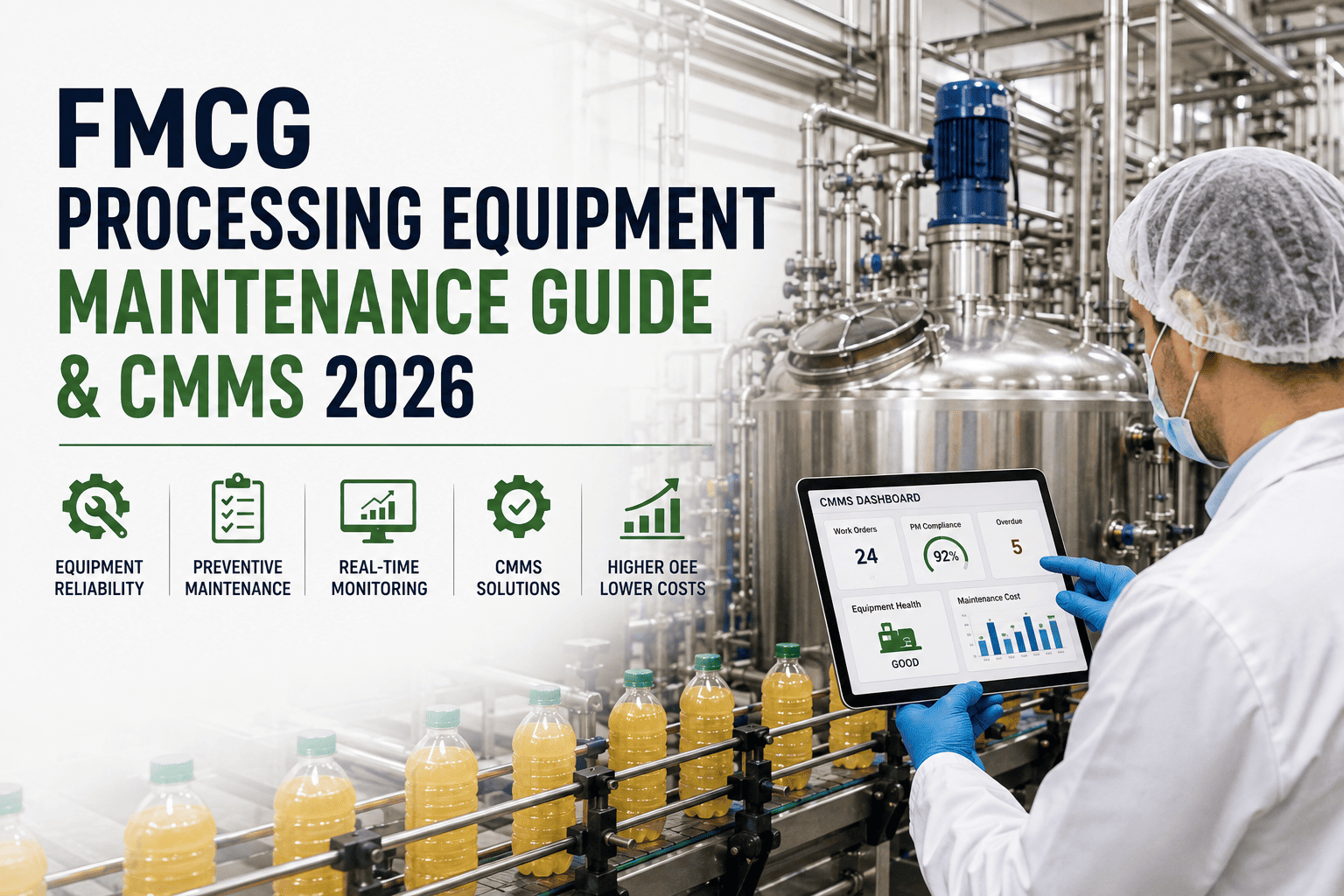
Beverage production maintenance operates at the intersection of food safety compliance, high-speed automation reliability, and cold chain integrity — three demands that most generic maintenance programmes are not designed to handle simultaneously. Breweries, robotic bottling lines, and dairy processing facilities share common maintenance challenges: CIP-dependent sanitation cycles that must be verified as maintenance activities, automated equipment running at speeds where a two-hour unplanned downtime event costs more than a month of preventive maintenance labour, and regulatory requirements that treat equipment condition as a direct food safety control. This guide covers the complete maintenance management framework for FMCG beverage operations — from brewery fermentation and filtration through robotic bottling, dairy processing, pasteurizer care, and cold chain management — with Oxmaint CMMS configuration guidance for each production environment. Book a beverage maintenance consultation to map this framework against your current operation.
Oxmaint's industry-specific PM templates for brewery, bottling, dairy, and cold chain equipment are pre-configured with the task frequencies, mandatory documentation fields, and food safety compliance checks that beverage facilities require — ready to deploy in days, not months.
$180K
Average Cost Per Hour of Unplanned Downtime on a High-Speed Beverage Bottling Line at Full Capacity
68%
Of Beverage Line Breakdowns Are Preventable With Structured PM Schedules and Condition Monitoring
94%
OEE Achievable on Robotic Bottling Lines With Proactive Maintenance and Real-Time Fault Monitoring
3.2x
Higher Equipment Lifespan in Dairy Facilities Using CMMS-Managed PM vs Reactive-Only Maintenance
The Beverage Maintenance Challenge: Why Standard CMMS Configurations Fail
Beverage production maintenance is fundamentally different from general manufacturing in three ways that most CMMS implementations fail to address. First, sanitation and maintenance are inseparable — CIP cycles are maintenance activities that must be documented, verified, and linked to specific equipment assets with pass/fail criteria recorded. Second, beverage equipment runs at speeds and temperatures that create wear patterns not found in general manufacturing — filler valve seats, conveyor chains, and pasteuriser tube bundles degrade on cycles and litres processed, not calendar time alone. Third, the regulatory environment treats equipment condition as a food safety control — a malfunctioning pasteuriser or contaminated CIP system is not just a quality problem, it is a recall event.
Reactive Maintenance Programme
Unplanned Downtime Rate
12–18% of production time lost to unplanned stoppages
CIP Documentation
Paper-based or absent — audit findings common
Filler Valve PM Compliance
55–65% — valves serviced after complaints or failures
Cold Chain Alert Response
Manual monitoring — temperature excursions often missed
Annual Maintenance Cost
2.8–4.2% of asset replacement value
CMMS-Managed PM Programme
Unplanned Downtime Rate
Under 3% of production time lost — OEE above 92%
CIP Documentation
Electronic records — full traceability, automatic audit trail
Filler Valve PM Compliance
97%+ — triggered by fill volume and calendar interval
Cold Chain Alert Response
Automated CMMS work order on threshold breach — under 15 min response
Annual Maintenance Cost
1.4–1.9% of asset replacement value
CMMS-managed beverage maintenance reduces unplanned downtime by 75–85% vs reactive-only programmes
Brewery Equipment Maintenance: Fermentation, Filtration, and Packaging
Brewery maintenance spans three distinct asset categories with very different maintenance requirements — fermentation and conditioning vessels, filtration and clarification equipment, and packaging lines. Each category operates under food safety and quality requirements that mandate documented maintenance and sanitation records. The most common brewery maintenance failure is treating vessel CIP as a production activity rather than a documented maintenance task — which means CIP completion, chemical concentrations, temperatures, and contact times are not captured in CMMS as verifiable maintenance records.
01
Fermentation Vessel Maintenance
Monthly: CIP verification — chemical concentration, temperature, contact time recorded. Quarterly: pressure relief valve test and recertification, vessel integrity inspection (welds, seals, manway gaskets), cooling jacket pressure test. Annual: full vessel internal inspection, all valve seat replacement on high-cycle vessels, temperature sensor calibration.
02
Bright Beer Tank and Conditioning
Weekly: CO2 pressure system check, sample valve integrity. Monthly: CIP full cycle with documentation, carbonation system valve inspection. Quarterly: all gaskets and seals on product-contact fittings, pressure gauge calibration, CO2 purity verification. Annual: full tank internal inspection, PRV recertification, jacketed cooling system service.
03
Filtration and Centrifuge Systems
Per-batch: filter integrity check, differential pressure log. Weekly: filter media inspection and replacement schedule review, centrifuge balance check. Monthly: bearing temperature and vibration monitoring, seal replacement on high-cycle centrifuges. Quarterly: full drive train inspection, flow meter calibration, turbidity sensor calibration.
04
Brewhouse Equipment (Kettles, Mash Tuns)
Weekly: steam jacket pressure check, agitator seal inspection. Monthly: CIP verification with temperature log, steam trap inspection and replacement schedule. Quarterly: heat exchanger plate inspection and gasket condition, flow control valve service. Annual: full heat exchanger disassembly and cleaning, pump impeller inspection, all steam valve recertification.
05
CO2 Recovery and Dosing Systems
Daily: CO2 storage pressure log, leak detection system verification. Weekly: purity analyser calibration check, scrubber system inspection. Monthly: compressor oil analysis, filter element inspection and replacement. Quarterly: full compressor service, all safety valve testing, CO2 purity certificate verification from supply.
06
Water Treatment and Liquor Systems
Daily: inlet water quality log, softener regeneration cycle verification. Weekly: RO membrane pressure differential check, dosing pump calibration. Monthly: filter element replacement schedule, water quality testing (hardness, chlorine, pH) with results recorded in CMMS. Quarterly: full RO membrane integrity test, dosing system calibration verification.
Oxmaint's brewery equipment PM templates cover all six asset categories with pre-built task lists, frequency triggers, mandatory documentation fields, and CIP verification workflows — configured for food safety compliance and audit readiness from day one.
Robotic Bottling Line Maintenance: Fillers, Cappers, Labellers, and End-of-Line
Robotic bottling lines represent the highest concentration of maintenance risk per square metre in beverage production — high-speed automated equipment running at 20,000–120,000 bottles per hour, where a single worn filler valve or misaligned robot joint causes product loss, line stoppage, and potential contamination events. The critical maintenance difference between high-performing beverage facilities and low-performing ones is not equipment quality — it is maintenance trigger discipline. High performers service filler valves on fill volume triggers, not calendar time, and they measure conveyor chain wear before it becomes chain skip, not after.
01
Filler Valve Maintenance
Highest-Impact Asset
Filler valve seats, seals, and springs serviced on fill volume trigger (typically 2M–5M fills per valve depending on product). Full valve strip, clean, inspect, and seal replacement. Valve performance data — fill weight accuracy, product loss rate — tracked per valve in CMMS asset record. Valves with degraded fill accuracy flagged for early replacement before product quality impact.
02
Capper and Seamer Maintenance
Seal Integrity Critical
Capping head chuck and bell replacement on production cycle trigger — typically 500K–2M caps per head. Roll-on and roll-under seamer roll inspection every 200K units. Torque verification at start of every shift and after product changeover. Vacuum seamer vacuum level and seal integrity tested per batch. All results recorded in CMMS with batch traceability.
03
Robotic Palletiser and Depalletiser
Highest Robot Hours Asset
Robot joint inspection and lubrication every 500 operating hours. Gripper and suction cup replacement on wear inspection (typically every 250K cycles for heavy products). End-of-arm tooling inspection daily for physical damage. Servo drive temperature monitoring with automatic CMMS alert on thermal excursion. Annual full axis calibration and battery replacement on all robot controllers.
04
Conveyor and Transfer System
Chain Wear is the Leading Failure
Chain elongation measurement every 4 weeks — chains replaced at 2% elongation before skip risk. Conveyor drive motor current monitoring — rising current indicates chain wear or drive issue before failure. Lubrication on defined schedule by chain type (dry lube, wet lube, plastic modular). All conveyor guides and rails inspected for wear weekly — worn guides cause container damage and line stoppages.
05
Labeller and Sleeve Applicator
Changeover Risk Zone
Glue system — temperature, viscosity, and nozzle condition checked at every changeover. Glue nozzle replacement on output quality check failure. Label drum and applicator head cleaned and inspected at each shift start. Print and apply head inspection and calibration weekly. Sleeve applicator steam and hot air system pressure and temperature verified each shift.
06
Rinser and Pre-Treatment System
Food Contact Zone
Container rinser nozzle inspection and replacement monthly — blocked or worn nozzles create incomplete rinsing and product contamination risk. Rinser water quality verified daily — microbiological testing monthly with results in CMMS. Treatment chemical concentration checked at shift start. Full rinser CIP cycle documented and verified after any product changeover involving allergen risks.
Oxmaint's robotic bottling line PM templates use production volume triggers — fills, cycles, and operating hours — rather than calendar-only intervals, ensuring maintenance is performed at the right point in equipment life rather than arbitrarily by date.
Dairy Processing Maintenance: CIP Systems, Separators, and Homogenisers
Dairy processing maintenance carries the highest food safety risk profile of any beverage category — pathogen control, allergen management, and regulatory compliance (FDA PMO, EU Regulation 853/2004, BRC) all require that maintenance on product-contact equipment is documented, that post-maintenance CIP verification is recorded as a controlled process, and that calibration of pasteurisation and temperature monitoring equipment is traceable to national standards. The consequences of maintenance failures in dairy — a Listeria outbreak linked to inadequate gasket replacement, a pasteurisation failure caused by a miscalibrated temperature sensor — are existential events for a facility.
Pasteuriser (HTST/UHT)
Daily: temperature and flow rate verification, divert valve test. Weekly: full gasket inspection on all product-contact plates. Monthly: complete disassembly inspection of plate pack, flow diversion valve overhaul. Quarterly: calibration of all temperature sensors (traceable). Annual: full regulatory inspection and recertification.
FDA PMO / EU 853/2004
Centrifugal Separator
Per-run: bearing temperature and vibration check. Weekly: bowl inspection, seal condition. Monthly: full bowl disassembly, disc stack inspection, seal and gasket replacement schedule. Quarterly: drive belt/coupling inspection, motor current analysis. Annual: full bearing replacement and bowl rebalancing.
BRC 4.7 / EHEDG
Homogeniser
Daily: operating pressure verification, seal integrity check. Weekly: valve and seat inspection, plunger seal condition. Monthly: full valve assembly replacement on high-volume units, plunger packing inspection. Quarterly: drive system inspection, pressure gauge calibration. Annual: full pump overhaul including all seals and valves.
3-A Sanitary Standards
CIP System (Tanks, Pumps, Valves)
Per-cycle: chemical concentration verification, temperature and time records. Weekly: CIP pump mechanical seal inspection, spray ball coverage verification (ATP swab). Monthly: CIP valve seat inspection, heat exchanger condition. Quarterly: full CIP circuit audit — all spray devices tested, piping integrity checked. Annual: CIP validation study.
EHEDG / BRC 4.11
Evaporator and Dryer (Powder)
Per-run: inlet and outlet temperature log, atomiser speed check. Weekly: atomiser bearing vibration, spray nozzle inspection. Monthly: heat exchanger fouling assessment, cyclone inspection, fan and motor current check. Quarterly: full atomiser disassembly and bearing replacement. Annual: complete vessel internal inspection and cleaning verification.
FSSC 22000 / SQF 11
Aseptic Filling System
Per-campaign: sterilisation cycle validation, H2O2 concentration verification. Daily: filling head integrity, UV lamp intensity check. Weekly: aseptic zone pressure differential, HEPA filter integrity. Monthly: all seals and gaskets in sterile zone. Quarterly: full aseptic system validation including biological indicators. Annual: complete system revalidation.
FDA 21 CFR / ISO 13408
Membrane Filtration (UF/MF/RO)
Per-run: transmembrane pressure log, permeate quality check. Weekly: membrane integrity test (bubble point or pressure hold). Monthly: CIP cycle effectiveness verification via permeate quality comparison. Quarterly: membrane replacement schedule review, housing gasket inspection. Annual: full membrane replacement on schedule or as indicated by performance data.
EHEDG / 3-A Standards
Cold Storage and Refrigeration
Daily: temperature log at minimum 2 points per store, door seal inspection. Weekly: evaporator coil condition, drain line clear. Monthly: refrigerant pressure check, condenser coil clean. Quarterly: defrost cycle verification, door seal replacement schedule. Annual: full refrigeration system service, F-Gas compliance check and leak test certification.
EU 517/2014 / BRC 4.4
All dairy processing PM records should be linked to the batch production records they support — a food safety auditor reviewing a specific production batch needs to be able to retrieve the maintenance and calibration status of all food-contact equipment used in that batch within minutes, not hours.
Pasteuriser Maintenance: The Food Safety Critical Asset
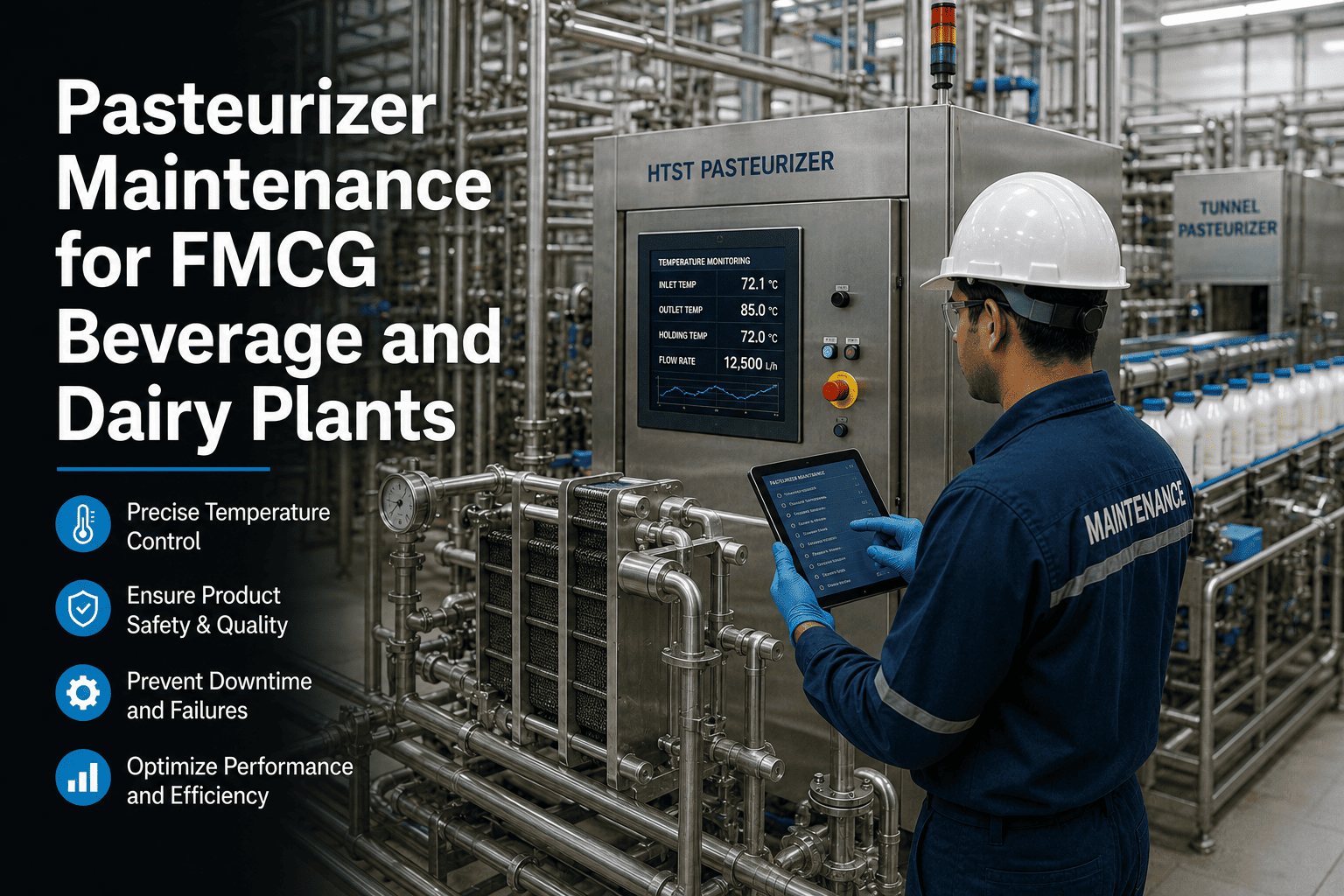
The pasteuriser is the single most food safety critical asset in any dairy, juice, or beer production facility. A pasteuriser maintenance failure — whether a miscalibrated temperature sensor, a failed flow divert valve, or a compromised plate gasket — is a direct food safety critical control point failure. Pasteuriser maintenance cannot be deferred, adjusted in scope, or treated as a routine maintenance task without a documented food safety risk assessment. This is the one asset category in beverage maintenance where a maintenance failure directly causes a public health event.
D
Daily Pasteuriser Checks
Temperature recording thermometer vs indicating thermometer comparison — both must agree within ±0.5°C. Flow rate verification against design specification. Divert valve operation test — valve must divert to reject on temperature drop below critical limit. Log all readings with operator ID and time in CMMS. Any deviation triggers immediate production hold and maintenance notification.
W
Weekly Pasteuriser Maintenance
Full gasket inspection on all accessible plate pack sections — visible damage or deformation requires immediate shutdown and gasket replacement. Product-to-product and product-to-water differential pressure check across heat exchanger sections. CIP effectiveness verification — ATP swab at defined sample points inside plate pack. Divert valve seal and actuator inspection.
M
Monthly Pasteuriser Tasks
Full plate pack disassembly and internal inspection — every plate inspected for pitting, cracking, and gasket groove condition. All gaskets replaced on food-contact plate sections on defined cycle (typically monthly for high-volume dairy). Flow divert valve full overhaul — seats, seals, and actuator spring. Temperature sensor accuracy verification against certified reference thermometer.
Q
Quarterly Pasteuriser Tasks
Full calibration of all temperature sensors and recording equipment — traceable to national standards (UKAS, NIST). Calibration certificates retained in CMMS asset record. Heat exchanger efficiency test — rising pressure drop or falling heat transfer rate indicates fouling requiring chemical or mechanical intervention. All safety interlocks tested and documented.
A
Annual Pasteuriser Overhaul
Full regulatory inspection per applicable standard (FDA PMO Section 16 or equivalent). All plates inspected by qualified engineer — dye penetrant test on suspect plates. Complete replacement of all gaskets and seals. Divert valve replacement or full rebuild. All temperature sensors replaced or recertified. Process validation run with biological and chemical indicators documented.
!
Post-Breakdown Protocol
Any pasteuriser breakdown or abnormal event (temperature alarm, divert valve operation, power loss) triggers a mandatory post-event maintenance inspection before restart. Inspection documents: cause of event, repairs performed, food safety risk assessment for product in system at time of event, product hold status, and QA release sign-off. No restart without documented QA clearance.
Oxmaint treats pasteuriser maintenance as a critical control point — mandatory daily verification records, automatic QA escalation on any deviation, calibration certificate storage with expiry alerts, and post-breakdown inspection workflows that prevent restart without documented clearance.
Cold Chain Maintenance: Refrigeration, Cold Stores, and Temperature Monitoring
Cold chain maintenance failures in FMCG beverage facilities are rarely catastrophic in the way a filler failure is — they are slow, accumulating failures that only become visible as product quality complaints, shortened shelf life, or a cold store temperature excursion during audit. The maintenance challenge is that refrigeration systems run continuously, often with minimal intervention until they fail, and temperature monitoring systems are frequently not integrated with maintenance workflows — meaning an excursion is logged but does not automatically generate a CMMS corrective action work order.
01
Evaporator Coil Fouling
Most Common Cold Store Failure
Ice and product deposit accumulation on evaporator coils reduces cooling capacity progressively without obvious signs. Prevention: monthly evaporator coil inspection, defrost cycle effectiveness verification, coil cleaning on defined schedule. CMMS trigger: rising compressor run time for same setpoint temperature — early indicator of coil fouling before capacity loss becomes visible.
02
Door Seal Degradation
Highest Energy Waste Cause
Cold store door seals degrade through regular use — cracking, compression set, and physical damage cause air infiltration that accounts for 25–40% of cooling load in high-traffic stores. Weekly visual inspection with smoke pencil test quarterly. Seal replacement on condition assessment — average 12–18 month replacement cycle in active stores. CMMS asset record tracks seal replacement history per door.
03
Refrigerant Leak — Gradual Loss
Regulatory and Performance Risk
Small refrigerant leaks reduce system capacity gradually, often undetected until significant charge loss has occurred. EU F-Gas Regulation 517/2014 mandates leak check frequency based on system charge — facilities with HFC systems over 5 kg CO2e must check at minimum annually. CMMS tracks leak check compliance, charge weight logs, and F-Gas certificates. Rising suction superheat is the earliest field indicator of charge loss.
04
Condenser Fouling
Efficiency and Compressor Life
Air-cooled condenser coil fouling raises condensing pressure, increases compressor power consumption, and shortens compressor life. Monthly condenser coil inspection and cleaning in dusty or outdoor environments — quarterly minimum for clean indoor systems. CMMS trigger: rising condensing pressure trend logged from system controller. Dirty condensers are the most common cause of premature compressor failure in beverage cold stores.
05
Temperature Sensor Drift
Regulatory Monitoring Risk
Cold store temperature sensors drift over time — a sensor reading 2°C when actual temperature is 5°C is a regulatory non-conformance and a product safety issue. Annual calibration of all temperature monitoring sensors against certified reference. CMMS calibration record with traceable certificate stored per sensor. Any sensor showing deviation during routine verification triggers immediate replacement and investigation of products stored since last verified calibration.
06
Compressor and Drive System Wear
Highest Replacement Cost Asset
Compressor wear is the highest-cost maintenance event in cold chain — a failed screw or reciprocating compressor on a large cold store costs £30K–£150K to replace. Prevention through oil analysis every 6 months (catches bearing and valve wear before failure), vibration trending quarterly, and operating hours-based overhaul scheduling in CMMS. Compressor oil changes on schedule — not deferred — are the single highest-return maintenance investment in cold chain.
FMCG Beverage Maintenance PM Scheduling: Volume, Time, and Condition Triggers
Effective beverage maintenance scheduling uses three trigger types simultaneously — and the right trigger for each asset determines whether PM intervals are genuinely protective or are simply administrative compliance. Calendar-only PM intervals are adequate for equipment where wear is time-dependent (gasket degradation, bearing lubrication intervals). Volume or cycle triggers are essential for equipment where wear is production-dependent (filler valves, capper heads, conveyor chains). Condition-based triggers are appropriate for assets where degradation can be monitored in real time (vibration, temperature, pressure differential). Most beverage facilities use only calendar triggers — which means they are either over-maintaining low-use equipment or under-maintaining high-use equipment.
Calendar-Only PM Triggers (Common but Suboptimal)
Filler Valve Seals
Replaced every 3 months regardless of fill volume — over-maintenance at low volumes, under-maintenance during peak season
Conveyor Chain
Replaced annually — chain at 110K hours replaced at same time as one at 8K hours
Robot Joint Service
Scheduled every 6 months — misses wear during high-throughput periods
CIP Chemical Strength
Checked at fixed time intervals — misses concentration drift between checks
Multi-Trigger PM Scheduling (Best Practice)
Filler Valve Seals
Triggered at 3M fills OR 12 weeks, whichever comes first — always matches actual wear
Conveyor Chain
Triggered at 2% elongation measurement OR 52 weeks — prevents skip failures
Robot Joint Service
Triggered at 500 operating hours OR 26 weeks — aligned with actual usage
CIP Chemical Strength
Per-cycle verification with automated alert on out-of-specification result
Volume-triggered PM reduces over-maintenance costs by 22–35% while eliminating under-maintenance failures
Oxmaint's PM scheduling engine supports calendar, production volume, operating hours, and condition-based triggers simultaneously — automatically generating the right work order at the right time based on actual equipment usage, not just elapsed calendar time.
Beverage Maintenance KPIs: What to Measure and What Good Looks Like
Beverage maintenance performance measurement requires KPIs that reflect the production-speed, food safety, and asset-intensity characteristics of the sector. Generic maintenance KPIs — percentage of work orders completed on time, number of work orders generated — do not capture the metrics that matter: line availability, filling efficiency, CIP compliance rate, and unplanned downtime by cause. The benchmark data below reflects performance levels achieved by best-in-class FMCG beverage facilities using structured CMMS-based maintenance programmes.
Overall Equipment Effectiveness (OEE)
Industry average 72–78% on high-speed bottling lines. Best practice with structured PM: 91–94% sustained OEE.
Target: 92%+
Unplanned Downtime Rate
Industry average 8–14% of scheduled production time. Best practice: under 3% — achieved through condition-based and volume-triggered PM.
Target: Under 3%
PM Compliance Rate (Food-Contact Assets)
Minimum acceptable for food safety audit: 90%. Best practice: 97–99% with automated escalation on overdue PMs.
Target: 97%+
Mean Time Between Failures (MTBF)
Filler lines industry average MTBF: 18–28 hours. Best practice with structured lubrication and valve PM: 65–90+ hours between unplanned stops.
Target: 65hr+ MTBF
Mean Time to Repair (MTTR)
Industry average on bottling line faults: 45–90 minutes. Best practice with CMMS fault history and spare parts availability: under 25 minutes.
Target: Under 25min
CIP Documentation Completeness
Industry average (paper-based): 65–75% complete records. Best practice with electronic CMMS-linked CIP records: 99%+ completeness with automatic non-conformance alerts.
Target: 99%+
Maintenance Cost as % of Asset Value
Industry average: 2.8–4.2% of asset replacement value per year. Best practice with PM optimisation: 1.4–1.9% of asset replacement value.
Target: Under 2%
Reactive vs Planned Maintenance Ratio
Industry average (reactive-heavy): 55–65% reactive work orders. Best practice: under 15% reactive, 85%+ planned and predictive work.
Target: Under 15% Reactive
KPI targets should be set against your current baseline and improved progressively — a facility moving from 72% to 80% OEE in 12 months delivers more value than one that sets an unrealistic 94% target and manages to 76% while claiming partial success.
Oxmaint's beverage maintenance dashboard tracks all eight KPIs in real time — OEE, MTBF, MTTR, PM compliance, reactive ratio, and CIP documentation completeness — with automatic alerts when metrics drift below target and root cause drill-down to specific assets and failure modes.
Frequently Asked Questions
What is the most important maintenance difference between brewery, bottling, and dairy operations?
The critical difference is the primary failure mode and its consequence. In brewery operations, the highest-risk maintenance failure is CIP documentation — an undocumented or ineffective CIP cycle creates a microbiological contamination risk that may not be detected until product is already in trade. In robotic bottling, the highest-risk maintenance failure is filler valve degradation — a worn valve seat creates fill volume drift and potential contamination ingress at high speeds. In dairy processing, the highest-risk maintenance failure is pasteuriser temperature sensor calibration — a miscalibrated sensor creates a CCP failure that is a public health event. Each environment requires a different maintenance priority hierarchy, which is why industry-specific CMMS templates rather than generic work order lists are essential for beverage operations.
How should filler valve maintenance be triggered — by time or by fill volume?
Best practice is to use both triggers simultaneously — whichever threshold is reached first should generate the maintenance work order. Fill volume is the primary trigger because filler valve seal wear is directly proportional to cycles completed, not elapsed time. A facility running two 8-hour filling shifts per day will wear valve seats roughly twice as fast as one running a single shift, regardless of calendar weeks elapsed. The secondary calendar trigger catches valves on assets that have been on standby or running at reduced throughput, where time-dependent degradation (seal compression set, material ageing) may be significant even at low fill volumes. Typical triggers are 2M–5M fills as the primary trigger (depending on product type, temperature, and carbonation) with 12–16 weeks as the calendar backstop.
What CIP documentation should be captured in CMMS for dairy and brewery compliance?
For food safety audit compliance, each CIP cycle record should capture: asset or circuit identifier, CIP start and end time, pre-rinse duration and final rinse turbidity, caustic phase — chemical name, concentration (verified by titration or conductivity), temperature, and contact time, acid phase — same parameters, final rinse completion confirmation and residual conductivity, ATP swab results at defined sample points if required by the cleaning validation protocol, operator ID, and any deviations from the standard CIP programme with corrective action taken. This level of documentation satisfies BRC Clause 4.11, SQF Module 11.6, FSSC 22000 prerequisite programme requirements, and FDA GMP documentation expectations for allergen and pathogen cleaning programmes.
How often should pasteuriser temperature sensors be calibrated and what records are required?
Under FDA PMO requirements, the temperature recording thermometer must be calibrated against the indicating thermometer at least daily during operation, and the indicating thermometer must be calibrated at least quarterly against a certified reference thermometer. Under BRC and SQF requirements, calibration frequency must be justified based on risk — quarterly is the minimum widely accepted for CCP instruments. Records required include: calibration date, instrument ID, reference standard used and its calibration certificate (with traceability statement), the as-found and as-left readings, any adjustment made, calibrator identity, and next due date. These records must be retained for the life of the instrument plus at least 2 years and must be retrievable by instrument ID and date range for audit. Oxmaint stores calibration certificates directly on the asset record with automated due date alerts at 30, 14, and 7 days before expiry.
What robotic palletiser maintenance tasks have the highest impact on line availability?
Based on fault frequency data from high-speed FMCG beverage operations, the four robotic palletiser maintenance tasks with the highest availability impact are: gripper and end-of-arm tooling inspection (missed wear causes product drops, line stoppages, and container damage — weekly inspection with replacement at 250K cycles prevents the majority of end-of-arm failures); robot joint lubrication on operating hours trigger (under-lubrication is the primary cause of joint wear and servo drive overload — 500-hour lubrication interval with CMMS tracking prevents most wear-related downtime); pallet conveyor chain elongation measurement (chain skip on the infeed or outfeed conveyor causes line stoppages that take 45–90 minutes to clear — monthly elongation measurement and replacement at 2% prevents all chain skip events); and servo drive temperature monitoring (thermal events on servo drives are the highest-frequency electrical fault on robotic palletisers — automated CMMS alerts on drive temperature excursion enable intervention before drive failure).
How does Oxmaint handle beverage maintenance differently from a generic CMMS?
Oxmaint includes industry-specific PM templates for brewery, robotic bottling, dairy processing, and cold chain equipment — pre-built with the task lists, trigger mechanisms (calendar, volume, operating hours, and condition-based), mandatory documentation fields, and CIP verification workflows that beverage operations require. Generic CMMS systems require months of configuration to reach the same point. Specific features relevant to beverage operations include: production volume counter integration for fill-volume-triggered PM, CIP cycle documentation with mandatory concentration, temperature, and time fields, pasteuriser daily verification workflows with automatic QA escalation on any deviation, F-Gas compliance tracking for refrigeration systems, and multi-trigger PM scheduling that generates work orders on whichever threshold — time or volume — is reached first.
Book a demonstration to see the beverage maintenance templates in action.
Maintenance Management for FMCG Beverage Operations
Brewery, Bottling, Dairy, and Cold Chain — One Platform, Industry-Specific Templates
Oxmaint is the CMMS built for FMCG beverage operations — with pre-configured PM templates for brewery equipment, robotic bottling lines, dairy processing, pasteurisers, and cold chain. Volume and operating hours triggers, CIP documentation workflows, food safety compliance records, and real-time OEE and downtime dashboards — deployed in days, not months.
✓
Industry-Specific PM Templates — Brewery, Bottling, Dairy, Pasteuriser, Cold Chain
✓
Volume and Operating Hours Triggers — Filler Valves, Robot Joints, Conveyor Chains
✓
CIP Documentation Workflows — Chemical Concentration, Temperature, Time, ATP Results
✓
Pasteuriser Daily Verification With Automatic QA Escalation on Any Deviation
✓
Real-Time OEE Dashboard — Line Availability, MTBF, MTTR, PM Compliance, Reactive Ratio
✓
Audit-Ready Food Safety Records — BRC, SQF, FSSC 22000, FDA PMO Compliance