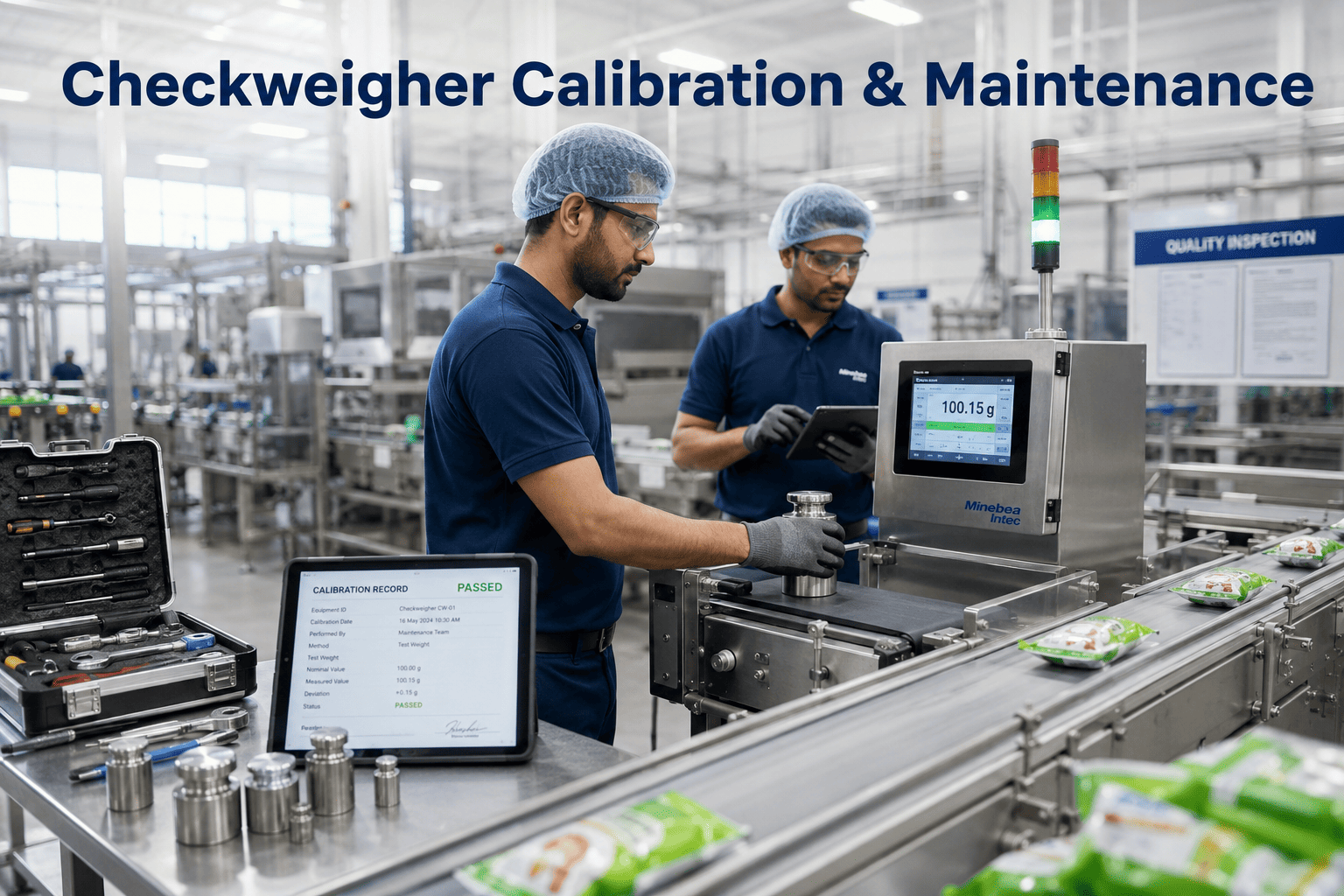
Checkweigher Calibration and Maintenance for FMCG: Daily, Weekly, and Annual Programs
By Jack Edwards on May 16, 2026
A single failed NTEP audit can shut down a production line, trigger product recalls, and expose your facility to regulatory fines that dwarf the cost of a proper calibration program. For FMCG manufacturers, checkweighers are legal-for-trade instruments — and every gram of tolerance drift is a compliance liability. The difference between an audit-ready facility and one facing line shutdowns is a structured daily, weekly, and annual calibration program executed consistently and documented digitally. Start a free OxMaint trial and build your checkweigher calibration program from day one — or book a demo to walk through a checkweigher PM workflow.
FMCG Quality · Legal-for-Trade Compliance
Checkweigher Calibration and Maintenance for FMCG: Daily, Weekly, and Annual Programs
One failed NTEP audit can shut down a line. Learn the daily, weekly, and annual checkweigher calibration program that keeps FMCG production lines legal-for-trade and audit ready year-round.
NTEP tolerance limit for legal-for-trade checkweighers — any drift beyond this triggers non-compliance
$2.3M
Average cost of an FMCG product recall triggered by weight non-compliance (FDA enforcement data)
600+
Packages per minute processed by high-speed in-motion checkweighers on modern FMCG lines
Annual
NTEP re-verification requirement for all legal-for-trade checkweigher installations in certified facilities
What Is Checkweigher Calibration and Why Does It Define Legal-for-Trade Status
A checkweigher is an in-motion weighing instrument installed in a production line to verify that every package meets its declared net weight. In FMCG manufacturing, checkweighers are classified as legal-for-trade instruments under NTEP (National Type Evaluation Program) in the USA, Weights and Measures regulations in the UK, and equivalent frameworks in Canada, Australia, the EU, and the UAE. This means the accuracy of every weighing event carries regulatory and commercial weight.
Calibration is the process of verifying that the checkweigher's measurement output matches certified reference standards — and adjusting the instrument when it does not. Unlike a simple scale, an in-motion checkweigher must maintain accuracy across belt speed changes, vibration from adjacent equipment, temperature fluctuations, and product shape variation. Without a structured calibration and maintenance program, measurement drift is silent, cumulative, and discovered only when an auditor, retailer, or regulator tests your line.
Core Concepts Every FMCG Maintenance Team Must Understand
Effective checkweigher calibration requires understanding the technical framework governing dynamic weighing accuracy. These eight concepts form the foundation of a compliant PM program.
01
NTEP Certification
The National Type Evaluation Program certifies checkweigher models for legal-for-trade use. Certified instruments carry a Certificate of Conformance number that must be on file and valid. Annual re-verification confirms continued compliance at the installation site.
02
Tolerance of Error (TOE)
TOE defines the maximum permissible error for a weighing event. For most FMCG checkweighers, this is 0.1% of full scale or the value of the smallest scale division — whichever is greater. Drift beyond this threshold makes every weigh legally invalid.
03
Static vs. Dynamic Calibration
Static calibration verifies accuracy with the belt stopped using certified test weights. Dynamic calibration verifies accuracy under actual line speed with test packs of known weight. Both are required — static alone does not capture belt vibration or speed-related drift.
04
Product Effect (PE)
Product effect describes signal interference from product conductivity on the weighing cell. High-moisture or metallic-content products require specific phase angle settings to prevent false weight readings. PE must be set correctly during initial commissioning and verified after product changeovers.
05
Weigh Cell Load Cells
The load cell converts mechanical force to an electrical signal. Contamination, overload events, and mechanical wear degrade load cell accuracy over time. Load cell condition monitoring is a critical PM activity that prevents invisible drift between calibration events.
06
Belt Speed and Filter Settings
Checkweigher filter settings are tuned to line speed and product length to determine the measurement window. When line speed changes, filter settings must be reconfigured and verified. Running at speeds outside the calibrated range invalidates the calibration.
07
Reference Weight Traceability
Calibration test weights must be OIML Class F1 or better, with current calibration certificates traceable to national standards. Using uncertified or expired test weights produces a calibration record that has no legal standing during a Weights and Measures inspection.
08
Reject System Verification
The checkweigher's value is only realised if its reject mechanism — air blast, pusher, or diverter — actually removes non-conforming packs. Reject system testing must be part of every verification event to confirm the full system performs as intended, not just the weighing cell.
The Pain Points That Ground FMCG Lines Without Warning
Without a structured calibration program, checkweigher failures follow a predictable pattern — silent drift, reactive discovery, and expensive consequences. These four pain points cost FMCG manufacturers far more than a proper PM program ever would.
Silent Calibration Drift Producing Giveaway
Checkweigher drift of just 2 grams on a 500g pack running 400 packs/minute adds 48kg of free product per hour. On a two-shift operation running 250 days per year, that is over 24,000 kg of margin lost annually — discovered only when a quarterly audit compares fill weights to declared values.
Failed NTEP Audit Triggering Line Shutdown
Weights and Measures inspectors can test any legal-for-trade checkweigher without notice. A single out-of-tolerance finding requires immediate line shutdown, recalibration by a certified technician, and re-inspection before production can resume. Downtime costs in high-volume FMCG typically exceed $15,000 per hour.
Load Cell Contamination Causing Measurement Error
In food and beverage environments, product spillage, condensation, and CIP chemical residue contaminate load cells gradually. Contaminated load cells produce non-linear output that passes static calibration but fails under dynamic load — the exact condition that an in-motion checkweigher operates under all day.
Paper-Based Records Failing Retailer Audits
Major FMCG retailers including Walmart, Tesco, and Woolworths require BRCGS- or SQF-aligned quality records. Paper calibration logs — illegible, incomplete, or missing entries — are a top-three finding in retailer technical audits. One failed audit can trigger de-listing of product ranges worth millions in annual revenue.
Most FMCG facilities lose 15–30% of checkweigher calibration intervals to untracked drift — discovered only at the worst possible moment.
How OxMaint Structures Your Checkweigher Calibration Program
OxMaint connects daily verification tasks, weekly calibration events, and annual NTEP re-verification to a single tracked system — so every calibration interval is hit, every record is timestamped, and every audit request is answered in minutes.
01
Daily Verification Checklists
Configure mandatory pre-shift digital verification routines — zero balance check, test weight span verification, reject system function test, and belt condition inspection. Checklists are timestamped, technician-signed, and stored automatically. No paper forms to lose or backdate.
02
Weekly Calibration Work Orders
Automated weekly PM work orders trigger for full static and dynamic calibration using certified test weights. Work orders capture calibration readings before and after adjustment, technician sign-off, and certificate numbers for the reference weights used — creating a complete calibration history per instrument.
03
Annual NTEP Re-Verification Scheduling
OxMaint generates annual work orders for NTEP re-verification 60 days before due, with the certified third-party contractor pre-assigned. Certificate numbers, inspection dates, and official re-verification reports are stored against the asset record — available instantly during a Weights and Measures inspection.
04
Test Weight Certificate Tracking
Every set of calibration test weights is an asset in OxMaint with its own calibration due date, OIML class, and certificate file attached. When a test weight set is approaching recertification, a maintenance alert fires automatically — ensuring calibration is never performed with an expired reference standard.
05
Multi-Line Calibration Dashboard
View calibration compliance status across every checkweigher on every production line from a single screen. See which instruments are current, which are overdue, and which have upcoming NTEP re-verification — without emailing each shift supervisor for a status update before an audit.
06
Audit-Ready Record Export
When a BRCGS auditor, SQF assessor, or Weights and Measures inspector requests calibration records, filtered exports by instrument, date range, or line are generated in minutes. Records include timestamps, technician IDs, calibration readings, and certificate references — exactly what auditors require.
Reactive vs. Planned: Checkweigher Calibration Comparison
Calibration Requirement
Reactive Approach
OxMaint Planned Program
Daily zero balance check
Done when operators remember — no record kept
Mandatory pre-shift digital checklist — timestamped
Test weight verification
Performed ad hoc — no span check documented
Weekly PM work order — before/after readings captured
NTEP re-verification
Remembered after an audit failure or inspector visit
Scheduled 60 days in advance — contractor pre-assigned
Reference weight certification
Unknown expiry — often expired during use
Asset record with expiry alert — never calibrate with expired weights
Load cell condition monitoring
Inspected only after measurement complaints
Quarterly PM inspection — condition scored and trended
Reject system test
Assumed functional — tested before audits only
Daily reject function test in pre-shift checklist
Audit record retrieval
Hours searching paper binders before each audit
Filtered digital export ready in under 5 minutes
Product changeover recalibration
Speed and filter settings unchanged between products
Changeover checklist triggers recalibration work order
Scroll right to view full table on mobile
ROI from a Structured Checkweigher Calibration Program
Achieved by FMCG sites switching from ad hoc to structured weekly calibration cycles
94%
Audit pass rate with digital calibration records
vs. 61% for facilities relying on paper-based calibration logs at time of inspection
5 min
To generate 12 months of calibration records
vs. hours of manual retrieval from paper files before BRCGS or SQF audit
4.8x
Cost of reactive repair vs. planned PM
Emergency load cell replacement with line shutdown vs. scheduled quarterly inspection and condition monitoring
FMCG facilities with CMMS-tracked calibration programs see 40% fewer audit findings than those managing checkweigher records on paper.
Frequently Asked Questions
How often must FMCG checkweighers be calibrated to maintain NTEP legal-for-trade status?
NTEP legal-for-trade status requires annual re-verification by a licensed Weights and Measures technician. However, maintaining accuracy between annual events requires daily zero balance verification, weekly full static and dynamic calibration using certified OIML Class F1 reference weights, and immediate recalibration after any product changeover, line speed change, or maintenance event that could affect measurement accuracy. A CMMS tracks all three frequencies automatically and flags any missed event before an auditor does.
What records does a BRCGS or SQF auditor require for checkweigher calibration?
BRCGS Issue 9 and SQF Edition 9 both require documented evidence of calibration frequency, the reference standards used (with valid certificates traceable to national standards), calibration results before and after any adjustment, technician identification, and corrective actions taken when out-of-tolerance conditions are found. Records must cover the full audit period — typically 12 months — and be retrievable on demand. Digital CMMS records satisfy all these requirements; paper logs frequently fail on completeness and traceability grounds.
What should maintenance teams do when a checkweigher fails its daily verification?
When a daily verification check reveals an out-of-tolerance condition, the line must be stopped immediately, the checkweigher taken out of service, and all product produced since the last successful verification must be placed on hold pending investigation. A corrective action work order should be raised, a qualified technician should perform full recalibration, and the instrument should be re-verified before returning to production. All of these steps — hold decision, corrective action, recalibration, and release — should be documented in the CMMS work order record to create a complete audit trail.
How does OxMaint handle checkweigher calibration records across multiple production lines?
OxMaint registers each checkweigher as a discrete asset within the production line hierarchy — Portfolio, Site, Line, Instrument. Each asset has its own PM schedule, calibration history, and test weight reference. Multi-line dashboards show calibration compliance status across all instruments simultaneously, so quality managers see every overdue calibration in real time rather than waiting for shift reports. When an auditor requests records for a specific line or instrument, the filtered export is generated in minutes rather than requiring manual assembly from multiple paper binders.
Keep Every Line Legal-for-Trade. Every Day.
Stop Losing Margin to Calibration Drift — Build an Audit-Ready Checkweigher Program with OxMaint
Daily verification checklists. Weekly calibration work orders. Annual NTEP re-verification scheduling. Test weight certificate tracking. Multi-line compliance dashboards. Audit-ready record export in minutes. OxMaint connects every calibration interval to a documented, traceable, timestamped record that keeps your FMCG lines legal-for-trade and your auditors satisfied.
Real-time calibration compliance across all production lines
Automated overdue alerts before auditors find the gap
12-month audit-ready record export in under 5 minutes
Used by FMCG operations teams managing 50+ checkweighers across multi-site portfolios. Live in days, not months.