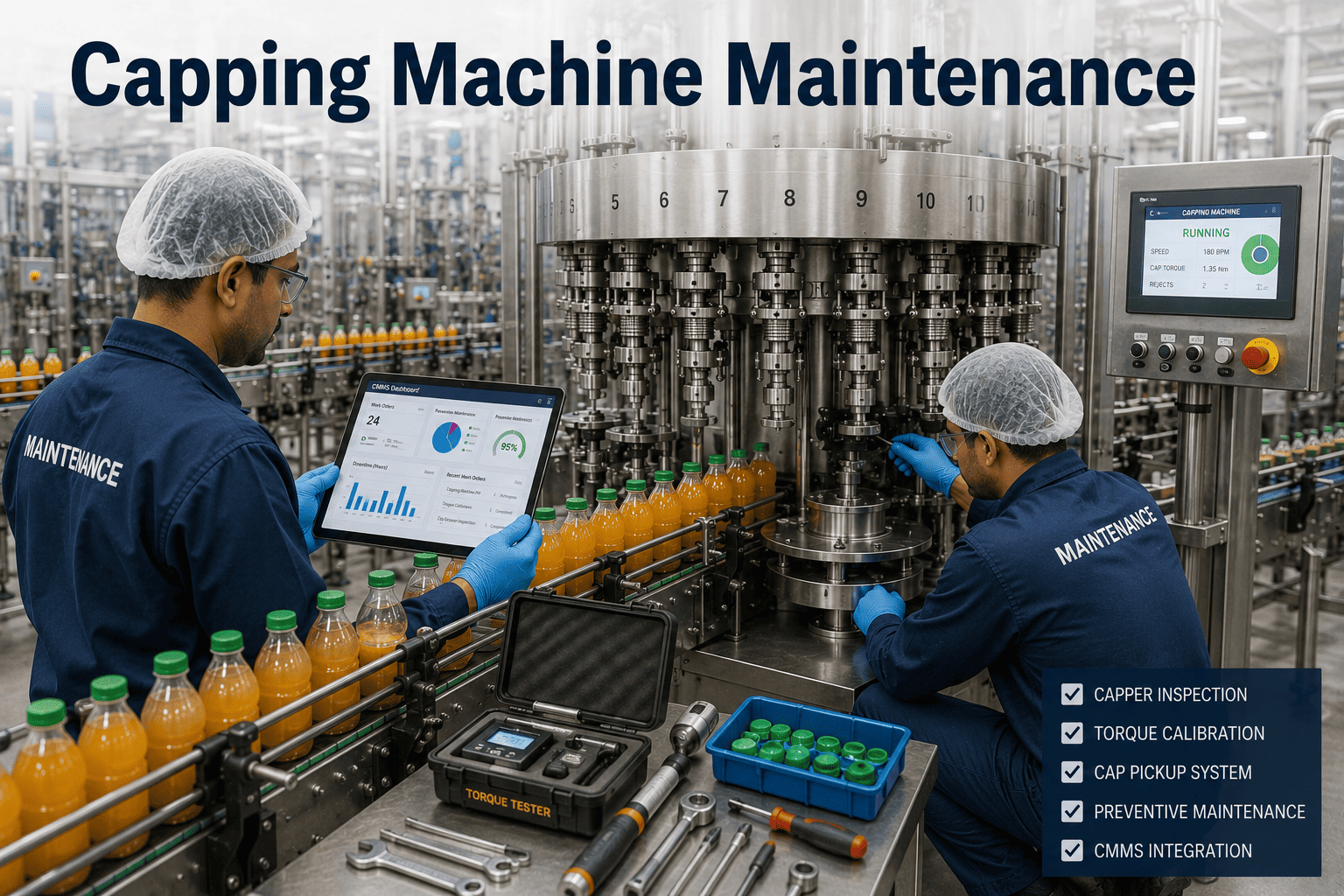
Capping Machine Maintenance for FMCG Lines: Torque, Chuck, and Cap Pickup Programs
By Jack Edwards on May 15, 2026
The capping machine is the last line of defence between your product and the consumer — and the most rejected-against asset on any FMCG packaging line. A loose cap, a cross-threaded closure, or a missing seal is not a cosmetic defect; it is a product safety event that generates consumer complaints, triggers retailer chargebacks, and in repeated incidence, forces a quality audit of the entire production run. Yet capping machines are routinely undermaintained relative to filling and labelling equipment, because their failure modes — chuck wear, torque head degradation, cap pickup inconsistency — are gradual and rarely catastrophic. The damage accumulates in reject rate statistics that most quality teams track but few operations teams trace back to their maintenance root cause. Plants implementing equipment-specific PM checklists tied to a CMMS platform reduce unplanned packaging downtime by 62% and extend capping equipment life by 2.3 times — outcomes that are directly traceable to structured chuck inspection, torque calibration scheduling, and cap pickup system PM. Start a free trial to register your capping assets and build your first PM schedule in Oxmaint, or book a demo to see how FMCG operations teams manage capper maintenance in Oxmaint.
62%
Reduction in unplanned packaging downtime with CMMS-driven equipment-specific PM checklists
2.3×
Equipment life extension achieved through proactive chuck wear and torque head maintenance programmes
15%
Fewer product recalls from fill and closure errors in facilities following structured calibration protocols
58 hrs
Annual valve and capper downtime reduction at a Midwest bottler through systematic trend analysis of maintenance data
Get Your Custom Capper Maintenance Plan
See how much reject rate and downtime you can eliminate from your capping operations with structured PM in Oxmaint.
✔ Chuck wear and torque calibration scheduling✔ Cap pickup system inspection tracking✔ Audit-ready maintenance documentation
No heavy implementation required | Works across multi-site portfolios | Live in days, not months
What Is Capping Machine Maintenance
Capping machine maintenance in FMCG operations covers four distinct machine types — screw cappers, snap cappers, ROPP (Roll-On Pilfer-Proof) cappers, and press-on cappers — each with different failure modes, different PM intervals, and different quality consequences when maintenance is deferred. What they share is a common vulnerability: the torque delivery system. Whether the capper applies torque through clutch-driven chuck heads, magnetic torque limiters, or servo-driven spindles, the accuracy of torque application degrades over time through mechanical wear, lubrication changes, and spring fatigue. A capper that is applying 15% less torque than specified is producing a line of bottles that will fail tamper-evidence on the shelf — an event that may not be detected until consumer complaints surface weeks after production.
The cap pickup system — the cap sorting bowl, elevator, chute, and placement mechanism — is the second major maintenance domain. Cap pickup failures generate jams, cap-missing events, and double-cap placements that shut down the line and produce a burst of non-conforming containers that must be hand-sorted before the line can restart. Pickup system maintenance is often neglected because failures are intermittent and appear to be random — until maintenance records reveal that the jam frequency correlates directly with bowl liner wear cycles and chute guide rail condition. Structured PM eliminates this intermittency by replacing worn components before failure, not after the jam count has climbed beyond acceptable thresholds. Start a free trial to register your capper assets and build structured PM schedules in Oxmaint.
Capper torque drift of 15% below specification produces bottles that fail tamper-evidence on the shelf — an event invisible at production that surfaces as consumer complaints weeks later.
Eight Key Concepts in Capping Machine Maintenance
Effective capping machine maintenance requires mastery of eight distinct technical areas — each one a source of reject rate impact, consumer safety risk, or regulatory non-conformance if not proactively managed.
01
Torque Calibration and Verification
Applied torque must be verified against a calibrated torque measurement tool at defined intervals. Torque verification covers both application torque during capping and removal torque on finished containers — the two parameters that define tamper-evidence integrity at retail.
02
Chuck Wear Inspection and Replacement
Chuck inserts — the gripping surfaces that engage the cap during torque application — wear through mechanical contact with every closure. Worn chuck inserts produce inconsistent grip, cap slippage, and torque variance. Inspection intervals should be defined by production volume, not calendar time.
03
Torque Head Clutch and Spring Maintenance
Clutch-driven torque heads rely on spring tension calibrated to deliver a specific torque limit. Spring fatigue and clutch disc wear reduce the effective torque ceiling over time. Clutch disc inspection and spring replacement on defined schedules prevents systematic under-torquing across the capper's entire head set.
04
Cap Pickup Bowl and Elevator Maintenance
The cap sorting bowl liner wears through continuous cap-to-liner contact, changing the friction characteristics that determine cap orientation and feed rate. Worn liner surfaces generate misoriented caps entering the chute — the root cause of most cap placement errors and chute jams.
05
Chute Guide Rail and Cap Feed System PM
Cap chutes and guide rails accumulate cap fragments, adhesive residue, and foreign material that narrows the cap feed channel and increases jam frequency. Defined cleaning and inspection intervals tied to production volume prevent the jam escalation pattern that characterises neglected cap feed systems.
06
Cap Placement Sensor Calibration
Sensors detecting cap presence, cap orientation, and cap placement before the torque station require periodic calibration verification. Sensor drift that causes delayed rejection of missing-cap events allows non-conforming containers to pass the torque station — generating downstream reject events at the case packer or end-of-line check-weigher.
07
Lubrication of Drive and Cam Mechanisms
Capper drive systems — cam followers, starwheels, spindle bearings — require food-grade lubrication on defined schedules. The dual challenge is that over-lubrication in cap-contact zones creates a contamination risk, while under-lubrication accelerates cam wear and introduces torque variability through mechanical friction changes.
08
Induction Seal Head Maintenance
For products using induction-sealed closures, the induction sealing head coil and power delivery system require periodic inspection and calibration. Coil degradation produces inconsistent seal energy — the root cause of seal failures that present as loose caps or incomplete liner fusion invisible to visual inspection at production.
The 6 Capping Machine Pain Points Driving FMCG Quality Losses
Torque heads that are producing below-specification application torque pass all in-plant checks — the caps sit correctly on the bottles at line speed. The failure surfaces when a consumer applies standard removal torque and the cap rotates freely without the tamper band breaking. By the time retail complaints reach quality, thousands of units may be in distribution.
Cap Jam Events With No Root Cause Data
Cap jams appear random when they are not — they follow a wear curve in the cap pickup bowl, elevator, and chute guide rails that becomes predictable once jam frequency data is trended against production volume. Without maintenance records linking jam events to component wear, each jam is treated as an isolated incident rather than a signal of an impending maintenance requirement.
Chuck Wear Affecting Torque Consistency Across Heads
A capper with 12 torque heads where 4 have worn chuck inserts does not produce 4 out of 12 bad bottles — it produces a statistically distributed quality problem across the production run. Without individual head tracking, the defective heads are identified only through statistical analysis of finished product — expensive, slow, and after the damage is done.
No Torque Calibration Records for Audits
BRC/BRCGS, FSSC 22000, and retailer quality audits require documented evidence of torque calibration at specified intervals for all closure application equipment. Plants without structured torque calibration records — with calibration tool IDs, technician sign-off, and result values — face non-conformance findings that cannot be contested with paper logs.
Induction Seal Failures Invisible at Production
Induction seal failures — incomplete foil fusion, partial liner adhesion, pinhole seals — are typically invisible to production line operators and downstream vision systems calibrated for cap presence, not seal integrity. Product reaching retail with compromised induction seals creates a consumer safety and product liability event that originates at an undermaintained induction head coil.
Format Changeover Maintenance Gaps
Capping machines running multiple cap formats — 28mm PCO, 38mm ROPP, push-pull sports caps — require format-specific chuck sets and adjustment records for each configuration. Without tooling condition tracking and changeover verification work orders, format errors are discovered during production startup, not during the changeover itself.
How Oxmaint Powers Capping Machine Maintenance Excellence
Asset Management
Capper Asset Registry with Head-Level Tracking
Register each capping machine with individual torque heads as sub-assets. Log chuck condition ratings, torque calibration results, and clutch spring assessments per head — building the per-position wear history that enables targeted head replacement rather than full capper servicing.
Calibration Management
Torque Calibration Work Orders with Documented Results
Auto-generate torque calibration work orders at defined intervals with fields for application torque per head, removal torque on finished containers, calibration equipment ID, and sign-off. Results are stored per head, per capper, and per audit period — satisfying BRC, FSSC 22000, and retailer audit requirements without manual compilation.
Cap Feed System
Cap Pickup Bowl and Chute PM Scheduling
Configure cap pickup system PM — bowl liner inspection, chute cleaning, guide rail condition check, elevator belt assessment — as volume-triggered or calendar-interval work orders. Link jam event reporting to cap feed system component condition to build the trend data that makes jam frequency predictable and preventable.
Format Management
Chuck Set Tooling Registry with Format Change Verification
Register every format-specific chuck set with condition ratings and PM intervals. Build format changeover work order templates that include chuck installation verification, torque test completion, and first-container quality check sign-off — converting changeover errors from production discoveries to planned pre-production verifications.
Quality Integration
Reject Rate Trending Linked to Maintenance Events
Log reject rate readings as custom data fields within capper PM work orders. When rejection rates trend upward, correlate the trend against maintenance event timing to identify the component wear pattern driving the quality deterioration — converting quality data from a reactive complaint driver into a proactive maintenance signal.
MRO Inventory
Chuck Inserts and Torque Head Spares with Reorder Triggers
Link chuck insert sets, clutch springs, induction head coils, and cap bowl liner replacements to each capper asset with minimum stock levels and reorder triggers based on consumption history. Eliminate the discovery that the chuck inserts needed for tonight's format change are out of stock.
Plants implementing equipment-specific PM checklists tied to a CMMS platform reduce unplanned packaging downtime by 62% and extend capping equipment life by 2.3x.
Reactive vs Planned Capping Machine Maintenance: What Changes
The shift from reactive to planned capping machine maintenance produces measurable improvements across quality metrics, reject rates, and audit readiness — not just downtime statistics. This comparison shows the full picture.
Maintenance Area
Reactive / Unplanned
Planned / CMMS-Driven
Torque calibration frequency
Ad hoc — after consumer complaints or audit findings
Scheduled intervals — documented results per head
Chuck wear detection
Discovered via reject rate increase or jam escalation
Per-head inspection on volume-trigger schedule
Cap jam root cause analysis
No data — each jam treated as isolated event
Jam frequency trends linked to component wear cycles
Format changeover verification
Discovered at production startup if chuck is wrong
Pre-run changeover WO with chuck verification sign-off
Induction seal integrity
Unknown — coil condition not tracked or inspected
Coil inspection and calibration on defined schedule
BRC and retailer audit readiness
No torque calibration records — non-conformance risk
Complete calibration history per capper, per head
Equipment life
Run-to-fail — premature full capper replacement
2.3× life extension through component-level PM
Product recall risk from closures
High — torque drift invisible until consumer complaint
Low — 15% fewer recall events with calibration protocols
ROI and Results for FMCG Capping Machine Operations
Plants implementing CMMS-driven capper PM programmes reduce unplanned packaging stoppages by up to 62% in Year 1
2.3×
Equipment Life Extension
Component-level chuck and torque head PM extends capping equipment service life more than double vs reactive replacement
15%
Fewer Recall Events
Facilities following structured torque calibration protocols report 15% fewer product recalls from closure and fill errors annually
7.3mo
Average Payback Period
Average Oxmaint deployment achieves full payback in 7.3 months — accelerated when a single prevented recall event covers multiple years of platform cost
Frequently Asked Questions
How does Oxmaint support torque calibration scheduling and record-keeping for capping machines?
Oxmaint generates recurring torque calibration work orders at the interval you specify — typically weekly for high-speed lines, monthly for medium-speed operations. Each calibration work order template includes fields for application torque per head, removal torque on finished containers, the calibration equipment ID used, the technician performing the test, and the result classification against specification limits. All results are stored against the individual torque head sub-asset record, enabling per-head trending and rapid identification of heads drifting outside specification before they produce consumer-facing defects. Start a free trial to configure your first capper torque calibration programme in Oxmaint.
Can Oxmaint track chuck wear individually per torque head to enable targeted replacement?
Yes. Each torque head on a capping machine can be registered as a sub-asset within the parent capper asset record in Oxmaint. Chuck condition ratings — scored on a defined wear scale during inspection work orders — are logged against each head separately. When a head's chuck condition reaches the replacement threshold, Oxmaint generates a targeted corrective work order for that specific head, with the correct chuck insert part number pre-populated from MRO inventory. This eliminates the common practice of replacing all chucks simultaneously when only a subset are worn — reducing spare parts consumption and maintenance labour by targeting replacement to actual wear condition.
How does Oxmaint handle cap pickup system maintenance for bowl, elevator, and chute components?
Cap pickup system components — sorting bowl liner, elevator belt, chute guide rails, and cap placement sensors — are registered as individually tracked components within the capper asset record. PM work orders for each component are configured with production-volume or calendar triggers appropriate to each component's wear rate. Jam event reporting is captured as a corrective action work order type, with the affected component tagged for each event. Over time, the jam event history per component builds a trend dataset that reveals whether jam frequency is escalating — the signal that a bowl liner or chute cleaning is overdue. Book a demo to see cap pickup system maintenance configured in Oxmaint.
Does Oxmaint support capping machine maintenance records for BRC, FSSC 22000, and retailer quality audits?
Yes. All torque calibration results, chuck condition records, format changeover verifications, and cap pickup system PM completions are stored against the capper asset record with timestamps, technician identities, and result values. For BRC/BRCGS and FSSC 22000 audits requiring documented evidence of closure application equipment maintenance, Oxmaint generates a complete maintenance history export filtered by asset, date range, and maintenance type. This replaces the manual document compilation process — which typically takes 2–3 days before a major retailer audit — with a single-click report that covers the entire audit period without gaps.
Stop Losing Customers to Preventable Closure Defects
Turn Your Capping Machine Into a Precision Quality Asset
From per-head torque calibration records to chuck wear tracking, cap pickup system PM, and audit-ready closure compliance documentation — Oxmaint gives FMCG packaging teams the maintenance infrastructure to eliminate the closure failures that drive consumer complaints, retailer chargebacks, and product recalls. Used by operations teams managing 10,000+ assets. See measurable results in the first 30 days.