FMCG Co-Manufacturing and Co-Packing Plants: Maintenance Across Mixed Brand SKUs
By Jack Edwards on May 15, 2026
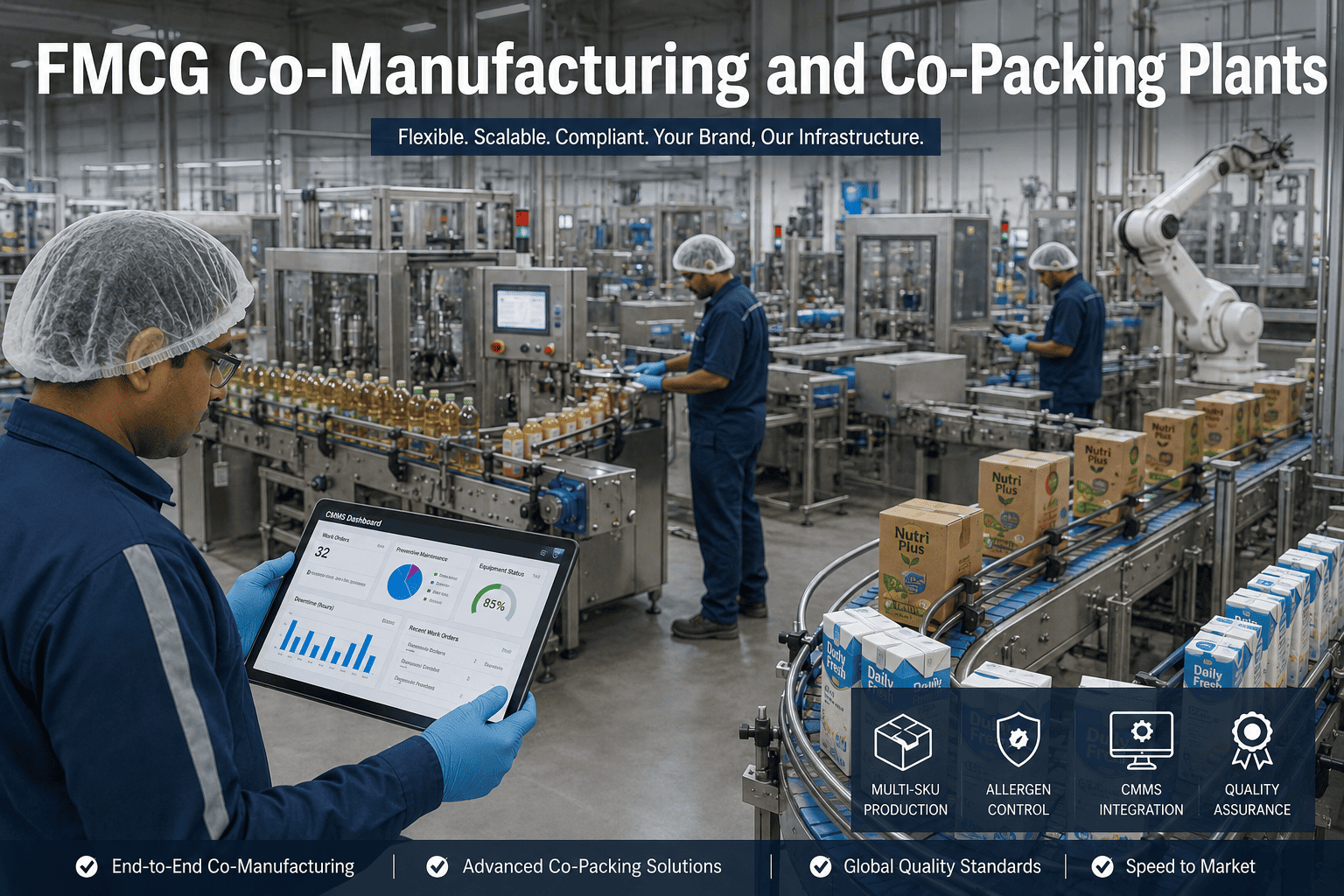
FMCG co-manufacturing and co-packing operations carry a maintenance burden that no single-brand facility faces: every changeover is a compliance event, every customer brand brings its own specifications, and every allergen cleaning protocol must be documented as if an auditor is watching — because one day, they will be. Contract manufacturers serving 5, 10, or 20 brand customers on the same lines need maintenance infrastructure that can handle rapid SKU switches, allergen segregation, packaging format changes, and simultaneous compliance with multiple brand-level food safety standards. The global FMCG packaging market reached USD 901.5 billion in 2024, and co-manufacturers sit at the operational core of that system. Without structured maintenance and changeover documentation, the speed advantage of co-packing collapses into a liability of brand risk and audit failure. Start a free trial to build your co-manufacturing maintenance program in Oxmaint, or book a demo to see how co-packers manage multi-brand compliance inside Oxmaint.
$901B
Global FMCG packaging market in 2024 — co-packers sit at the operational core of this system
4.8×
Higher cost of reactive maintenance vs planned — every emergency repair hits multiple brand commitments
62%
Reduction in unplanned downtime achieved by plants implementing CMMS-driven PM programs
30 days
Typical time to measurable improvement after deploying a structured CMMS in packaging operations
Get Your Custom Co-Packing Maintenance Plan
See how much cost and compliance risk you can eliminate from SKU changeovers and allergen clean-outs.
No heavy implementation required | Works across multi-site portfolios | Live in days, not months
What Is Co-Manufacturing and Co-Packing Maintenance
Co-manufacturing (co-man) and co-packing operations produce or package goods for multiple brand owners on shared equipment. A single filling line may run a premium retailer's organic sauce, a mass-market ketchup, and a private-label condiment — all in the same week, each with different fill weights, viscosity profiles, sealing temperatures, and allergen statuses. The maintenance challenge is not complexity in isolation — it is complexity compressed into tight windows. Changeovers between brand SKUs are not just equipment setups; they are compliance transitions that must be documented, verified, and traceable to each brand customer's audit package.
Contract manufacturers typically operate under SQF, BRC/BRCGS, or FSSC 22000 certifications — and their brand customers layer additional requirements on top. A maintenance failure on a co-packing line does not just affect one customer's production schedule. It triggers cascading rescheduling across all brands sharing that line, with penalty clauses, expedited freight costs, and brand relationship damage that no single downtime event is worth. The maintenance system that underpins co-manufacturing operations must be faster, more accountable, and more audit-ready than single-brand facilities — not the same or worse. Start a free trial to see how Oxmaint is purpose-built for multi-brand maintenance accountability.
A single unplanned line stoppage in a co-packing facility doesn't affect one customer — it cascades across every brand sharing that equipment that week.
Key Maintenance Concepts for Co-Manufacturing Operations
The operational complexity of running multiple brand SKUs on shared equipment creates eight distinct maintenance concepts that co-man facilities must master — each one a potential compliance failure if not systematically managed.
01
SKU Changeover PM Integration
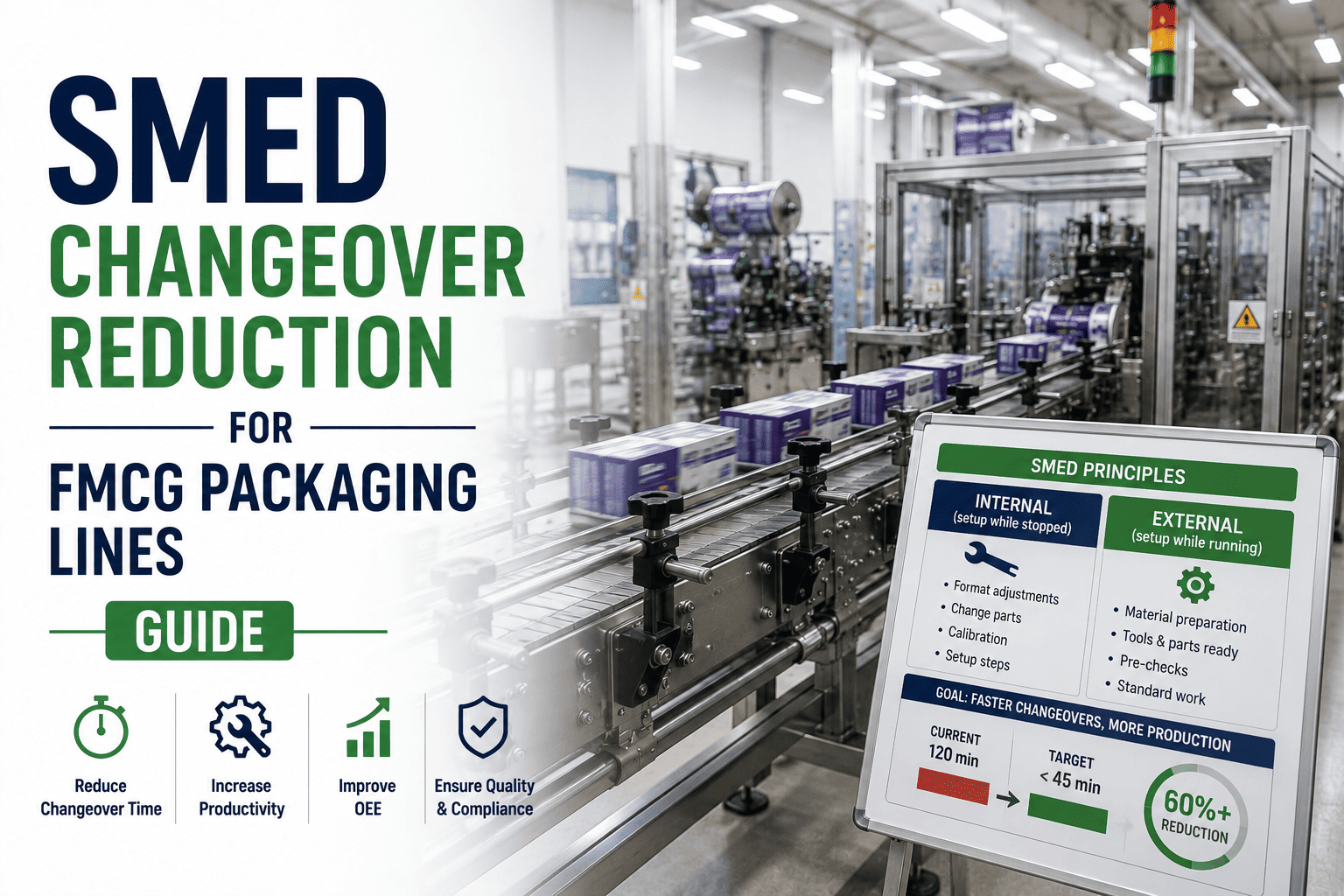
Each product changeover triggers equipment adjustments — fill weight calibration, sealing temperature reset, label web change. These are maintenance tasks, not just operator setups, and must be logged as work orders with sign-off records.
02
Allergen Cleaning Verification
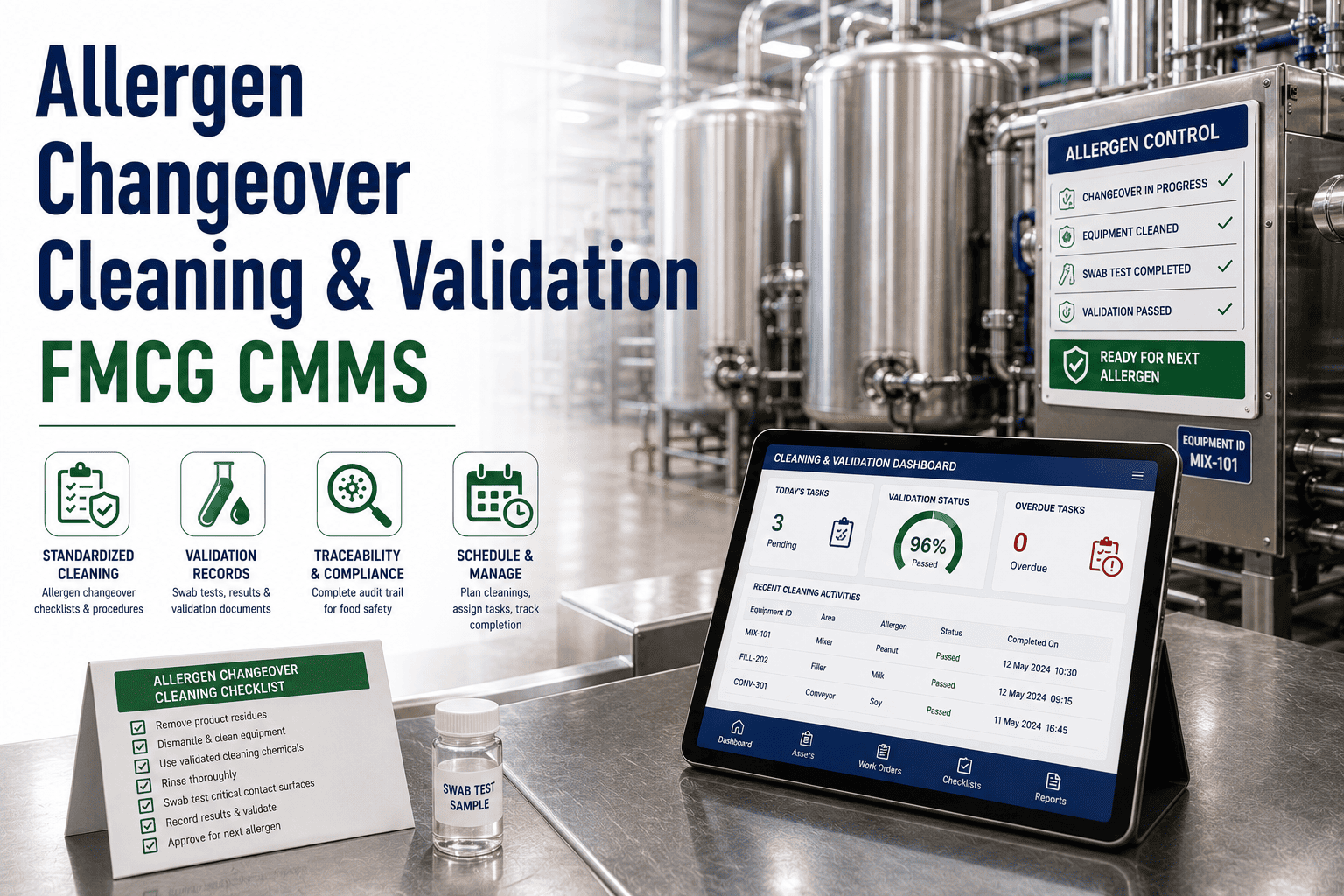
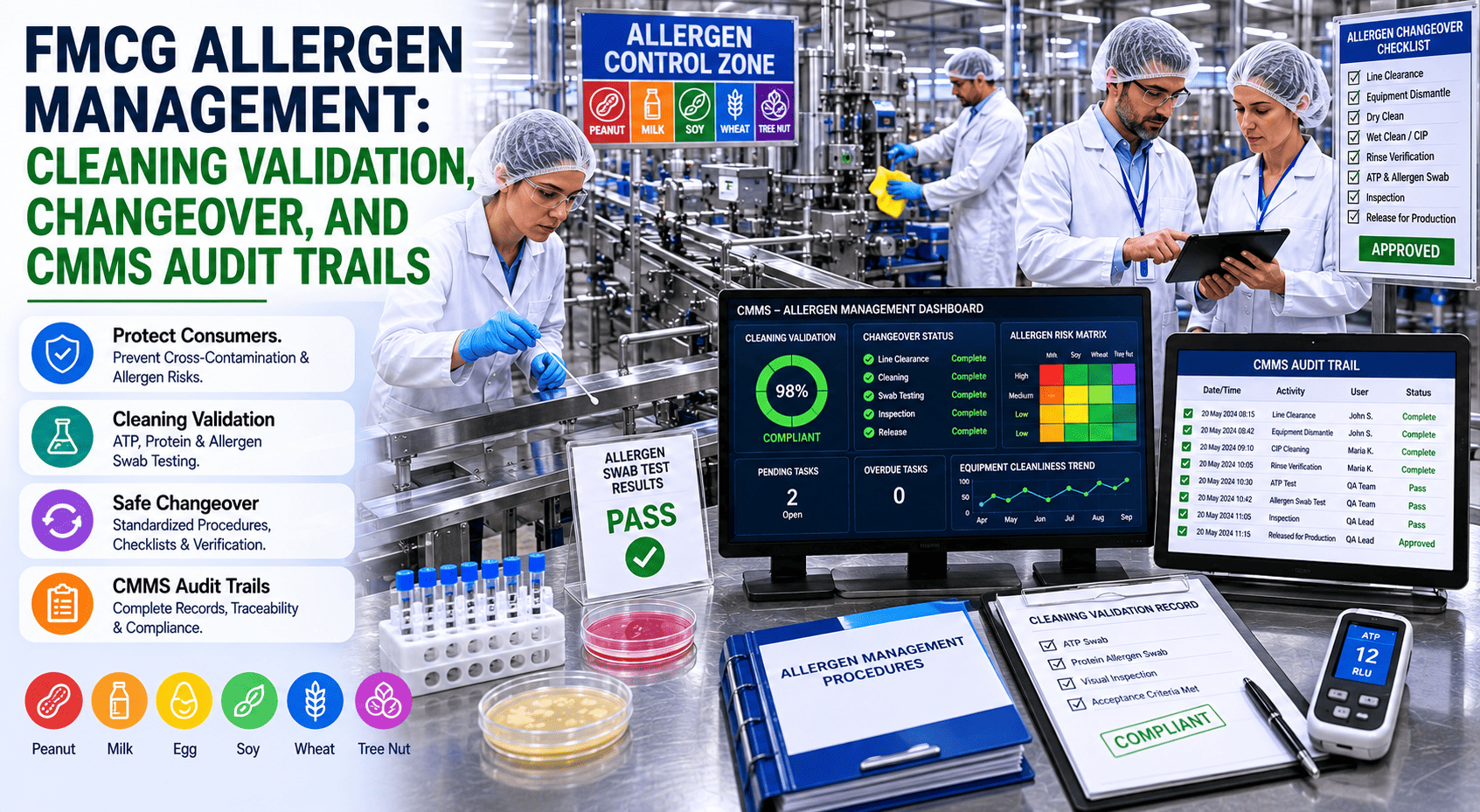
When switching from an allergen-containing SKU to allergen-free production, full CIP or physical clean-out must be documented with ATP swab results and technician sign-off. Each brand customer may require specific verification evidence.
03
Packaging Format Change Maintenance
Format changes — bottle size, cap type, label format, carton configuration — require tooling changes, guide rail adjustments, and sensor recalibration. Every format change is a maintenance event that must be documented and validated before production restart.
04
Multi-Standard Compliance Documentation
Co-manufacturers must satisfy SQF, BRC, FSSC 22000, and individual brand audit requirements simultaneously. Maintenance records must be retrievable by brand, by date, and by equipment — structured from day one, not assembled during an audit.
05
Line Speed and Throughput Validation
Brand customers contract specific minimum throughputs. Equipment degradation that reduces line speed below the contracted rate is not just a maintenance issue — it is a commercial breach. PM schedules must protect rated line speeds, not just prevent catastrophic failure.
06
Sanitation and Hygiene Zone Management
Co-packers managing both high-care and low-care products on adjacent lines must maintain equipment in hygiene zones with documented cleaning frequencies, hygiene equipment condition checks, and airlock/barrier integrity inspections.
07
Parts and Tooling Inventory by SKU
Co-packers carry brand-specific tooling — format parts, dies, sealing heads — across dozens of SKUs. Tracking tooling condition, availability, and scheduled PM against each format prevents the scenario where a format change is delayed by a worn or missing brand tooling set.
08
Brand Audit-Readiness Reporting
Brand customers conduct unannounced audits. Co-manufacturers must be able to produce a complete maintenance history for any line, any asset, and any changeover event — instantly, not after 48 hours of document hunting across paper files.
The 6 Pain Points That Break Co-Manufacturing Maintenance Programs
The structural complexity of multi-brand co-packing creates failure modes that are invisible in single-brand facilities. These six pain points are where co-manufacturer maintenance programs break down — and where they lose both money and brand customers. Start a free trial to close these gaps before they cost you a major brand contract.
Allergen Crossover Without Verified Records
Paper-based allergen cleaning logs create unverifiable gaps between brand production runs. A single undocumented allergen changeover can trigger a voluntary recall affecting multiple brand customers — with liability distributing across every party in the chain.
Multi-Brand Audit Failures from Fragmented Records
When three brand customers audit the same line in the same quarter, maintenance records must be brand-segregated, date-searchable, and instantly accessible. Paper-and-spreadsheet systems fail this test reliably — and brand audit failures cost contracts.
Changeover Time Blowout from Maintenance Gaps
Unplanned maintenance discoveries during a SKU changeover — worn seals, miscalibrated sensors, blocked nozzles — extend changeover windows from 45 minutes to 3 hours. Every minute of extended changeover is lost revenue across the entire production schedule.
Format Tooling Loss and Condition Degradation
Co-packers managing 20+ brand formats accumulate hundreds of format-specific tooling sets. Without structured tooling inventory and condition records, format changes are delayed by missing or worn tooling discovered only when the production run is about to start.
No Visibility into Cross-Brand Equipment Degradation
On shared lines, cumulative wear across multiple brand production runs is invisible until failure. One brand's high-viscosity product accelerates pump seal wear that surfaces during the next brand's run — a failure attributed to the wrong production context entirely.
Penalty Clause Exposure from Unplanned Downtime
Brand co-packing contracts increasingly include penalty clauses for missed delivery windows caused by equipment failure. A reactive maintenance culture that accepts 2–3 unexpected stoppages per month is accumulating penalty liability that eventually exceeds the contract margin.
How Oxmaint Powers Co-Manufacturing Maintenance Excellence
Changeover Management
SKU-Linked Work Order Templates
Create changeover work order templates linked to each brand SKU — including allergen cleaning steps, calibration tasks, and format tooling checks. Triggering a SKU switch auto-generates the complete changeover task list with nothing left to memory.
Compliance Documentation
Brand-Segregated Audit Records
Every maintenance event, changeover, and allergen clean-out is tagged to the brand and SKU in production. When a brand customer audits, filter the complete maintenance history by their brand — instant, complete, zero manual compilation required.
Asset Management
Shared Line PM Scheduling Across Brands
Assign PM schedules to equipment based on cumulative operational hours across all brand production — not calendar days. Fillers, cappers, and labelers that run high-viscosity products get accelerated PM intervals regardless of which brand last used the line.
Tooling Inventory
Format Tooling Registry with Condition Tracking
Register every format-specific tooling set — sealing heads, format guides, die plates — with condition ratings, PM intervals, and minimum availability checks before each scheduled production run. Eliminate the start-of-shift tooling discovery problem.
Mobile Operations
Technician Mobile App for Changeover Sign-Off
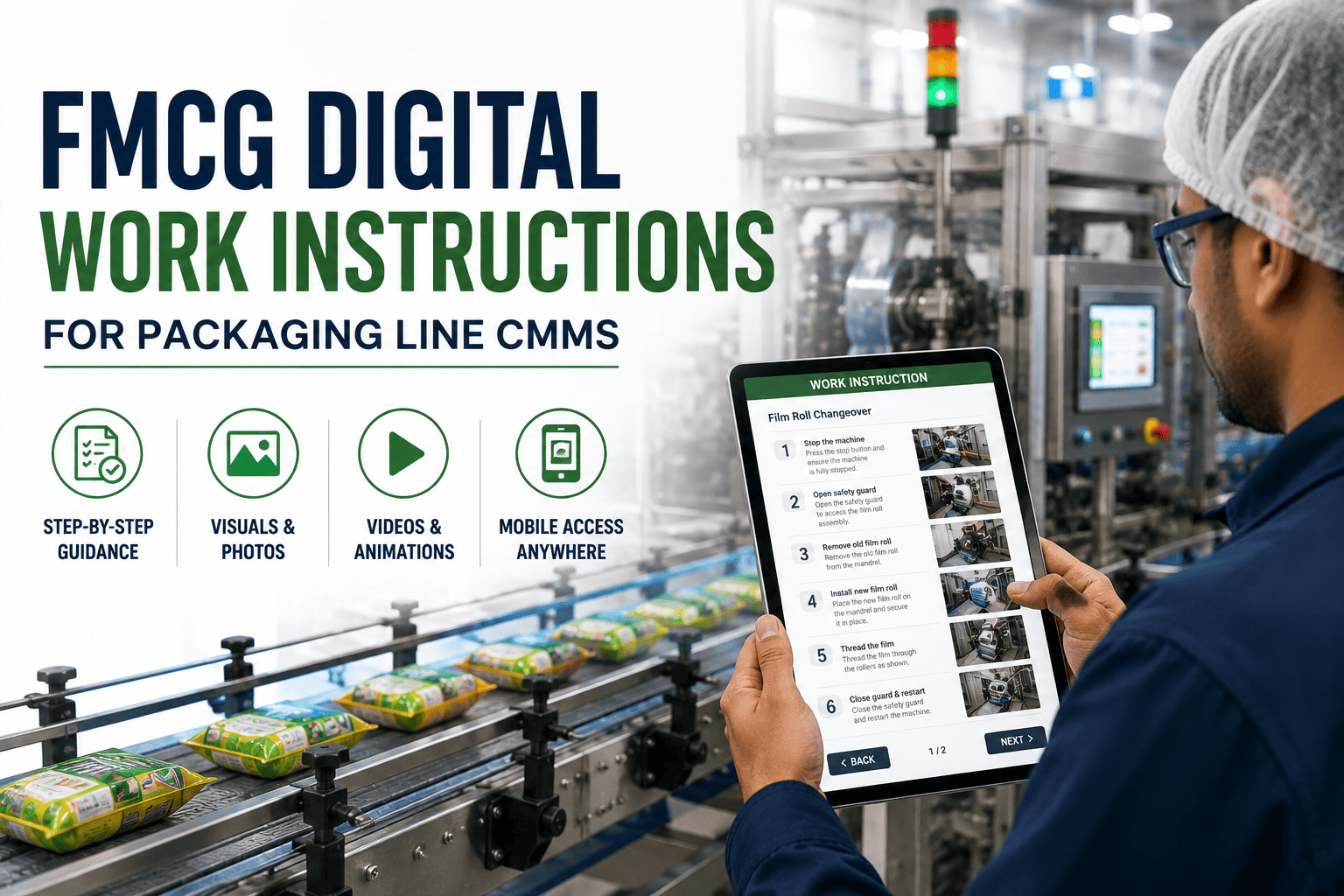
Technicians complete changeover tasks, capture photos of food-contact surfaces, and provide electronic sign-off from the line — on any mobile device, with or without wifi. Records sync automatically when connectivity is restored, maintaining the unbroken audit trail.
Performance Reporting
Line OEE and Changeover Efficiency Dashboards
Track OEE, changeover duration, unplanned stoppages, and PM compliance by line and by brand production period. Identify which brand SKUs create the most maintenance load — giving commercial teams data to reprice high-complexity contracts at fair rates.
Most co-manufacturers lose 20–30% of potential capacity to avoidable changeover delays and reactive maintenance events that compound across every brand on the schedule.
Reactive vs Planned Maintenance in Co-Manufacturing: Before and After
The stakes in co-manufacturing are higher than single-brand operations because every failure cascades across multiple customer relationships simultaneously. This comparison shows what the shift to structured maintenance delivers.
Operational Area
Before: Reactive Operations
After: CMMS-Driven Operations
Allergen changeover record
Paper log — missing entries, audit risk
Digital WO with photos — audit-ready instantly
SKU changeover time
Variable — 45 min to 4 hrs due to discovery events
Plants implementing CMMS-driven PM programs reduce unplanned stoppages by up to 62% — across every brand sharing the line
2.3×
Equipment Life Extension
Proactive wear-based maintenance extends equipment service life more than double vs reactive replacement on high-throughput co-packing lines
4.8×
Emergency Repair Cost Multiplier Eliminated
Reactive repairs cost 4.8× planned maintenance — on shared lines, that emergency cost hits while all brand customers wait for production to restart
7.3mo
Average Payback Period
Average Oxmaint deployment achieves full payback in 7.3 months — often faster in co-manufacturing where avoiding even one penalty clause event covers a year of platform cost
Frequently Asked Questions
How does Oxmaint support allergen changeover documentation across multiple brand SKUs on shared lines?
Oxmaint allows co-manufacturers to configure allergen changeover work order templates for each brand-to-brand transition type. When a changeover event is initiated, the appropriate template auto-generates with step-by-step cleaning tasks, mandatory ATP swab result recording, and photo capture of food-contact surfaces. Each completed work order is permanently linked to the SKU transition event, the production line, and the technician who performed it — creating an unbroken allergen clean-out history that satisfies FSMA, BRC/BRCGS, and individual brand audit requirements. Start a free trial to build your first allergen changeover template in Oxmaint.
Can Oxmaint generate brand-specific maintenance records that different customers can audit independently?
Yes. Every maintenance event, changeover work order, and PM completion in Oxmaint can be tagged to a specific brand production period. When a brand customer requests their audit documentation, you filter the maintenance record by brand tag and export the complete history — work orders, photos, technician sign-offs, and calibration results — for the requested period. This eliminates the 2–3 day manual document compilation process that most co-packers currently endure before every audit.
How do we track equipment wear across multiple brands running on the same line?
Oxmaint tracks PM intervals based on cumulative operational hours across all production runs — regardless of which brand is running. This means a filler that runs a high-viscosity tomato sauce for Brand A, then a low-viscosity dressing for Brand B, accumulates run-time hours in Oxmaint that trigger seal inspection and calibration work orders at the correct cumulative wear threshold. The brand attribution on each production period lets you later analyze which SKUs drive the most maintenance load — directly informing commercial pricing for high-complexity contracts. Book a demo to see cross-brand equipment wear tracking configured for your lines.
Can Oxmaint track format-specific tooling and spare parts across multiple brand packaging formats?
Yes. Oxmaint's asset and inventory management supports registration of format-specific tooling — sealing heads, die plates, format guides, size parts — as individual tracked items linked to the relevant brand and packaging format. Condition ratings, PM intervals, and usage history are maintained per tooling set. Pre-run availability checks can be built into changeover work order templates, so a missing or worn tooling item is identified during planning — not at the start of the production run when the line is already stopped and the brand customer is waiting.
Stop Letting Maintenance Gaps Cost You Brand Contracts
Turn Multi-Brand Complexity Into a Competitive Advantage
From allergen changeover documentation to brand-segregated audit reports and cross-brand equipment PM scheduling — Oxmaint gives co-manufacturers the maintenance infrastructure to deliver on every brand commitment, every time. Used by operations teams managing 10,000+ assets. See measurable results in the first 30 days.
.png)