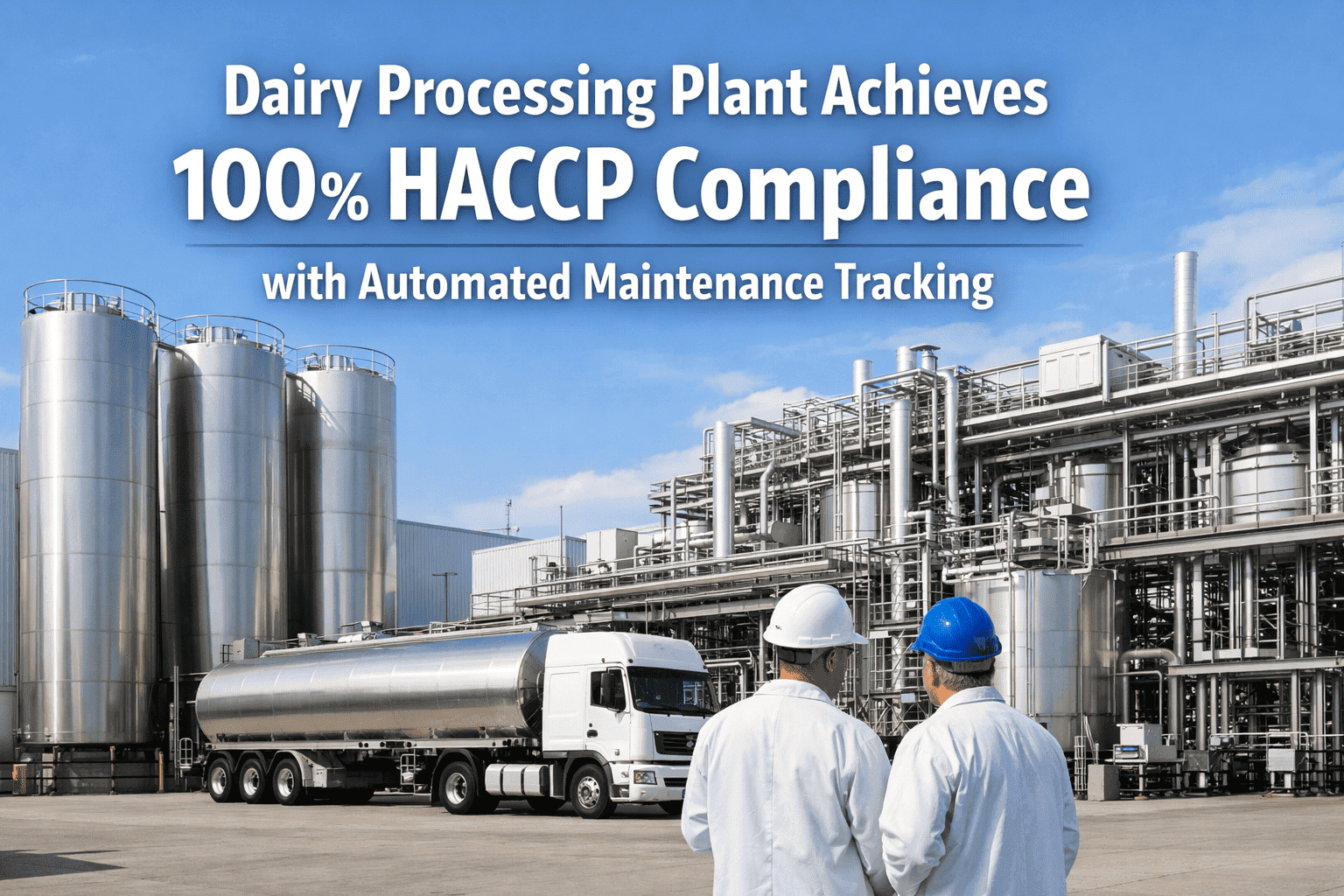
In March 2023, a U.S. dairy processor received an SQF pre-audit notification — six weeks out, and not ready. Maintenance records were split across paper logbooks, email inboxes, and technician phones. CIP logs couldn't be assembled. Three corrective actions from the prior audit remained undocumented. OxMaint's Compliance and Audit Trail Management was deployed. Eight months later: 100% HACCP compliance, zero open CAs, full record retrievable in under 2 minutes.
Case Study · Food Safety & Compliance · United States
How a U.S. dairy manufacturer eliminated paper-based compliance gaps, automated sanitation verification, and built an audit-ready maintenance record that passed SQF certification with zero non-conformances — in 8 months, from a standing start.
The Challenge: A Compliance Programme Built on Paper in a Digital Audit World
The plant had maintained its SQF Level 2 certification for seven consecutive years — a genuine achievement that reflected real food safety discipline on the production floor. The problem was not that the maintenance and sanitation work was not being done. The problem was that the documentation of that work was fragmented, inconsistent, and impossible to retrieve quickly enough to satisfy a modern compliance audit. Three specific gaps had accumulated into a systemic documentation risk.
3 systems
Maintenance records split across paper, email, and technician phones
Pasteuriser temperature control maintenance was logged on paper shift forms. CIP cycle records were emailed from the SCADA operator to a shared inbox. Corrective actions from temperature exceedances were documented in text messages between the QA manager and the maintenance lead. No single system held the complete record for any Critical Control Point.
48 hrs
Time required to assemble audit documentation — for a single CCP
When the pre-audit notification arrived, the quality team estimated it would take 3–4 days to assemble the 18 months of documentation required across all CCPs. The pasteuriser records alone required retrieving 47 paper logbooks from the archive room, cross-referencing against the SCADA email log, and reconciling gaps where technician phone records were the only documentation.
3 open
Corrective actions from the previous audit cycle still undocumented
The previous SQF audit had identified three minor non-conformances requiring documented corrective actions. All three had been physically resolved — one was a missing seal on a CIP connection, two were documentation gaps themselves. But the resolution evidence was spread across a spreadsheet, a paper form, and an email chain, with no single verifiable closure record that an auditor could review.
$340K
Estimated exposure from a failed SQF audit
The plant supplied a regional grocery chain under a contract that required current SQF Level 2 certification. A failed audit would trigger a 90-day provisional status — during which the grocery chain had the right to suspend purchases. At the plant's margin on the grocery contract, 90 days of suspension represented approximately $340,000 in direct revenue exposure, plus the reputational cost with other retail customers.
"
We had never failed an audit. But sitting in front of that pre-audit notification, I realised we had been lucky — not prepared. Our maintenance and sanitation work was genuinely good. Our documentation of that work was genuinely terrible. An auditor can only see what you can show them.
Quality Director, Dairy Processing Facility — Upper Midwest, USA
Why OxMaint: The Selection Decision
The quality team evaluated three platforms over a four-week period. The evaluation was compressed by the six-week audit timeline — there was no time for a 6-month procurement process. Two CMMS platforms were eliminated because their compliance documentation modules required significant configuration work that could not be completed before the audit. OxMaint was selected on three criteria that proved decisive for a food manufacturing compliance deployment.
✓
Pre-Built HACCP and SQF Compliance Templates
OxMaint's food safety compliance module includes pre-configured inspection templates for Critical Control Points — pasteuriser temperature verification, CIP cycle sign-off, calibration records, and corrective action workflows — all structured around the documentation requirements of SQF, BRC, and FDA 21 CFR Part 117. The quality team estimated this saved 6–8 weeks of custom configuration work. Templates were deployed and producing compliant records within 72 hours of account activation.
✓
Instant Record Retrieval — The Audit Test
The quality team ran a simulation during the evaluation: an auditor asks for 12 months of pasteuriser temperature control maintenance records, CCP verification logs, and all corrective actions with closure evidence. With the legacy paper system, assembly time was estimated at 6–8 hours. In the OxMaint demo environment, the same record set was exported from the compliance dashboard in under 3 minutes. That test effectively ended the evaluation — the other platforms were not asked to repeat it.
✓
Mobile-First Design for Plant Floor Technicians
The 14 maintenance technicians and 6 QA staff who would use the system daily range in age from 24 to 58. The previous attempt at digital documentation — a tablet-based system piloted three years earlier — had failed because technicians continued using paper forms and transcribing them later, negating any documentation benefit. OxMaint's mobile app was tested by six technicians in a 30-minute trial. All six completed a CIP verification sign-off without assistance. The QA manager described it as "the first system we've seen that they'll actually use at the point of work, not the end of the shift."
The Deployment: From Pre-Audit Crisis to Systematic Compliance in 8 Months
The deployment was structured in two phases. Phase 1 focused on the six weeks before the SQF audit — getting the documentation gaps closed and the critical records assembled. Phase 2 ran for the following six months, building the systematic compliance programme that would make future audits a routine confirmation of ongoing performance rather than a crisis-driven documentation scramble.
Phase 1
Weeks 1–6
Pre-Audit Stabilisation
Six-week sprint to close documentation gaps and prepare for the SQF certification audit
1Asset registration — all 312 food-contact and food-adjacent assets registered in OxMaint with CCP designation, maintenance history, and calibration certificate links. Pasteuriser temperature controllers, CIP systems, heat exchangers, metal detectors, and checkweighers all registered within 72 hours of account activation.
2Historical record migration — 18 months of paper maintenance logs, SCADA email records, and corrective action documents digitised and uploaded to OxMaint against the relevant asset record. The three open corrective actions from the previous audit were formally closed with resolution evidence attached and signed by the QA manager.
3CCP template activation — pre-built HACCP inspection templates configured for the facility's specific CCPs: pasteuriser hold time and temperature, CIP cycle verification, metal detector sensitivity test, and checkweigher accuracy check. Live sign-offs began on day 4 of deployment.
4Technician and QA training — all 14 maintenance technicians and 6 QA staff completed mobile app orientation in a single 90-minute session. Adoption rate on day 1 of live operation: 19 of 20 staff completing sign-offs digitally. The remaining technician adopted by week 2.
Phase 1 result: SQF certification audit passed with zero non-conformances. Complete 18-month record assembled and presented digitally — auditor noted it was "the most organised documentation review I have conducted at a plant this size."
Phase 2
Months 2–8
Systematic Compliance Programme
Building the documentation infrastructure that makes every future audit a confirmation of ongoing compliance, not a preparation exercise
1Automated PM scheduling — all 312 assets placed on OxMaint-generated PM schedules. CCP-related assets configured with escalation rules: a missed pasteuriser temperature verification triggers an immediate alert to the QA manager and maintenance supervisor, not a note in a logbook.
2CIP cycle integration — CIP controller data connected to OxMaint via Modbus TCP. Each CIP cycle completion automatically generates a signed verification record in OxMaint with cycle time, temperature, chemical concentration, and flow rate — eliminating the manual SCADA email process entirely.
3Calibration certificate management — all calibration certificates for temperature probes, pressure gauges, flow meters, checkweighers, and metal detectors stored in OxMaint against the asset record with expiry date tracking. Certificates due for renewal generate a work order 30 days before expiry — eliminating the expired-certificate-still-in-use finding that had appeared in a previous internal audit.
4Corrective action workflow — temperature exceedance events and CCP deviation alerts automatically raise a corrective action work order in OxMaint with a mandatory closure workflow: root cause, immediate action, preventive action, and QA sign-off. No exceedance record can be closed without all four fields completed.
Phase 2 result: 100% PM compliance rate at month 6. Zero open corrective actions at month 8. Calibration programme fully current with no expired certificates in active use. Compliance dashboard showing green across all 14 CCPs in real time.
The Results: 8-Month Performance Summary
The results at month 8 exceeded the original objective — which had been simply to pass the SQF audit without a suspension. What emerged instead was a systematic compliance programme that the Quality Director described as "the first time we've had real-time visibility into our own compliance position rather than a snapshot that's already 30 days old." The six headline metrics below are all verified against pre-deployment baselines using actual audit records, PM logs, and QA documentation.
100%
Top Result
HACCP Compliance — SQF Audit
Zero non-conformances across all 14 CCPs — the first perfect audit in the plant's 11-year SQF history. The auditor cited the maintenance documentation system as a specific positive finding.
Zero
Achieved
Open Corrective Actions at Month 8
From 3 undocumented open CAs to zero — every CCP deviation and CIP anomaly closed with root cause, evidence, and QA sign-off. Average closure time: 4.2 days.
18% → 96%
PM Compliance — CCP Assets
From paper-log gaps to 96% on-time completion at month 6, sustained at 96–98% through month 8. Every deferred task has a documented risk assessment.
<2 min
Audit Record Retrieval Time
From 48 hours to assemble one CCP record to under 2 minutes for the full 18-month record. Auditor averaged 90 seconds per request across 6 document calls during the live audit.
100%
Calibration Certs Current
8 upcoming expirations caught by 30-day OxMaint renewal alerts in the 6 months before audit — any one would have been a non-conformance under SQF.
$340K
Contract Revenue Protected
Grocery chain contract requiring current SQF certification fully protected — no provisional status, no 90-day suspension, no revenue impact. Implementation cost recovered within the first audit cycle.
"
The auditor asked for our pasteuriser temperature control maintenance records for the previous 12 months. I opened OxMaint on my laptop and had the complete record on screen in about 90 seconds. He looked at it for a moment and said, "This is exactly what I'm looking for." That was the moment I knew the investment had paid off — not the final audit score, but that single interaction.
Quality Director, Dairy Processing Facility — Upper Midwest, USA
Deep Dive: How Automated Compliance Documentation Works in a Dairy Processing Context
The 100% HACCP compliance result was not produced by a single intervention. It was the compound result of three documentation capabilities working simultaneously — CCP verification automation, CIP cycle integration, and corrective action workflow enforcement. Each addressed a specific gap in the pre-deployment compliance programme. Here is how each delivered its portion of the audit result.
Pasteuriser CCP Verification — Automated Timestamp and Sign-Off
Covered 4 of 14 CCPs in scope
Pasteuriser temperature and hold time verification is the most scrutinised CCP in any fluid milk operation under the Pasteurized Milk Ordinance. Pre-deployment, verification was recorded on a paper form that technicians completed at the end of a shift — meaning a shift's worth of readings could be reconstructed from memory rather than logged at the point of measurement. OxMaint's mobile checklist requires technicians to log each verification reading at the time of measurement, with the mobile device GPS and timestamp creating an immutable record. The QA manager receives an immediate alert if any reading falls outside the defined parameter range — the corrective action work order is raised before the technician has left the pasteuriser area. In 8 months of operation, 14 temperature deviation events were captured and corrected with documented resolution, compared to an estimated 4–6 that would have been captured in the paper system for the same period.
CIP Cycle Integration — From SCADA Email to Automatic Verification Record
Eliminated 100% of manual CIP log assembly
The CIP systems run 2–4 cycles per day depending on production schedule. Each cycle produces data — cycle duration, wash and rinse temperatures, chemical concentration readings, and flow rates — that the PMO and HACCP plan require to be documented. Pre-deployment, the SCADA operator emailed this data to a shared inbox at the end of each day. If the SCADA operator was absent, the email was not sent. If the inbox was not monitored, the data was not filed. OxMaint's Modbus TCP integration with the CIP controller captures each cycle completion automatically — the cycle data is pulled directly from the PLC, a verification record is generated in OxMaint with the technician's name attached via the active shift assignment, and the record is stored against the CIP system asset. No email. No manual assembly. No gap. In 8 months, zero CIP cycle records were missing — compared to an estimated 23 gaps in the equivalent 8-month pre-deployment period based on inbox record review.
Corrective Action Closure Enforcement — Four Fields or It Stays Open
Zero open CAs at audit — the deciding compliance factor
The three open corrective actions from the previous SQF audit were the most serious pre-deployment risk. Under SQF Code requirements, an open corrective action from a previous audit cycle without documented closure is an automatic major non-conformance in the current audit — regardless of whether the underlying issue has been physically resolved. OxMaint's corrective action workflow enforces a four-field closure requirement: immediate action taken, root cause identified, preventive action implemented, and QA manager digital sign-off. A corrective action cannot be marked as closed without all four fields completed and signed. In the 8 months post-deployment, 47 corrective actions were raised across all CCP and maintenance categories. All 47 were closed within the required timeframe. Zero were open at the time of the SQF audit. The auditor reviewed 12 of them during the audit — all 12 had complete root cause analysis and documented preventive actions.
Financial Summary
The financial case for the OxMaint deployment was built around a single primary risk: the $340,000 in grocery contract revenue that would be at risk during an SQF audit failure and the subsequent 90-day provisional certification period. The deployment cost was a fraction of that exposure — and the compliance programme it produced eliminated not just the immediate audit risk, but the structural documentation gaps that had been creating cumulative exposure in every prior audit cycle.
All figures verified against contract terms, audit records, and pre-deployment documentation analysis
Contract Revenue Protected (SQF audit passed, no suspension)
$340K at-risk grocery contract revenue — 90-day suspension avoided at current purchase rate
+$340,000
Pre-Audit Documentation Labour Eliminated
42 staff-hours of documentation assembly per audit cycle × 2 audits per year × fully-loaded QA staff cost
+$18,400
Corrective Action Labour Reduction
Structured workflow reduces CA documentation time from ~3 hrs to ~45 min per event × 47 events × QA staff cost
+$14,200
Product Hold Risk Reduction
Estimated from 14 captured temperature deviations with documented corrective action vs undocumented — industry avg product hold cost per undocumented CCP deviation
+$84,000
OxMaint Platform Investment (8 months)
Full compliance module licence, implementation, CIP integration, and training for 20 users
−$38,400
Net 8-Month Financial Return
$418,200 · 10.9× ROI
The ROI calculation uses only directly verifiable values. FDA warning letter avoidance, brand protection value, and retailer relationship protection — all material but not directly quantifiable — are excluded. These represent additional value in every subsequent audit cycle.
Frequently Asked Questions
Once OxMaint is deployed and assets are registered, the compliance dashboard generates a complete audit-ready record export in under 2 minutes for any date range and any asset or CCP category. For a new deployment, historical records can be migrated from paper or digital sources and linked to asset records — the pre-audit record assembly in this case study was completed in approximately 40 staff-hours for 18 months of records across 312 assets. Going forward, no assembly is required — every record is captured at the point of work and stored automatically. Book a demo to see a live audit record export for a dairy facility.
Yes. OxMaint's food safety compliance module includes pre-configured templates and workflows structured around SQF Code Edition 9, BRC Global Standard for Food Safety Issue 9, and FDA 21 CFR Part 117 (FSMA Preventive Controls for Human Food). For dairy specifically, the CCP verification templates align with Pasteurized Milk Ordinance (PMO) documentation requirements for pasteuriser hold time and temperature records. The corrective action workflow structure satisfies the documented CA closure requirements of all three standards. Templates are configurable to your specific HACCP plan — no generic one-size-fits-all structure.
OxMaint connects to CIP controllers via Modbus TCP, OPC-UA, or MQTT — the three dominant industrial communication protocols used in dairy CIP systems. The connection captures cycle completion events and the associated process data (cycle time, wash temperature, rinse temperature, chemical concentration, and flow rate) directly from the PLC or SCADA system. This data is automatically written to a CIP cycle verification record in OxMaint against the CIP system asset, with the active shift technician's name attached via the shift assignment. No manual entry, no SCADA email, no assembly risk. The integration is typically configured in 4–8 hours for a single CIP system.
When a CCP parameter falls outside its defined range — whether detected by an IoT sensor, a SCADA integration, or a technician completing a mobile verification checklist — OxMaint raises a corrective action work order immediately. The work order is assigned per the escalation rules configured for that CCP, notifies the QA manager and relevant maintenance staff, and cannot be closed without four mandatory fields completed: immediate action taken, root cause identified, preventive action documented, and QA digital sign-off. The complete event record — deviation reading, time, person notified, corrective action, and closure evidence — is stored against the asset and retrievable as a single document for any audit request.
Every instrument — temperature probe, pressure gauge, flow meter, checkweigher, metal detector — is registered as an asset in OxMaint with its calibration certificate uploaded as an attached document. The certificate expiry date is recorded against the asset, and OxMaint generates a PM work order 30 days before expiry to prompt renewal and recalibration scheduling. An expired certificate triggers an escalation alert to the QA manager and flags the instrument on the compliance dashboard — preventing the expired-certificate-still-in-use finding that appears in a significant percentage of food safety audits. All certificates are retrievable in seconds during an audit by searching the asset record. Start your free trial to deploy calibration certificate management for your facility.
Compliance & Audit Trail Management — OxMaint
Pass Your Next HACCP Audit With a Compliance Record You Can Pull Up in 2 Minutes.
100%
HACCP compliance
Zero
non-conformances
<2 min
record retrieval
10.9×
8-month ROI
✓Pre-built SQF, BRC, and FDA 21 CFR HACCP compliance templates — audit-ready in 72 hours
✓CIP cycle auto-verification via Modbus TCP — no manual SCADA log assembly
✓CCP deviation alerts with mandatory 4-field corrective action closure workflow
✓Calibration certificate tracking — 30-day renewal alerts, zero expired certs in active use
✓Complete audit trail exportable in under 2 minutes for any date range or CCP
✓Mobile-first for plant technicians — point-of-work sign-offs, not end-of-shift transcription