Before you change a layout, retool a packaging line, or ramp up output for a seasonal peak, digital twin technology lets you run that entire scenario inside a virtual model — without touching a single machine on your actual floor. In FMCG manufacturing, where changeover time, throughput, and OEE directly determine profitability, the ability to simulate before you execute is not a luxury. It is a competitive advantage. Global digital twin adoption is accelerating: the market is tracking toward $149 billion by 2030, and 86% of manufacturers now consider the technology operationally relevant. For FMCG plant managers, the practical question is not whether digital twins deliver value — it is how to extract that value reliably, at plant scale, without a multi-year implementation program. Start a free trial to see how Oxmaint connects your real equipment data to a living asset model, or book a demo to see digital-twin-ready asset tracking in action.
95%
Failure prediction accuracy achieved in leading FMCG digital twin deployments
$149B
Projected global digital twin market size by 2030, driven by manufacturing adoption
40–70%
Reduction in changeover validation time using digital twin simulation before deployment
4–6x
ROI reported by manufacturers in the first year of digital twin implementation
Build Your Living Equipment Model With Oxmaint
Oxmaint's asset registry is the foundation of your digital twin — pairing real-time OEE data, maintenance history, and condition scoring in one connected system.
What Is a Digital Twin in FMCG Production?
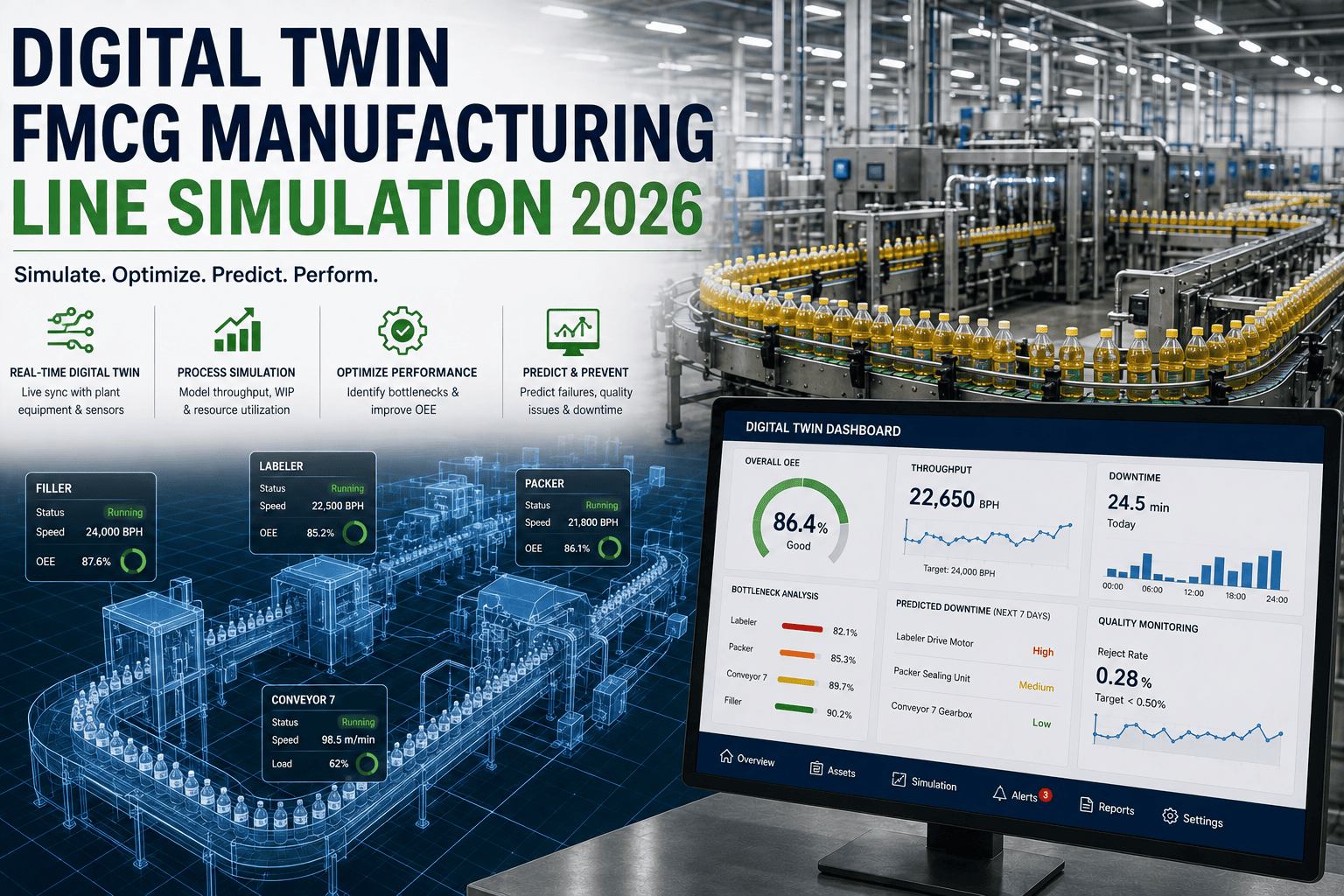
A digital twin is a continuously updated virtual replica of a physical asset, production line, or entire facility. It is synchronized in real time with data from IoT sensors, PLCs, and SCADA systems. Unlike a static CAD model or a historical spreadsheet, a digital twin changes as your equipment changes — capturing every operational state, wear event, and process variation as it happens. For FMCG plants, the most valuable applications fall into three categories: predictive maintenance (detecting failures before they occur), production simulation (testing changes in a virtual environment), and operational optimization (identifying and eliminating throughput constraints). Start a free trial and connect your first asset to a real-time digital record in Oxmaint.
Layer 1 — Physical
Real Equipment on the Floor
Motors, conveyors, filling heads, compressors, packaging lines — all instrumented with vibration, temperature, and cycle count sensors generating continuous data streams.
Layer 2 — Digital
The Virtual Asset Model
A synchronized virtual representation updated in real time as sensor readings change. Captures current condition, operational parameters, maintenance history, and failure event logs.
Layer 3 — Intelligence
Predictive Analytics & Action
The model runs simulations, generates failure predictions, and triggers maintenance work orders — giving plant managers the clarity to act on evidence, not instinct.
Where FMCG Plants Feel the Digital Twin Impact Most
Digital twin value is not evenly distributed. Some applications deliver immediate, measurable ROI — and those are the ones FMCG operations teams should prioritize in their first deployment phase. Book a demo to see how Oxmaint's asset data supports digital-twin-driven maintenance decisions.
Fastest ROI
Predictive Failure Detection
Virtual models identify wear patterns and thermal signatures weeks before failure. Stops production emergencies becoming costly disasters. 95% accuracy in trained models.
High Impact
Changeover Simulation
Validate new product format changeovers in the virtual model before the physical retool. Eliminate collision risks, sequence errors, and compliance gaps before they cost production time.
Strategic Value
Throughput Bottleneck Analysis
Run the digital model at different production rates to identify where uptime and throughput constraints live. Fix the right constraint instead of the most obvious one.
Training
Operator & Technician Onboarding
New staff train against the virtual model, not live equipment. Reduces onboarding time by up to 60% and eliminates the risk of training-related equipment damage or line stoppages.
Compliance
Process Validation Without Downtime
Simulate process changes and validate them against regulatory parameters in the virtual model. Reduce IQ/OQ/PQ validation cycles on GMP-regulated food production lines.
Long-Term
CapEx Planning Simulation
Model the asset aging trajectory using real wear data. Predict when equipment will reach end-of-life and project replacement cost — so CapEx decisions are data-driven, not calendar-driven.
Before Digital Twin vs. After Digital Twin
| Operational Area |
Without Digital Twin |
With Digital Twin |
| Failure Prediction |
Detected after the event or by random inspection |
95% accuracy, weeks before the event |
| Changeover Validation |
Validated on live line — risky, time-consuming |
Validated in simulation — 40–70% faster |
| Downtime Events per Year |
18–36 per production line |
4–8 per line (benchmark) |
| New Operator Training Time |
4–8 weeks on-machine supervised |
1–2 weeks on virtual model |
| OEE Improvement Visibility |
End-of-shift or daily reporting |
Real-time, per-line, with simulation comparison |
| CapEx Decision Basis |
Asset age, gut feel, or crisis events |
Real-time wear data and remaining useful life models |
| Process Change Risk |
Trial runs on production equipment |
Simulation-tested before reaching the floor |
The Numbers Behind FMCG Digital Twin Programs
20%
Unexpected Downtime Reduction
Average across FMCG implementations using data-driven digital twin models in production
86%
Manufacturers Considering It Relevant
McKinsey 2024 survey — adoption is accelerating from pilot to standard practice
60%
Digital Twin Value From Existing Data
60% of implementation value achieved using PLC and SCADA data already being collected
4–7%
Monthly Cost Savings
Smarter scheduling and throughput optimization through simulation-driven production planning
Make Every Equipment Decision on Evidence, Not Opinion
Oxmaint's asset registry, OEE tracking, and IoT integration give you the data foundation your digital twin strategy requires. Start with real-time visibility and build toward full predictive simulation at your pace.
Frequently Asked Questions
What is the difference between a digital twin and a digital model in FMCG?
A digital model is a static representation of an asset — think a 3D CAD file or a spreadsheet. A digital twin is a live, continuously updated virtual replica that receives real-time data from its physical counterpart. The twin changes as the physical asset changes, making it useful for predictive maintenance, operational simulation, and condition-based decision-making in ways a static model cannot support.
How does Oxmaint support digital twin capabilities for FMCG plants?
Oxmaint provides the foundational layer for digital twin programs: a full asset registry with condition scoring, IoT and SCADA integration for real-time data ingestion, OEE tracking per production line, and rolling CapEx forecasting models. These capabilities create the "living asset record" that digital twin platforms consume. Many FMCG clients achieve 60–80% of digital twin value through Oxmaint alone before adding dedicated simulation software.
Do we need to replace existing sensors or PLCs to implement a digital twin?
In most cases, no. Research indicates that 60% of digital twin value can be achieved using data already being collected by existing PLCs and SCADA systems. Oxmaint connects to this infrastructure via API, OPC-UA, or MQTT without requiring hardware replacement. The most common first step is adding targeted vibration or temperature sensors to critical rotating assets not yet instrumented — a relatively low capital commitment with an immediate monitoring payoff.
How long does it take to see production improvement from a digital twin in FMCG?
Plants that start with data-driven digital models — using existing PLC and SCADA data — typically see measurable improvement in fault detection within 30–60 days. Full simulation capabilities and high-accuracy predictive models take 3–6 months as the twin accumulates facility-specific historical data. The 4–6x ROI benchmark reported in the industry is typically achieved within the first 12 months for plants with strong data foundations.

.png)


