
A beverage plant in Pune ran its DCS and CMMS as two completely separate worlds for eleven years. The DCS logged every process deviation, alarm, and equipment parameter in real time. The CMMS managed every work order, PM schedule, and repair history. Neither system talked to the other. When a filling line's pump cavitation alarm fired at 2:14 AM, the DCS logged it — and nothing happened until a technician noticed the low-flow condition at the 6 AM shift start. The pump had been running in a degraded state for nearly four hours. The bearing failed at 9:40 AM. Six hours of unplanned downtime and an emergency bearing replacement followed. When DCS and CMMS are integrated, that cavitation alarm generates a CMMS work order at 2:14 AM, assigns it to the on-call technician, pulls the pump's maintenance history, and triggers a spare parts availability check — all before anyone sets foot on the production floor. Oxmaint's DCS integration connects your process control layer directly to automated maintenance workflows. Book a demo to see it live on your plant.
67%
of FMCG Unplanned Downtime Events Are Preceded by a DCS Alarm That Was Not Acted On Within 2 Hours
4.1×
Faster Mean Time to Response When DCS Alarms Auto-Generate CMMS Work Orders vs. Manual Notification
38%
Reduction in Unplanned Downtime — FMCG Plants With Full DCS-CMMS Integration vs. Standalone Systems
$890K
Average Annual Value of DCS-CMMS Integration — Mid-Size FMCG Plant, 6–10 Process Lines
DCS Integration — Automated Maintenance Triggers
Turn Every DCS Alarm Into a Maintenance Action — Automatically
Oxmaint connects your DCS process control layer to CMMS work order management — so process deviations, equipment alarms, and threshold breaches automatically generate the right maintenance response without manual intervention.
DCS ARCHITECTURE
What a DCS Controls in FMCG Plants — and Why It's Maintenance-Critical Data
DCS systems generate continuous process data that reveals equipment health — but only if that data reaches the maintenance team
DCS Primary Function — Process Control
Temperature Loops
PID control of pasteurisers, heat exchangers, CIP temperature — setpoint vs. actual logged continuously
Pressure Control
Filling head pressure, pump discharge, vessel pressure — deviations from setpoint are real-time equipment health signals
Flow Regulation
Product flow rates, CIP flow, utilities — flow degradation is often the first sign of pump wear or valve seat erosion
Level Control
Buffer tanks, dosing vessels, wash tanks — level control instability reveals valve or sensor degradation
Alarm Management
Process alarms, interlock trips, high/low limits — typically 200–800 active alarm points in a mid-size FMCG plant
DCS Secondary Value — Equipment Health Intelligence
PID Performance Drift
A loop that required ±0.5°C correction now oscillates ±2.2°C — the control valve is wearing, not the process
Pump Efficiency Index
Flow output per unit drive current — declining ratio is a pump wear signature 3–6 weeks before failure
Heat Exchanger Fouling
Rising approach temperature at constant flow and inlet conditions — fouling index calculated from DCS data alone
Valve Response Time
Time from command to position confirmation — increasing lag is early-stage actuator or positioner wear
Interlock Trip Frequency
Rising trip frequency on specific interlocks indicates equipment approaching its protection limits — a maintenance signal, not just an operations event
The DCS already has the data to predict most process equipment failures. The gap is the connection between that data and the maintenance team who can act on it.
INTEGRATION ARCHITECTURE
Four-Layer DCS–CMMS Integration Model
How process control data flows from the DCS to maintenance work orders — and back
Layer 1
Data AcquisitionOPC-UA / Modbus / Historian
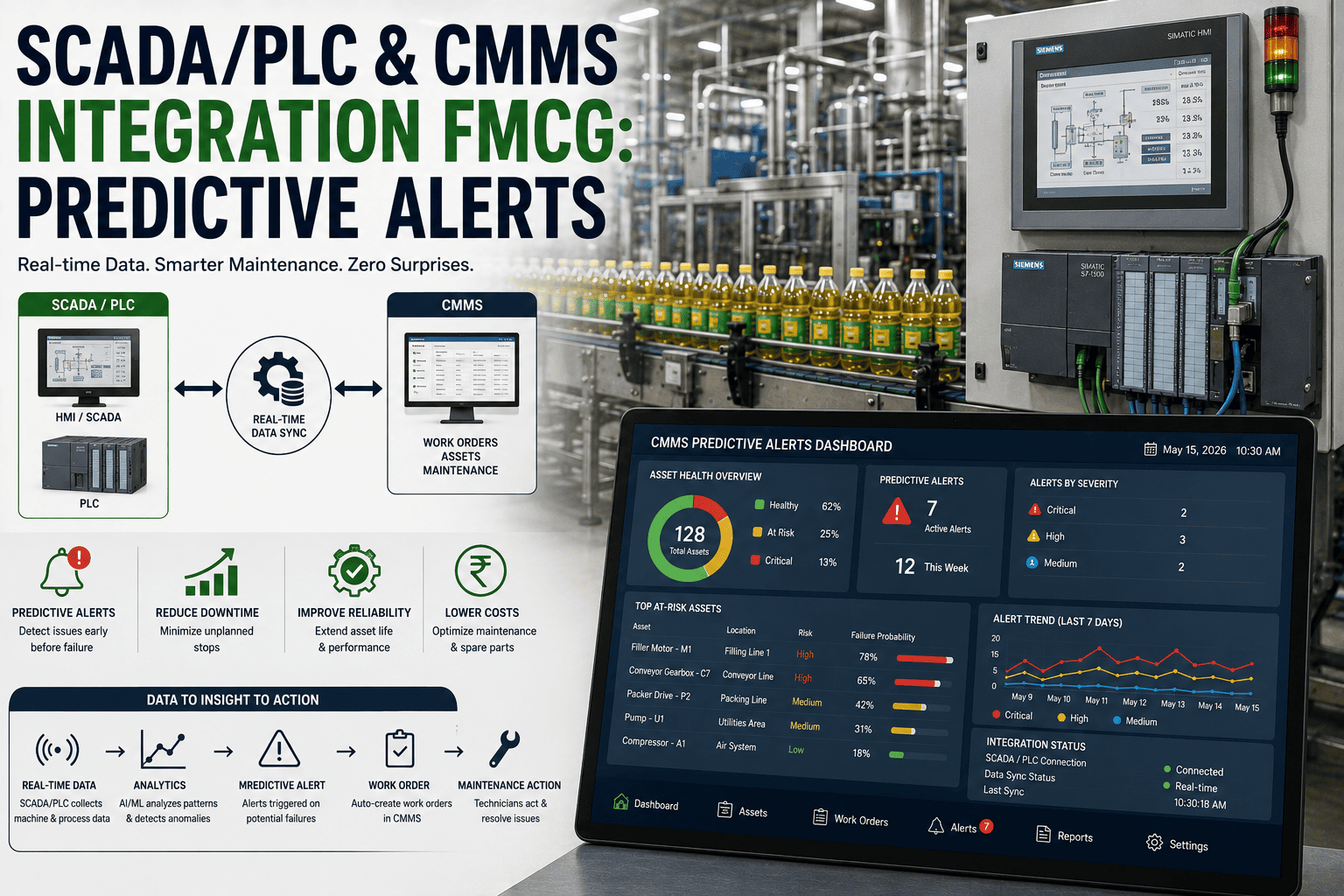
OPC-UA server on DCS exposes process variables — CMMS subscribes to configured tag list at defined polling intervals
Alarm and event streams forwarded in real time — alarm tag, severity, timestamp, and current process value transmitted on alarm activation
Historian integration for trend data — CMMS pulls historical process data to correlate with maintenance events
Modbus TCP for legacy DCS without OPC-UA — register map configured once, polled continuously
Output: Live process data stream available to CMMS logic layer
Layer 2
Trigger LogicAlarm Rules & Thresholds
Alarm-to-work-order rules configured per asset — specific DCS alarm codes map to specific maintenance work order templates
Threshold-based triggers — sustained deviation (not momentary spike) above configurable duration triggers work order creation
Composite triggers — multiple related alarms within a time window trigger a single consolidated work order rather than alarm flood
Suppression logic — alarms during known planned maintenance or CIP cycles suppressed to prevent false work order generation
Output: Intelligent alarm triage — only actionable events reach the CMMS
Layer 3
Work Order GenerationCMMS Automation
Work order auto-created with asset ID, alarm description, current process values, and relevant historical trend data pre-populated
Priority assigned based on alarm severity and asset criticality — DCS high-priority trip generates urgent WO, low alarm generates standard inspection
Maintenance procedure linked automatically — work order opens with the correct LOTO procedure and repair checklist for that alarm type
Parts availability checked at creation — recommended spares for the failure mode verified against current inventory
Output: Ready-to-execute work order in technician queue within 60 seconds of alarm
Layer 4
Feedback LoopClosed-Loop Learning
Work order outcomes written back to DCS-CMMS correlation model — confirmed failure modes refine which alarm patterns predict real equipment problems
PM intervals adjusted based on DCS-observed degradation rates — if heat exchanger fouling index shows 90-day cycle, PM interval updated accordingly
False alarm reduction — DCS alarms that consistently produce "no finding" maintenance outcomes are reclassified or threshold-adjusted
Regulatory evidence trail — every DCS alarm, triggered work order, and maintenance outcome stored with full timestamp chain for audit
Output: Integration that improves with every maintenance event
AUTOMATED TRIGGERS
Eight High-Value DCS-to-CMMS Automated Trigger Scenarios
Documented trigger patterns that prevent unplanned downtime in FMCG process plants
Pump Cavitation Detection
Flow + Pressure
Sustained low discharge pressure with normal suction — cavitation signature triggers inspection WO with pump condition checklist. Prevents bearing failure from extended cavitation operation.
Heat Exchanger Fouling Index
Temperature + Flow
Rising approach temperature at constant flow rate — fouling index calculated in real time. Triggers CIP scheduling work order when fouling reaches 15% efficiency loss, before product temperature deviations occur.
Control Valve Positioner Drift
Command vs. Position
Increasing lag between position command and confirmed position feedback signals positioner wear or air supply issues. Generates inspection WO before valve loses control authority and causes process deviation.
PID Loop Performance Degradation
Control Performance
Loop variance analysis detects when a previously stable control loop begins oscillating — indicating mechanical wear in the final control element. Triggers calibration WO before deviation affects product quality.
Interlock Trip Frequency Trending
Safety Interlock
Rising trip count on a specific interlock over a rolling 14-day window — equipment approaching its protection limits. Triggers proactive inspection before a production-stopping trip occurs at peak throughput.
Compressor Efficiency Monitoring
Pressure Ratio
Declining compression ratio at constant suction conditions — valve wear or ring wear signature. Triggers planned maintenance during next scheduled downtime window rather than emergency replacement during production.
CIP Cycle Time Drift
Cleaning Efficacy
CIP cycle completing above target time or below conductivity targets — spray nozzle blockage or pump degradation. Triggers inspection WO before hygiene compliance is affected and before an audit finds an incomplete CIP record.
Dosing Pump Stroke Accuracy
Chemical Dosing
Deviation between commanded dose volume and flow meter confirmation — diaphragm wear or check valve degradation. Triggers replacement WO before dosing inaccuracy creates a food safety or cleaning efficacy risk.
Automated DCS–CMMS Triggers — Live in Your Plant
Every Process Alarm Becomes a Maintenance Action in Under 60 Seconds
Oxmaint's DCS integration layer connects to your existing OPC-UA, Modbus, or historian infrastructure — no DCS reprogramming required. Configure alarm-to-work-order rules once, and your CMMS responds automatically from that point forward.
DCS ALARM MANAGEMENT
Rationalising DCS Alarms for Maintenance — The FMCG Alarm Flood Problem
Most FMCG DCS installations generate far more alarms than maintenance teams can act on — rationalisation is the prerequisite for effective integration
Alarm Flood Baseline
A typical mid-size FMCG DCS generates 400–1,200 alarms per day. EEMUA 191 guidance sets the acceptable alarm rate at 1–2 per 10 minutes for a single operator. Most FMCG plants are operating at 5–15× this rate — operators have learned to screen alarms rather than act on them, and maintenance teams receive no alarm data at all.
Industry Problem
Alarm Classification
Before DCS-CMMS integration, alarms must be classified into three categories: process alarms (operator action required), maintenance alarms (technician response required), and nuisance alarms (no action required — to be eliminated or suppressed). Maintenance alarms are typically 20–35% of total alarm volume and are the integration target.
Prerequisite Step
Chattering Alarm Suppression
Chattering alarms — those that activate and clear repeatedly within short windows — must be suppressed at the integration layer before they reach the CMMS. A single chattering alarm can generate hundreds of work orders per day. Dead-band configuration, confirmation delays (alarm must be active for 5+ minutes), and suppression during known process transitions are the standard controls.
Filter Design
Priority Mapping
DCS alarm priorities (critical/high/medium/low) must map to CMMS work order priorities (emergency/urgent/routine/scheduled). The mapping is not 1:1 — a DCS medium-priority alarm on a single-point-of-failure asset may warrant an emergency CMMS work order; the same alarm on a redundant system may warrant a routine inspection. Asset criticality from the CMMS asset register must inform the mapping.
Configuration
Standing Alarm Management
Standing alarms — those that have been active for more than 24 hours without work order resolution — should escalate automatically. A standing high-temperature alarm on a critical heat exchanger that has not generated a closed work order within 24 hours should trigger supervisor notification. Oxmaint's integration layer provides standing alarm dashboards linked to open work order status.
Escalation Logic
Alarm rationalisation does not require DCS reprogramming — suppression, dead-band, and classification rules are applied at the CMMS integration layer. DCS configuration remains unchanged.
PROCESS OPTIMISATION
Using DCS Data for Maintenance-Driven Process Optimisation
How integrated DCS–CMMS data enables PM interval optimisation and energy efficiency gains beyond downtime prevention
IMPLEMENTATION ROADMAP
DCS–CMMS Integration — 90-Day Implementation Roadmap
Phased approach from connectivity to full condition-based maintenance
Days 1–14: Connectivity
Establish OPC-UA or Modbus connection between DCS and Oxmaint. Configure tag list for the 20–40 highest-priority process variables on critical assets. Validate data flow — confirm correct values, units, and polling intervals. Set up DCS historian query for trend data access.
Foundation
Days 15–30: Alarm Mapping
Export DCS alarm list and classify by category: process, maintenance, nuisance. Configure suppression rules for chattering alarms and planned-operation periods. Map DCS alarm priorities to CMMS work order priorities factoring in asset criticality. Test trigger rules with simulated alarm events.
Configuration
Days 31–60: Live Triggers
Activate automated work order generation for the configured alarm-to-WO rules. Monitor trigger quality daily — review every auto-generated WO for 30 days to tune false positive rate. Adjust threshold and duration settings based on real-alarm experience. Train technicians on DCS-sourced work orders and how to close with outcome data.
Activation
Days 61–90: Condition Trends
Activate trend-based triggers: fouling index, PID loop variance, pump efficiency index. These require 30–45 days of baseline data before threshold triggers become reliable. Configure PM interval review dashboard — DCS-observed degradation rates vs. current PM intervals for each monitored asset class.
Optimisation
Day 90+: Condition-Based Maintenance
For assets with validated DCS health signals, replace time-based PMs with condition-based triggers. Document PM interval changes with DCS evidence. Activate spare parts demand forecasting from DCS degradation trends. Present DCS-CMMS integration data package to BRC/FSSC auditor as proactive maintenance evidence.
Full Operation
Implementation does not require DCS vendor involvement or DCS reprogramming. Oxmaint connects at the OPC-UA or Modbus layer — the DCS configuration is read-only from the integration perspective.
ROI FRAMEWORK
DCS–CMMS Integration ROI — FMCG Plant Benchmarks
Value delivered per category — mid-size FMCG plant, 6–10 process lines, 150–350 DCS-monitored assets
Downtime Prevention
Converting DCS alarm-triggered interventions from reactive to planned — 38% average unplanned downtime reduction. At $8,000–$22,000/hour for a mid-size FMCG line, even 4–6 prevented stoppages per year delivers significant value.
$320K–$880K/yr
PM Labour Optimisation
Condition-based PM intervals from DCS data eliminate 20–30% of time-based PMs that occur before any degradation is present. Maintenance labour redirected from unnecessary scheduled work to value-adding predictive and corrective activities.
$65K–$145K/yr
Energy Efficiency Recovery
Identifying and correcting degraded equipment running inefficiently — pumps below best-efficiency point, fouled heat exchangers increasing utility consumption, compressors with declining compression ratio. Typical 8–12% energy reduction on DCS-monitored process equipment.
$55K–$130K/yr
Emergency Parts Elimination
DCS degradation trend forecasting provides 14–28 day lead time for parts procurement, eliminating emergency sourcing premiums (typically 3–6× standard parts cost). Reduces safety stock requirements as demand becomes predictable.
$38K–$85K/yr
Audit and Compliance Value
DCS-CMMS integration evidence packages for BRC, FSSC, and retailer audits demonstrating risk-based maintenance. Reduces audit preparation time and non-conformance risk. Plants with documented DCS-triggered maintenance records report stronger audit outcomes.
$28K–$60K/yr
Integration and platform investment typically $85K–$210K/year for a plant of this scale. Net ROI: $420K–$1.1M/year. Most plants achieve full payback within the first 90-day implementation phase from a single prevented major stoppage.
Frequently Asked Questions
No — Oxmaint's DCS integration is read-only from the DCS perspective. The integration connects to the DCS via OPC-UA server, Modbus TCP, or historian query interface — all of which are standard read interfaces that do not require DCS program modification. The DCS continues to operate exactly as before; Oxmaint subscribes to process data and alarm events without writing to or modifying any DCS configuration. This means DCS vendor support agreements are not affected, and the plant's process safety validation remains intact. The only configuration work required is on the Oxmaint side: defining which DCS tags to monitor, setting alarm-to-work-order trigger rules, and mapping DCS alarm priorities to CMMS work order priorities.
Oxmaint integrates with any DCS that exposes an OPC-UA server, OPC-DA server, or Modbus TCP interface — which covers the majority of DCS platforms deployed in FMCG manufacturing including Honeywell Experion, Siemens PCS 7, ABB System 800xA, Emerson DeltaV, Yokogawa CENTUM, and Rockwell PlantPAx. For plants with historian infrastructure (OSIsoft PI, Wonderware Historian, Ignition), Oxmaint can query the historian directly for trend data rather than connecting to the DCS live data layer. Legacy DCS platforms without OPC support can typically be integrated via Modbus TCP if the DCS has network connectivity — most DCS installations from 2005 onward support this. For very old DCS platforms, an OPC gateway device can be installed between the DCS and Oxmaint without modifying the DCS itself.
SCADA and DCS integrations follow similar protocols but serve different plant types. DCS systems are typically deployed in continuous process FMCG environments — brewing, dairy, beverage, sauces, and other liquid process plants — where the DCS manages closed-loop process control across an entire production unit. SCADA systems are more commonly found in discrete or hybrid manufacturing environments managing equipment state rather than continuous process variables. In practice, the integration approach is largely the same — OPC-UA or Modbus for live data, historian query for trends — but the type of maintenance-relevant signals differs. DCS integrations tend to focus on process variable trends (fouling, efficiency, loop performance), while SCADA integrations tend to focus on equipment state alarms and cycle count triggers. Oxmaint handles both architectures through the same integration framework.
Alarm flood management is the most important design consideration in DCS-CMMS integration, and it is addressed through four mechanisms in Oxmaint. First, alarm classification: before activation, alarms are categorised into process, maintenance, and nuisance — only maintenance alarms generate work orders. Second, confirmation delay: an alarm must be active for a configurable duration (typically 5–15 minutes) before a work order is triggered, eliminating transient process upsets that self-resolve. Third, suppression rules: alarms during configured periods (CIP, changeover, startup, planned maintenance) are suppressed at the integration layer. Fourth, deduplication: multiple alarms on the same asset within a rolling time window generate a single consolidated work order rather than individual orders per alarm. With these controls in place, a plant generating 800 DCS alarms per day typically produces 15–35 maintenance work orders per day — a manageable and actionable volume.
Yes — DCS-CMMS integrated maintenance records provide particularly strong evidence for BRC Global Standard Issue 9 and FSSC 22000 maintenance requirements. BRC clause 4.6 requires a planned maintenance programme covering all equipment that could affect product safety, legality, or quality — and specifically references the need for documented maintenance responses to equipment deviations. DCS integration provides an automatically generated evidence chain: the DCS alarm timestamp, the triggered CMMS work order, the technician response time, the repair action taken, and the process parameter restoration confirmation. This evidence package demonstrates that every process deviation with maintenance implications was detected, logged, actioned, and resolved — the explicit intent of food safety maintenance requirements. Several FMCG plants using Oxmaint's DCS integration have specifically used this audit trail during BRC Grade A audits to satisfy maintenance compliance questions with automated evidence rather than manual records.
DCS Integration + CMMS + Automated Triggers — One Platform
Connect Your DCS to Maintenance Management — 14 Days to First Automated Work Order
Oxmaint integrates with your existing DCS via OPC-UA or Modbus — no DCS reprogramming, no vendor involvement. Configure alarm-to-work-order rules, activate condition trend monitoring, and shift from reactive alarm response to automated maintenance management within your first production month.
OPC-UA & Modbus Integration — Works With All Major DCS Platforms
Alarm-to-Work-Order in 60 Seconds — No Manual Notification Required
Alarm Rationalisation — 60–75% Reduction in Actionable Alarm Volume
Condition-Based PM Intervals — DCS Degradation Data Replaces Fixed Calendars
BRC/FSSC Audit Trail — Every DCS Alarm and Maintenance Response Documented
No DCS Reprogramming — Read-Only Integration, Safety Validation Intact
Compatible with Honeywell, Siemens, ABB, Emerson, Yokogawa, and Rockwell DCS platforms. Implementation support included. No minimum contract.


-in-fmcg-monitoring-production-quality-in-real-time.png)