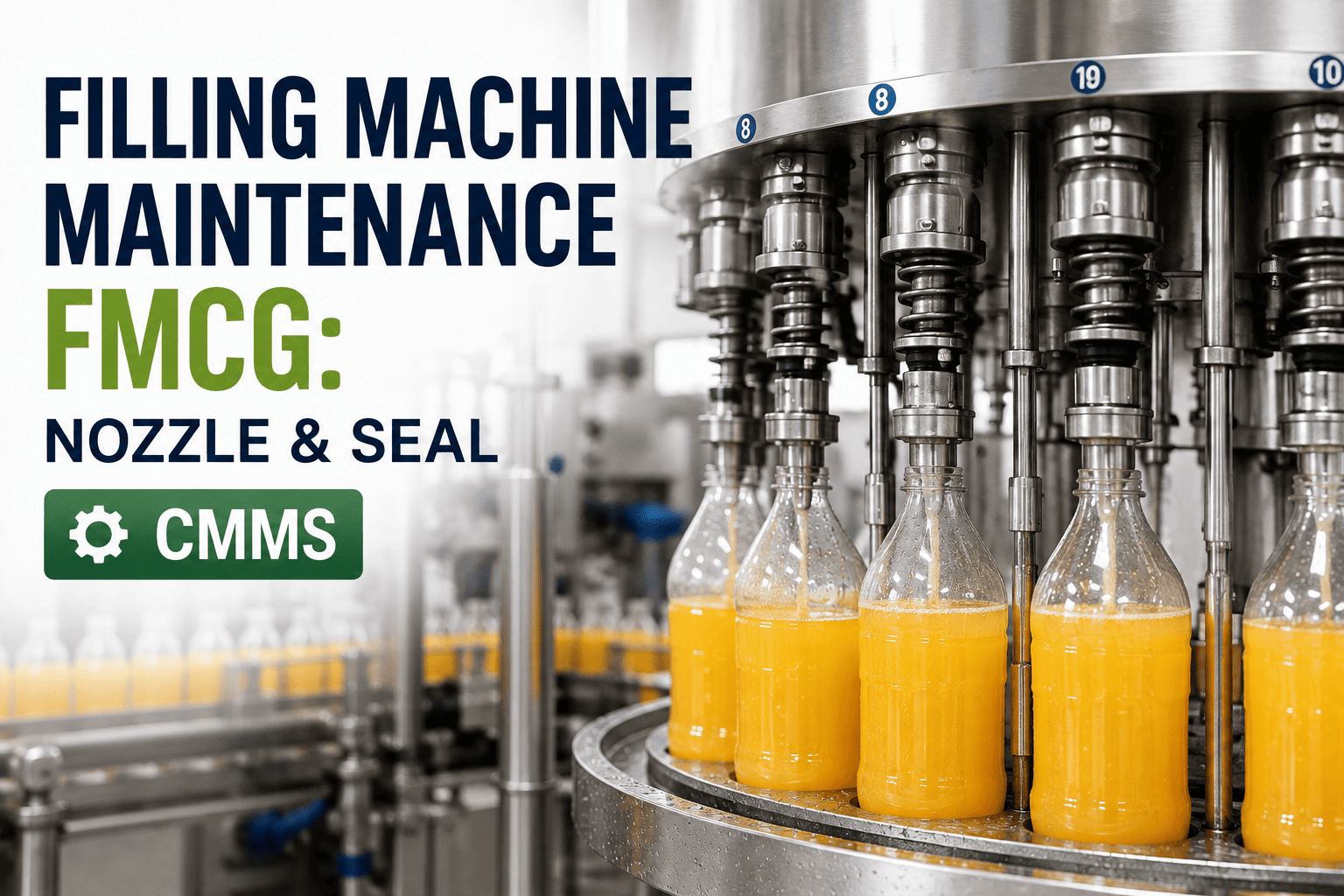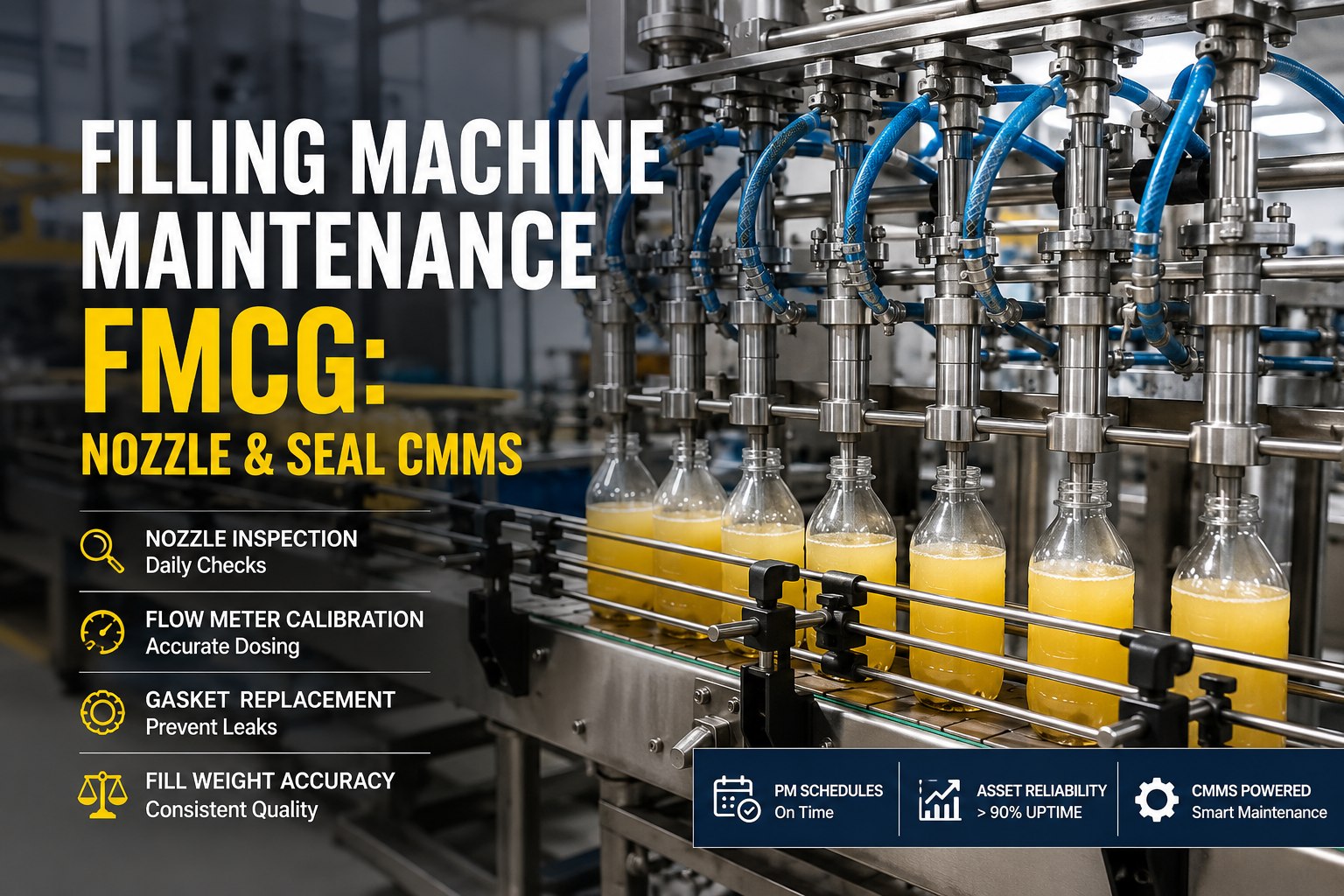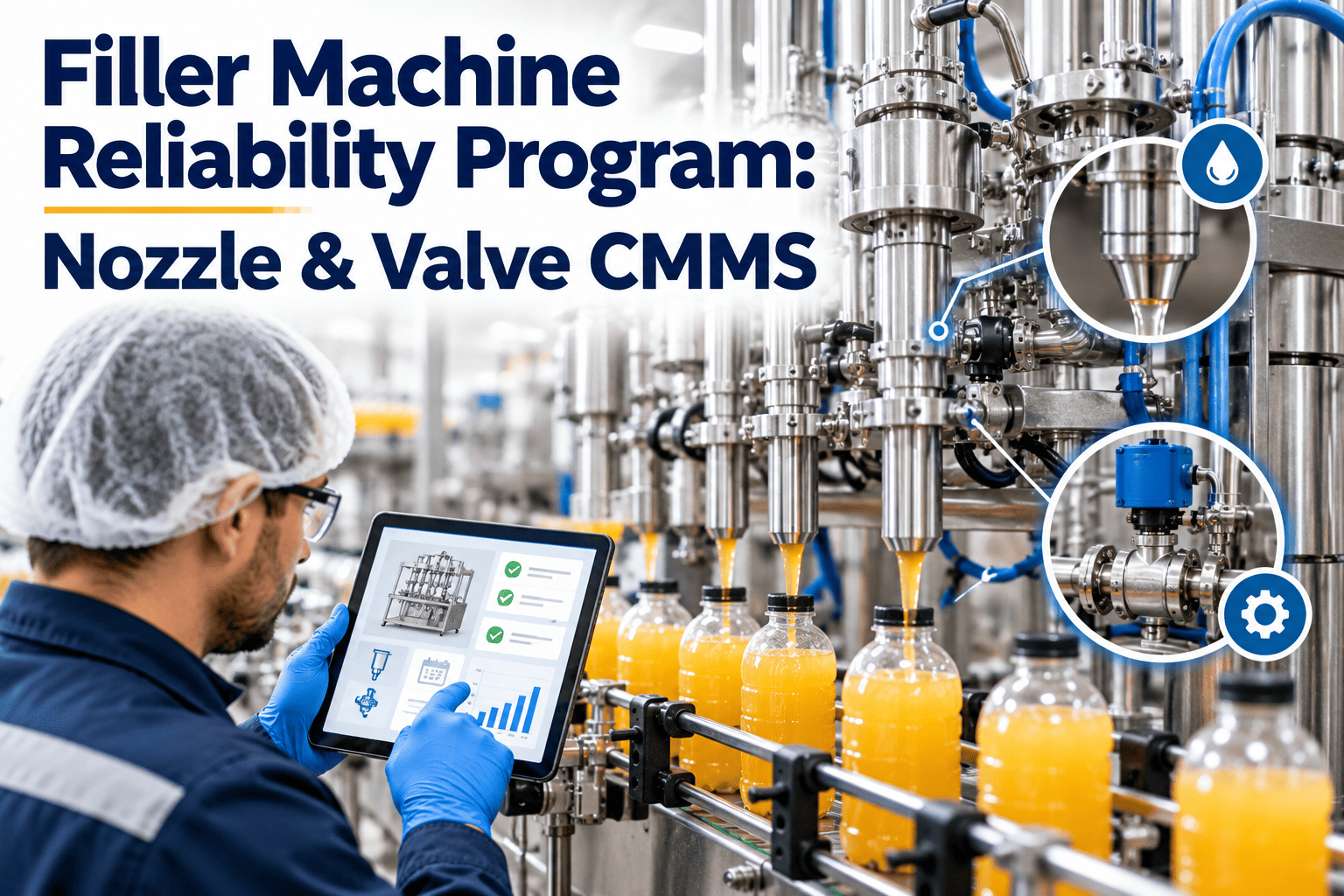
Fillers rarely fail in a way that stops the line on the spot. They drift: a nozzle wears a little, a valve seat starts to weep, a flow meter reads slightly off, and the fill target is quietly missed until a check weigher or a customer notices. In an FMCG plant, where one filler may serve many SKUs and run across several shifts, that slow decline is the real reliability problem. This guide sets out how to track nozzles by cycle, watch valve seats and flow meters for early signs, and run the whole program from one maintenance system that keeps counts, inspections, and repairs together.
Filler Machine Reliability Program: Nozzle and Valve Wear Tracking
A filler is a stack of wear parts working together. Count the cycles, inspect the seats, verify the meter, and the drift becomes a scheduled job instead of an unplanned stop.
Why Filler Problems Are Usually Reliability Problems in Disguise
Most filler complaints reach maintenance as symptoms: "head 7 is dripping", "the fill keeps moving", "we are giving away product". Treating each one as a separate event hides the pattern, which is that the same few wear parts are behind most of them.
What operators see
- Occasional drips at cutoff that clear after a clean.
- Fill weights creeping toward one limit during a run.
- A head that needs frequent offset changes to stay in range.
- Foam, splash, or poor container-neck cleanliness on specific positions.
What the asset history shows
- The same head or valve appearing in several short repairs.
- Seal and nozzle changes made at different times with no shared record of cycles.
- Calibration done on a calendar date regardless of how hard the filler worked.
- Adjustments on the HMI that were never logged against the cause.
Nozzle Wear Tracking by Cycle
Calendar intervals treat a filler that ran two shifts the same as one that ran six. Cycle counts, taken from the machine counter or an operator reading, track the stress the parts actually saw, which is why usage-based schedules suit nozzles better.
| Wear mechanism | What happens at the nozzle | How it shows up | What to record |
|---|---|---|---|
| Edge erosion or rounding | The cutoff edge loses its profile, so product clings or strings after shutoff | Drips, tails, or dirty container necks | Head number, cycle count, photo of the tip |
| Partial blockage | Dried product, particulates, or fibers narrow the bore | Low fill and slower flow on one head | Head number, product, cleaning method used |
| Seal and o-ring set | Elastomers compress, harden, or swell after contact with the product | Leak at joints, air drawn into the stream | Seal material, hours in service, product type |
| Chemical attack | Cleaning agents or the product itself degrade seals or surface finish | Pitting, sticky seals, short seal life | Cleaning chemical, concentration, seal material |
| Thread and clamp wear | Fittings loosen or lose their seat after repeated changeovers | Misalignment, leaks, inconsistent stream | Torque used, number of changeovers |
Setting cycle-based triggers
Which Wear Mechanisms Are Hardest to Spot
The bar shows how difficult each condition is to detect without a planned inspection. The harder it is to see, the more it needs a scheduled check rather than reliance on operator awareness.
Valve Seat Condition: From First Weep to Failure
Seats and seals wear in stages. Matching the response to the stage keeps small defects from turning into stops, and keeps healthy valves from being replaced early.
Pneumatic and actuator checks that protect the valve
Flow Meter Drift Monitoring
Volumetric and mass-flow fillers depend on the meter being right. Calibration alone proves the meter was correct on a given day, not that it has stayed correct since.
Calibration on a calendar only
- Drift is found at the next scheduled calibration, after weeks of off-target fill.
- Product giveaway and underfill are discovered at the check weigher or by a complaint.
- No link between meter readings and fill trends.
- Replacement decisions rely on opinion.
Drift monitored between calibrations
- Reference checks against a known weight or volume are logged at set intervals.
- Trends in zero offset and fill spread are reviewed by asset.
- A shift beyond your own limit opens a work order before the next calibration.
- Replacement is justified from recorded drift history.
Building the Reliability Program in Your CMMS
Product Type Changes the Wear Pattern
A reliability program built for water-thin liquids will mislead you on viscous or particulate products. Adjust triggers and inspection methods by product family rather than by machine alone.
| Product family | Main wear and drift risk | Adjustment to the program |
|---|---|---|
| Thin liquids | Seat and seal leaks, foaming at the nozzle, dripping after cutoff | Emphasize seat inspection and cutoff behavior, record foam control settings |
| Viscous creams and gels | Stringing, air entrapment, higher load on pumps and valves | Check pump and valve loading, inspect nozzle bore for buildup, track product temperature |
| Products with particulates | Bore wear, blockage, and seat damage from solids | Shorten inspection triggers, check strainers, record particle size changes |
| Abrasive or sugary products | Faster erosion, crystallized residues in valves | Review cleaning verification and track seal and seat life by product |
The Operational Impact of Unmanaged Filler Wear
Documentation That Supports Audits and Handover
What to keep on record
- The cycle count and date at every nozzle, seat, and seal change.
- Fill spread by head before and after each repair.
- Calibration and reference checks for meters and scales.
- The cleaning and sanitation method used before inspection.
Why it matters
- Quality teams can show that fill performance was controlled, not assumed.
- New technicians inherit a repair history instead of relying on the previous shift.
- Supplier warranty conversations rest on documented cycles and conditions.
- Capital requests for a rebuild can point to repeated failures on named assets.
From Reactive Fixes to Condition-Based Filler Care
KPIs for the Filler Reliability Program
Filler Readiness Checklist for PM and Changeover
- Nozzle tips inspected for edge condition and blockage.
- Seats and seals checked against the cycle trigger.
- Valve stroke and response compared across heads.
- Air filters, regulators, and dryers checked for moisture and oil.
- Flow meter reference check logged against a known value.
- Torque and alignment confirmed on fittings and clamps.
- Head numbers recorded on every adjustment or part change.
- Spare parts confirmed in stock before the PM window starts.
Mistakes That Make a Reliability Program Stall
Common errors
- Collecting cycle counts that nobody reviews or uses.
- Copying replacement intervals from another plant or a catalog without checking them against your product.
- Treating a head adjustment on the HMI as a repair.
- Logging parts as used without naming the head or product.
What keeps it alive
- A named owner who reviews the filler report each week.
- Intervals revised after each early failure and each uneventful inspection.
- Operators and technicians using the same asset structure.
- Findings linked to a work order, so action is tracked to completion.
Start small: choose the two or three filler heads with the worst repair history, build their cycle triggers first, and extend the program once the team trusts the numbers and the reports it produces.
Rolling the program out across several fillers
Start with
- The filler with the most repeat repairs.
- The products that cause the most nozzle or seat damage.
- A single, shared task template and asset structure.
Then extend to
- Fillers with similar valves and nozzles.
- Meters and scales used for fill verification.
- Spare parts and reports across the plant.