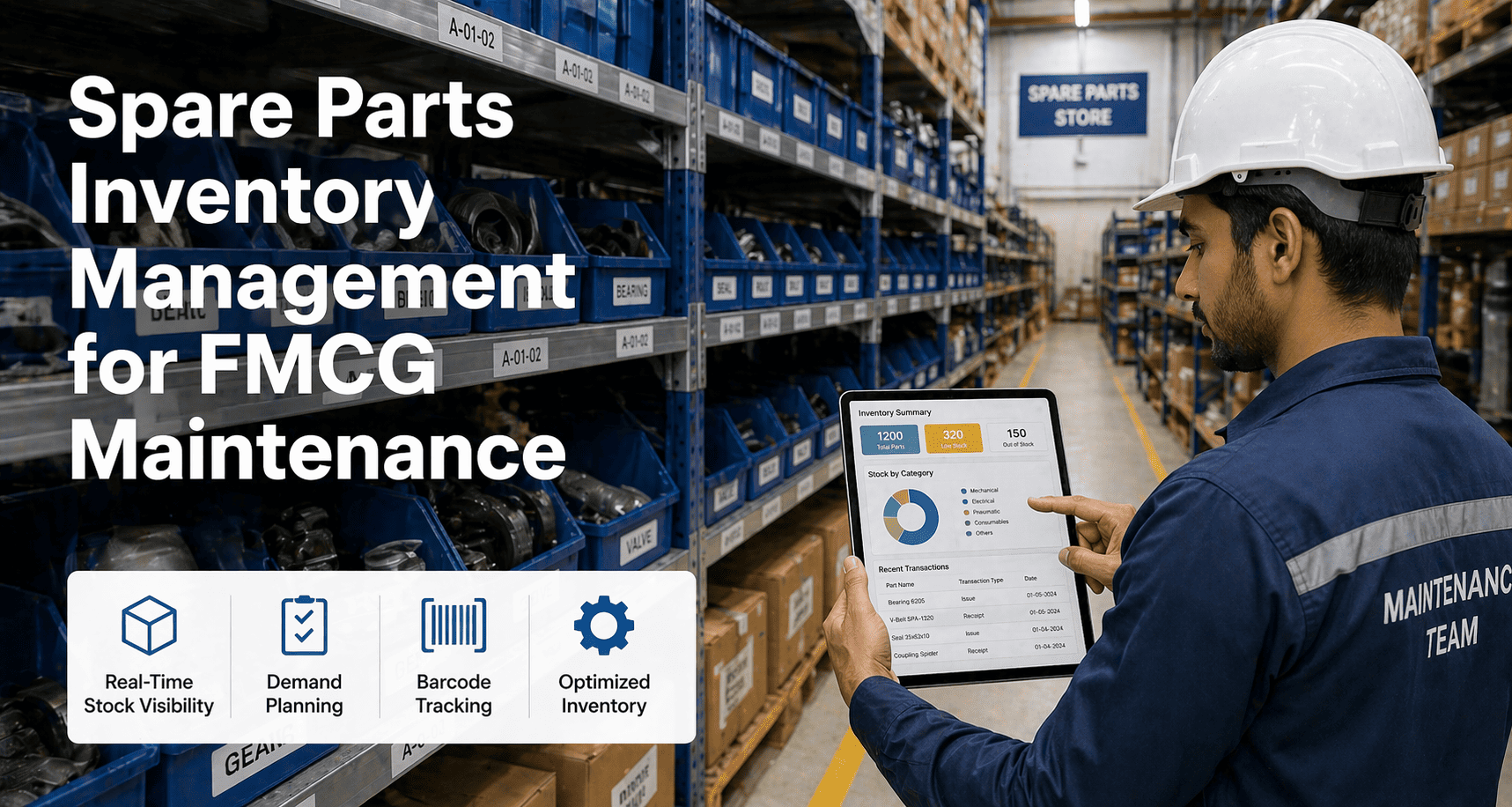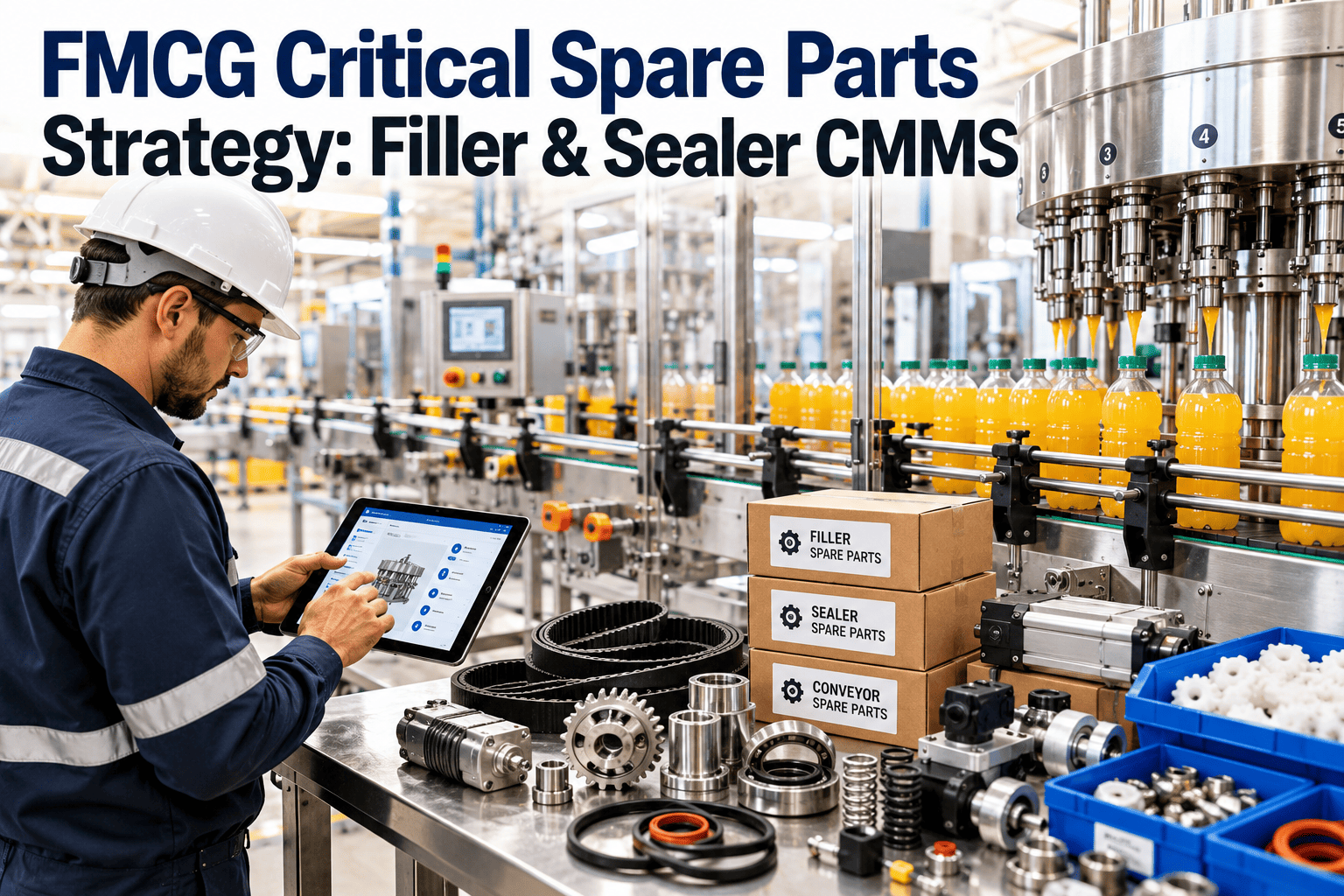
A ten-minute repair becomes a ten-hour stoppage when the part is not on site. FMCG plants feel this most on fillers, sealers and labelers, where small wear components such as nozzle seals, heater cartridges and sensors can halt a whole line. Stocking everything is not the answer either, because it ties up cash, space and shelf life. A critical spare parts strategy decides what to hold, how much, where and why, using failure history and lead times rather than habit. This guide explains how, and how Oxmaint inventory and work order tools can connect spares to the machines that use them.
Critical Spare Parts Strategy for FMCG Fillers and Sealers
Decide which filler nozzles, sealing jaws, heaters and labeler components deserve stock, based on line impact and lead time, and keep them linked to PM and repair work.
Where Spare Parts Programs Go Wrong
Most problems come from stocking by habit instead of by risk. These patterns appear in many plants.
- Stock-outs on small parts. A missing seal or sensor stops a machine worth far more.
- Overstock of the wrong items. Cash sits in parts for retired formats or obsolete models.
- No link to the machine. Technicians cannot tell which parts belong to which asset.
- Unknown lead times. Orders are placed after the failure, not before.
- Format parts forgotten. Changeover items go missing between product runs.
Building the Critical Spares List in Four Steps
Start from the machine and its failure modes, not from the storeroom shelf.
- 1
Break Down the Machine
List assemblies and wear components using the asset hierarchy and bill of materials.
- 2
Link to Failure Modes
Use work order history, FMEA or RCM results to see which parts actually fail.
- 3
Score Criticality
Rate line impact, quality and safety risk, lead time and substitute availability.
- 4
Assign a Stocking Policy
Set minimum, maximum and reorder levels, and name the storage location and owner.
Criteria for Scoring a Spare Part
| Criterion | Question to ask | Effect on stocking |
|---|---|---|
| Line impact | Does the part stop the whole line or only one lane? | Higher impact raises stock priority |
| Quality or safety effect | Could failure affect seal integrity, fill accuracy or product safety? | Justifies holding even low-use items |
| Lead time | How long from order to delivery, including imports? | Long lead time favors on-site stock |
| Failure likelihood | How often has it failed or worn out? | Frequent wear sets quantities |
| Substitutes | Can another part or supplier cover it? | Alternatives reduce the need to stock |
| Repairability | Can it be rebuilt or exchanged? | Supports rotable or pool approaches |
| Shelf life | Do seals, elastomers or adhesives age in storage? | Limits quantities and requires rotation |
Typical Critical Spares on Fillers, Sealers and Labelers
Treat this as a prompt for discussion, then confirm against your own machines and history.
| Machine | Component | Why it matters | Stocking approach |
|---|---|---|---|
| Filler | Nozzle valve seals and O-rings | Wear causes drip and fill variance | Kits per nozzle set, sized to change frequency |
| Filler | Dosing piston seals | Volume accuracy depends on them | Kits held on site |
| Filler | Flow meter or load cell | Drift or failure stops accurate filling | One spare when lead time is long |
| Filler | Solenoid valves and pneumatic fittings | Control of product and air flow | Minimum stock for common types |
| Sealer | Heater cartridges and thermocouples | Loss of temperature control | Held as matched sets |
| Sealer | Jaw tape and wear strips | Seal quality and jaw protection | Planned from PM usage |
| Sealer | Complete jaw assemblies | Long repair or lead time | Exchange pool |
| Labeler | Label and web sensors | Placement accuracy and stops | Spare per sensor type |
| Labeler | Peel plate, rollers and drive parts | Mechanical wear | Wear kit on site |
| Labeler | Print head or coding components | Legible codes may be a compliance need | Spare based on lead time |
Sealing Jaw Exchange Inventory: A Rotable Pool
For expensive assemblies that can be rebuilt, a pool often costs less than a spare for every machine. Parts rotate between the line, the workshop and the store.
- Step 1
Remove
Take the worn jaw off the machine during the stop.
- Step 2
Replace
Fit a refurbished jaw from the pool and restart.
- Step 3
Rebuild
Inspect, repair and test the removed jaw in the workshop.
- Step 4
Return
Place it back in the pool with its history recorded.
Stop Chasing Parts During Breakdowns
Link spares to assets, PM tasks and work orders so the right part is in the right place before the machine needs it.
Setting Stock Levels: Reorder Logic
A reorder point makes sure replenishment starts early enough to cover the supply lead time.
Illustrative example: a seal kit uses 6 units a month with a lead time of three weeks. Demand during lead time is about 4.5 units. Add 2 for safety and the reorder point is 7.
Stock Tiers for Packaging Spares
Tier A: Critical
Line-stopping or quality-critical parts with long lead times. Always held on site with named owners.
Tier B: Important
Frequent wear items and common replacements. Held at calculated min and max levels.
Tier C: General
Low-impact or readily available items. Ordered on demand or through supplier programs.
Spares Management: Before and After
Reactive Storeroom
- Orders raised after a failure
- Part numbers unclear or duplicated
- Usage not tied to machines
- Obsolete stock builds quietly
Risk-Based Spares
- Reorder points trigger replenishment
- Parts linked to assets and bills of materials
- PM tasks reserve required items
- Reviews remove obsolete stock
How a CMMS Supports Critical Spares
Inventory works best when it is part of the maintenance workflow, not a separate list.
Parts Linked to Assets
Show technicians which spares fit each filler, sealer or labeler.
Minimum and Reorder Levels
Flag low stock early and support purchase requests.
PM Part Requirements
Attach expected parts to scheduled tasks so they are staged in advance.
Work Order Consumption
Record parts used per repair to refine stock levels.
Reporting
Review stock-outs, usage and slow-moving items.
KPIs for Spare Parts Performance
| KPI | What it tells you | Action if poor |
|---|---|---|
| Stock-outs causing downtime | Whether critical parts are available | Review criticality and levels |
| Emergency purchases | Reactive buying frequency | Add or raise reorder points |
| Time to locate a part | Storeroom organization | Fix locations and labeling |
| Slow-moving or obsolete stock | Capital tied up unnecessarily | Reduce levels, return or dispose |
| Inventory accuracy | Trust in system records | Cycle counts and issue discipline |
Format and Changeover Parts Need a Separate Plan
Fillers, labelers and conveyors often run several pack sizes, and each format has its own tooling. These parts wear out of sight between runs.
- Nozzles and fill tubes. Damage or residue can cause drips and inaccurate fills when a format returns to the line.
- Guides, star wheels and neck rings. Wear changes container handling and can create jams.
- Label wipers and peel plates. Worn edges produce skew and bubbles.
- Gripper and carton tooling. Needed in matching sets for each case or tray style.
Inspect format sets when they are removed, not when they are next needed, so repairs happen before the production deadline.
Supplier Lead Times and Agreements
A stocking level is only as good as the lead time behind it. Verify lead times with suppliers and record them against each part.
- Confirm actual delivery time. Include customs, transport and supplier processing, not only catalog values.
- Ask about alternates. Approved equivalents can shorten lead time and reduce risk.
- Agree emergency service. Know what the supplier can do for urgent orders and at what cost.
- Consider consignment or exchange. Some suppliers hold stock or offer rebuilt exchange assemblies.
- Review regularly. Supply conditions change, so check lead times at least annually for Tier A parts.
Storing Spares So They Work When Needed
| Item type | Storage concern | Good practice |
|---|---|---|
| Seals and O-rings | Ageing, heat, light and contamination | Keep in sealed packaging, date label and rotate stock |
| Electronics and sensors | Static, moisture and damage | Use protective packaging and clean, dry shelving |
| Heater cartridges and thermocouples | Handling damage | Store in original packaging, matched sets together |
| Bearings and chains | Corrosion and dirt | Keep wrapped and lubricated as specified |
| Rebuilt assemblies | Mix-ups with unserviceable items | Tag condition, test date and asset compatibility |
Stocking Decision Example: Heater Cartridges
This hypothetical example shows how the criteria combine. Use your own data for real decisions.
Line Impact
Failure stops the sealer and the line behind it.
Failure History
Several replacements in the past year across similar sealers.
Lead Time
Supplier delivery takes longer than the plant can tolerate downtime.
Decision
Tier A. Hold matched spare sets on site and reorder when stock falls below the minimum.
Storeroom Discipline and Cycle Counting
- Clear locations. Every part has a labeled bin, and the location is recorded in the system.
- Issue on a work order. Parts are withdrawn against a job, so usage reaches the asset history.
- Count critical items often. Cycle count Tier A parts more frequently than lower tiers.
- Return unused parts. Parts brought back are re-shelved and re-recorded.
Accurate records matter more than perfect shelving. A reorder point is useless if the stock balance is wrong.
Obsolescence and Last-Time Buys
Older fillers and labelers may depend on parts that manufacturers are withdrawing. Act before availability disappears.
Reactive Approach
- Discover the part is discontinued during a breakdown
- Search brokers at high cost
- Accept used parts of unknown condition
Planned Approach
- Monitor supplier notices for critical parts
- Decide on a last-time buy or substitute early
- Plan an upgrade if the machine depends on obsolete items
Kitting for PM and Planned Shutdowns
Planned work should never wait for parts. Kitting groups everything needed for a task and reserves it in advance.
- 1
Define the Kit
List parts, consumables and special tools for the task.
- 2
Reserve Against the Work Order
Attach the required items so stock is held for the planned job.
- 3
Stage Before the Window
Move the kit to the line or workshop before the stop begins.
- 4
Reconcile After the Job
Record parts used, return the rest and trigger reorders.
Reviewing the Spares Program
- After each stock-out. Find out why the part was missing and adjust levels or criticality.
- When equipment changes. New machines or formats require updates to the list.
- Annually. Review slow-moving items, lead times and supplier performance.
- Using failure analysis. New findings from RCM, FMEA or defect elimination may add or remove critical spares.
Common Spare Parts Mistakes in FMCG Plants
- Copying the OEM list without review. Manufacturer lists are a useful start, but they do not reflect your products, speeds or failure history.
- Using the same levels for every site. Lines with different formats and volumes consume parts at different rates.
- Ignoring consumption data. Work orders show how many seals, tapes and sensors are really used.
- Holding spare machines worth of stock. A full second set of expensive assemblies may be better replaced by an exchange pool or supplier agreement.
- Leaving ownership unclear. Without a named owner, reorder points drift out of date.
Who Does What in a Spares Program
| Role | Responsibility | Decision input |
|---|---|---|
| Reliability or maintenance engineer | Criticality scoring and failure modes | RCM, FMEA, defect and work order data |
| Maintenance planner | Kits, reservations and PM part needs | Planned work schedule |
| Storekeeper | Receiving, locations, counts and issue discipline | Stock accuracy and usage |
| Purchasing | Supplier terms, lead times and alternates | Cost and delivery performance |
| Production and quality | Confirm line impact and quality requirements | Output and compliance priorities |
Teams ready to organize this in software can book an Oxmaint demo to see how inventory, PM and work orders share one asset record.
Measuring the Value of the Program
A spares program should reduce stoppages without letting inventory grow unchecked. Track both sides of that balance.
- Downtime tied to missing parts. Review work orders where waiting for parts is recorded and trace the cause.
- Inventory value by tier. Check that most capital sits in genuinely critical items.
- Rotable pool health. Confirm rebuilt jaws and assemblies return to service on time.
- Planned job readiness. Count how many planned tasks start with a complete kit.
Practical First Steps
- Start with the filler and sealer. They usually have the clearest line impact and the longest part lead times.
- Use two years of work orders. Identify parts that were actually used, and by which machine.
- Interview technicians. Ask which missing part caused the longest wait in the past year.
- Set levels for Tier A first. Extend to other tiers once the critical list is stable.
- Review monthly at first. Adjust quantities as consumption data becomes more reliable.
Spare Parts Strategy FAQs
How many nozzle spares should we hold?
Base it on wear rate, lead time and the number of nozzles on the filler.
Should we stock everything for critical machines?
No. Hold parts that fail, are hard to source and stop the line.
How do we handle shelf-life items?
Use dated stock, rotate first in first out and limit quantities.
Can a CMMS track spares by machine?
Where can we see this in action?
Hold the Right Spares, Not Just More Spares
Build a criticality-based stock list, link it to your machines and give planners the visibility to prevent parts-related stoppages.