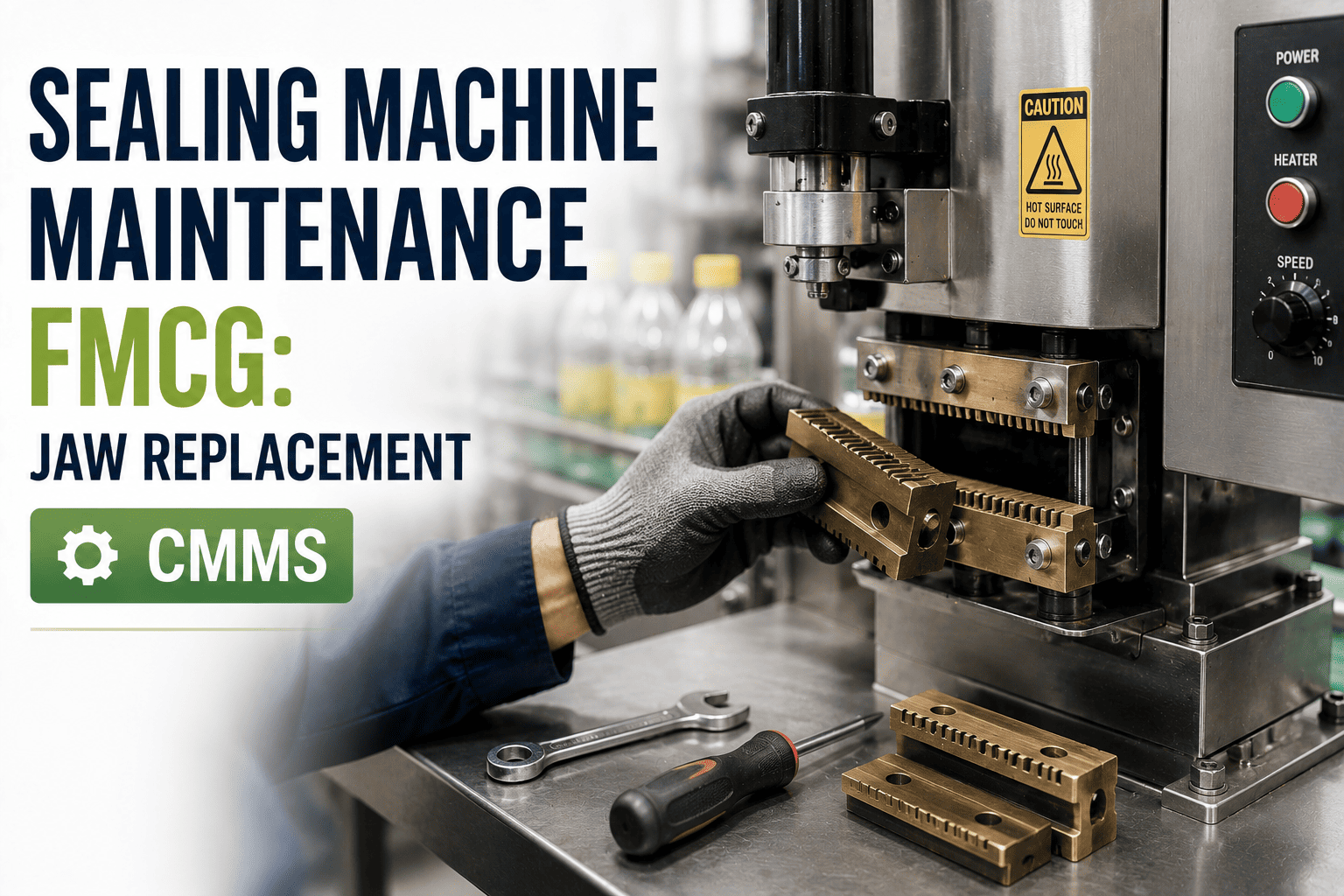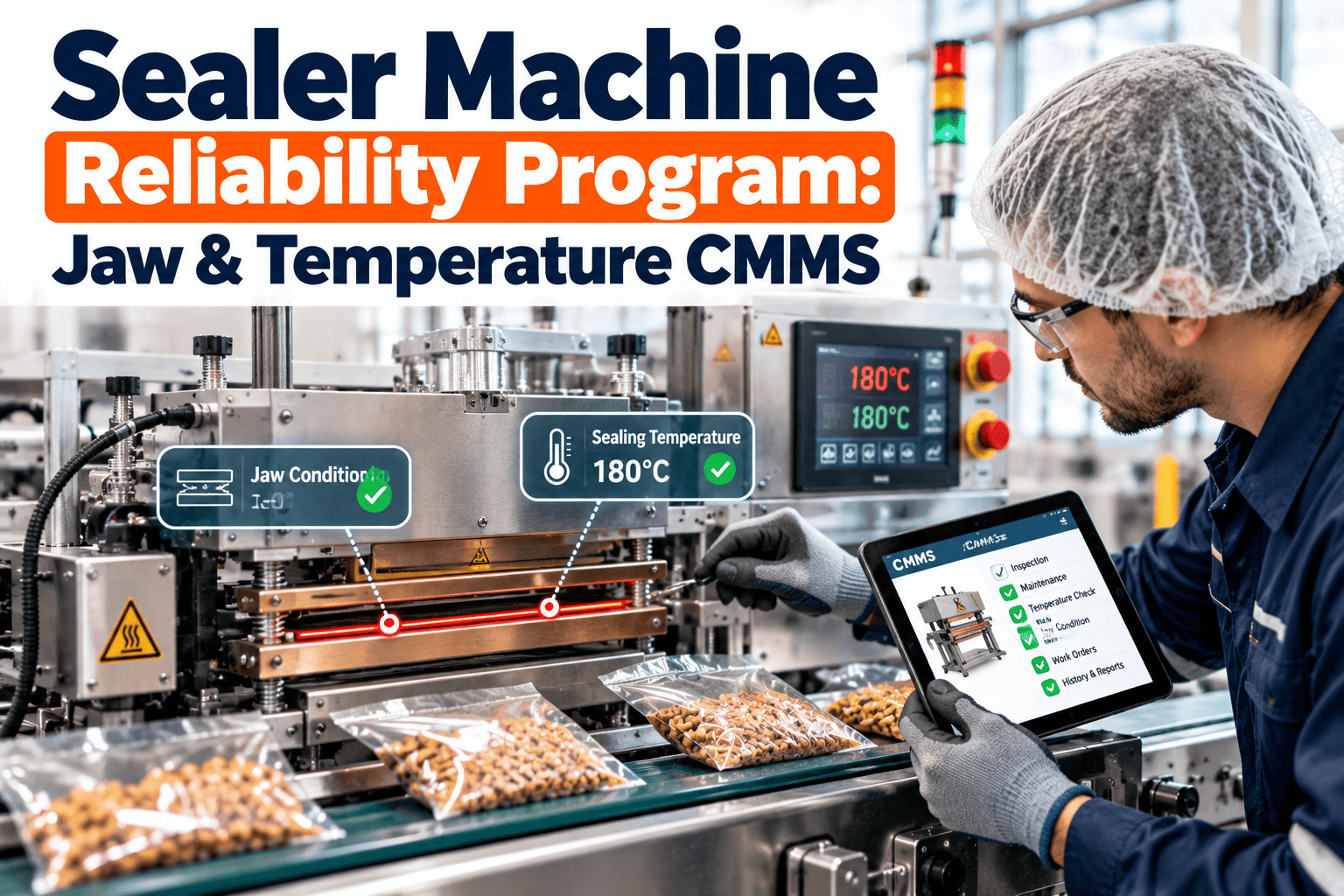
Sealer failures rarely arrive as a sudden stop. A jaw coating wears thin, a heater cartridge drifts, the seal narrows by a fraction of a millimetre, and the first warning is a leaking pack at a customer. FMCG plants running flow-wrap and form-fill-seal lines need a sealer reliability program driven by seal cycles and temperature trends rather than calendar dates. This guide explains how to track jaw wear and thermal uniformity inside Oxmaint maintenance management software so seal quality is managed before it fails.
Sealer Machine Reliability Program: Jaw Wear and Temperature Tracked by Seal Cycle
Why Sealer Reliability Is a Quality Problem Before It Is a Downtime Problem
On most FMCG packaging lines the sealer is the last value-adding step. Mixing, forming, and filling are wasted if the seal leaks, so sealer condition protects product as much as it protects uptime.
Jaw surface degrades
Cover tape glazes or cuts, serrations round off, and film residue bakes onto the sealing face.Heat transfer changes
The controller still shows the correct setpoint, but the film receives less energy along the seal line.Seal geometry drifts
Seal width narrows, channels appear in crimps, or hot tack weakens at higher line speeds.Defects escape
Leakers, weak peels, and contaminated seals reach retailers, triggering returns and audit findings.A cycle-based program interrupts this chain at step one or two, while the line is still running to specification.
Jaw Wear Is Consumed by Cycles, Not by Weeks
A sealer on a high-speed flow wrapper accumulates cycles far faster than one on a slower pillow line, yet both often share the same monthly PM. Counting cycles ties maintenance to actual wear.
Wear mechanisms worth tracking on every jaw set
In Oxmaint, a jaw set can be set up as its own asset under the sealer, so cycle readings, replacements, and defects stay with the part that actually wore.
How to set cycle thresholds that your plant can trust
- Start with the supplier's expected jaw life for your film structure and line speed.
- Log the cycle count at every jaw or cover tape change in the work order.
- Compare the logged life against leak test results and reject data for the same period.
- Adjust thresholds by film type, because laminates, mono-films, and heavy-gauge films age jaws differently.
Temperature Uniformity: The Setpoint Is Not the Seal Surface
A controller can read perfectly while one end of the jaw runs cool. The thermocouple measures one point, and the film seals along the whole length.
Within band
Within band
Within band
Within band
Running cool
Edge of band
Within band
Within band
Causes of thermal non-uniformity
- Heater cartridge degradation or partial element failure
- Thermocouple drift, poor contact, or damaged leads
- Loose terminals and connectors that heat or lose signal
- Controller tuning that overshoots during speed changes
- Insulating residue between the heater block and the cover tape
What to record at each thermal check
- Setpoint, displayed temperature, and a calibrated surface reading
- Readings at both ends and the centre of each jaw
- Film type, line speed, and dwell time at the time of the reading
- The technician who took the reading and the instrument used
Seal Width Drift: The Early Warning Most Lines Ignore
Seal width is slow to change and easy to measure. Trending it shift after shift shows jaw wear weeks before a leak test fails.
Measure
Take seal width with a gauge or calibrated loupe at fixed positions each shift.Record
Enter values on a mobile inspection checklist instead of paper.Trend
Compare against the nominal value and the lower control limit.Trigger
Raise a corrective work order when readings trend toward the limit.Verify
Confirm the repair by re-measuring and logging the result.Pair width readings with burst or leak test results so the plant knows how much drift is actually acceptable for each pack format.
Symptom to Cause to CMMS Action
| Symptom on the line | Likely sealer cause | First check | Record in Oxmaint |
|---|---|---|---|
| Leakers at one end of the seal | Cool jaw end or uneven pad pressure | Surface temperature at both ends, pad condition | Inspection result and corrective work order |
| Seal narrows over several shifts | Rounded serrations or worn cover tape | Jaw face and seal width trend | Cycle count and jaw replacement task |
| Brown marks or scorched film | Overheating, controller overshoot, or stuck thermocouple | Thermocouple reading versus surface probe | Calibration record and parts used |
| Wrinkles or channels in the seal | Damaged tape, misaligned jaws, or film tension | Tape surface, jaw parallelism, web path | Alignment task and photo evidence |
| Packs not separating cleanly | Dull knife or incorrect cut timing | Blade condition and timing settings | Blade change and setting log |
| Frequent temperature alarms | Connector fault, cartridge failure, or wiring damage | Resistance and continuity checks | Electrical work order and spare issued |
Put Seal Cycles and Jaw Temperature Into One Maintenance Record
Film and Product Factors That Change How Fast Jaws Wear
Two lines with identical sealers can show very different jaw life. Film structure, product contamination, and speed all shift the wear curve.
| Factor | Effect on the jaw | What to adjust in the program |
|---|---|---|
| Laminated and metallised films | Higher sealing temperatures and tighter windows increase thermal stress on tape and heaters | Shorter inspection interval and tighter temperature band |
| Dusty or oily products | Product in the seal area leaves residue and forces higher dwell or heat | More frequent cleaning tasks and visual checks of the jaw face |
| High line speed | More cycles per hour and less time for heat transfer | Lower cycle thresholds and thermal checks at running speed |
| Frequent changeovers | Repeated jaw adjustments disturb parallelism and pressure settings | Post-changeover verification step on the work order |
| Heavy-gauge or thick seal layers | Greater pressure and longer dwell compress pads faster | Pad inspection tied to cycle count |
Common Mistakes in Sealer Maintenance Programs
A Three-Phase Rollout That Fits a Busy Plant
Most plants do not need to instrument every line at once. Start with the sealers that cause the most rejects and expand from there.
Building the Reliability Program in Oxmaint
The program works because each piece of data has a home. Structure the assets first, then the triggers, then the reviews.
Spare Parts Planning for Jaws and Heaters
A sealer stopped for a missing cartridge is an avoidable loss. Link parts to assets and set stock levels by criticality.
Keep on the shelf
- Cover tape or PTFE sleeve kits for each jaw type
- Counter pads and fasteners
- Heater cartridges and thermocouples for critical lines
- Connectors, terminals, and fuses specific to the heater circuit
Order on trigger
- Complete jaw sets approaching the planning band
- Crimp jaws for low-volume pack formats
- Cut-off knives for special films
- Controller modules where lead times are long
Who Does What: Operators, Technicians, and Quality
Operators
- Visual jaw check and seal width reading at shift start
- Immediate report of leakers, scorch marks, or unusual noise
- Clean-down of the jaw face using approved methods
Maintenance technicians
- Cycle-based replacement of tape, pads, and cartridges
- Calibrated thermal profiling and thermocouple checks
- Alignment, pressure, and timing verification after repairs
Quality and engineering
- Leak and burst test results linked to the machine record
- Approval of acceptable seal width and temperature bands
- Monthly review of jaw life and reject trends
Weekly KPIs for Sealer Health
Reactive Versus Cycle-Based Sealer Maintenance
Reactive routine
- Jaws replaced when leakers appear
- Temperature checked only when an alarm trips
- Seal width measured on request
- Parts ordered after failure
- No link between rejects and machine condition
Cycle-based program
- Jaws replaced inside a planned window
- Thermal profile trended each shift or week
- Seal width logged on a mobile checklist
- Parts staged before thresholds are reached
- Rejects reviewed against asset history
Safety and Food Safety Records Around Sealers
Sealers combine heat, pinch points, and pressure. Maintenance records should show that both safety and product protection were considered.
- Lockout and tagout steps attached to each jaw and heater task
- Cool-down confirmation before cover tape or cartridge changes
- Guard and interlock checks recorded after every jaw adjustment
- Seal integrity test results linked to the batch and the machine state
- Calibration records for thermocouples and surface thermometers
- Foreign material control for torn tape or loose fragments after jaw work
Retail and GFSI-benchmarked audits commonly look for evidence that packaging controls are verified and records can be retrieved quickly.
Shift-Start Sealer Checklist
Sealer Reliability FAQs
How do I decide jaw replacement intervals?
Start with supplier guidance, record actual cycles at each change, and refine by film type. Review the data in Oxmaint.
Can I track temperature drift without extra sensors?
Yes. Use scheduled surface readings at jaw ends and centre, recorded through inspection checklists, and trend them over time.
What should trigger an urgent sealer work order?
Seal width nearing its lower limit, repeated leak test failures, or a thermal reading outside your defined band should open a corrective task.
Does this apply to both horizontal and vertical sealers?
The method is the same. Only the wear points differ, such as end seals, fin seals, or crimp jaws.
Can I see this in a live setup?
Yes. Book a demo to walk through sealer assets, checklists, and reports.