Most predictive maintenance pilots don't fail because the technology doesn't work. They fail because nobody picked the right assets, defined a KPI upfront, or set a hard evaluation date, so the pilot just quietly runs forever without ever proving anything. A pilot with a clear structure either proves value in twelve weeks or tells you fast that something needs to change. Sign up to structure a predictive maintenance pilot that actually produces a scale-up decision, not a shelf project.
What This Guide Covers
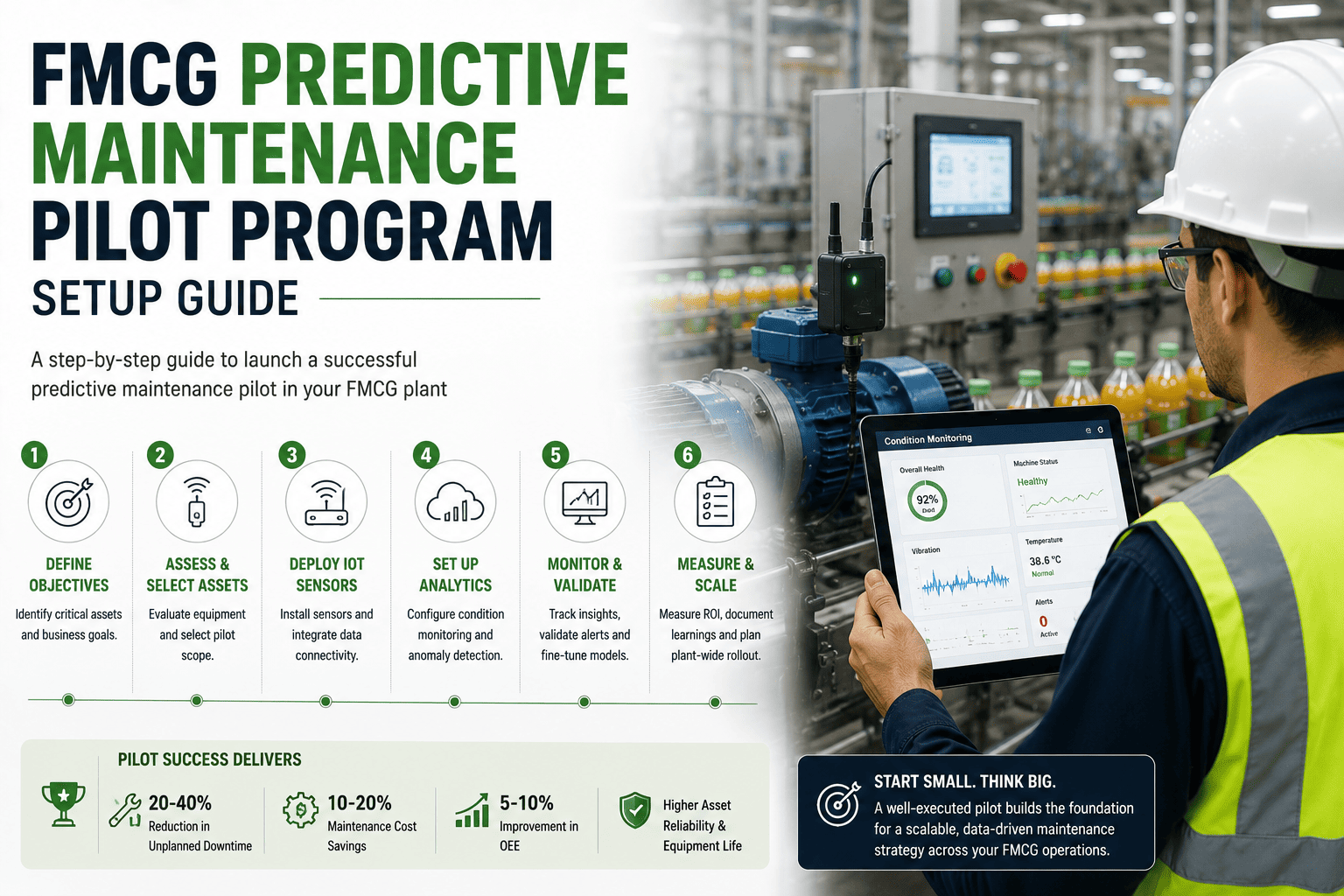
An FMCG predictive maintenance pilot is where PdM either proves value fast or becomes a shelf project nobody revisits. This guide covers FMCG predictive maintenance pilot program setup: critical asset selection, technology choice, KPI definition, sensor deployment and baseline data collection, and the twelve-week pilot design that consistently generates the proof case for enterprise-scale investment.
A 12-Week Pilot Timeline
W1-2
Critical Asset Selection
Select three to five assets by ranking downtime cost, failure frequency, and how measurable their signals are
W3-4
Sensor Deployment And Baseline Data
Install sensors and start collecting behavioral data long enough to establish what normal actually looks like
W5-10
Live Monitoring And KPI Tracking
Run predictive monitoring against the defined KPIs, logging every alert, catch, and false positive along the way
W11-12
Evaluation And Enterprise Case
Compare pilot results against the baseline and KPIs, then package the outcome into a scale-up decision
Four Decisions That Determine Pilot Success
| Decision |
Why It Matters |
| Asset selection |
Picking assets that are too healthy or too unpredictable makes it hard to show a clear before-and-after result in twelve weeks |
| Technology choice |
Sensor and analytics choices that don't fit the asset's failure modes waste the pilot window collecting the wrong data |
| KPI definition |
Without a KPI agreed before the pilot starts, results become a debate at review time instead of a clear yes or no |
| Evaluation criteria |
A fixed evaluation date and threshold keeps the pilot from drifting into an open-ended project nobody ever closes out |
Run Your Pilot On A System Built To Prove It
OxMaint ties asset selection, baseline data, KPI tracking, and pilot results together in one dashboard your team can present. Sign up for a free trial to start structuring your predictive maintenance pilot, or book a demo to see how it maps to your lines.
What A CMMS Adds To A Predictive Pilot
Baseline Data Log
Baseline readings for every pilot asset stay stored and timestamped, giving the evaluation a real before-and-after
KPI Dashboard
Downtime, catches, and false positives track live against the KPIs agreed before the pilot ever started
Pilot Asset History
Every alert, work order, and outcome stays attached to its asset, building the evidence base for the scale-up case
Scale-Up Readiness Report
Pilot results roll up into a single report leadership can use to approve or adjust the enterprise rollout
A Pilot Without KPIs Is Just A Demo
A predictive pilot that runs without an agreed KPI and evaluation date rarely gets a clean answer, it just gets extended. The pilots that actually produce a scale-up decision are the ones with the asset list, the KPIs, and the evaluation date locked in before week one, not the ones figuring it out as they go.
Frequently Asked Questions
Q
How many assets should a predictive maintenance pilot actually include?
Most successful pilots stay in the range of three to five assets, since that's enough to show a meaningful pattern without spreading the pilot team too thin to properly analyze the results within twelve weeks.
Q
Which KPIs matter most for a predictive maintenance pilot?
Unplanned downtime avoided, alert accuracy, and time from alert to resolved work order are usually the three KPIs that tell leadership the most about whether the pilot is actually working, ahead of any secondary metric.
Q
Why does a pilot need a full twelve weeks?
The first few weeks are needed just to establish a reliable baseline, so a shorter pilot often ends before there's been enough live monitoring time to actually catch and evaluate a meaningful number of real events.
Turn Your Pilot Into A Decision, Not A Shelf Project
OxMaint turns asset selection, baseline data, and KPI tracking into one clear pilot record you can present to leadership. Sign up for a free trial to start structuring your predictive maintenance pilot, or book a demo to see it built around your plant.