Most FMCG plants that fail at predictive maintenance do not fail because the technology does not work. They fail because they deployed sensors without a data strategy, connected monitoring hardware without defining alarm thresholds, or purchased an AI platform without integrating it into the CMMS workflow where technicians actually receive and act on work orders. Predictive maintenance is not a technology purchase — it is a technology stack. Each layer must be specified, deployed, and integrated in sequence. This article defines the complete stack: from sensor selection and placement through edge computing, AI model configuration, CMMS integration, and the workflow changes that convert algorithm outputs into maintenance actions that prevent failures. Start your free trial to connect predictive data to your maintenance workflow. Book a demo to see OxMaint's AI-Powered Predictive Maintenance module in a live FMCG configuration.
AI-Powered Predictive Maintenance
Sensors Generate Data. OxMaint Converts It Into Work Orders That Prevent Failures.
OxMaint's predictive maintenance module ingests vibration, temperature, and process data from connected sensors, applies AI-driven anomaly detection, and automatically creates prioritised work orders when thresholds are exceeded — closing the loop between condition monitoring and maintenance execution.
$180B
estimated annual unplanned downtime cost in global manufacturing — 80% preventable with condition monitoring
10:1
average ROI on predictive maintenance investment across discrete and process manufacturing sectors
4–8 wks
average warning period vibration analysis provides before rotating equipment failure in FMCG applications
Why Most PdM Deployments Fail — and What the Successful Ones Do Differently
A 2024 survey of manufacturing PdM deployments found that 63% of plants that invested in predictive maintenance technology reported disappointing results within 24 months. The failure modes were consistent: sensors installed on non-critical equipment, alarm thresholds set too tight producing alert fatigue, monitoring data never integrated with the CMMS, and maintenance teams that did not trust or understand the algorithm outputs. The 37% that reported strong results shared four common characteristics — asset criticality-led deployment, integrated CMMS workflow, trained technician interpreters, and a defined escalation process from alert to work order to repair.
Monitoring data not connected to CMMS work order workflow
34%
Integration
Alert fatigue from poorly configured thresholds
23%
Configuration
Sensors deployed on wrong (non-critical) assets
17%
Strategy
No trained personnel to interpret condition data
11%
Skills
Technology deployed before PM foundation in place
9%
Sequencing
Vendor lock-in preventing CMMS integration
6%
Technology
The Five-Layer Predictive Maintenance Technology Stack
A complete predictive maintenance deployment comprises five distinct technology layers. Each layer has a specific function, and the failure of any single layer breaks the chain between physical equipment condition and maintenance action. Most FMCG plants that deploy PdM successfully build layers 1–3 first — establishing reliable data collection before investing in AI analytics — and add layers 4–5 once baseline condition data for each asset has been established over 3–6 months.
Layer 5
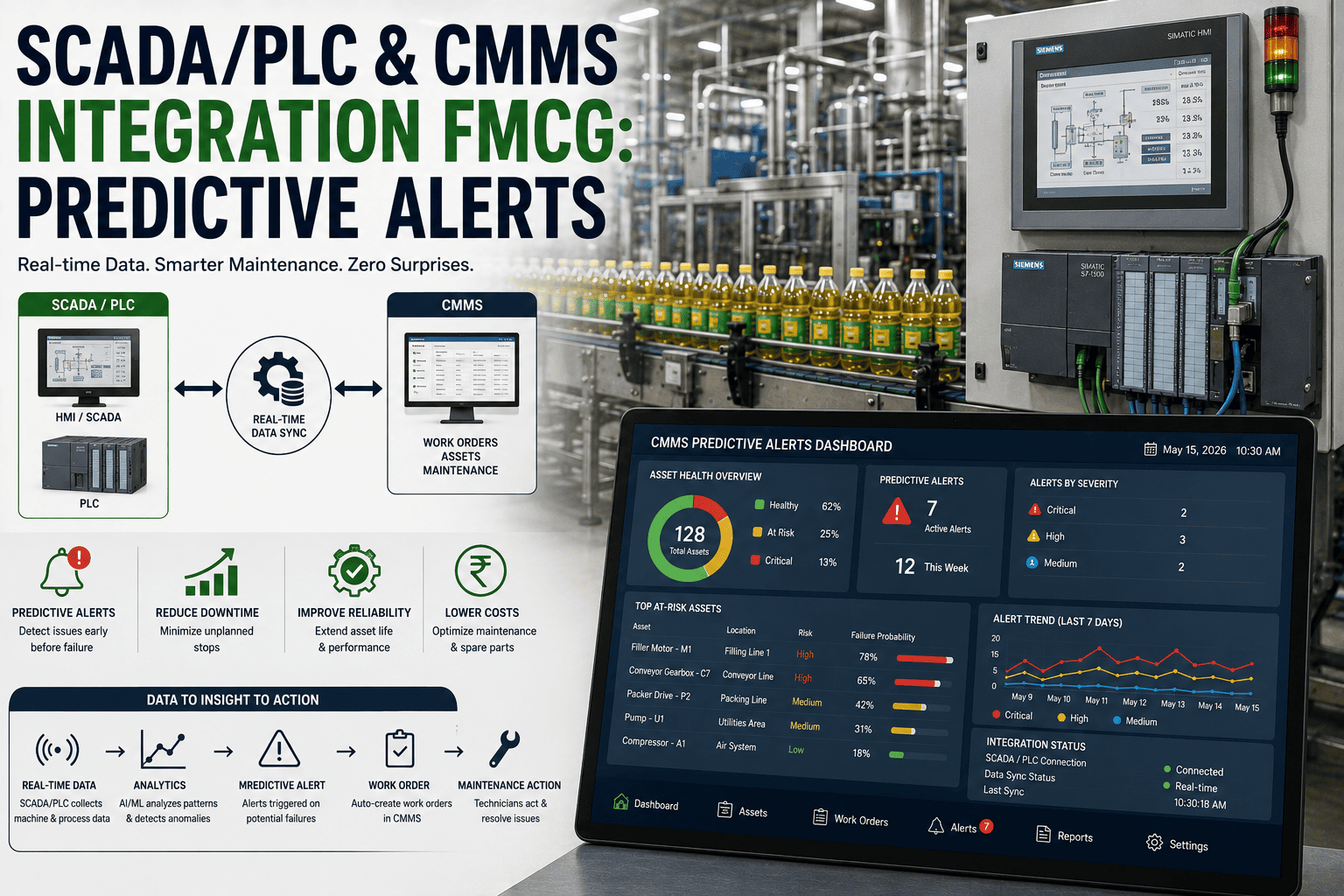
CMMS Workflow Integration & Action Management
Converts algorithm outputs into maintenance work orders, assigns priority, routes to technician, tracks completion, and feeds outcomes back into the model as training data.
Act
Layer 4
AI Analytics & Anomaly Detection Platform
Machine learning models trained on asset-specific baseline data identify deviation patterns, predict remaining useful life, and generate prioritised maintenance alerts with confidence scores.
Predict
Layer 3
Edge Computing & Data Preprocessing
Local processing nodes filter noise, apply FFT transformation to vibration data, compute statistical features, and transmit processed data to the cloud — reducing bandwidth and enabling real-time threshold alerting without cloud latency.
Process
Layer 2
Connectivity & Data Transmission Infrastructure
Wireless protocols (LoRaWAN, WiFi 6, Bluetooth 5, 4G/5G), gateways, and network architecture that reliably transmits sensor data from the plant floor to edge or cloud processing — with appropriate security and redundancy.
Connect
Layer 1
Sensing & Data Acquisition Hardware
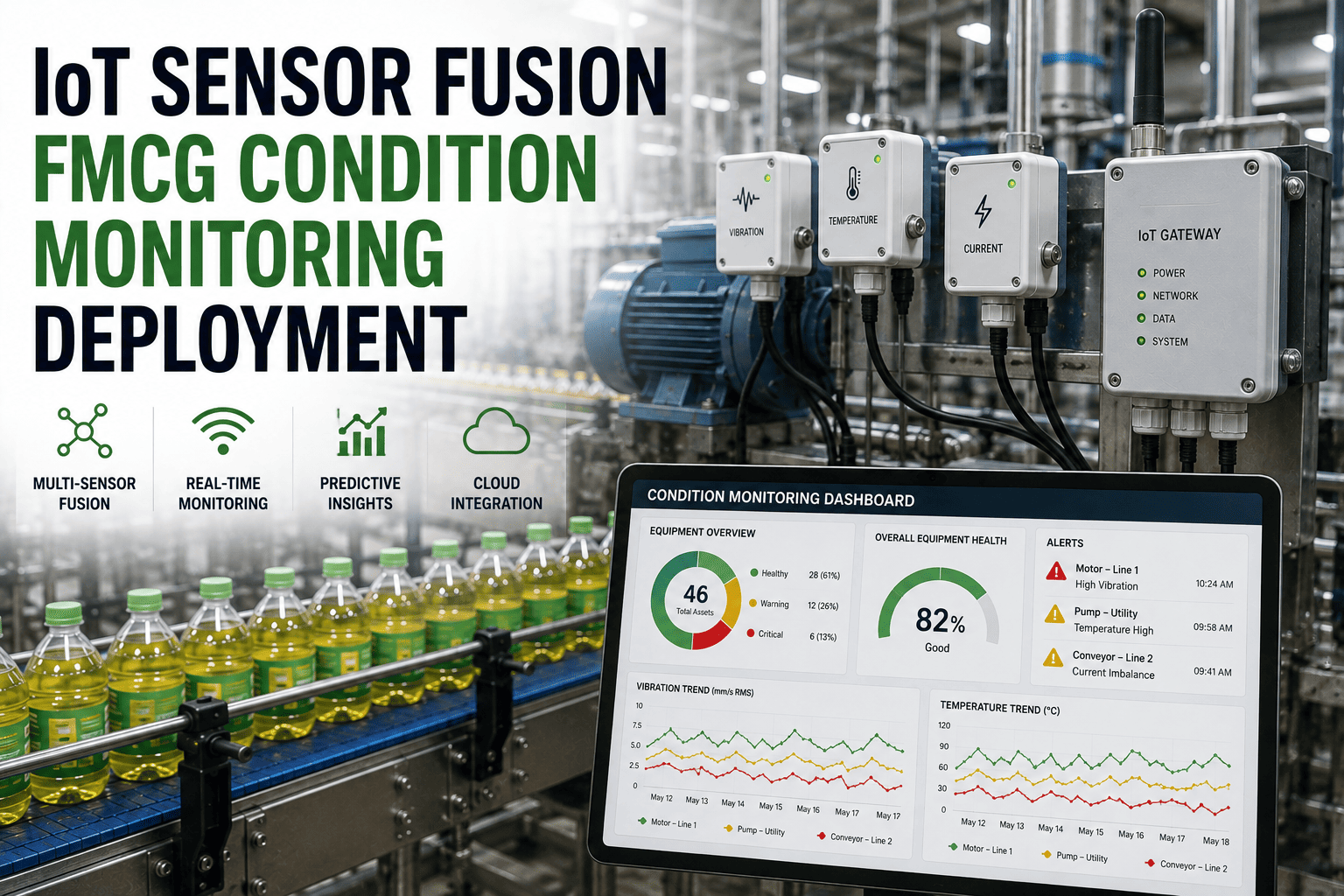
Vibration sensors, temperature sensors, current sensors, ultrasonic transducers, oil quality sensors, and process variable instruments that capture physical equipment condition at the required sampling frequency and accuracy.
Sense
Layer 1: Sensing Technology — Matching Sensor to Failure Mode
Sensor selection is the most consequential decision in a PdM deployment. The wrong sensor on the right asset produces data that cannot detect the target failure mode. The right sensor on the wrong asset wastes capital and generates noise. Every sensor deployment decision must start with a specific failure mode, determine whether that failure mode produces a detectable physical signal, and select the sensor technology that most reliably detects that signal with sufficient warning time.
Vibration Sensors — Rotating Equipment
Detects: Bearing defects (BPFO/BPFI frequencies), shaft misalignment (2x running speed), imbalance (1x running speed), looseness (sub-harmonics), gear mesh defects (GMF and sidebands). Warning period: 2–8 weeks for bearing defects in typical FMCG rotating equipment.
Deployment: MEMS or piezoelectric accelerometer mounted on bearing housing. Triaxial sensors for comprehensive coverage. Sampling rate: 10–25 kHz for bearing defect detection. Wireless sensors (e.g., SKF Enlight Collect, Schaeffler OPTIME) enable battery-powered deployment without cabling cost. Target: all motors and pumps above 7.5 kW, all gearboxes, critical compressors.
Thermal
Electrical + Mech
Infrared Temperature Sensors — Electrical and Mechanical
Detects: Loose or high-resistance electrical connections (localised hot spots), overloaded circuits, failing bearings (surface temperature rise), conveyor belt splice degradation, heat exchanger fouling, steam trap failure. Warning period: 1–6 weeks depending on failure progression rate.
Deployment: Fixed IR sensors on critical electrical panels and motor junction boxes for continuous monitoring. Handheld or drone-mounted thermal cameras for quarterly plant-wide scanning. Fixed sensors justified where panel access is restricted or continuous monitoring is required for fire risk compliance. Resolution: ±2°C, temperature range −20°C to 550°C for most FMCG applications.
Ultrasonic
Leak + Early Bearing
Ultrasonic Sensors — Compressed Air and Early-Stage Bearing Defects
Detects: Compressed air and steam leaks (turbulent flow produces ultrasonic signature), electrical arcing and corona discharge in HV equipment, very early-stage bearing defects (Stage 1–2 on bearing defect progression scale) before vibration analysis can detect them. Warning period: 4–12 weeks for bearing defects at Stage 1–2.
Deployment: Handheld ultrasonic detector for quarterly leak surveys — compressed air leaks in FMCG plants average 25–35% of total compressed air consumption, representing $12K–$35K annual energy waste per plant. Fixed ultrasonic sensors on critical high-speed bearings for early-warning supplementation to vibration monitoring. Frequency range: 20–100 kHz.
Current / Power Sensors — Motor Health and Process Anomalies
Detects: Motor winding degradation (Motor Current Signature Analysis — MCSA), rotor bar defects, pump cavitation (current signature change), conveyor belt tension changes, and process load anomalies that indicate downstream equipment issues. Warning period: 4–16 weeks for winding degradation detection.
Deployment: Non-invasive clamp-on current transformers installed on motor supply cables — no motor shutdown required for installation. Current data combined with speed data enables torque calculation and efficiency trending. Particularly valuable in hygienic FMCG environments where sensor placement on equipment is restricted by washdown requirements and FDA/GMP surface access rules.
Oil Quality
Gearbox + Hydraulic
Oil Quality Sensors — Gearboxes and Hydraulic Systems
Detects: Ferrous particle count (gear and bearing wear metal accumulation), oil viscosity change (degradation or contamination), water ingress (emulsification), and particle size distribution changes that indicate progression from normal wear to accelerated wear. Warning period: 1–4 months through trend analysis.
Deployment: Inline oil quality sensors on critical gearboxes enable continuous monitoring vs quarterly lab sampling. Particle counters (ISO 11171 calibrated) measure contamination level in real time. Dielectric sensors measure oil condition continuously. For plants with 10+ critical gearboxes, inline sensors pay back in 18–24 months through optimised oil change intervals and prevented gearbox failures.
Sensor Integration & Data Ingestion
OxMaint Connects to Your Sensors — Whatever Protocol They Use
OxMaint ingests condition monitoring data via MQTT, REST API, OPC-UA, and direct sensor cloud integrations — translating raw sensor readings into equipment health scores, trend alerts, and automated work orders without custom development work.
Layer 2: Connectivity — Choosing the Right Protocol for Your Plant Environment
Wireless connectivity for industrial sensors in FMCG plants is not a single technology choice — it is a protocol selection matched to the specific requirements of range, data rate, power consumption, interference resilience, and food safety compliance in each deployment zone. The wrong protocol produces connectivity gaps, battery drain, or interference with production control systems that undermines the entire PdM investment.
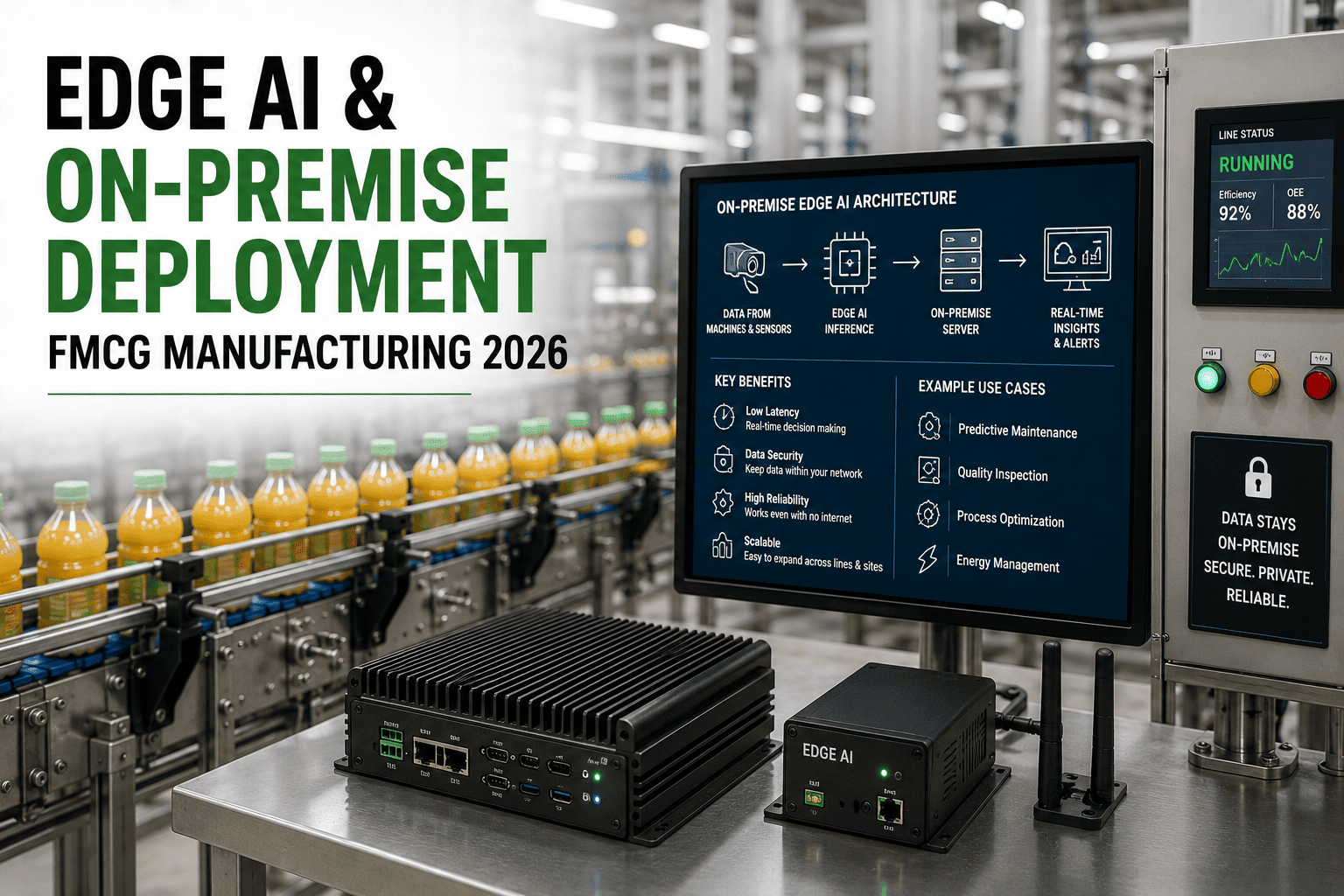
Layer 3: Edge Computing — Why Local Processing Changes the Economics
Raw vibration data from a single accelerometer sampled at 25 kHz generates approximately 50 MB per measurement. Transmitting this raw data from hundreds of sensors to a cloud platform creates bandwidth costs and latency that make real-time alerting impractical. Edge computing — local processing nodes installed in electrical cabinets or equipment enclosures — transforms this economics by computing the features that matter (RMS velocity, kurtosis, crest factor, FFT spectrum peaks) locally and transmitting only the derived metrics, reducing data volume by 95–99% while enabling sub-second threshold alerting without cloud dependency.
Are edge nodes rated for the plant environment — IP65+ and temperature-rated for the installation zone?
FMCG plant environments range from ambient dry goods areas to -25°C cold stores to +40°C boiler rooms to high-humidity washdown zones. Edge computing hardware must be rated for the specific zone — an IP54-rated node in a washdown area will fail within months. Specify IP65 minimum for any production area. For cold stores, verify operating temperature range extends to -30°C. For washdown areas, confirm stainless housing or appropriate protective enclosure.
Is the edge node computing capacity matched to the number of sensors and sampling frequency?
FFT computation on 25 kHz vibration data from 8 sensors simultaneously requires approximately 2–4 GFLOPS of processing capacity. Underpowered edge nodes introduce processing latency that delays alerts and can miss transient fault signatures. Size edge computing capacity at 2x the calculated requirement to accommodate future sensor additions and algorithm complexity increases without hardware replacement.
Is there a defined data retention policy for edge-stored data during cloud connectivity outages?
Cloud connectivity outages in FMCG plants average 4–12 hours per month due to network maintenance, IT changes, and infrastructure issues. Edge nodes must buffer and store data locally during outages and reliably synchronise to cloud when connectivity resumes. Define minimum local storage as 7 days of full-resolution data per sensor. Without this, connectivity outages create gaps in the condition history exactly when they are most likely — during maintenance windows that coincide with network changes.
Are OT/IT network security boundaries correctly implemented between edge nodes and plant control systems?
Edge PdM nodes connect to both the sensor network and the plant IT/cloud network — making them a potential bridge between OT (operational technology) and IT networks. This bridge must be explicitly designed with unidirectional data flow (sensor data can flow out; no commands can flow in to the OT network), network segmentation, and monitoring. A poorly secured edge node is an attack surface on the production control system. Review OT cybersecurity requirements before finalising edge architecture.
Layer 4: AI Analytics — How Predictive Models Are Built, Trained, and Validated
AI predictive maintenance models are not plug-and-play. They require a baseline period of normal-condition data collection, a training process that establishes what "normal" looks like for each specific asset, and an ongoing validation process that confirms the model is maintaining accuracy as equipment ages, is serviced, and is operated under varying load conditions. Understanding this process allows maintenance teams to set realistic expectations, avoid the alert fatigue trap, and extract maximum value from the AI investment.
Phase 1
Baseline Data Collection
Duration: 4–12 weeks
Sensors collect condition data during normal operation across the full range of operating conditions — different speeds, loads, temperatures, and product runs. The model needs to see what "healthy" looks like under all normal conditions before it can identify deviations. Attempting to deploy anomaly detection before 4 weeks of baseline data produces high false positive rates that destroy team confidence in the system.
Phase 2
Model Training and Threshold Setting
Duration: 1–2 weeks
Unsupervised ML models (Isolation Forest, Autoencoder, LSTM) establish the statistical boundaries of normal behaviour for each asset and each operating condition. Alert thresholds are set at 2–3 standard deviations from normal baseline — calibrated to balance sensitivity (catching real failures) against specificity (avoiding false alarms). Initial thresholds require tuning during the first 60 days of live operation.
Phase 3
Live Alerting and Threshold Refinement
Duration: Months 3–6
The system generates alerts in live operation. Each alert is reviewed by the maintenance team — investigated, confirmed or dismissed, and the outcome (real failure vs false alarm) fed back into the model as labelled training data. This supervised feedback loop progressively improves model accuracy. False alarm rate should drop below 15% by month 4 on well-configured deployments. Above 25% after month 6 indicates threshold or feature engineering problems.
Phase 4
Remaining Useful Life Prediction
Duration: After 6 months of data
Once sufficient failure history exists (typically 3–5 confirmed failure events per asset type), the model can transition from anomaly detection to prognostics — estimating remaining useful life (RUL) in days or weeks. RUL prediction enables maintenance scheduling within production windows rather than emergency response. Confidence intervals on RUL predictions should always be displayed — a prediction of "14 ± 5 days" is more actionable than a point estimate with no uncertainty range.
Layer 5: CMMS Integration — Closing the Loop From Alert to Action
The most common and most expensive failure in PdM deployments is the absence of Layer 5: a monitoring system that generates excellent alerts that nobody acts on in time because there is no defined process for converting an algorithm output into a scheduled, assigned, tracked maintenance work order. In plants with this gap, the monitoring investment is complete — but the value is captured only intermittently, when a technician happens to notice the alert and acts on their own initiative rather than through a systematic workflow.
Deployment Sequencing: The Right Order to Build the Stack
Deploying the five layers in the wrong sequence is the most common reason PdM programmes stall after initial investment. Layer 5 (CMMS integration) must be configured before Layer 4 (AI analytics) generates live alerts — because alerts without a workflow produce nothing but noise. Layer 4 requires Layer 3 (edge processing) to be stable before training begins — because noisy, gap-filled data trains poor models. The correct deployment sequence is always bottom-up: 1 → 2 → 3 → 4 → 5.
Month 1–2
Asset Selection, CMMS Foundation, and Sensor Specification
Rank all assets by criticality and failure cost. Select top 20 assets for initial PdM deployment — prioritise rotating equipment above 7.5 kW and high-consequence single points of failure. Verify CMMS asset register is complete and accurate for target assets. Select sensor technology for each target failure mode. Specify edge computing hardware for each deployment zone. Configure CMMS alert-to-work-order workflow before any sensors are installed.
Month 3
Sensor Installation, Edge Deployment, and Connectivity Validation
Install sensors on selected assets with documented placement positions (exact mounting location, orientation, and coupling method). Deploy edge computing nodes. Validate connectivity — verify data flow from each sensor to edge to cloud with no gaps. Establish baseline sampling schedule. Configure initial alert thresholds conservatively (set high to avoid early false alarms). Begin baseline data collection period — do not enable AI alerting until 6 weeks of clean baseline data is collected.
Month 4–5
Baseline Collection, Model Training, and Technician Preparation
Continue baseline data collection through full operating range. Train maintenance technicians on reading condition monitoring dashboards, understanding alert levels, and the work order response protocol. Simulate alert scenarios in the CMMS to verify workflow. Build failure mode library in the CMMS — document what signature each failure type produces in the sensor data for this specific plant. Complete AI model training on baseline data at end of month 5.
Month 6+
Live Alerting, Threshold Refinement, and Expansion Planning
Activate live AI alerting with CMMS work order integration. Review every alert for the first 8 weeks — confirm or dismiss with outcome documented. Track false positive rate and refine thresholds. Measure early failure detections and calculate cost avoidance. At month 9, review deployment against original ROI projection and plan expansion to next priority asset tier. Target: 15 or fewer false positives per 100 alerts by month 8.
ROI Framework: Calculating the Financial Case for PdM Investment
Prevented failures (20 assets)
$420K/yr
Compressed air leak reduction
$28K/yr
Oil change interval optimisation
$18K/yr
Reduced maintenance overtime
$14K/yr
Extended equipment life
$9K/yr
Year 1 PdM stack investment (sensors + software + integration)$48K
Year 1 total value delivered$489K
10:1 ROI in Year 1 — Rising as Model Accuracy Improves and Coverage Expands
The $420K prevented failure figure is calculated conservatively: 20 monitored assets, each averaging 2.1 prevented failures per year at an average failure cost of $10,000 (including repair labour, parts, and production downtime impact). Plants with higher-consequence failures — large compressors, multi-line conveyors, critical mixing vessels — will see significantly higher per-failure cost avoidance. The financial model should be rebuilt for each deployment using actual failure history costs from the plant's own CMMS data before investment approval.
Frequently Asked Questions
AI-Powered Predictive Maintenance
Connect Your Sensors. Close the Loop. Prevent Every Preventable Failure.
OxMaint's AI-Powered Predictive Maintenance module ingests sensor data from vibration, temperature, current, and process sensors — applies anomaly detection and trend analysis — and automatically creates prioritised work orders when thresholds are exceeded. Every alert is tracked from detection to resolution, with the outcome fed back into the model to improve accuracy over time. Used by FMCG maintenance teams across India, Southeast Asia, and the Middle East achieving 10:1 ROI on their PdM investment within 12 months.
10:1
average ROI year one
4–8 wks
failure warning period
<15%
false alarm rate at month 8
✓MQTT, REST API, and OPC-UA sensor ingestion
✓AI anomaly detection with confidence scoring
✓Automatic work order creation on alert trigger
✓4-level alert escalation with auto-notification
✓Remaining useful life trending and prediction
✓Alert outcome feedback loop for model improvement