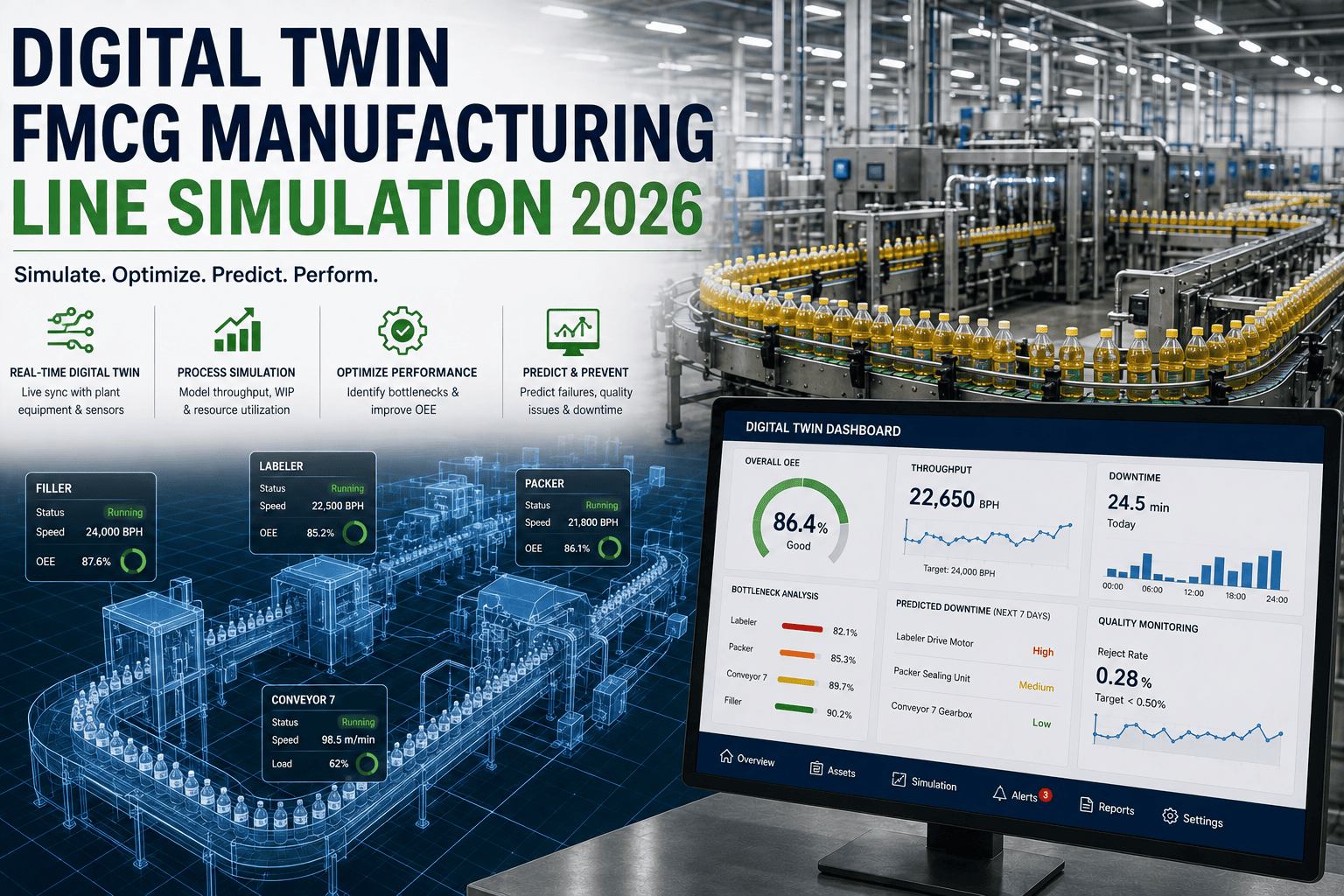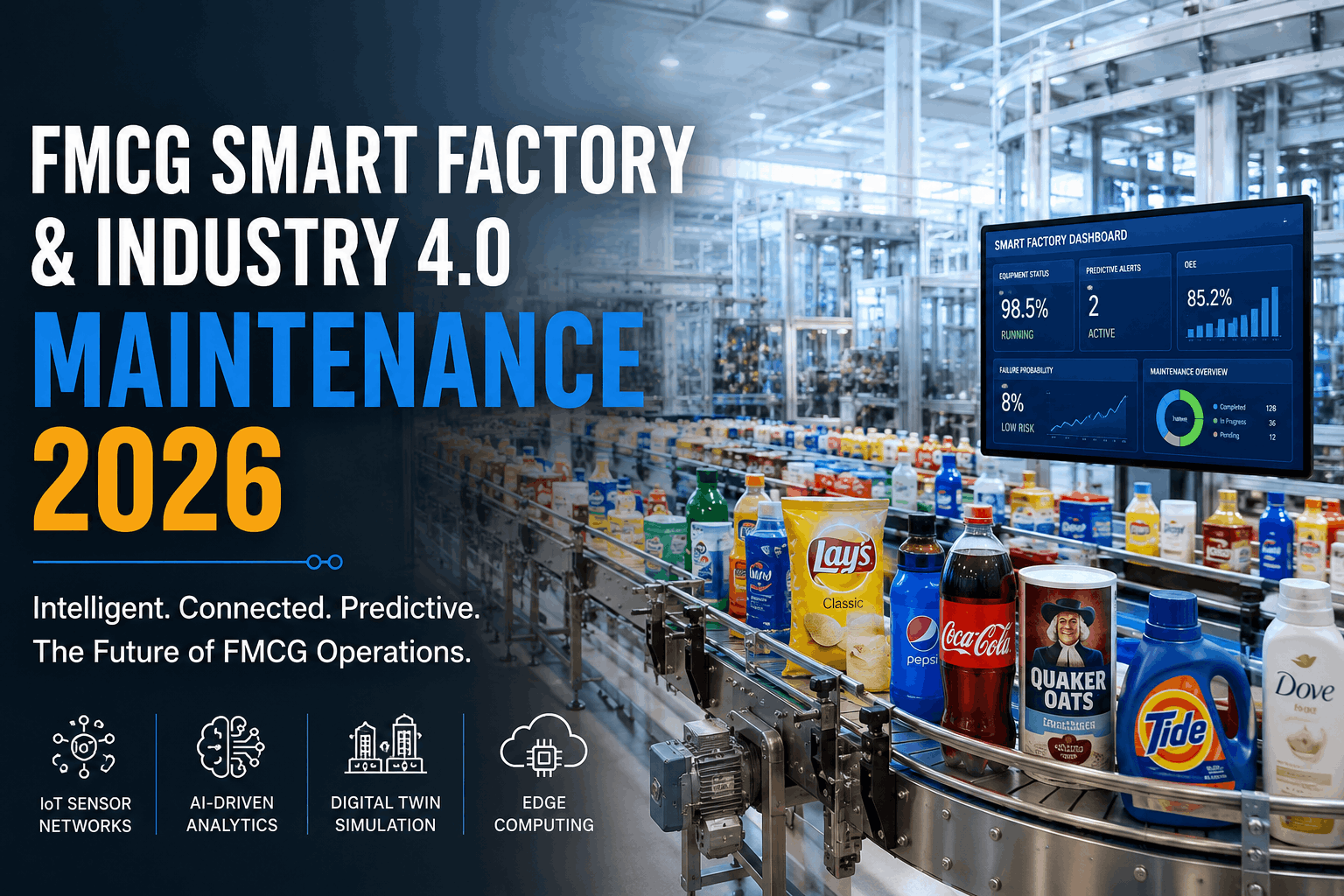
Smart factory technology is reshaping FMCG manufacturing in 2026. Industry 4.0—the integration of IoT sensors, artificial intelligence, edge computing, and digital twins—transforms reactive maintenance into predictive intelligence that prevents failures before they cost production. FMCG plants implementing IoT-connected CMMS platforms report 30–50% reduction in unplanned downtime, 15–25% OEE improvement, and $1M–$3M annual savings without replacing existing equipment. The challenge is not technology availability—it is closing the gap between data collection and maintenance response. Most FMCG facilities have sensor infrastructure but no connected system to convert that data into work orders. OxMaint bridges this gap by connecting IoT sensors directly to AI-powered maintenance workflows, enabling FMCG plants to achieve smart factory capabilities without the enterprise CMMS complexity or 12-month implementation cycles.
FMCG Smart Factory & Industry 4.0 Maintenance: IoT Sensors, AI Predictive Analytics & Digital Twin Simulation 2026
Industry 4.0 smart maintenance for FMCG plants: Real-time IoT sensor networks collect equipment data from every asset. AI-driven predictive analytics detect bearing degradation, seal wear, and alignment drift 2–4 weeks before failure. Digital twin simulation models production scenarios without risking live lines. Edge computing processes data locally at sub-second latency. Every layer connects through CMMS-orchestrated workflows, automating responses from sensor alert to technician dispatch to parts inventory to production schedule. Transform reactive maintenance into autonomous self-optimizing production.
Understanding Industry 4.0 Smart Factory Architecture for FMCG Maintenance
Industry 4.0 is the systematic integration of four technology layers into a single nervous system for manufacturing. Layer 1 is sensing: IoT sensors embedded on rotating equipment, conveyors, pumps, motors, and control systems collect real-time data on vibration, temperature, current draw, pressure, and flow at sub-second frequency. Layer 2 is edge intelligence: local computing nodes process this data stream in milliseconds without sending every data point to cloud infrastructure, eliminating latency and reducing bandwidth requirements. Layer 3 is AI reasoning: machine learning models trained on equipment baseline data recognize patterns that precede failures—bearing degradation signatures, seal wear trajectories, alignment drift profiles—and alert maintenance 2–4 weeks before catastrophic failure occurs. Layer 4 is orchestrated action: CMMS systems receive alerts, automatically generate work orders with equipment ID, failure mode diagnosis, recommended spare parts, and optimal service windows, then dispatch technicians and update production schedules without manual intervention. For FMCG plants, this architecture transforms maintenance from a firefighting discipline into a predictive science. Bearing failures that historically caused 4–6 hour line shutdowns are now prevented before they start. Seal degradation that might cascade into 8-hour emergency repairs with overtime labor is caught during scheduled maintenance windows. The ROI compounds because every prevented failure frees technician capacity to execute higher-value predictive work instead of reactive emergency repairs. OxMaint's Industry 4.0 platform deploys this full architecture in FMCG plants within 48 hours—no hardware capital investment required, no lengthy IT integration, mobile-first operation for production floor realities.
IoT Sensor Deployment Strategy: Where FMCG Plants Start and Why Most Fail
The biggest mistake FMCG plants make with Industry 4.0 is deployment order. Companies buy expensive IoT sensor kits and AI software but deploy them without establishing a functional CMMS first. The result: sensors generate alerts that no system acts on, data streams with no interpretation framework, and frustrated leadership blaming technology instead of recognizing the sequencing error. The correct order is Phase 1: CMMS foundation (mobile work order system, asset register, operator checklists), Phase 2: IoT sensor rollout (starting with highest-impact assets generating most downtime or repair cost), Phase 3: AI model training (requires 12+ months of Phase 2 data), Phase 4: autonomous optimization (requires validated Phase 3 predictions and Phase 1 CMMS maturity to act autonomously). Most FMCG plants targeting smart factory results do so at Phase 3 or 4 without adequately completing Phase 1. That sequencing failure costs 12–18 months of progress when technology gets swapped out mid-implementation. The fastest path to measurable Industry 4.0 ROI is targeting your worst-performing 15–20 assets first (the ones with highest downtime, highest repair cost, or most frequent emergency calls). Typical FMCG plants starting with 15–20 critical assets see predictive maintenance catches within 8 weeks. That first prevented failure usually pays back the entire first-year IoT investment. Schedule a consultation to discuss which assets in your FMCG plant are highest ROI targets for predictive sensor deployment.
Bearing Failure Prediction in Action: Real FMCG Industry 4.0 Case Study
A beverage FMCG plant in Gujarat deploying vibration sensors on a critical filling line motor reported detection of bearing degradation 21 days before catastrophic failure would have occurred. Baseline vibration signature on the motor was established over 3 months of normal operation—frequency range 8–12 kHz, amplitude averaging 2.1 mm/s peak velocity. By week 18 of operation, the AI model detected anomalous vibration signatures: amplitude increasing to 3.4 mm/s, harmonic frequencies in the 3–5 kHz range indicating early-stage rolling element bearing fatigue. The system issued a predictive alert with 95% confidence that bearing failure would occur within 21–28 days. Maintenance scheduled replacement during the next planned line shutdown (day 17 of the 21-day window). Emergency replacement parts were ordered and staged. The technician arrived at the scheduled shutdown window, removed the failing bearing (visible spalling under inspection—confirming the AI diagnosis), installed the replacement, and verified operation. Total downtime: 2 hours. Cost: $4,200 for bearing + $1,800 labor. Hypothetical failure scenario (no AI prediction): bearing seizes during high-speed production run on day 22, line stops unplanned, emergency repair required, overnight labor premium (+$2,100), expedited parts shipping (+$1,200), cascading failure damage to motor coupling (+$3,600), lost production window (8 hours) valued at $48,000 in missed throughput. Total unplanned downtime cost: $56,100. ROI from this single predictive catch: $56,100 – $6,000 = $50,100. The plant's annual IoT + CMMS subscription cost: $18,000. ROI from one prevented failure: 2.8x annual platform investment, in one incident. FMCG plants targeting Industry 4.0 typically identify 3–5 similar high-impact predictive opportunities per year once sensors are live.
CMMS as the Orchestration Layer: How OxMaint Connects IoT to Maintenance Workflows
Technology vendors often position IoT sensors, AI software, and CMMS as three separate products that must be integrated. That architecture creates data silos, integration latency, and the "sensor data goes nowhere" scenario that kills most smart factory projects. OxMaint approaches this differently: the CMMS IS the orchestration layer. Sensors connect directly to OxMaint's APIs. AI models run natively inside the platform, not as external services. Edge computing nodes process data locally and push only structured alerts into CMMS workflows. When a bearing degradation alert fires from the AI layer, the CMMS simultaneously: generates a work order with equipment ID, failure mode, recommended parts, and optimal service window; checks inventory to confirm spare bearing availability or auto-generate purchase requisition; identifies certified technicians available during planned maintenance window and routes work order to their mobile device; notifies production planning 72 hours ahead so they can buffer inventory or adjust changeover schedule; logs all actions to asset maintenance history and compliance audit trail; tracks technician response time and parts cost for KPI reporting. This closed loop takes 3–5 minutes from sensor alert to technician dispatch, eliminating the communication gaps that cause delays. Traditional architectures with separate systems require email notifications, manual work order creation, phone calls to inventory, and back-and-forth planning discussions. That manual loop takes 4–8 hours. In high-speed FMCG production, the difference between 5-minute response and 8-hour response is whether maintenance happens during a planned window or becomes an emergency shutdown. OxMaint's architecture closes this loop automatically, turning every sensor alert into an executed maintenance action without human intervention.
FMCG Industry 4.0 Frequently Asked Questions
"OxMaint's predictive maintenance caught bearing degradation on our number-three filling line 18 days before failure would have hit us. That single prevented shutdown saved us $54,000 in emergency labor and lost throughput. Six months in, we've prevented three more major failures. Industry 4.0 isn't a future concept—it's already delivering measurable ROI on our production floor."
— Raj Patel, Maintenance Manager, FMCG Beverage Manufacturer, Gujarat
Transform FMCG Maintenance from Reactive to Predictive
OxMaint connects IoT sensors, AI predictive analytics, digital twins, and CMMS workflows into a single orchestrated system. Predict equipment failures 2–4 weeks ahead. Prevent downtime instead of reacting to emergencies. Achieve Industry 4.0 smart factory results without replacing existing equipment or lengthy IT integration—deploy in 48 hours, achieve ROI in 6–8 weeks from your first predictive catch.