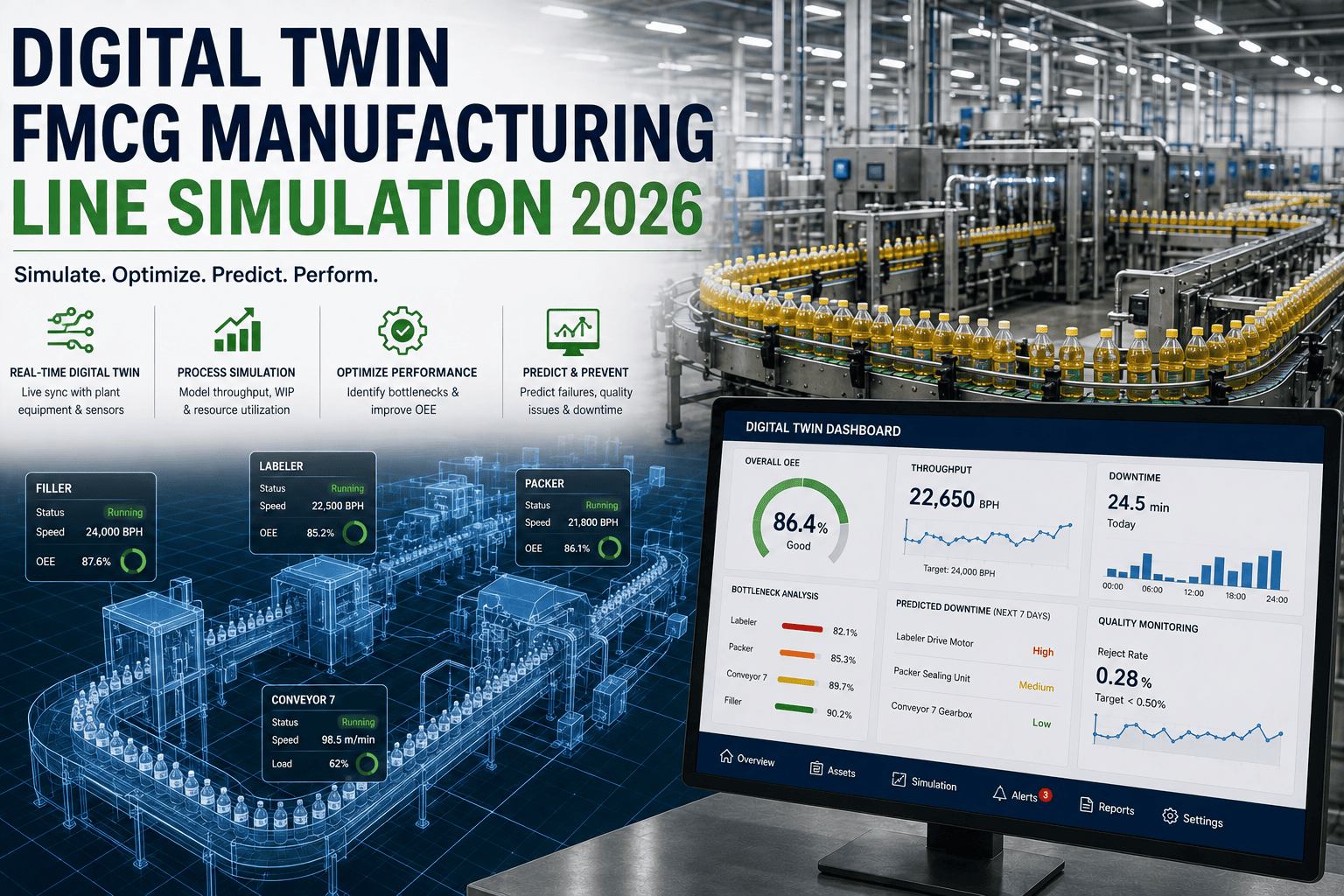
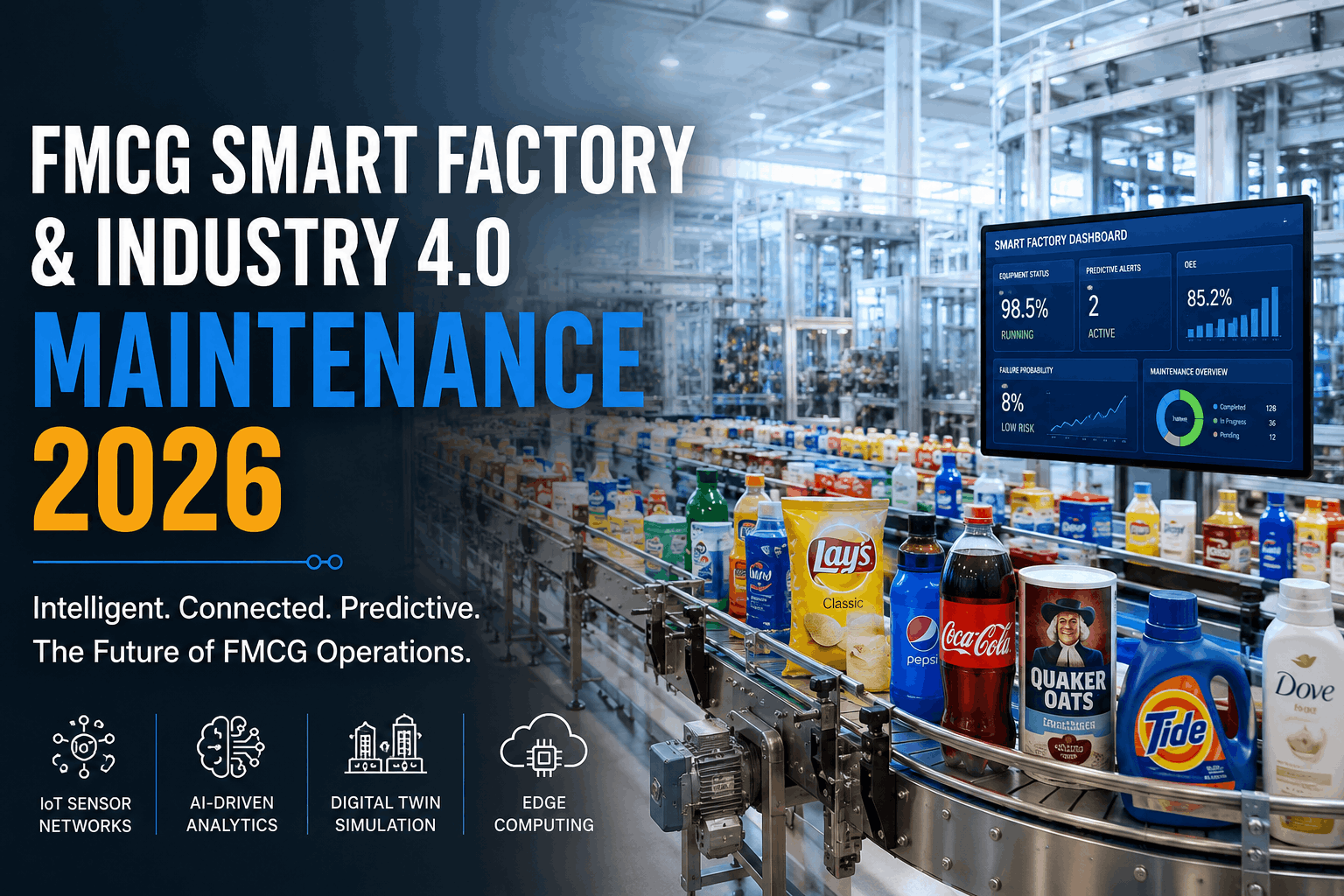
A biscuit manufacturer in Maharashtra was running 14 production lines in 2021 with a maintenance system built on WhatsApp groups, printed PM schedules pinned to a noticeboard, and a shared Excel file that was always three weeks out of date. By 2024, the same plant had a live OEE dashboard visible from every shift supervisor's phone, operator AM checklists completed digitally before every production run, and an AI-assisted work order system that automatically prioritised the maintenance team's day. Unplanned downtime fell 61%. Emergency repair spend dropped 44%. The transformation did not happen overnight, and it did not happen by deploying every technology at once. It happened through a structured, phased roadmap that matched digital capability to operational readiness — building each layer on the foundations established by the one before it. This is that roadmap. Digital transformation in FMCG manufacturing is not a technology decision. It is an operations decision with technology as the instrument. The FMCG plants achieving 60–70% downtime reduction, 15–25% OEE improvement, and 4–8x maintenance ROI in 2025 and 2026 are not the ones with the largest technology budgets — they are the ones with the clearest implementation sequence. Ready to start your transformation? Start a free trial or book a demo to see how Oxmaint deploys in 48 hours.
61%
Unplanned Downtime Reduction — Maharashtra Biscuit Plant Case Study, 2021–2024
4–8x
Maintenance ROI Achieved by FMCG Plants Completing All Four Transformation Phases
30–42
Months for Full Paper-to-Smart-Factory Transformation — Mid-Size FMCG Plant
75%
FMCG Plants Globally Prioritising Digital Transformation in 2026 — McKinsey 2025
Phase 1 Starts With a CMMS — Deploy in 48 Hours
Your Digital Foundation Is One Decision Away
Every FMCG smart factory started with Phase 1: replacing paper work orders and WhatsApp with a mobile CMMS. Oxmaint deploys in 48 hours, works offline on the production floor, and gives you the baseline KPI data every subsequent phase depends on.
DIGITAL MATURITY
FMCG Digital Maturity — Five Stages from Paper to Smart Factory
Where most FMCG plants sit today and what the transformation journey looks like stage by stage
Stage 1–2: Paper / Basic Digital (Most Plants Today)
Maintenance Management
Paper work orders, WhatsApp, shared Excel — no CMMS
Equipment Monitoring
Manual rounds, operator phone calls when breakdowns occur
Production Data
End-of-shift manual entry — 4–12 hour data lag
Decision Making
Experience-based — no live data, no trend visibility
Unplanned Downtime
12–22% of scheduled production time
Stage 4–5: Connected / Smart Factory (Target by 2026)
Maintenance Management
Mobile CMMS + AI work order prioritisation + predictive alerts
Equipment Monitoring
IoT sensors + AMR patrol + continuous condition data
Production Data
Real-time OEE dashboard — zero data entry lag
Decision Making
AI-assisted — anomaly alerts, root cause analysis, trend forecasts
Unplanned Downtime
3–6% of scheduled production time
Gap Between Stage 1 and Stage 5: $290K–$1.06M Annual Value Per Production Line
2026 URGENCY
Why 2026 Is the Inflection Point for FMCG Digital Transformation
The forces making digital transformation urgent in 2026 across FMCG manufacturing
Raw Material Volatility
35–55% higher commodity price volatility vs. 2018–2020 baseline makes manufacturing efficiency the primary margin lever — OEE improvement outperforms procurement gains
Margin Pressure
Skilled Technician Scarcity
Experienced maintenance technicians retiring faster than they are replaced — digital systems capture institutional knowledge before it walks out the door
Knowledge Risk
Competitor Digital Advantage
Plants that completed Phase 1–2 in 2022–2024 now operate with 8–14% lower maintenance costs per unit — gap compounds 2–3% annually for non-adopters
Compounding Gap
Technology Cost Collapse
IoT sensor cost down 68% since 2020. Mobile CMMS SaaS models eliminate upfront investment. AMR inspection robots now ROI-positive within 14–22 months in FMCG
Barrier Removed
Regulatory Compliance Pressure
FSSAI, BRC, FDA, and ISO audit requirements increasingly expect digital maintenance records — paper-based compliance is creating audit risk and export market barriers
Compliance Risk
The 75% figure comes from McKinsey's 2025 FMCG operations survey. Of that 75%, fewer than 30% have a clear phased implementation roadmap. The gap between intent and execution is where FMCG plants lose 18–36 months of transformation progress to false starts, scope creep, and technology-first approaches that lack operational foundations.
IMPLEMENTATION ROADMAP
Four-Phase FMCG Digital Transformation Roadmap — Paper to Smart Factory
Phase 1
Digital FoundationMonths 1–6
Deploy mobile CMMS — replace paper work orders and WhatsApp with digital work order management accessible from every technician's phone
Asset master data: audit, clean, and load every asset into the CMMS with QR code labels — 100% asset coverage before Phase 2 begins
Digital operator AM checklists: replace paper PM sheets with mobile checklists, photo abnormality logging, and automated work order creation
Training records: operator and technician qualification tracking in the CMMS — who is trained on what, to what level, with what requalification schedule
KPI baseline: establish wrench time, MTTR, first-time fix rate, and breakdown frequency baselines before any Phase 2 investment
Exit Criteria: 85%+ work order digital compliance, 90%+ AM checklist completion, baseline KPIs established
Phase 2
Connected OperationsMonths 7–14
IoT sensor deployment on critical assets: vibration, temperature, current draw on motors, drives, and bearings — starting with the top 20% highest-impact assets
Real-time OEE dashboard: live availability, performance, and quality data replacing end-of-shift manual entry — visible on floor screens and supervisor phones
Condition-based maintenance triggers: sensor threshold alerts automatically create work orders in the CMMS — no manual monitoring required
Spare parts digital inventory: integrate parts stock with work orders — parts consumed automatically deducted, reorder points auto-triggered
Energy monitoring: sub-metering on major energy consumers — production line power, compressed air, refrigeration — to identify waste and benchmark efficiency
Exit Criteria: Top 20% assets on live condition monitoring, OEE dashboard live, reactive maintenance below 35%
Phase 3
AI & Predictive IntelligenceMonths 15–24
AI predictive maintenance: machine learning models trained on 6–12 months of Phase 2 sensor data — fault prediction with 14–21 day lead time on critical assets
AI work order prioritisation: CMMS work queue ranked by production impact, asset criticality, and failure probability — technicians always work the highest-value task first
AI copilot for technicians: conversational fault diagnosis available on mobile — cross-references asset history, failure patterns, and OEM data to deliver ranked diagnoses in under 4 minutes
Predictive spare parts: ML-based parts forecasting reduces inventory holding by 18–28% while eliminating stockouts on critical components
Root cause analysis automation: AI analyses recurring failure patterns and surfaces systemic causes — maintenance team addresses root causes, not just symptoms
Exit Criteria: Predictive model catching 55%+ of faults before failure, reactive maintenance below 20%, MTTR reduced 35%+
Phase 4
Robotic & Autonomous OperationsMonths 25–36
AMR inspection robots: autonomous mobile robots running continuous inspection patrol routes — vibration, thermal, acoustic, and visual data from every accessible asset on every shift
AGV integration: automated guided vehicles for materials handling and kitting — maintenance team receives parts at the asset, zero parts-room travel time
Digital twin deployment: virtual asset models updated continuously from sensor and maintenance data — simulation used to plan interventions, test process changes, and optimise PM schedules
Closed-loop autonomous maintenance: AMR data feeds AI model feeds CMMS work order feeds mobile technician — zero human intervention in the detection-to-dispatch loop
Smart factory integration: CMMS data integrated with ERP, MES, and supply chain systems — maintenance planning fully integrated with production scheduling and procurement
Exit Criteria: Unplanned downtime below 4%, OEE above 88%, maintenance cost per unit reduced 40%+
Phase 1 Starts With a CMMS — Deploy in 48 Hours
Your Digital Foundation Is One Decision Away
Every FMCG smart factory started with Phase 1: replacing paper work orders and WhatsApp with a mobile CMMS. Oxmaint deploys in 48 hours, works offline on the production floor, and gives you the baseline KPI data every subsequent phase depends on.
PHASE 1 ROI
Phase 1 Standalone ROI — Digital Foundation Without Any IoT or AI
Wrench Time Recovery
+28 Percentage Points
Mobile CMMS eliminates the office round-trip, manual documentation, and information hunting that consume 40–52% of a technician's shift. Average FMCG technician wrench time rises from 28–32% to 52–62% within 90 days of mobile deployment. For a 12-technician team, this recovers 6,700+ productive hours annually — equivalent to adding 3.2 technicians without hiring.
Operator Failure Detection
35–50% of Faults Caught Early
Digital AM checklists with photo abnormality logging turn operators into structured early-warning systems. Within 6 months of checklist deployment, 35–50% of maintenance-confirmed faults are first identified by operator AM logs — before they cause downtime. Each early detection converts a reactive repair into a planned intervention, reducing repair cost by 60–80% per event.
Maintenance Data Foundation
12 Months to AI-Ready Dataset
Every work order completed through the CMMS builds the failure history database that Phase 3 AI models require to make accurate predictions. Plants that deploy Phase 1 in Month 1 have 12–18 months of rich failure data ready for AI training when Phase 3 begins — plants that delay Phase 1 delay AI capability by exactly the same amount. The data compound effect starts on Day 1.
TECHNOLOGY SELECTION
FMCG Digital Transformation Technology Selection Matrix
When each technology category delivers value — and what premature deployment costs
Mobile CMMS
Phase 1 — Immediate ROI. The operational system of record that every subsequent technology reports into. Deploy first, deploy completely, achieve 90%+ compliance before adding anything else.
Month 1
Digital AM Checklists
Phase 1 — Deploy alongside CMMS. Operator checklists feed abnormality data into work orders. Paper checklists at this stage defeat the purpose of CMMS deployment.
Month 1–2
IoT Vibration / Thermal Sensors
Phase 2 — After asset master data is clean and CMMS compliance is 85%+. Sensors deployed on assets without complete maintenance history generate uninterpretable alerts that erode trust in the system.
Month 7–9
Real-Time OEE Dashboard
Phase 2 — After production data flow from equipment is established. Manual OEE entry is a Phase 1 acceptable compromise; automated OEE requires Phase 2 connectivity infrastructure.
Month 9–12
AI Predictive Maintenance
Phase 3 — Requires 6–12 months of Phase 2 sensor data and 12+ months of CMMS failure history. AI deployed on insufficient data makes predictions that are wrong often enough to destroy credibility.
Month 15–18
AMR Inspection Robots
Phase 4 — After CMMS work order system is fully operational and AI predictive models are validated. AMR data amplifies an existing system; it cannot substitute for one that does not exist.
Month 25–30
Digital Twin
Phase 4 — Requires 24+ months of integrated sensor, maintenance, and production data to build a digital model with enough fidelity to generate reliable simulations for planning and optimisation.
Month 30–36
The IoT-before-CMMS error is the most expensive mistake in FMCG digital transformation. Sensor alerts with no work order system to action them, no asset history to interpret them against, and no technician workflow to respond to them generate noise, not intelligence. The sensor investment is wasted and the organisation becomes sceptical of future technology proposals. The fix is always the same: go back and build Phase 1 properly first.
PHASE 4 — ROBOTICS
Six AMR and AGV Integration Capabilities in FMCG Smart Factory Phase 4
Continuous Patrol Inspection
24/7 Coverage
AMR robots run programmed patrol routes collecting multi-sensor data from every accessible asset — replacing manual inspection rounds that cover 15–20% of assets per shift with 100% coverage on every patrol cycle
Thermal & Vibration Mapping
±0.5°C / 0.1mm/s
High-precision infrared and vibration sensors on AMR platforms detect developing bearing faults, motor overheating, and compressed air leaks at detection thresholds impossible with handheld instruments during brief manual rounds
Automated Work Order Generation
Zero Human Dispatch
AMR sensor anomalies above configured thresholds automatically create prioritised work orders in the CMMS — the technician receives a notification on their mobile before the AMR has completed its patrol route
AGV Parts Delivery
Zero Travel Waste
AGVs retrieve parts from the stores and deliver them to the asset location — technicians receive parts at the machine before they finish diagnosis. Parts-room travel time, a 14–18 minute average per repair event, is eliminated entirely
Trend Accumulation
Compounding Data
Each AMR patrol adds a data point to the asset's condition history — after 90 days, trend lines reveal degradation rates that no manual inspection programme could detect. AI predictive models improve continuously as patrol data accumulates
Safety Zone Compliance
ISO 10218 Certified
AMRs operate under ISO 10218 and ISO/TS 15066 collaborative robot safety standards — certified safe for human-shared spaces, no production line shutdown required for inspection patrol operation
ROI BY PHASE
Digital Transformation ROI by Phase — Conservative FMCG Benchmarks
Documented value delivered per phase — mid-size FMCG plant, 8–14 production lines, $36M–$72M annual output
Phase 1 — Digital Foundation
Wrench time recovery (6,700 hrs/yr) + operator early detection (35% fault catch rate) + emergency repair reduction (38%) = combined annual value
$170K–$385K/yr
Phase 2 — Connected Operations
IoT condition monitoring eliminates 55% of unexpected failures on monitored assets + real-time OEE visibility drives 4–7% availability improvement
$340K–$770K/yr
Phase 3 — AI & Predictive
Predictive fault detection 14–21 days ahead reduces unplanned downtime to 4–6% + AI work order optimisation reduces technician reactive time to under 20%
$505K–$1.18M/yr
Phase 4 — Robotic & Autonomous
AMR 24/7 coverage eliminates manual inspection rounds + AGV parts delivery recovers 14–18 min/repair + digital twin enables proactive shutdown optimisation
$820K–$1.73M/yr
Full Smart Factory Value — All Four Phases Mature
$1.8M–$4.1M/yr
Payback periods: Phase 1 — 3–5 months. Phase 2 — 8–14 months. Phase 3 — 12–18 months. Phase 4 — 18–28 months. Each phase is independently ROI-positive before the next begins. No phase requires a leap of faith — every investment is justified by the documented outcome of the phase before it.
$170K–$385K/yr from Phase 1 Alone — Payback in 3–5 Months
Start the Roadmap at Phase 1 — See ROI Before Phase 2 Begins
Oxmaint's mobile CMMS is the Phase 1 foundation deployed by FMCG plants across India, Southeast Asia, and the Middle East. 48-hour setup, offline-first, AI copilot included. Your Phase 2 IoT investment depends on the data quality Phase 1 builds — start now.
FAILURE MODES
Eight Digital Transformation Failure Modes in FMCG Manufacturing
KPI FRAMEWORK
Digital Transformation KPI Framework — Phase-Specific Measurement
Leading indicators and exit thresholds for each transformation phase
Phase 1 KPIs
Work order digital compliance ≥85%, AM checklist completion ≥90%, wrench time baseline established, technician CMMS adoption ≥95%
Month 1–6
Phase 2 KPIs
Critical asset IoT coverage ≥80%, reactive maintenance ≤35%, OEE dashboard live with ≤15 min data lag, parts stockout rate ≤2 per quarter
Month 7–14
Phase 3 KPIs
Predictive fault detection rate ≥55%, MTTR reduction ≥35% vs. Phase 1 baseline, reactive maintenance ≤20%, AI copilot adoption ≥80% of technicians
Month 15–24
Phase 4 KPIs
Unplanned downtime ≤4%, OEE ≥88%, maintenance cost per unit ≤40% of Phase 1 baseline, AMR patrol coverage ≥95% of monitored assets per shift
Month 25–36
Smart Factory Maturity KPIs
Zero unplanned stoppage events ≥72 hours on any single line, digital twin simulation accuracy ≥92%, ERP-CMMS integration fully automated, zero paper in maintenance workflow
Year 3+
The 30–42 month full transformation timeline assumes consistent leadership commitment, adequate change management investment, and no phase-skipping. Plants that attempt to compress the timeline below 24 months invariably sacrifice Phase 1 depth — and the compounding costs of that shortcut appear in Phase 3 and Phase 4 as AI models with insufficient training data and AMR systems reporting to incomplete asset databases.
Frequently Asked Questions
A complete four-phase transformation from paper-based operations to smart factory maturity takes 30–42 months for a mid-size FMCG plant of 8–14 production lines. The timeline is not determined by technology deployment speed — it is determined by the time required to build genuine operational competency at each phase before advancing to the next. Phase 1 typically takes 4–6 months to achieve 85%+ work order compliance and 90%+ AM checklist completion. Phase 2 takes 6–9 months to deploy IoT coverage on critical assets and achieve live OEE visibility. Phase 3 requires 12+ months of Phase 2 sensor data before AI predictive models can be trained to production accuracy. Phase 4 robot integration requires 18+ months of validated AI and CMMS operation as its foundation.
The minimum viable Phase 1 consists of three components: a mobile CMMS with offline capability (Oxmaint deploys in 48 hours on a SaaS model with no upfront hardware investment), digital operator AM checklists replacing paper PM sheets, and a 2–3 week asset data audit to clean and populate the CMMS with accurate asset records before go-live. For a plant of 200–400 assets with a 10–15 person maintenance and operator team, Phase 1 typically requires $10K–$22K in total first-year investment including software, devices, and implementation time. The standalone ROI of Phase 1 returns $170K–$385K annually, producing payback within 3–5 months. Phase 1 is the lowest-risk, highest-return investment in the entire transformation roadmap.
CMMS selection at Phase 1 determines the ceiling of what is achievable at Phases 2, 3, and 4 — making it the most consequential technology decision in the entire roadmap. A CMMS that cannot ingest IoT sensor data will prevent Phase 2 condition-based maintenance. A CMMS with no AI layer will require a separate platform at Phase 3, creating data silos that undermine predictive accuracy. A CMMS that does not support mobile offline operation will fail on the production floor regardless of its feature set. The selection criteria that matter most: open API for IoT sensor and ERP integration, mobile-first offline-capable architecture, AI copilot capability either native or roadmapped, and a vendor who can demonstrate Phase 3 and Phase 4 deployments in FMCG environments. Switching CMMS platforms mid-transformation costs 12–18 months of lost progress and resets the failure history dataset that Phase 3 AI depends on.
Cobots and AMRs serve different functions in FMCG smart factory operations and should not be conflated. Collaborative robots in FMCG plants are primarily production assets — assisting operators in packaging, assembly, palletising, and quality inspection tasks. They are not maintenance tools. AMRs in the maintenance context are inspection platforms — they carry sensor payloads along programmed patrol routes, collecting vibration, thermal, acoustic, and visual data from production equipment that the CMMS and AI layer then analyse. AGVs are logistics platforms — handling materials movement, spare parts kitting and delivery to technicians at the asset location. AMRs deploy in Phase 4 as inspection platforms after the CMMS and AI layers they report into are fully operational. AGVs deploy alongside AMRs to close the parts delivery loop.
The FMCG digital transformation roadmap directly addresses GMP and FSSAI compliance requirements at every phase. Phase 1 delivers timestamped, user-attributed digital work order and AM checklist records that satisfy GMP documentation requirements — replacing paper maintenance logs that are frequently incomplete and difficult to retrieve during an audit. Phase 2 sensor data provides objective evidence of equipment operating within validated parameters. Phase 3 AI predictive maintenance demonstrates a systematic, risk-based approach to equipment care that aligns with FSSAI's Good Manufacturing Practice maintenance requirements and BRC Global Standard equipment maintenance clauses. When AM checklists are designed to include GMP-critical inspection points, every completed checklist generates a GMP-compliant maintenance record simultaneously — achieving two compliance programmes with one operator action.
Mobile CMMS + AI Copilot — Phase 1 Ready in 48 Hours
Start Your FMCG Digital Transformation at Phase 1 Today
Oxmaint is the mobile CMMS and AI maintenance platform built for FMCG plants across India, Southeast Asia, and the Middle East. Deploy in 48 hours with no hardware investment. One system, four phases, $1.8M–$4.1M in documented smart factory value.
Mobile CMMS — Offline-First, Deploys in 48 Hours
AI Copilot — Fault Diagnosis on the Production Floor
Digital AM Checklists — Operator-Led Failure Prevention
IoT Sensor Integration — Phase 2 Ready from Day 1
Training Records — Qualification Tracking by Operator & Equipment
Phase 1 Payback in 3–5 Months — $170K–$385K/yr Standalone ROI
Android & iOS. No hardware required for Phase 1. FSSAI, BRC, and ISO audit-ready maintenance records from Day 1.