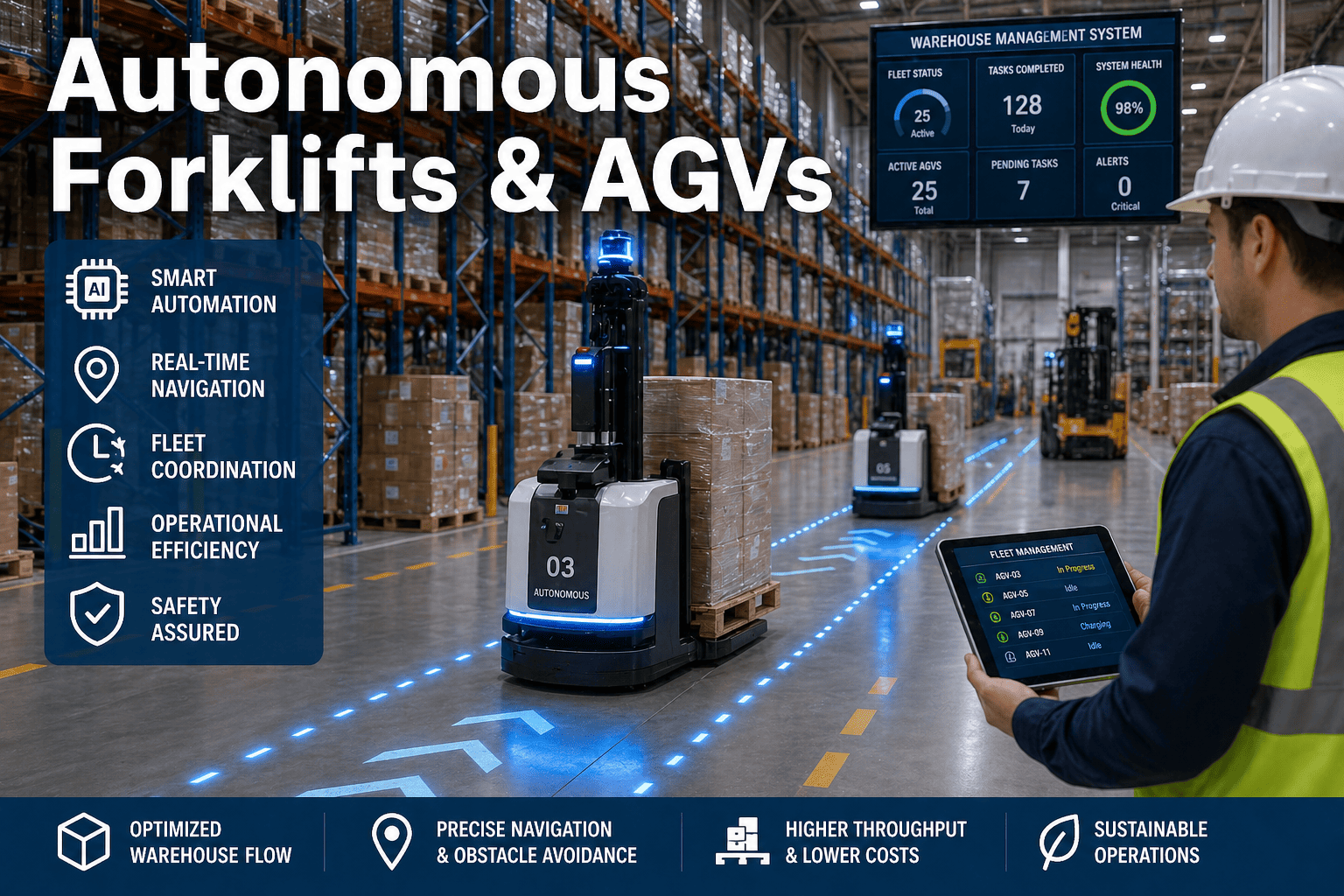
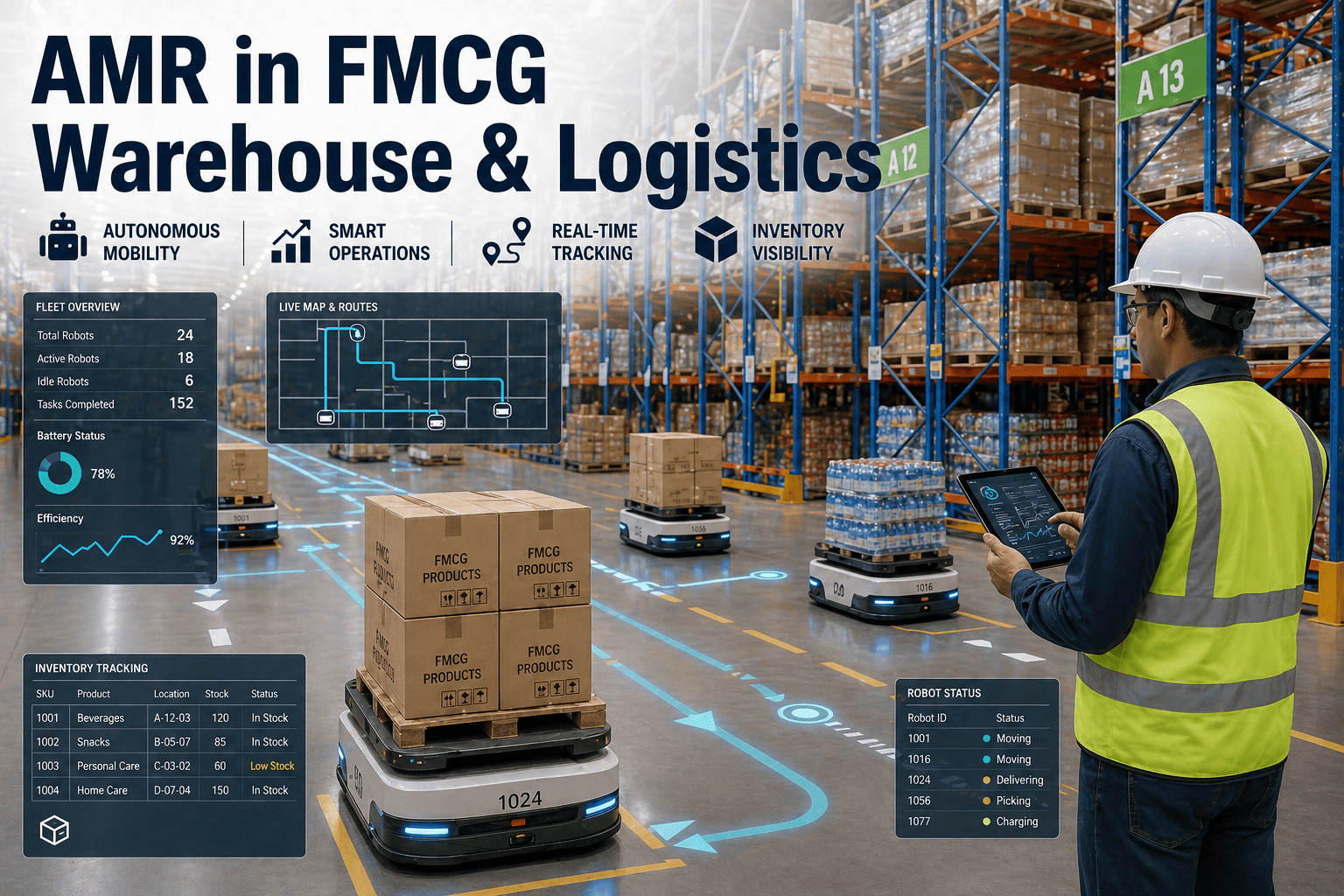
When an autonomous mobile robot (AMR) stops mid-aisle during a peak-season night shift, the immediate cost is the pallet it was carrying and the 12 minutes a technician spends rebooting it. But when the same AMR stops again three days later — and a second unit starts throwing the same navigation error the following week — the real cost is the 340 picks per hour your fleet is no longer making, the manual labor backfilling the gap at 4x the cost, and the retailer delivery window you just missed. FMCG warehouse operations scaling from 5 AMRs to 50 are discovering that the transition from "manageable robot fleet" to "unmanageable maintenance chaos" happens faster than anyone expects. The fleet that ran reliably at 8 units starts generating cascading failures at 20 — not because the robots changed, but because spreadsheet-based tracking, ad-hoc spare parts management, and reactive maintenance cannot scale with fleet complexity. A CMMS purpose-built for fleet work order management transforms AMR maintenance from a bottleneck into a competitive advantage. Schedule a consultation to see how Oxmaint helps FMCG warehouses maintain AMR fleets at scale — with automated work orders, fleet-wide health dashboards, and predictive maintenance workflows that keep every robot on the floor.
The AMR Fleet Scaling Problem in FMCG Warehouses
Most FMCG warehouses deploy their first AMRs with a pilot mindset — a small fleet managed by a dedicated champion who knows every robot by serial number. But as the fleet grows to meet throughput demands, that tribal knowledge model collapses. Industry data reveals how quickly unmanaged fleet maintenance erodes the ROI that justified the automation investment in the first place.
23%
of AMR fleet capacity lost to unplanned maintenance in warehouses without structured PM programs
$8,400
average cost per AMR downtime event when accounting for lost throughput, manual labor backfill, and missed SLAs
3.2x
increase in maintenance work orders when fleet scales from 10 to 30 AMRs — without proportional technician headcount
The pattern repeats across FMCG distribution centers: a fleet of 10 AMRs runs reliably with one technician and a shared spreadsheet. At 20 units, battery degradation patterns diverge, navigation sensor calibrations fall behind, and wheel wear rates vary by zone. At 30+, the maintenance team is drowning in reactive tickets, spare parts are either overstocked or unavailable, and nobody can answer the question that matters most: "Which robots are about to fail, and what do we need to fix them before they stop?" A fleet-capable CMMS answers this question continuously, automatically, and at any scale.
Your AMR Fleet Is Only as Strong as Its Weakest Maintenance Program
Oxmaint captures every fleet event, tracks individual robot health histories, automates PM scheduling across your entire AMR fleet, and generates work orders before failures happen — so your robots stay on the floor and your throughput stays on target.
Sign Up Free
Five Fleet Maintenance Strategies Every AMR Operation Should Deploy
There is no single maintenance approach that works for every component on an AMR. The best warehouse automation teams layer multiple strategies based on component criticality, failure mode, and fleet-wide data patterns. Here are the five most effective fleet maintenance frameworks for FMCG AMR operations.
Foundational
Calendar & Runtime-Based Preventive Maintenance
Scheduled maintenance at fixed intervals — calendar-based (every 30/60/90 days) or runtime-based (every 500/1,000/2,000 operating hours). This is the baseline that prevents the most common AMR failures: wheel wear, drive belt tension loss, and sensor contamination from warehouse dust. Without this foundation, every other strategy is built on sand.
AMR PM Interval Example
Every 500 hoursDrive wheel tread depth measurement, caster bearing inspection, bumper sensor cleaning
Every 1,000 hoursLiDAR window cleaning and alignment check, motor brush inspection, belt tension adjustment
Every 2,000 hoursFull drive motor service, battery health assessment, firmware compliance audit
AnnualComplete battery replacement cycle, navigation system recalibration, safety system certification
Fleet Intelligence
Condition-Based Fleet Monitoring
AMRs generate rich telemetry data — motor current draw, battery charge cycles, navigation confidence scores, wheel encoder accuracy, and obstacle detection frequency. Condition-based maintenance uses this data to trigger work orders when actual equipment condition crosses predefined thresholds, rather than waiting for a calendar date. The result: fewer unnecessary PM events on healthy robots, and faster intervention on degrading ones.
Motor Health
Current draw trending, torque anomalies, thermal cycling
Battery State
Capacity degradation curve, charge cycle count, cell balance
Navigation
LiDAR confidence, localization drift, path deviation frequency
Wheels & Drive
Tread wear rate, encoder accuracy, caster vibration
Safety Systems
E-stop response time, bumper sensor sensitivity, zone compliance
Software
Firmware version, task completion rate, error log frequency
Proactive Risk Scoring
Fleet-Wide FMEA for AMR Components
Failure Mode and Effects Analysis applied across the entire fleet identifies which components carry the highest risk of causing throughput loss. Each failure mode is scored by Severity (impact on warehouse operations), Occurrence (likelihood based on fleet data), and Detection (ability to catch the failure before it stops the robot). The resulting Risk Priority Number directs your maintenance budget to the components that matter most.
Severity
(1-10)
×
Occurrence
(1-10)
×
Detection
(1-10)
=
RPN
(1-1000)
1-100: Monitor via CMMS
101-200: Shorten PM interval
201+: Immediate redesign or redundancy
Data-Driven Prioritization
Fleet Pareto Analysis & Failure Trending
Not all AMR failures deserve the same investigation effort. Pareto analysis applied to fleet-wide work order data reveals the vital few failure modes driving the majority of your downtime. Typically, 3-4 root causes account for 70-80% of all AMR stoppages — and they are usually battery degradation, navigation sensor contamination, wheel wear, and software faults. With a CMMS that codes every failure event by type, component, and root cause, Pareto charts become automatic — sign up for Oxmaint to turn months of fleet data into clear maintenance priorities instantly.
Predictive Intelligence
AI-Driven Predictive Maintenance for AMR Fleets
Machine learning models trained on fleet-wide telemetry data predict individual robot failures 2-6 weeks before they occur. The models analyze battery capacity degradation curves, motor current draw patterns, navigation confidence trends, and historical failure correlations to estimate remaining useful life for each critical component. At fleet scale (20+ AMRs), the data volume makes predictions increasingly accurate — each robot's experience improves the model for every other robot in the fleet. This is where CMMS fleet management delivers its highest ROI: predictive work orders generated automatically, parts pre-staged, and maintenance windows scheduled during low-throughput periods.
Which maintenance strategy fits your AMR fleet? Oxmaint includes built-in fleet PM templates, condition monitoring integration, and predictive analytics — linked directly to work orders so maintenance actions happen before robots stop.
How to Run an AMR Fleet Maintenance Investigation
When an AMR failure repeats across multiple units or a single robot develops a chronic issue, a structured investigation prevents the team from replacing parts endlessly without solving the underlying problem. Each phase builds on the previous one — and skipping steps is how fleet-wide failure patterns go undetected for months.
Phase 1
Capture Fleet Event Data Immediately
Before anyone reboots the robot, capture the failure state: error code, operating zone, payload weight, battery SOC, last successful task, and ambient conditions. In a CMMS, this means creating a failure event record linked to the specific AMR asset with all telemetry snapshots, photos, and operator observations attached. Fleet-wide pattern detection starts with consistent data capture on every single event.
Phase 2
Cross-Reference Fleet History & Identify Patterns
Pull the failing robot's complete maintenance history alongside fleet-wide data for similar units. Are other AMRs of the same model showing the same error? Does the failure correlate with a specific warehouse zone, shift pattern, or firmware version? A CMMS with fleet filtering capabilities reveals correlations invisible in individual robot logs — the difference between fixing one robot and preventing 20 failures.
Phase 3
Apply Root Cause Methodology
Use 5 Whys for single-robot issues with a clear causal chain. Use Fishbone analysis when the failure involves multiple systems (navigation + floor condition + battery + software interaction). Use fleet FMEA to proactively assess components showing early degradation signals across the fleet. For AMR-specific failures, always include the robot OEM's diagnostic tools alongside your CMMS data.
Phase 4
Verify Root Cause with Fleet-Wide Evidence
A root cause is not confirmed until fleet data supports it. If battery degradation is suspected, compare charge cycle counts, capacity fade curves, and operating temperatures across all units of the same age. If a warehouse zone correlation exists, map failure locations against floor surface condition, ambient temperature gradients, and traffic density. The root cause must explain both why this robot failed and why fleet-wide controls did not catch it earlier.
Phase 5
Deploy Corrective Actions Across the Fleet
Define corrective actions with clear owners and deadlines — then deploy them fleet-wide, not just to the failed unit. If a LiDAR cleaning interval needs to be shortened, update the PM schedule for every robot simultaneously. Use your CMMS to generate batch corrective work orders, update all affected PM templates, and set recurrence monitoring alerts.
Sign up for Oxmaint to automate fleet-wide corrective action deployment. Only close the investigation when data confirms the failure rate has dropped across the entire fleet.
Top 8 AMR Fleet Failure Root Causes in FMCG Warehouses
Analysis across hundreds of FMCG warehouse AMR deployments reveals a consistent set of root causes that account for the vast majority of fleet downtime. Knowing what to look for accelerates every investigation and helps prioritize your fleet PM strategy.
01
Battery Degradation & Charging Failures
25-30% of all AMR downtime events
Capacity fade below 80% SOH, cell imbalance, charging contact corrosion, and thermal management failures. Predictable 18-24 months in advance through capacity trending — if you are tracking it. A CMMS with battery health dashboards converts this from a surprise to a scheduled replacement.
02
Navigation Sensor Contamination & Drift
20-25% of fleet stoppages
LiDAR windows fouled by warehouse dust, camera lens degradation, reflector tape deterioration, and localization drift from facility layout changes. Detectable 1-4 weeks early through navigation confidence score trending.
03
Wheel & Drive System Wear
15-20% of mechanical failures
Drive wheel tread wear (accelerated by floor debris and turning zones), caster bearing failures, and drive belt tension loss. Wear rates vary 3-5x depending on warehouse zone — high-turn areas degrade wheels significantly faster than straight runs.
04
Software & Firmware Faults
15-20% of all fleet events
Task queue errors, fleet manager communication timeouts, firmware version mismatches across the fleet, and map update conflicts. Often the hardest to diagnose because the robot physically appears healthy.
Book a demo to see how Oxmaint tracks firmware compliance fleet-wide.
05
Environmental & Floor Condition Issues
10-15% of navigation-related failures
Floor surface changes (wax buildup, moisture, cracks), ambient lighting shifts affecting camera-based navigation, reflective surfaces creating LiDAR ghost readings, and temperature/humidity extremes in non-climate-controlled zones.
06
Charging Infrastructure Failures
8-12% of fleet availability losses
Charging station contact wear, power supply degradation, queue management failures (robots waiting for chargers), and network connectivity issues between chargers and fleet management systems.
07
Collision & Obstruction Events
5-10% of unplanned stops
Impacts with dropped pallets, unsecured inventory, manual forklifts, and pedestrians. Safety systems prevent injuries but generate protective stops that require manual intervention to clear. Repeated collision events in the same zone indicate a facility layout or traffic management problem, not a robot problem.
08
Network & Communication Failures
5-8% of fleet coordination issues
Wi-Fi dead zones, fleet manager server latency, API timeout errors between the AMR fleet and WMS/WCS systems, and MQTT broker failures. Often misdiagnosed as robot hardware faults when the actual root cause is warehouse IT infrastructure.
Turn Every Fleet Failure into a Permanent Fix Across All Robots
Oxmaint gives your warehouse automation team the complete fleet maintenance toolkit — individual robot health tracking, fleet-wide PM scheduling, automated work orders from telemetry data, spare parts management, and failure pattern analysis — all in one platform that scales from 5 AMRs to 500.
What Successful FMCG Warehouses Measure After Fleet CMMS Implementation
Implementing fleet maintenance management is only half the equation. Measuring results proves whether the program is actually reducing downtime and improving throughput — and builds the business case for expanding the fleet with confidence that maintenance can scale alongside it.
94%
Fleet availability rate achieved with structured CMMS-driven PM programs
62%
Reduction in unplanned AMR stoppages within 6 months of CMMS deployment
3.5x
ROI on fleet CMMS investment within the first year of implementation
40%
Reduction in spare parts inventory cost through consumption-based ordering
Frequently Asked Questions
How many AMRs can be managed in a single CMMS instance?
There is no practical limit. Oxmaint manages individual AMRs as distinct assets with unique serial numbers, maintenance histories, and PM schedules — whether your fleet is 5 robots or 500. Each robot gets its own health profile, work order history, and spare parts consumption record. Fleet-wide views aggregate data across all units for pattern detection, while individual robot views provide the detail technicians need for specific repairs.
Sign up for Oxmaint to see fleet management at scale.
How does a CMMS integrate with AMR fleet management software?
Modern CMMS platforms connect to AMR fleet managers (such as those from Locus Robotics, 6 River Systems, or Fetch/Zebra) through REST APIs, MQTT brokers, or webhook integrations. Telemetry data — battery SOC, motor temperatures, error codes, runtime hours — flows from the fleet manager into the CMMS, where it triggers condition-based work orders automatically. Work order status and maintenance windows flow back to the fleet manager so it can route tasks around robots scheduled for service.
Book a demo to see how the integration works with your specific AMR vendor.
What spare parts should we stock for an AMR fleet?
Start with the components that fail most frequently and have the longest lead times: drive wheels (stock 2 sets per 10 robots), LiDAR modules (1 per 15 robots), battery packs (1 per 8 robots based on 24-month replacement cycles), charging contacts, bumper sensor assemblies, and caster wheels. A CMMS with consumption tracking will refine these numbers within 6 months based on your actual failure data — most warehouses find they can reduce initial spare parts investment by 30-40% once they have data-driven min/max levels instead of "just in case" stockpiles.
How do we schedule AMR maintenance without impacting warehouse throughput?
The key is aligning PM windows with natural throughput valleys — shift changes, overnight low-volume periods, and planned downtime windows. A CMMS that integrates with your WMS can identify when specific zones have reduced demand and schedule maintenance for robots assigned to those zones. For fleets of 20+ AMRs, stagger PM schedules so no more than 5-8% of the fleet is in maintenance simultaneously. Oxmaint's fleet scheduling automatically enforces this constraint while ensuring every robot receives its required maintenance on time.
What ROI should we expect from implementing fleet CMMS on our AMR operation?
FMCG warehouse AMR fleet CMMS implementations typically deliver 3-5x ROI within the first 12 months, driven by three primary sources: reduced unplanned downtime (62% average reduction translates to $50K-$200K per year depending on fleet size), optimized spare parts inventory (30-40% cost reduction), and extended equipment life (15-25% longer useful life through proactive maintenance). Secondary benefits include reduced manual labor backfill costs, improved SLA compliance rates, and faster fleet expansion because the maintenance infrastructure scales predictably.
Sign up for free to run an ROI estimate on your specific fleet configuration.