AI Seal & Cap Inspection for FMCG Packaging (Guide)
By Jack Edwards on April 16, 2026
At a personal care manufacturing site in Dubai, a batch of 48,000 shampoo bottles left the line with induction seals that had bonded to only 70% of the bottle lip circumference — the result of a liner temperature drift of 4°C on the induction sealer that had gone undetected through two production shifts. The seals passed visual inspection. They passed manual pull-check sampling. But at 9 months shelf life in a 40°C retail environment, 11% of that batch had leaked, 7,800 units were returned, and the brand received a trading standards notice. An AI cap and seal inspection system running at 100% coverage would have flagged the first non-conforming unit 40 minutes into the temperature drift — before 48,000 more followed. Start a free OxMaint trial and connect your packaging inspection data to your sealer maintenance records — or book a demo to see seal inspection integrated with OxMaint maintenance management.
AI Vision & Quality · Packaging Integrity
AI Seal & Cap Inspection for FMCG Packaging
Detect seal defects, verify cap torque, and confirm tamper-evidence integrity at 100% coverage and line speed — before compromised packaging reaches the shelf or the consumer.
Of FMCG product returns are caused by packaging integrity failures — seal or cap defects
0.1%
Defect rate detectable by manual sampling — AI vision catches defects at 100% coverage
£40K+
Average cost of a packaging integrity recall per batch including logistics and disposal
98.5%
Seal defect detection accuracy with AI vision vs. 82% for trained manual inspectors
What AI Seal and Cap Inspection Verifies
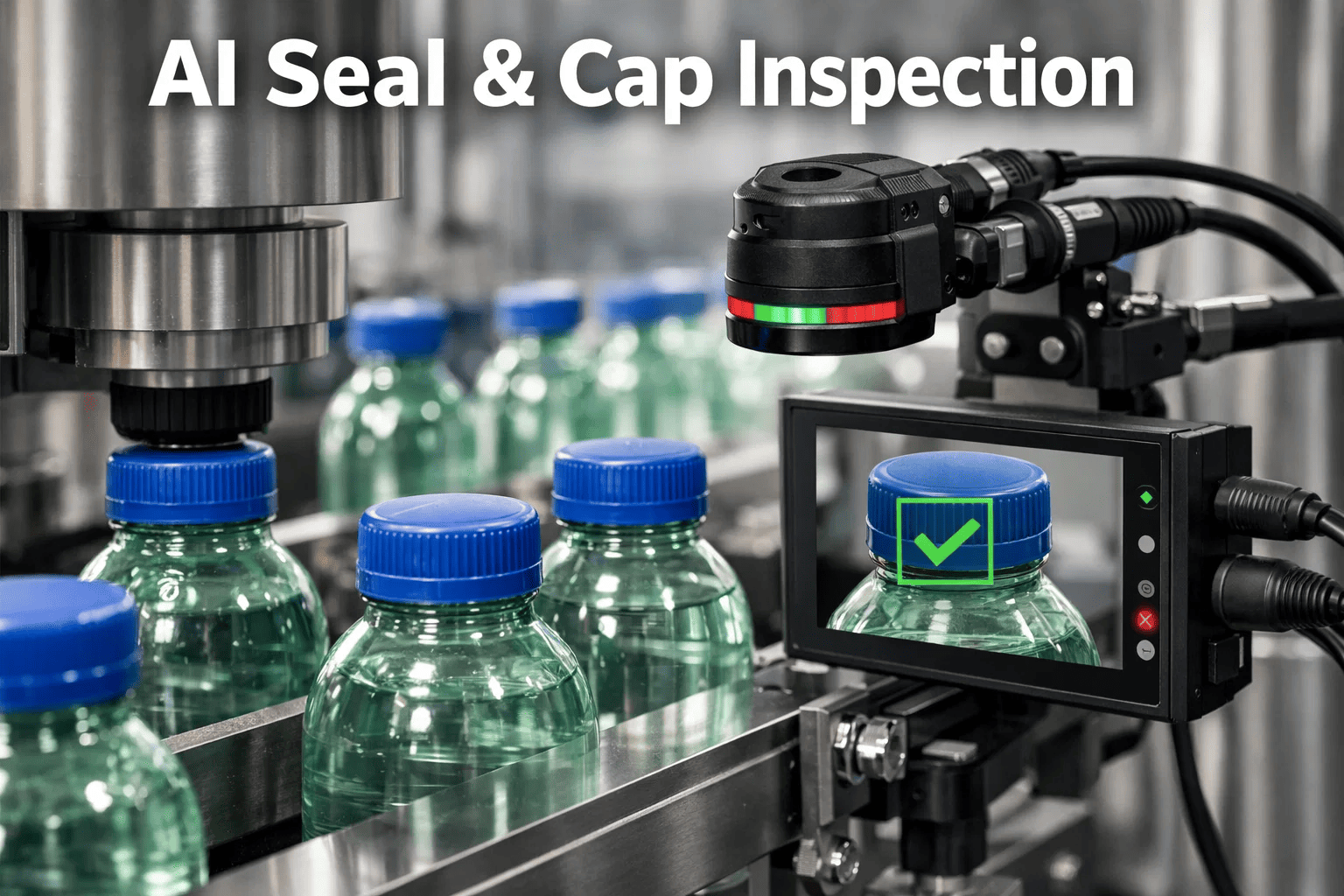
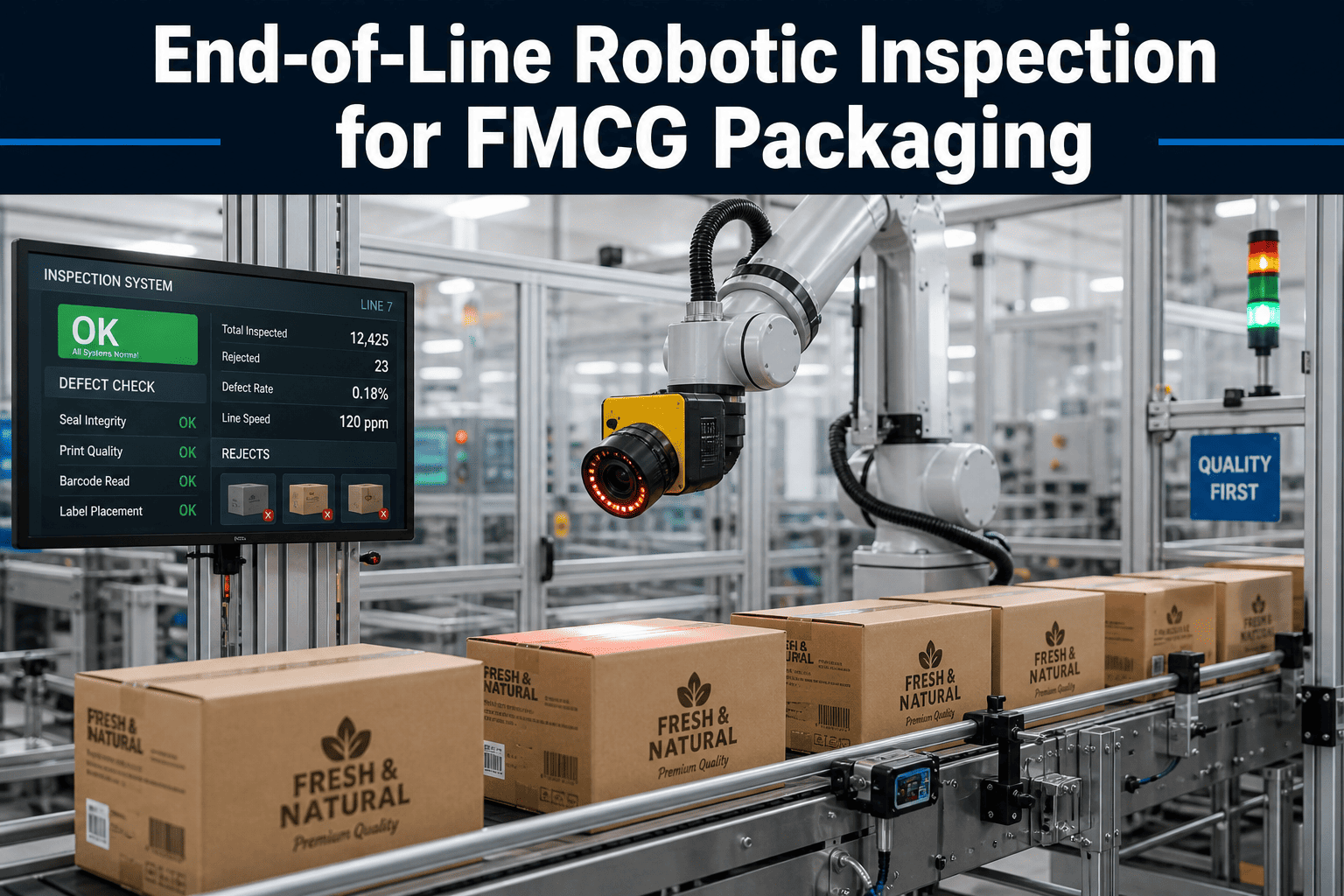
AI seal and cap inspection systems use combinations of machine vision cameras, torque measurement, and laser profilometry to verify packaging integrity at every unit — not just the sampled ones. The system checks four independent parameters that together confirm whether a package is safe to ship.
Seal Integrity
Induction seal bond coverage, heat seal width and uniformity, and weld seam integrity across the full container lip circumference
Cap Presence & Position
Cap applied, oriented correctly, seated to correct height, and not cocked or cross-threaded — verified per unit at line speed
Tamper Evidence Integrity
Tamper-evident band presence, breakage-ring continuity, and foil seal visual integrity verified — confirming consumer-safe tamper evidence on every unit
Torque Verification
Applied torque measured by capper sensor or AI-estimated from cap height profile — detecting under-torque (leak risk) and over-torque (strip risk) per head
The 6 Seal and Cap Defects That Drive Product Returns and Recalls
These defect types account for the majority of FMCG packaging integrity complaints, retailer deductions, and product liability incidents. Each is caused by a specific equipment failure — and each is detectable by AI vision at line speed.
Seal Defect
Partial Induction Seal Bond
Induction sealer temperature drift or power fluctuation causes incomplete bonding around the bottle lip. Passes visual inspection — no visible gap — but seal lifts under ambient heat and shelf pressure within weeks. Typical cause: induction sealer coil degradation or cooling system PM overdue.
Asset: induction sealer — PM trigger on temperature deviation
Cap Defect
Under-Torque Cap Application
Worn capper clutch or spindle misalignment reduces applied torque below minimum specification. Cap appears correctly applied visually but opens without breaking tamper ring — consumer receives a product that appears tampered with. Typical cause: capper spindle wear, clutch fatigue, or torque calibration drift.
Asset: capper head — PM trigger on torque deviation event
Seal Defect
Heat Seal Width Variation
Heat sealing jaws with worn or damaged sealing elements produce seals of inconsistent width — narrower seals in the worn jaw zone have lower burst pressure and longer-term integrity. Common in foil-lidded trays and sachets. Jaw condition degrades progressively between PM intervals.
Asset: heat sealing jaws — replacement PM by seal count
Cap Defect
Cross-Threaded Cap
Capper gripper wear or alignment drift causes caps to engage thread incorrectly — resulting in cross-threading that produces a cap that appears seated but does not seal. Cross-threaded caps typically fail within the first open/close cycle at retail. Cause: gripper wear or capper head alignment deviation.
Asset: capper gripper assembly — alignment check work order
Tamper Evidence
Missing Tamper-Evident Band
Tamper-evident shrink band not applied, or heat tunnel temperature too low to shrink band fully around container neck. Consumer-facing safety risk and regulatory violation in most markets. Cause: heat tunnel PM overdue, film feed system fault, or shrink tunnel temperature controller drift.
Asset: shrink tunnel — temperature controller PM and calibration
Seal Defect
Contaminated Seal Zone
Product contamination of the container lip or foil seal zone — from overfill splash or line contamination — prevents full seal bonding. Particularly common after CIP sequences where residual cleaning solution contaminates seal surfaces. Requires both process control and line hygiene management.
Asset: filling system — inspection after each CIP completion
How OxMaint Links Seal Defect Events to Packaging Equipment Maintenance
Every seal defect detected by AI vision traces back to a specific packaging equipment asset. OxMaint connects the inspection event to the maintenance record — creating work orders from defect triggers, not from breakdown calls.
Packaging Asset Registry with Condition Scoring
Every induction sealer, heat sealing jaw set, capper, shrink tunnel, and tamper-band applicator is registered in OxMaint with PM schedule, condition score, and service history. Defect events from AI vision update the asset condition score — giving quality managers and maintenance managers the same view of packaging line health in real time.
Defect-Rate Threshold Work Orders
When AI vision seal defect rate crosses the threshold — typically 0.5% — OxMaint generates a maintenance work order for the offending sealer or capper asset automatically. The work order includes defect type, defect count, time of first occurrence, and last PM date — so technicians arrive at the line with full context, not just a complaint.
Sealer PM by Production Volume
Induction sealer coil replacement, heat jaw set change, and capper clutch servicing are scheduled by units produced — not by calendar interval. A line running 3 shifts wears through PM intervals 3x faster than a 1-shift equivalent. OxMaint triggers the right PM at the right time for each asset based on actual production volume.
Capper Torque Calibration Scheduling
Capper torque calibration is scheduled as a recurring PM task in OxMaint — separate from reactive defect-triggered work orders. Calibration work orders require recorded pre- and post-calibration torque readings before the capper is marked serviceable. This creates the validation record that BRC and IFS auditors require for torque-critical packaging lines.
GMP Inspection Documentation for Packaging Lines
Every seal inspection session — defect types, defect rates, rejection counts, corrective actions — is logged with digital signatures and timestamps in OxMaint. When a BRC auditor or retailer quality team requests packaging inspection records for a specific date or batch, the complete record is filterable and exportable in under 5 minutes.
Multi-Line Seal Quality Dashboard
Quality managers see seal defect rates, cap rejection rates, and tamper-evidence pass rates across all lines simultaneously. Lines trending toward higher defect rates are flagged before they breach compliance thresholds — enabling preventive maintenance intervention at the asset level, not a recall response at the distribution level.
Manual Sampling vs. AI Seal & Cap Inspection
Inspection Parameter
Manual Sampling
AI Vision Inspection
Coverage rate
0.1–0.5% of units
100% of all units
Partial seal bond detection
Not detectable — no visual sign
Detected from induction seal temperature anomaly image
Torque verification
Sample torque meter check
Per-head torque estimated from cap height profile per unit
Cross-thread detection
Visual — 82% accuracy under fatigue
Cap height and tilt measurement — 98.5% accuracy
First defect unit detected
After hundreds of units produced
Immediately — first non-conforming unit flagged
Tamper band verification
Visual spot check only
Presence, position, and shrink completeness per unit
Maintenance linkage
None — defect and asset separate
Defect event creates work order for specific asset
Audit documentation
Paper log — incomplete, not searchable
Per-unit records — batch-filterable, digitally signed
Scroll right to view full table on mobile
Protect Packaging Integrity at Every Unit
AI vision catches the seal defect. OxMaint fixes the sealer that caused it. That is how packaging failures stop before reaching the shelf.
Packaging Integrity ROI — The Business Case for AI Seal Inspection
23%
Product returns from packaging failures
Of all FMCG returns — seal and cap defects are the single largest category
98.5%
AI detection accuracy
vs. 82% for trained manual inspectors under sustained production conditions
£40K+
Average batch recall cost avoided
Per packaging integrity event — including logistics, disposal, and retailer penalty
1 unit
First defect detected at source
vs. 500–5,000 units typically affected before manual sampling flags the issue
Frequently Asked Questions
Can AI vision verify induction seal integrity without destructive testing?
Yes. Modern AI induction seal inspection systems use near-infrared transmitted light or thermal imaging to detect seal bond quality without physical testing. Thermal imaging captures the temperature signature of the induction seal within milliseconds of sealing — a fully bonded seal shows a uniform heat distribution pattern, while a partially bonded seal shows distinct cool zones corresponding to unbonded lip segments. This allows 100% non-destructive induction seal verification at line speed. Destructive peel testing remains valid for statistical process validation but cannot provide the 100% coverage that AI vision achieves.
What torque range can AI vision estimate without direct torque measurement?
AI vision torque estimation from cap height profile measurement provides approximate torque ranges rather than precise torque values. For screw caps, AI vision can distinguish under-torque (cap seated high), correct torque (cap at design height), and over-torque (cap seated below design height, thread deformation) with sufficient accuracy to flag outliers for removal. For applications requiring precise torque certification — pharmaceutical packaging, medical devices — direct torque measurement via instrumented capper spindles is required. In standard FMCG applications, AI vision torque estimation catches the 3–5% of caps that require attention — the outliers that manual sampling misses between cycles.
How does OxMaint schedule heat sealing jaw replacement?
Heat sealing jaw replacement in OxMaint is scheduled by cumulative sealing cycles — typically in the range of 500,000 to 2,000,000 cycles depending on jaw material and product type, per the equipment OEM specification. OxMaint tracks seal cycle count on the jaw asset record and generates a replacement PM work order when the service interval approaches — with a 10% advance warning window that allows replacement to be scheduled during a planned changeover rather than forced by a mid-run failure. The jaw replacement work order requires a post-replacement seal integrity test result before the line can be marked ready for production.
Which certification standards require documented seal inspection records?
BRC Global Standard for Food Safety (Issue 9) Clause 6.4 requires documented packaging integrity verification for primary packaging — including seal integrity tests with frequency, method, and acceptance criteria specified in the quality plan. FSSC 22000 and IFS Food Version 8 have equivalent requirements for packaging quality documentation. For tamper-evident packaging specifically, most major UK and EU retailer codes of practice require 100% tamper-evidence verification records. OxMaint's GMP documentation trail — with per-unit inspection records, defect logs, corrective action records, and digital signatures — satisfies all three standard audit requirements and major retailer technical standards.
Seal Quality Starts With the Equipment That Creates It
AI Vision Detects the Defect. OxMaint Fixes the Asset. That Is How Packaging Failures Stop at the Line.
Packaging equipment registry with condition scoring. Defect-triggered work orders from AI vision events. Sealer PM scheduled by production volume. Capper torque calibration records. Shrink tunnel temperature controller PM. GMP-compliant seal inspection documentation for BRC, IFS, and FSSC 22000 audits. Multi-line seal quality dashboard. OxMaint connects every packaging integrity defect to the maintenance action that prevents the next one.