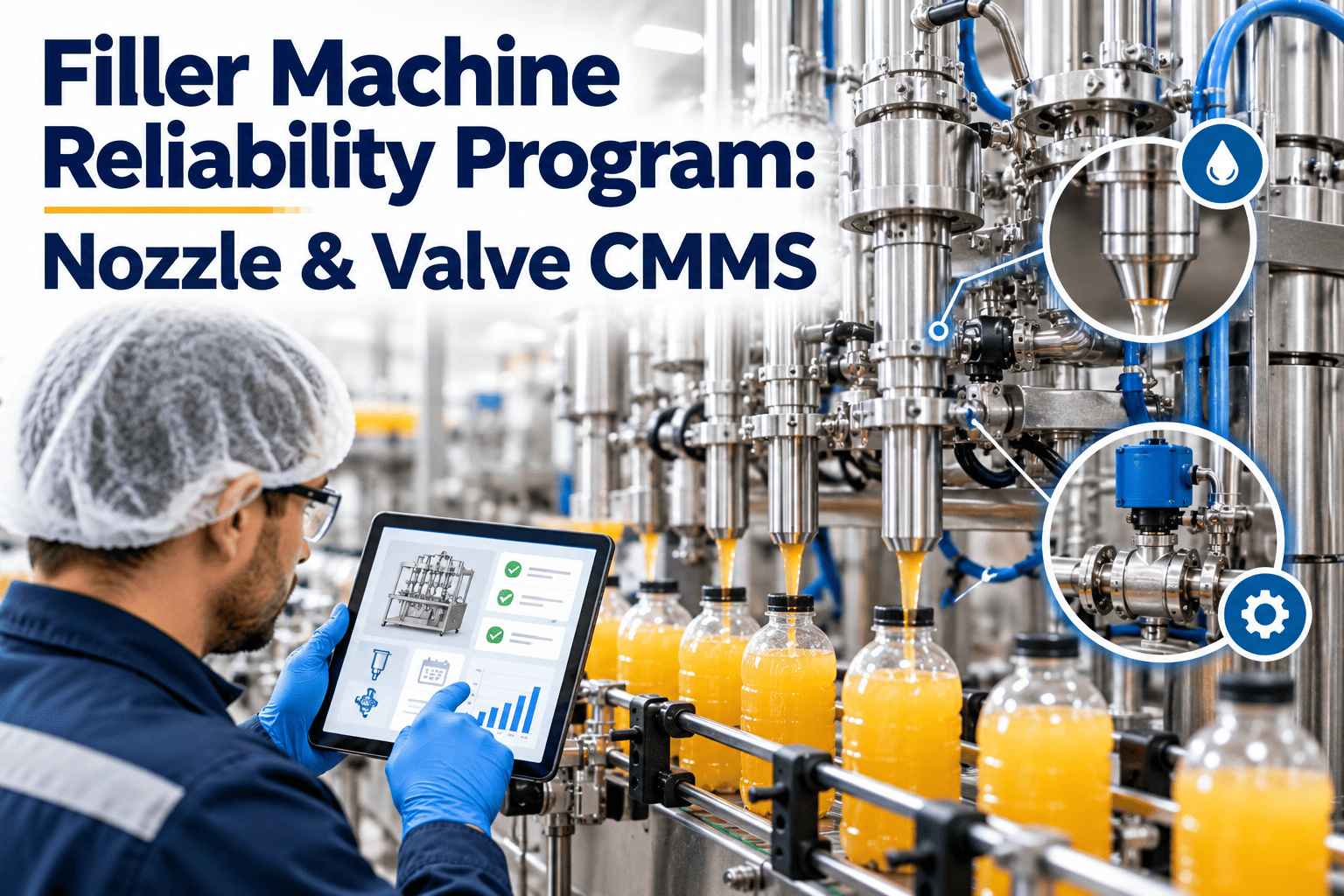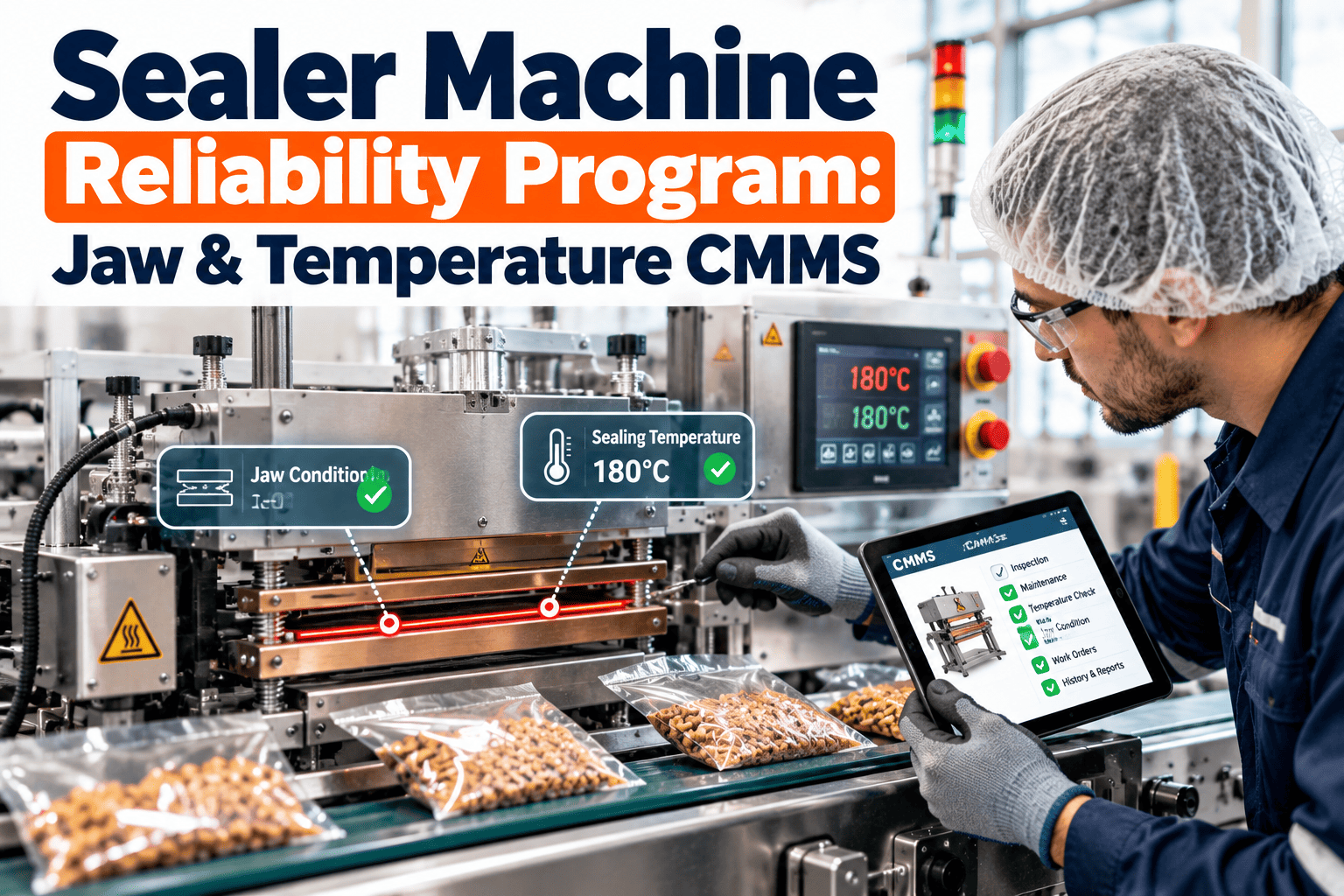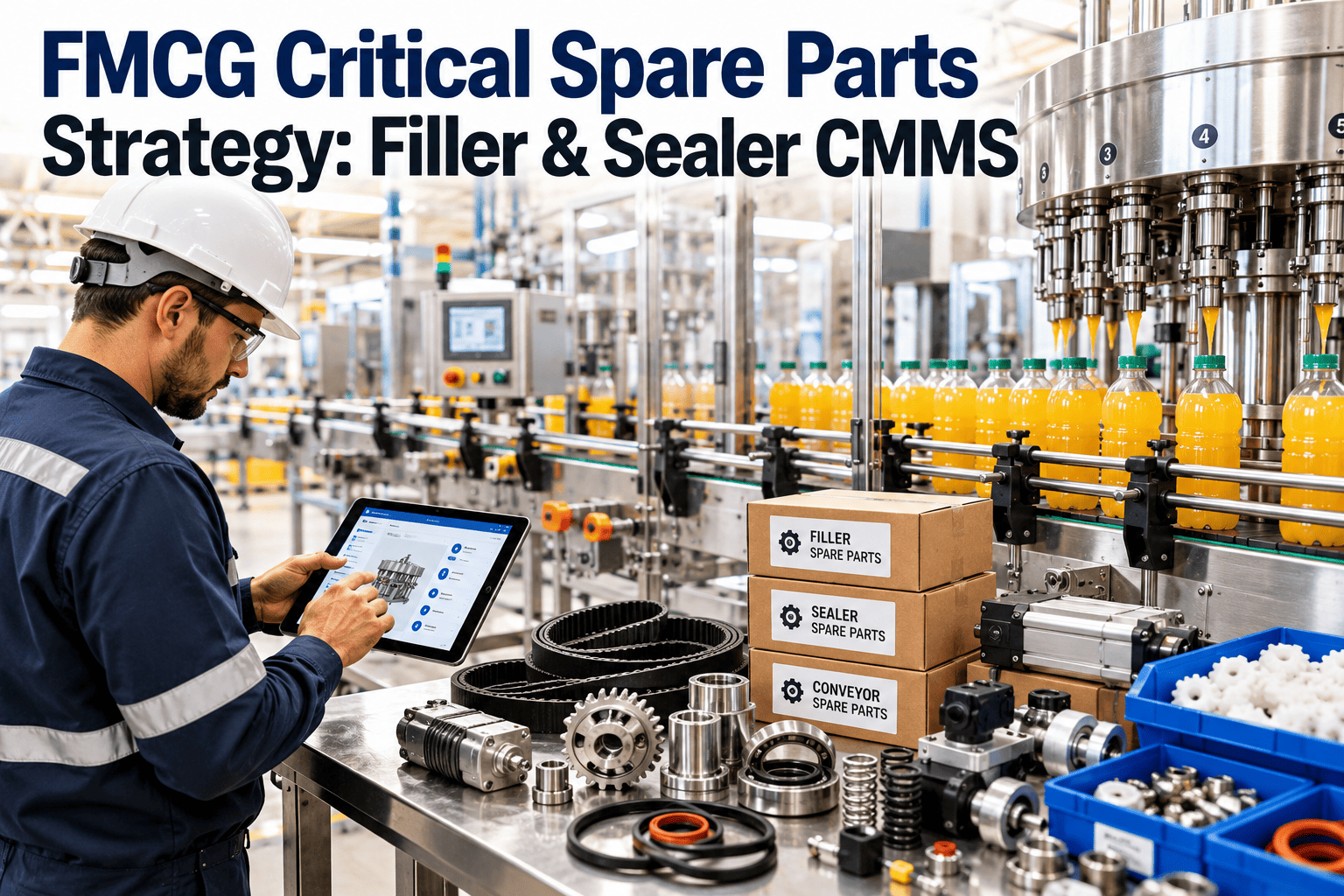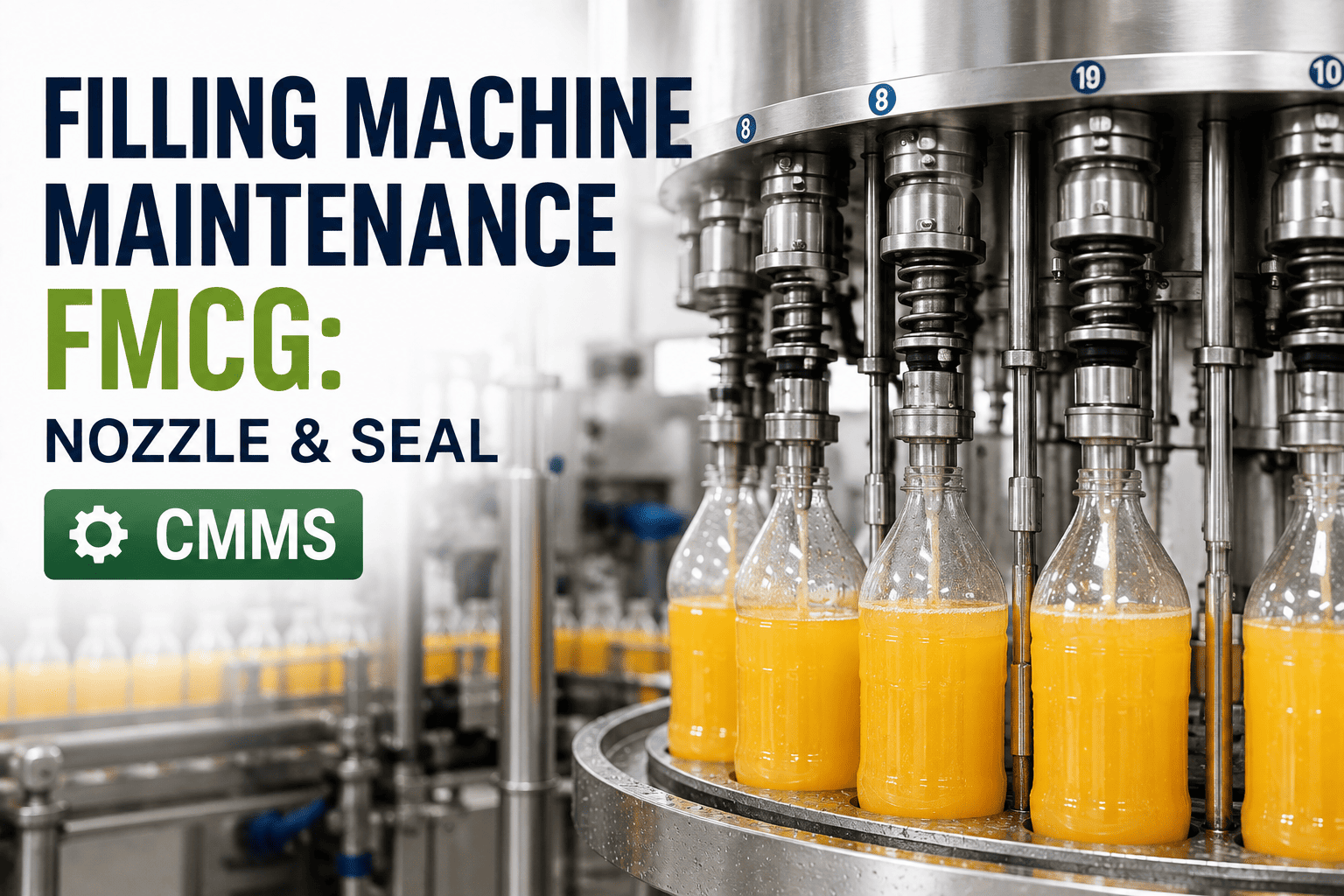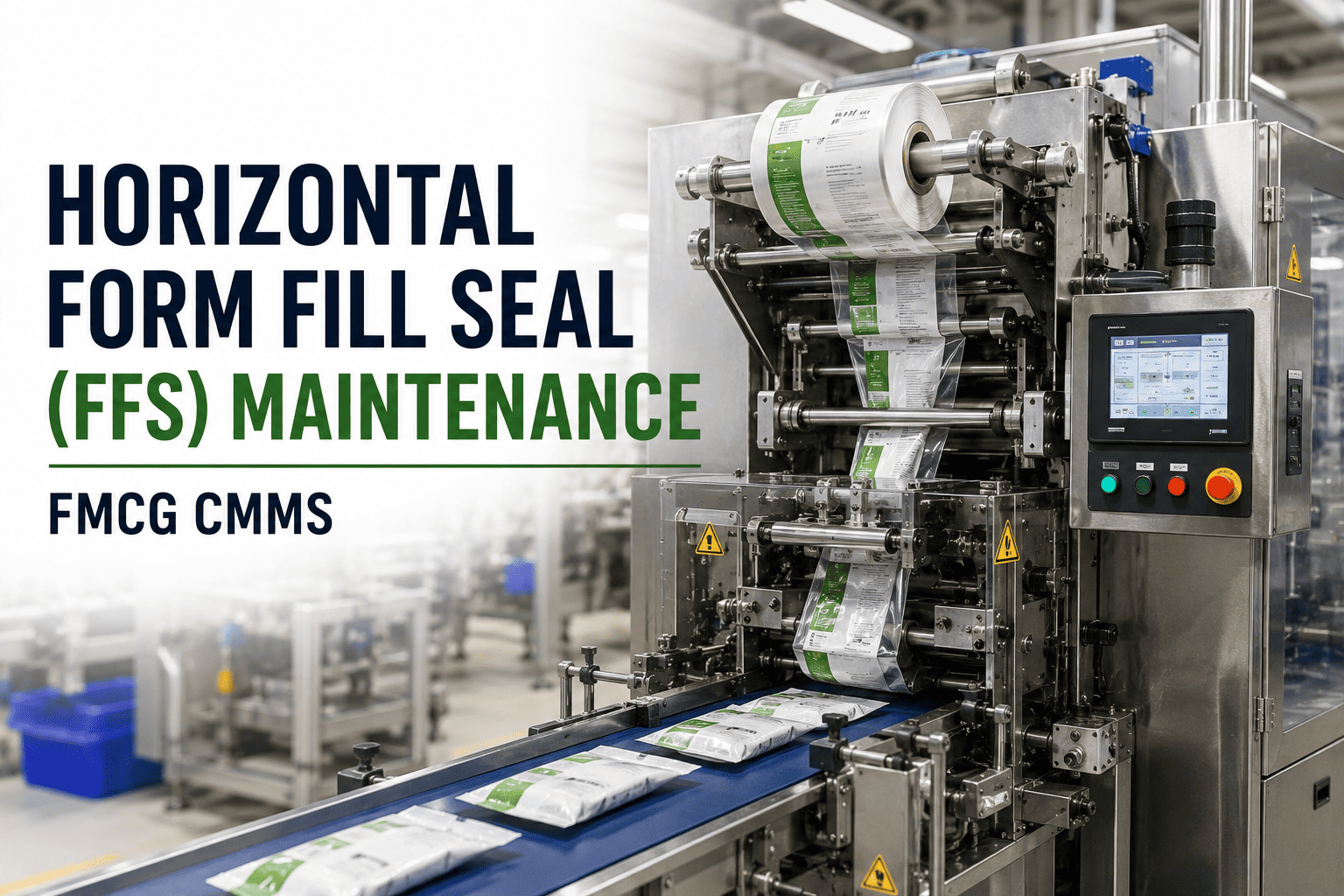
Horizontal form-fill-seal machines run at the intersection of mechanical complexity and unrelenting speed — a single misaligned sealing jaw or drifted registration sensor can scrap thousands of pouches per shift. For FMCG contract manufacturers operating on razor-thin margins, unplanned HFFS downtime routinely costs $4,000–$9,000 per hour in lost throughput and giveaway. This guide walks through the preventive maintenance, calibration, and CMMS-driven reliability practices that keep flexible packaging lines above 85% OEE. Ready to operationalize it? Start Free Trial and deploy a ready-made HFFS PM template in under an hour.
Is your HFFS line leaking availability — one microstop at a time?
Across FMCG packaging operations, 60–70% of HFFS unplanned downtime traces back to four failure modes: film tension drift, sealing jaw wear, registration mark misreads, and forming-set misalignment. A CMMS-driven PM program targets each one on a time-based cadence before a single pouch is scrapped.
The most maintenance-intensive asset on the packaging floor
Horizontal form-fill-seal machines synchronize film unwind, forming collar, product loading, sealing, and cutoff at 60–120 pouches per minute — each station with its own wear profile, calibration window, and failure signature. Run-to-failure is not a strategy here.
A 3-line FMCG contract packager running snack pouches at 110 ppm was losing 14 hours/month to HFFS microstops — sealing jaw film build-up, registration sensor drift, and tension roller misalignment. After deploying a CMMS-scheduled weekly PM cycle with calibration checks and sensor cleaning, unplanned HFFS downtime dropped 61% in 90 days, recovering roughly $45K/month in throughput. The PM labor cost? Under $1,800/month.
Where HFFS maintenance effort actually pays off
Not every PM task carries the same weight. These four subsystems account for the overwhelming majority of HFFS downtime events and should anchor your CMMS preventive maintenance plan.
Worn tension rollers and misadjusted dancer bars cause film wander, wrinkles, and splice failures. Inspect roller surfaces weekly, verify dancer arm freedom of movement, and calibrate tension setpoints against the film supplier spec — typically 8–15N for laminated polypropylene. A 2N drift can trigger a 3% film scrap rate on a 110 ppm line.
Sealing jaws accumulate polymer residue, springs fatigue, and temperature controllers drift. Clean jaw faces every shift, verify parallelism with feeler gauges weekly (target ±0.05mm across the seal face), and calibrate PID temperature zones monthly. A jaw running 8°C cold produces leakers — a recall risk in food packaging.
Photoelectric registration sensors drift with dust, film print contrast variation, and vibration. Clean the sensor window daily, verify eye-mark contrast ratio (minimum 70%), and run a registration accuracy check at each product changeover. Misregistration above 1mm triggers automatic rejects — and silent yield loss when the rejector itself is misaligned.
The forming collar and tube govern pouch geometry. Inspect for wear grooves monthly, verify collar-to-tube concentricity, and confirm product fall-tube clearance at every SKU change. A worn forming set produces inconsistent pouch widths — a silent driver of downstream carton-loading failures and retailer chargebacks.
HFFS preventive maintenance checklist by cadence
A time-based PM structure — daily, weekly, monthly, quarterly — assigned per asset in your CMMS, with checklists, parts, and labor estimates attached. Each task below is a building block of the full HFFS reliability program.
- Clean sealing jaw faces with non-abrasive pad
- Wipe registration sensor lens with lint-free cloth
- Inspect film splice quality at unwind
- Verify air supply pressure at regulator (6.2 bar)
- Log counter readings and reject count
- Inspect tension roller surfaces and dancer bearings
- Verify sealing jaw parallelism with feeler gauge
- Check drive belt tension and condition
- Lubricate forming collar guide per OEM chart
- Run registration accuracy test (10 pouches)
- Calibrate PID temperature zones on both jaws
- Inspect cutter blade edge and replace if nicked
- Verify forming tube concentricity (±0.1mm)
- Test emergency stop and light curtain response
- Review CMMS trend data for drift patterns
From checklist to closed-loop reliability program
A CMMS turns static checklists into a living reliability program — auto-triggered work orders, parts reservation, meter-based triggers, and failure-mode trending. Here is how an HFFS PM cycle moves through the system month over month.
Register each HFFS as a parent asset with child components (unwind, forming set, sealing jaw assembly, cutoff, registration sensor). Attach OEM manuals, PM templates, and BOM. Import 12 months of downtime history to establish baseline MTBF — typically 90–140 hours for unmanaged HFFS lines.
Activate daily, weekly, and monthly PM work orders with assigned technicians, estimated labor, and required parts. Configure meter-based triggers on pouch counters so a 500K-pouch jaw inspection fires automatically — not when someone remembers. Mobile CMMS app delivers checklists to the floor.
After 4–6 weeks of PM execution, analyze completion rates, finding-to-failure ratios, and mean-time-to-repair. Adjust PM intervals — some weekly tasks may extend to biweekly; some monthly tasks may need to move weekly. The CMMS trend dashboard surfaces drift in sealing temperature and registration accuracy before they become rejects.
Run a quarterly reliability review: top 5 failure modes, PM compliance percentage, MTBF trend, and OEE impact. Convert recurring corrective work into additional PM tasks. A mature HFFS CMMS program typically lifts MTBF from 110 to 240+ hours and cuts unplanned downtime 50–65% within two quarters.
CMMS-driven HFFS maintenance: the payback math
The business case for moving HFFS maintenance from clipboard to CMMS is rarely close. Below is a simplified payback model for a mid-size FMCG contract packager running three HFFS lines.
| Metric | Before CMMS | After CMMS (12 mo) | Delta |
|---|---|---|---|
| Unplanned HFFS downtime (hrs/month) | 42 | 16 | −62% |
| Mean time between failures (hrs) | 110 | 255 | +132% |
| Film scrap rate (%) | 3.8% | 1.4% | −63% |
| PM compliance (%) | 48% | 94% | +96% |
| OEE (line average) | 71% | 84% | +13 pts |
| Annual downtime cost ($) | $454K | $173K | −$281K |
Put your HFFS reliability program on autopilot
Pre-built HFFS PM templates, meter-based triggers, mobile checklists, and failure-mode trending — live on your floor this week.
Horizontal form fill seal maintenance, answered
Sealing jaw temperature zones should be calibrated monthly using a calibrated thermocouple probe, while jaw parallelism should be verified weekly with a feeler gauge (target ±0.05mm). In high-speed snack or dairy applications running 100+ ppm, consider biweekly temperature calibration — PID drift of 6–10°C is common after 200 hours of operation and directly causes leaker defects.
Film tension depends on material and pouch format, but laminated polypropylene typically runs at 8–15N at the unwind station, verified with a calibrated tension meter. The dancer bar should move freely through its full range without sticking. Tension drift beyond ±2N from spec causes wrinkles, splice failures, and registration errors — log readings weekly in your CMMS to catch drift early.
Yes. Meter-based triggers are one of the highest-value CMMS features for HFFS assets. You configure the system to fire a jaw inspection every 500,000 pouches, a belt check every 2 million, or a deep calibration every 5 million — all tied to the machine counter reading. To see this in action on your HFFS lines, Book a Demo and we will configure a live trigger during the session.
For a single HFFS line, expect roughly 6–8 labor hours per week of PM execution ($180–$300 in labor), plus $50–$120 in consumables (cleaning supplies, lubricants, calibration standards). The CMMS software itself runs $40–$120 per asset per month. Against $9,000/hour downtime cost, the PM program pays for itself by preventing a single 4-hour stoppage per quarter.
Most FMCG plants are live in 1–2 weeks: asset registration on day one, PM templates imported by day three, mobile checklists deployed to technicians by week one, and the first full PM cycle completed within 14 days. You can begin by Starting Free Trial and using the pre-built HFFS template, then customize intervals and BOMs as your reliability data matures.
Stop firefighting HFFS downtime — start preventing it
Join FMCG contract packagers using CMMS-driven PM to hold 84%+ OEE on their horizontal form-fill-seal lines.