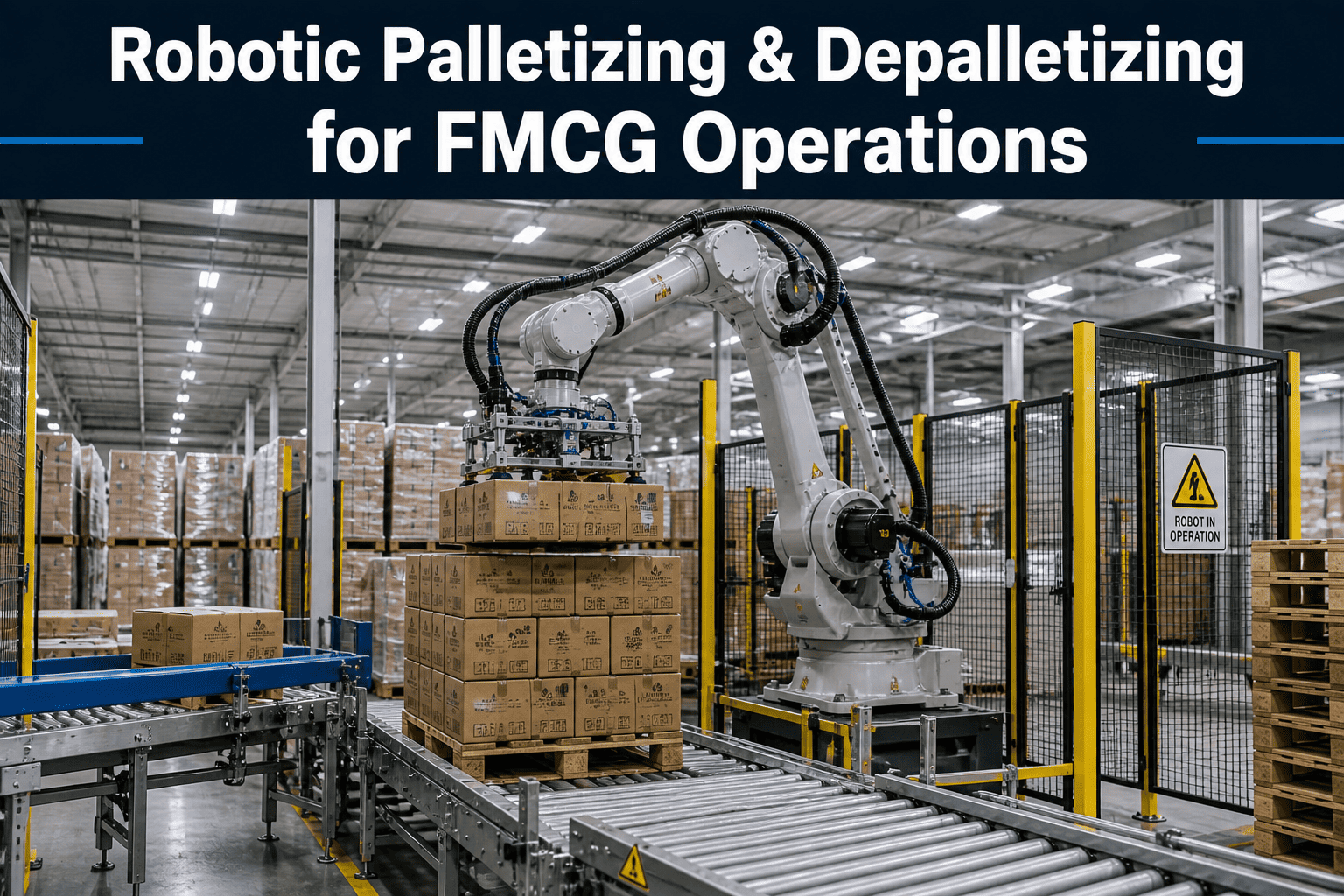
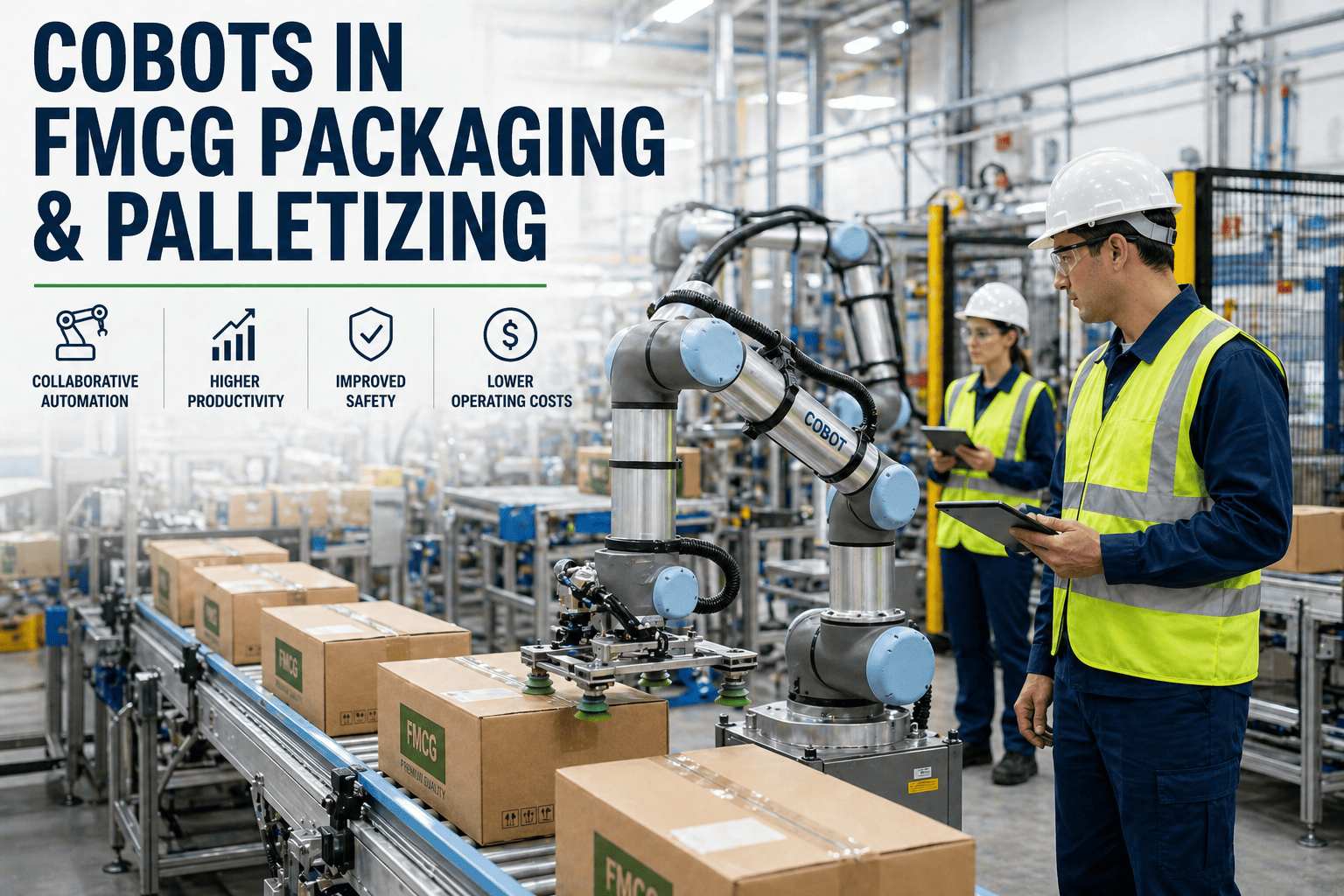
At the end of every FMCG production shift, palletising is where speed, accuracy, and safety collide — and where manual operations consistently underperform against what the operation needs. A palletising team of three operators stacking 25 kg cases for eight hours is producing musculoskeletal injuries, inconsistent pallet patterns, and throughput that cannot keep pace with modern filling and packaging line speeds. Robotic palletising and depalletising solve all three problems at once — stacking to exact retailer specifications, handling multiple SKUs without reprogramming delays, and running at speeds manual teams cannot sustain. This is one of the highest-ROI automation investments in FMCG warehouse operations today, and the facilities that have made it are not going back. When you are ready to connect your palletising robot performance to a live CMMS with full OEE and preventive maintenance tracking, start a free trial with Oxmaint or book a demo to see how it works across your warehouse floor.
Robotics & Automation · FMCG Warehouse Efficiency
Robotic Palletizing & Depalletizing in FMCG Operations
Faster stacking, multi-SKU handling, and optimised warehouse throughput — with full CMMS integration to keep your palletising robots running at peak performance.
1,800
Cases per hour — typical robotic palletiser throughput vs 400 manual
85%
Reduction in palletising-related musculoskeletal injuries after automation
99.4%
Pallet pattern accuracy rate on robotic systems vs 91% manual
30mo
Typical ROI payback period for robotic palletiser investment
Keep Your Palletising Robots at Peak Performance
Oxmaint tracks OEE at the palletiser level, schedules preventive maintenance by cycle count and runtime hours, and connects every work order to your robot's full maintenance history — so your highest-throughput assets never go down unplanned.
Palletising vs Depalletising — Two Different Problems
Robotic palletising and depalletising are distinct operations with different requirements and automation profiles. Most FMCG operations need both — and managing them as separate automation projects is a common planning error that increases integration complexity and CMMS visibility gaps.
Palletising
End of Production Line
What it does
Stacks finished product cases, cartons, or bags onto pallets in retailer-specified patterns at the end of the production or packaging line.
Key requirement
Pattern accuracy, speed matched to line output, and multi-SKU flexibility for facilities running frequent changeovers.
Typical throughput
800 to 2,400 cases per hour depending on case weight, pallet pattern complexity, and robot configuration.
Manual equivalent
3 to 5 operators per line running 300 to 450 cases per hour — with fatigue rate affecting quality in the second half of shift.
Depalletising
Start of Production or Warehouse
What it does
Removes incoming raw materials, packaging materials, or finished goods from supplier pallets for line feeding, storage, or order picking.
Key requirement
Handles mixed-height and non-uniform layers from supplier pallets — a harder vision and gripping problem than palletising uniform cases.
Typical throughput
600 to 1,800 units per hour — lower than palletising due to the added complexity of reading variable incoming pallet configurations.
Manual equivalent
2 to 4 operators per receiving dock — highest injury risk point in FMCG warehouse operations due to awkward lifts and variable load weights.
The Four Operational Gains from Robotic Palletising
01
Speed That Matches Your Line
Modern FMCG palletisers reach 1,800 cases per hour — 4 to 5 times the sustained throughput of a manual team. A robot never slows down in hour seven of the shift. It stacks at specification speed from the first case to the last.
02
Retailer-Exact Pallet Patterns
Major retailers in the UK, US, Germany, and Australia specify exact pallet patterns for space optimisation and load stability. Robotic systems execute these patterns with 99.4% accuracy — eliminating the retailer chargebacks that manual stacking inconsistency generates.
03
Multi-SKU Without Reprogramming
Modern robotic palletisers switch between product programmes in under 60 seconds — no operator changeover, no physical reconfiguration. A facility running 40 SKUs across 3 lines can automate all of them on a single robotic cell.
04
Zero Injury Risk from Palletising
Palletising is the leading cause of musculoskeletal injury in FMCG warehouse operations. FMCG facilities in Australia and Germany — where workers' compensation costs run 35% above global average — see the fastest ROI from automation on safety liability reduction alone.
How Oxmaint Maximises Palletiser Uptime
OEE Tracking
Real-Time Palletiser OEE Dashboard
Availability, performance, and quality metrics at the individual palletiser level — not just line-level aggregates. See exactly where your palletising cells are losing output.
Preventive Maintenance
Cycle-Based PM Scheduling
Palletiser maintenance triggers by cycle count and runtime hours — not calendar dates. Servo inspections, gripper checks, and lubrication tasks fire automatically when the robot reaches the threshold.
IoT Integration
Servo & Gripper Anomaly Detection
Vibration, torque, and pressure sensor data feeds into Oxmaint from palletiser controllers. Anomalies trigger work orders before they become failures — keeping unplanned downtime at zero.
Spare Parts
Critical Spare Parts Inventory
Oxmaint tracks palletiser spare parts — servo motors, gripper heads, vacuum pads, safety sensors — and reorders automatically when stock drops below minimum threshold.
Changeover Management
SMED-Optimised Programme Switches
Oxmaint records every product programme switch as a changeover event — tracking duration, technician, and outcome — to support SMED analysis and changeover time reduction programmes.
Asset Lifecycle
Robot Lifecycle Tracking & CapEx Planning
Oxmaint builds a full maintenance cost history per palletiser — enabling condition-based replacement planning and 5-year CapEx forecasting for your warehouse automation fleet.
A palletiser that goes down unexpectedly can stop an entire production line within minutes. Oxmaint's preventive maintenance scheduling and IoT anomaly detection keep your palletising robots at peak performance — and when maintenance is needed, the right parts are already in stock. Start a free trial and add your first palletiser to Oxmaint today, or book a demo to see the full OEE and PM workflow.
Manual Palletising vs Robotic — The Numbers
What the ROI Looks Like in Practice
4.5x
Throughput vs Manual
1,800 cases/hour robotic vs 400 manual — enabling one robot to replace a full palletising team while running faster than the team could sustain
$320K
Annual Labour Saving
3-shift FMCG operation: 4 FTE per shift at $28/hr average across three shifts — saved on one palletising line after automation
85%
MSK Injury Reduction
Verified across FMCG facilities post-palletiser automation — with workers' compensation savings in high-labour-cost markets delivering 20–30% of total ROI
30mo
Payback Period
Modelled across labour savings, injury liability reduction, retailer chargeback elimination, and OEE improvement from consistent pallet quality
Frequently Asked Questions
How many SKUs can a robotic palletiser handle simultaneously?
Modern FMCG palletisers store hundreds of product programmes — one per SKU and pallet pattern combination — and switch between them in under 60 seconds. A single robotic cell can handle the full SKU range of most FMCG facilities without physical reconfiguration. Multi-arm configurations handle simultaneous mixed-SKU palletising, placing different products on different pallets from the same robot in the same cycle — critical for facilities running promotional packs or gift sets alongside standard lines.
What types of FMCG products are suitable for robotic palletising?
Robotic palletisers handle virtually any rigid or semi-rigid secondary packaging: cardboard cases, corrugated trays, shrink-wrapped multipacks, polybags in rigid outer cases, and plastic crates. Very soft or irregular primary packaging — loose bags, flexible pouches — typically requires case packing before palletising. Robotic depalletisers have a harder task with mixed-load or non-uniform supplier pallets but modern 3D vision systems achieve 92 to 96% success rates on mixed incoming loads without pre-sorting.
How does Oxmaint track palletiser performance differently from manual reporting?
Manual palletiser reporting captures daily throughput totals at best. Oxmaint captures cycle-level data from the robot controller — cases per hour, pattern errors, cycle times, gripper engagement rates, and downtime events — and presents this as real-time OEE at the individual palletiser level. When OEE drops, the specific loss category (availability, performance, or quality) is visible immediately, and the maintenance work order is already triggered if the cause is a sensor or servo anomaly. This level of granularity is impossible with manual reporting and typical paper-based maintenance logs.
What is the typical maintenance requirement for a robotic palletiser?
A robotic palletiser running 24/7 typically requires: daily visual inspection and gripper check (15 minutes); weekly servo and joint lubrication (45 minutes); monthly safety system and sensor calibration (2 hours); 6-monthly full mechanical inspection and wear part replacement (4 to 6 hours). Oxmaint schedules all of these automatically — triggering work orders by runtime hours and cycle counts rather than calendar dates, which more accurately reflects actual wear. Most FMCG facilities report palletiser uptime above 96% after implementing Oxmaint-managed PM schedules, compared to 88 to 91% with calendar-based maintenance.
Start a free trial to build your palletiser PM schedule today, or
book a demo to see the full cycle-based maintenance workflow.
Your Palletising Robots Are Only as Good as Their Maintenance
Oxmaint connects robotic palletiser and depalletiser assets to real-time OEE dashboards, cycle-based PM scheduling, and full maintenance history — keeping your highest-throughput warehouse assets performing at the speed and accuracy your operation depends on. No implementation fees. Live in 30 days.