Cloud-first analytics promised FMCG manufacturers a single view of every production line. In practice, it delivered latency. By the time a quality defect is flagged, analyzed in the cloud, and returned as an alert, the line has produced another 400 units. In food manufacturing, that is not a software problem — it is a product recall risk. Edge computing changes the equation fundamentally: intelligence moves to the machine, decisions happen in milliseconds, and the cloud handles aggregation and reporting rather than real-time control. The plants implementing this architecture today are not just faster — they are catching defects before they become batches, and reducing waste at a rate cloud-only systems cannot match. Start a free trial to see how Oxmaint integrates with edge devices for real-time OEE and production analytics, or book a demo with our team.
REAL-TIME PRODUCTION INTELLIGENCE
Edge Computing for FMCG: Real-Time Analytics Where Decisions Actually Happen
Move quality inspection, OEE tracking, and predictive maintenance from the cloud to the machine level — where latency is measured in milliseconds, not minutes, and production decisions are made on live data.
See Real-Time Production Analytics in Action
Oxmaint connects with IoT sensors, SCADA systems, and edge devices to deliver live OEE dashboards, production-based maintenance triggers, and instant anomaly alerts — per line, per shift, per asset. No cloud lag.
5ms
Edge processing latency vs 100–300ms for cloud-routed decisions
99.7%
Defect detection rate with edge AI vision inspection on packaging lines
60%
Bandwidth cost reduction when edge devices process data locally before transmission
18%
CAGR of edge computing in global food and beverage manufacturing through 2028
What Is Edge Computing in an FMCG Plant?
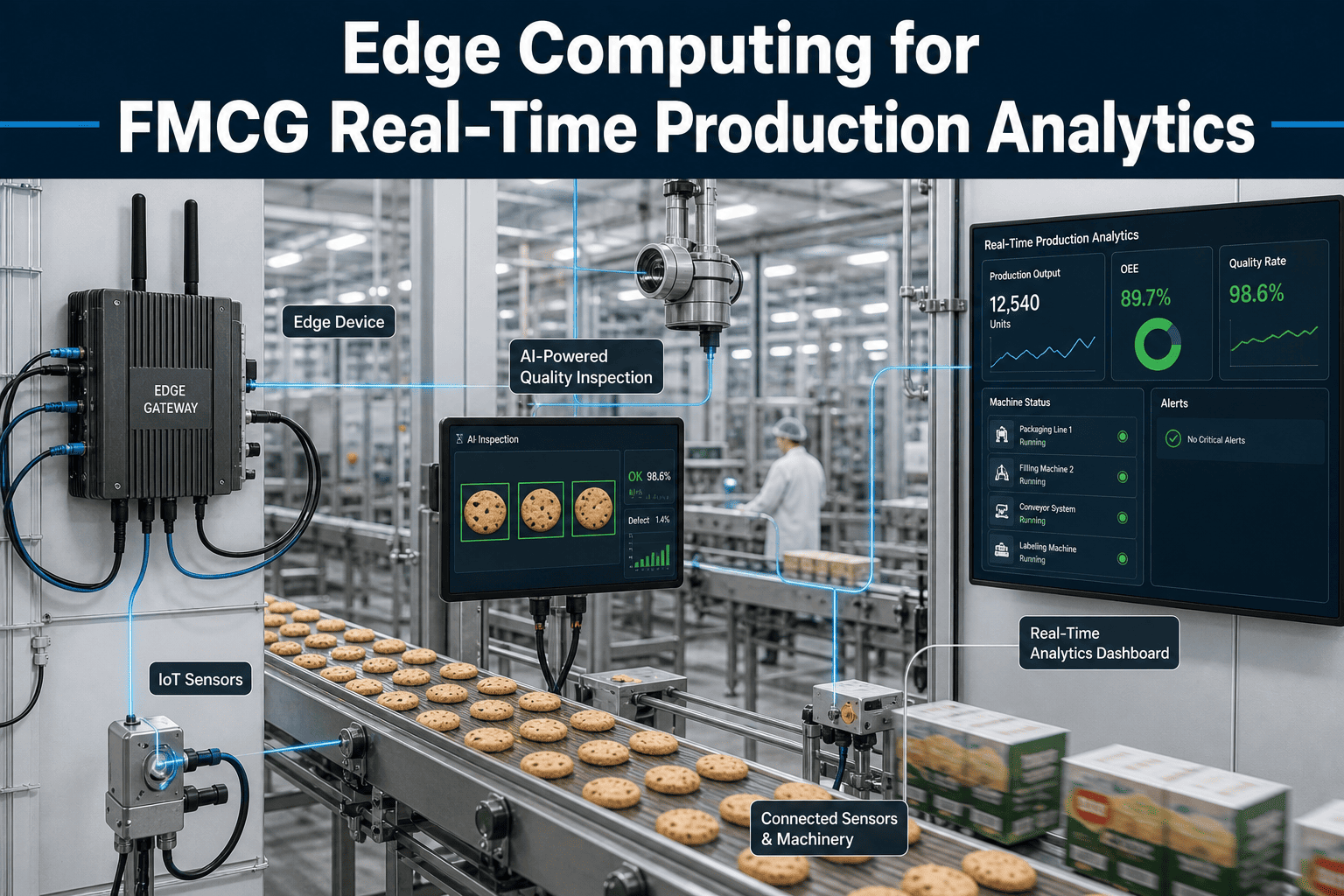
Edge computing places processing power at or near the data source — on the production floor, at the machine controller, or inside the quality inspection camera housing — rather than routing all data to a central cloud server. In an FMCG context, this means a vision inspection system that rejects defective packs in under 10 milliseconds, a vibration sensor that detects bearing wear and triggers a maintenance alert before the shift ends, or a temperature monitor that halts a CIP cycle the moment chemistry parameters drift. The edge device does the thinking. The cloud stores the history. Together they give plant managers both the speed of real-time control and the depth of historical analytics. Start a free trial to connect Oxmaint with your existing SCADA and IoT infrastructure and see production data in real time from day one.
Four Layers of Edge Computing in FMCG Production
Layer 1
Device Layer
Sensors, PLCs, Vision Cameras
Physical instruments generating raw data — vibration sensors, temperature probes, vision cameras, flow meters. These produce data streams at rates from 1Hz to 10kHz. Without edge processing, this volume overwhelms any cloud connection.
Layer 2
Edge Processing Layer
Industrial PCs, Edge Gateways
The intelligence layer. Filters, aggregates, and analyzes device data locally. Triggers immediate actions — line stops, reject activations, maintenance alerts — without cloud roundtrip. Processes decisions in 3–15 milliseconds.
Layer 3
Plant Network Layer
OPC-UA, MQTT, SCADA
Aggregates processed signals from multiple edge nodes across the plant floor. Feeds SCADA displays, OEE dashboards, and CMMS platforms with structured, cleaned production data rather than raw sensor noise.
Layer 4
Cloud Analytics Layer
Long-Term Trends, Reporting
Receives summarized, structured data from the plant layer. Handles long-term trend analysis, cross-site benchmarking, predictive model training, and compliance reporting. Never responsible for real-time production decisions.
Where Cloud-Only Architectures Fail FMCG Plants
Latency Makes Quality Decisions Too Late
A cloud-routed defect alert takes 100–300 milliseconds after detection. At 400 units per minute, that delay means 2–3 defective products pass inspection before the reject signal arrives. Edge processing cuts this to under 10ms — below the physical response time of the reject mechanism.
Connectivity Loss Blinds the Entire Plant
85% of manufacturing sites experience unplanned network interruptions monthly. A cloud-only architecture means zero visibility and zero automated response during these windows. Edge devices continue operating, logging, and alerting regardless of internet connectivity status.
Raw Sensor Data Volume Crushes Bandwidth
A single vibration sensor sampling at 10kHz generates 80MB of data per hour. A plant with 200 sensors generates 16GB hourly — impossible to transmit economically. Edge preprocessing reduces this to structured events and anomalies, typically 99% data reduction before transmission.
Maintenance Triggers Come After the Damage
Cloud-polled sensor data typically arrives in 5–15 minute intervals. A bearing reaching critical temperature in 3 minutes produces no cloud alert until the next poll cycle — by which time the failure has occurred. Edge AI catches anomalies within seconds and triggers work orders immediately.
How Oxmaint Connects With Your Edge Architecture
Oxmaint is built to receive structured production data from edge devices, SCADA systems, and IoT gateways — and convert it into actionable maintenance intelligence. When a vibration sensor at the edge detects bearing wear, Oxmaint creates a work order, assigns it to the right technician, and logs it against the asset's maintenance history — automatically. OEE dashboards update in real time from production signals, and maintenance triggers fire based on actual output, not calendar schedules. Start a free trial and connect your first edge data source today, or book a demo to see the IoT integration workflow live.
IoT Integration
SCADA and Edge Gateway Connectivity
Native integration with OPC-UA, MQTT, and Modbus protocols. Oxmaint ingests structured production signals from any compliant edge device or industrial gateway without custom development.
Real-Time OEE
Live OEE Per Line, Per Shift
Availability, performance rate, and quality rate calculated from live production signals. OEE dashboards refresh continuously — plant managers see actual performance, not shift-end summaries.
Smart Triggers
Production-Based Maintenance Triggers
PMs and inspections triggered by actual production output — units, cycles, operating hours — sourced directly from edge device readings. No manual data entry, no estimation.
Anomaly Response
Automated Work Order Creation
When edge sensors detect an anomaly — vibration spike, temperature excursion, pressure drop — Oxmaint automatically creates a work order, classifies the priority, and dispatches to the right technician.
Asset Intelligence
Condition Scoring From Live Data
Asset condition scores update continuously from IoT-fed performance data. Remaining useful life estimates sharpen over time as historical patterns accumulate — moving you from preventive to truly predictive maintenance.
Multi-Site View
Portfolio-Wide Production Analytics
Aggregate real-time data from every connected site into a single portfolio dashboard. Compare OEE, downtime rates, and maintenance performance across all plants from one login.
Cloud-Only vs Edge-Integrated FMCG Analytics
Capability
Cloud-Only System
Edge + Oxmaint
Quality Defect Response
100–300ms — defects pass line before alert
3–10ms at edge — reject activated before defect passes
Network Outage Behavior
Complete loss of visibility and automated response
Edge continues operating, alerts, and logging independently
OEE Reporting Frequency
End-of-shift or daily summary
Continuous real-time updates per line
Maintenance Triggers
Calendar-based or manual entry
Production-based, auto-created from live sensor signals
Bandwidth Cost
Full raw sensor stream transmitted to cloud
Pre-processed events only — 60% lower bandwidth usage
Predictive Maintenance Accuracy
Low — polled data misses fast-developing failures
High — continuous monitoring catches anomalies within seconds
45%
Reduction in quality escapes
FMCG plants with edge AI inspection vs traditional end-of-line sampling
3x
Faster failure detection
Edge-based anomaly detection vs scheduled PM intervals alone
99.5%
System availability
Edge-integrated production monitoring vs 94% for cloud-only architectures
$1.2M
Annual waste savings
Average FMCG plant savings from real-time defect detection and prevention
Frequently Asked Questions
Does edge computing replace cloud analytics or work alongside it?
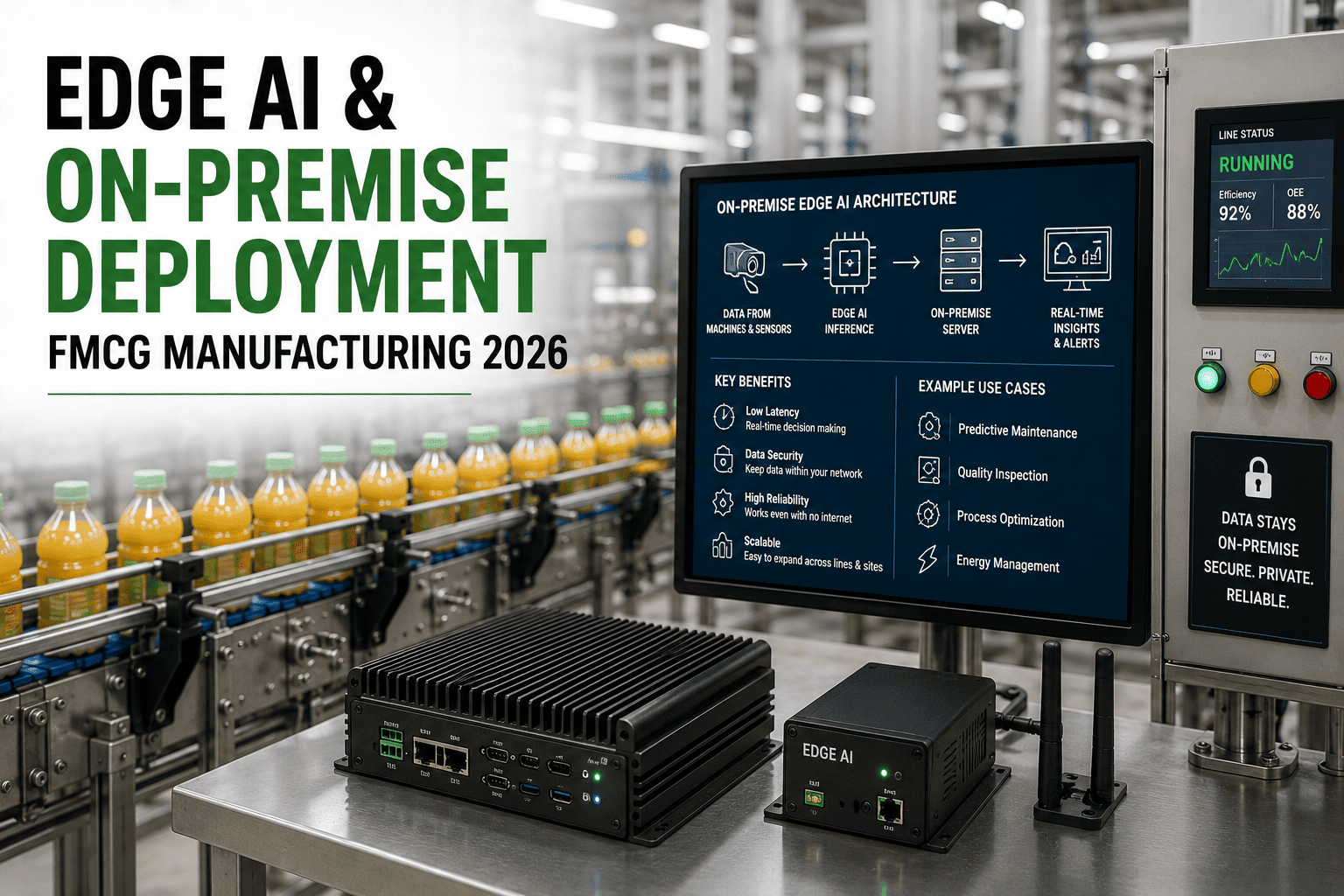
Edge computing and cloud analytics are complementary layers, not alternatives. Edge handles real-time control, quality decisions, and immediate maintenance triggers. The cloud handles long-term trend analysis, cross-site reporting, model training, and compliance documentation. Oxmaint sits at the intersection — receiving structured production data from edge devices and surfacing it through dashboards and automated workflows.
What does Oxmaint need to connect with our existing edge infrastructure?
Oxmaint connects via standard industrial protocols including OPC-UA and MQTT, and through REST API integrations with SCADA platforms. Most FMCG plants with existing IoT infrastructure can complete the integration in days, not months. No hardware replacement is required — Oxmaint layers asset management and maintenance scheduling on top of your existing sensor and gateway setup.
How does Oxmaint use edge data to trigger maintenance work orders?
You define threshold rules for any IoT-connected asset — vibration above a set amplitude, temperature above a defined limit, production count reaching a PM interval. When edge data crosses a threshold, Oxmaint automatically creates a work order, assigns it based on technician availability and skill, and logs it against the asset's full maintenance history. The technician receives a mobile notification and completes the task with digital sign-off.
Can Oxmaint handle multi-site edge integration across different plant configurations?
Yes. Oxmaint's portfolio architecture is designed for multi-site operations where each plant has different equipment, different sensor networks, and different edge configurations. The portfolio dashboard aggregates normalized OEE and maintenance performance data from all sites — regardless of the underlying edge hardware — into a single cross-site view for operations leadership.
OXMAINT FOR EDGE-CONNECTED FMCG PLANTS
Real-Time Data. Automated Maintenance. Zero Blind Spots on the Production Floor.
Oxmaint integrates with your IoT infrastructure to deliver live OEE dashboards, production-triggered maintenance, and instant anomaly response — across every line, every site, every shift. Stop managing assets from yesterday's data.




.png)