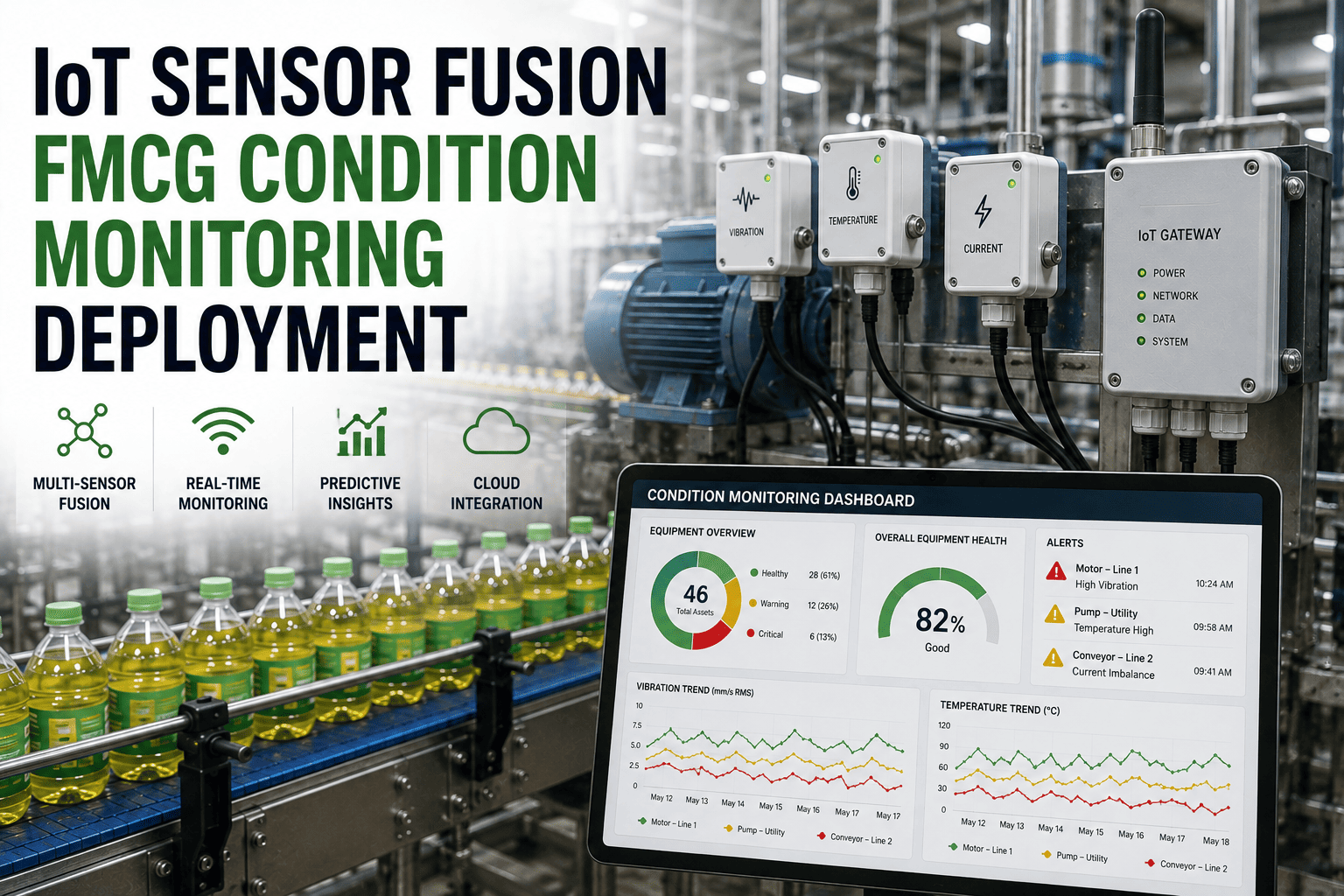
One vibration sensor on a motor says everything looks fine. Add a temperature sensor and a current sensor to the same motor, and suddenly the pattern across all three says the bearing has four weeks left. No single signal tells the whole story — the fusion of a few does. Sign up to deploy multi-sensor condition monitoring across your plant without drowning in integration work.
What This Guide Covers
This guide covers IoT sensor fusion for FMCG condition monitoring deployment: multi-sensor architecture combining vibration, thermal, and motor current data, edge gateway design, fusion algorithms, and the deployment approach that scales to hundreds of assets without integration overload.
Why One Sensor Alone Isn't Enough
Vibration
Catches mechanical wear like bearing defects and imbalance, but stays quiet on electrical or thermal-only faults
Thermal
Flags overheating and loose connections, but can miss an early-stage mechanical fault that hasn't raised temperature yet
Current
Reveals load imbalance and winding issues, but on its own can't tell a mechanical cause from an electrical one
Where IoT Deployments Stall Out
| Stage |
How It Costs The Rollout |
| Sensor sprawl |
Mixing sensor brands and protocols asset by asset turns a simple rollout into a permanent integration project |
| Data silos |
Vibration, thermal, and current data landing in separate systems makes fusing them into one insight nearly impossible |
| Gateway scaling |
An architecture that works for ten sensors often breaks down when it needs to reach hundreds of assets |
| Actionability |
A fused insight that stays in a monitoring dashboard never becomes the work order a technician actually sees |
Four Pillars Of A Sensor Fusion Deployment
1
A Standardized Multi-Sensor Architecture
Consistent sensor types and communication protocols across assets, so adding the next hundred doesn't mean a new integration
2
Edge Gateways That Aggregate Before They Send
Local processing that combines readings at the edge, cutting the data volume and delay before it reaches the platform
3
Fusion Algorithms That Cross-Check Signals
Logic that weighs vibration, thermal, and current data together, catching what any single signal would miss alone
4
A Phased Rollout Across Critical Assets
Starting with the highest-risk assets and expanding in stages keeps deployment manageable instead of overwhelming
Instrument Hundreds Of Assets Without The Integration Headache
OxMaint brings vibration, thermal, and current data into one platform per asset, so fusion happens automatically instead of across disconnected dashboards. Sign up for a free trial to start your sensor rollout, or book a demo to see it mapped to your plant.
What A CMMS Adds To Sensor Fusion Deployment
All Sensor Streams On One Asset Record
Vibration, thermal, and current readings land against the same asset instead of scattered across separate tools
Cross-Signal Alert Logic
Alerts that only fire when multiple signals agree, cutting down on noise from any single sensor acting up
Work Orders Generated From Fused Insight
A confirmed cross-signal fault opens a work order directly, moving straight from detection to scheduled repair
A Scalable View As Sensors Multiply
Adding the next hundred sensors extends the same dashboard instead of requiring a new monitoring tool
The Real Value Is In The Agreement Between Signals
A single sensor spiking could be noise or a false reading. When vibration, temperature, and current all point the same direction at once, that's the moment worth acting on — and that's what fusion is built to catch.
Frequently Asked Questions
Q
Which sensors are usually combined in an FMCG sensor fusion setup?
Vibration, thermal, and motor current are the most common trio, since together they cover mechanical, thermal, and electrical failure modes on the same rotating asset.
Q
Do all sensors need to be from the same manufacturer?
Not necessarily, but a consistent communication protocol across brands matters far more than the brand itself for keeping the deployment manageable at scale.
Q
How should a plant decide which assets to instrument first?
Starting with assets that have the highest downtime cost or the worst failure history gives the fastest return before expanding sensor coverage plant-wide.
Deploy Sensor Fusion Without The Integration Overload
OxMaint brings multi-sensor architecture, edge data, and cross-signal alerts into one CMMS built to scale across hundreds of assets. Sign up for a free trial to get started, or book a demo to see it mapped to your plant's rollout.