Somewhere in last year's sensor logs, a filler drive bearing was already showing the pattern that would fail it twelve weeks later. Nobody caught it because nobody was looking for a pattern — just a threshold. A trained model would have flagged it in week one. Sign up to turn that kind of buried signal into a maintenance decision weeks before the failure, not a post-mortem after it.
What This Guide Covers
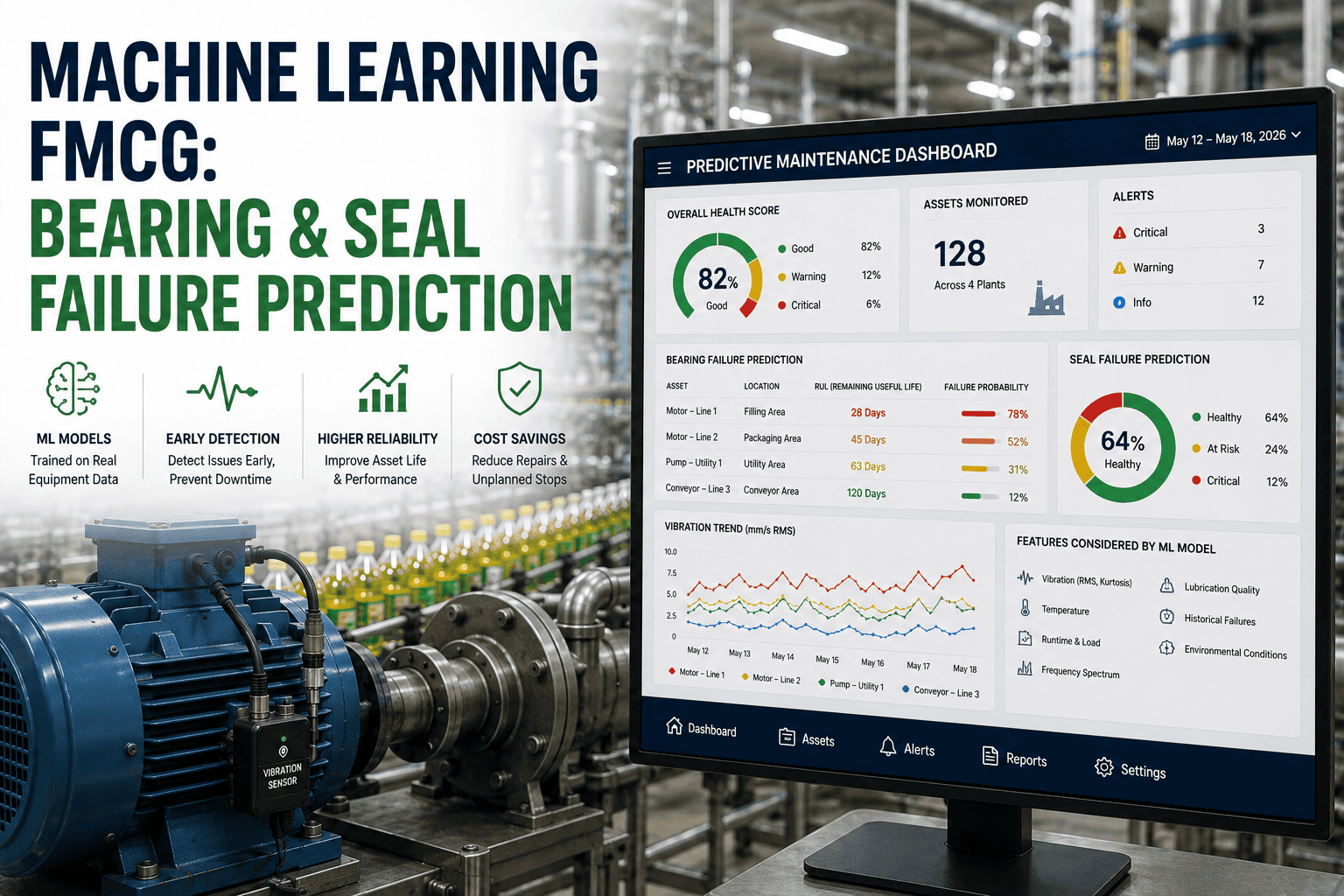
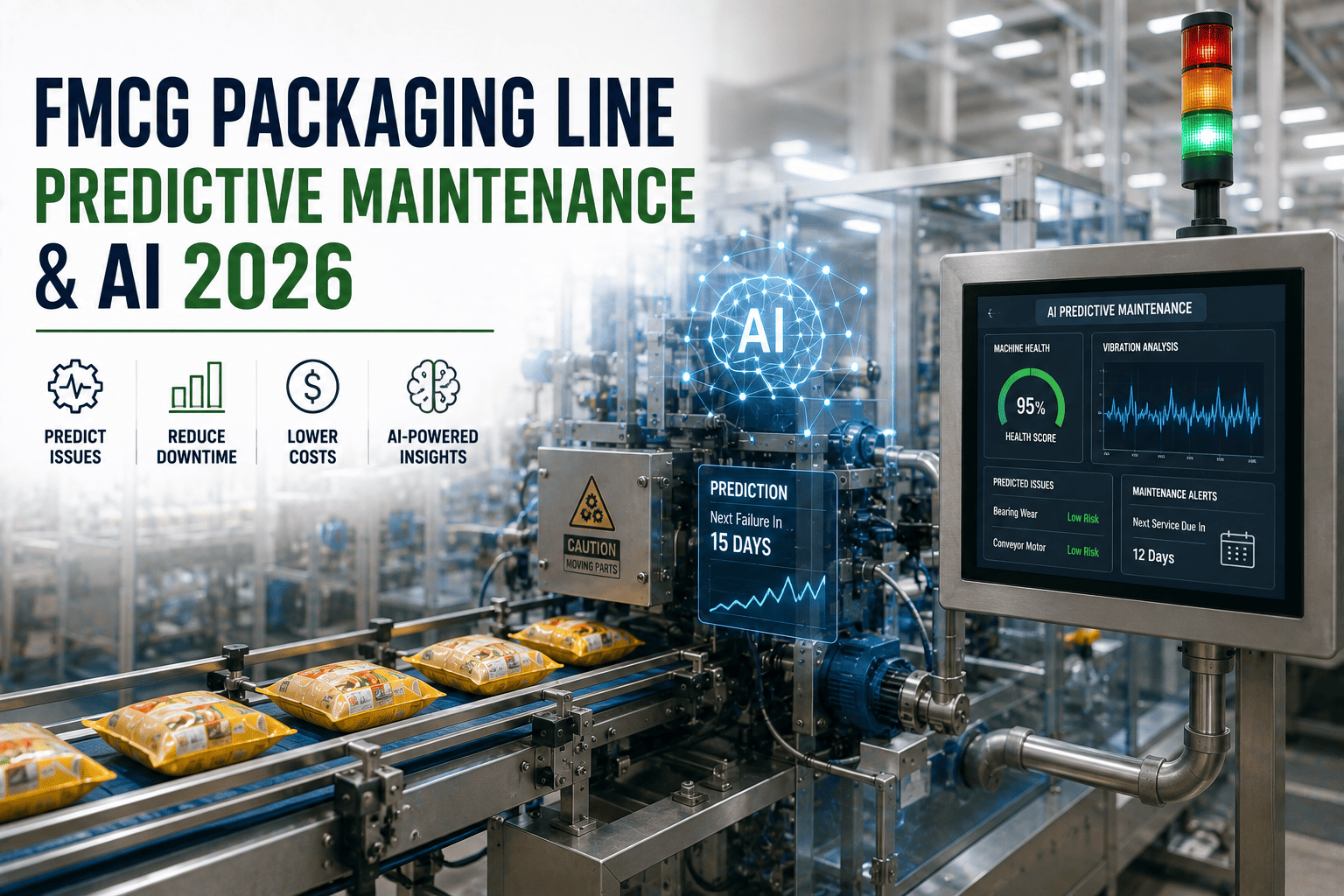
This guide covers machine learning for FMCG bearing and seal failure prediction: model selection, training data requirements, the 4-12 week advance warning window, deployment approach, and how a CMMS turns a model's prediction into a scheduled maintenance decision.
How Far Ahead Can A Model Actually Warn You
4 wks out
Early drift in vibration and temperature features starts nudging the model's failure probability score upward
8 wks out
The pattern strengthens enough to cross the model's confidence threshold, which is when a work order should get planned
12 wks out
Without action here, the bearing or seal typically reaches the failure signatures the model was originally trained on
Where FMCG Plants Get ML Prediction Wrong
| Stage |
How It Costs Prediction Accuracy |
| Training data |
Too few labeled failure examples leaves the model guessing at patterns instead of recognizing ones it has actually seen |
| Model choice |
A model that's too complex for the available data overfits to noise and looks accurate in testing but fails in production |
| Deployment |
A model that only runs offline in a spreadsheet never reaches the technician in time to act on its own prediction |
| Action gap |
A prediction that doesn't automatically become a work order sits in a dashboard while the warning window quietly closes |
Four Pillars Of ML-Based Failure Prediction
1
Model Selection Matched To The Failure Mode
Bearing wear and seal degradation behave differently, so the right model architecture depends on which failure it's built to catch
2
Sufficient Labeled Training Data
Enough historical failure and healthy-run examples for the model to actually learn the difference between the two
3
A Deployment Path Into Daily Operations
A prediction only matters if it reaches a technician's screen the same day it's generated, not buried in a report
4
CMMS Integration From Prediction To Work Order
A model crossing its confidence threshold should open a work order automatically, not wait for someone to check a dashboard
Act On Weeks Of Warning, Not A Post-Mortem
OxMaint turns bearing and seal failure predictions into scheduled work orders the moment a confidence threshold is crossed. Sign up for a free trial to start building your prediction pipeline, or book a demo to see it mapped to your equipment.
What A CMMS Adds To ML Failure Prediction
Automatic Work Order Generation
A prediction crossing its threshold opens a work order instantly, closing the gap between insight and action
Feature History Tied To Each Asset
Sensor and maintenance history stay attached to the specific bearing or seal the model is scoring
Confidence Scores Technicians Can Act On
A visible probability score helps technicians prioritize which prediction to act on first during a busy shift
Closed-Loop Feedback For Retraining
Actual outcomes flow back into the model, sharpening predictions with every completed work order
The Real Value Is In The Action, Not The Model
A brilliant model that predicts a failure eight weeks out is worthless if that prediction never reaches a technician's work queue. The plants getting real value from ML are the ones that closed the loop between prediction and scheduled work.
Frequently Asked Questions
Q
How much historical data does a bearing or seal failure model actually need?
There's no fixed number, but the model needs enough labeled failure events across similar assets to learn the pattern rather than memorize a handful of isolated cases.
Q
Why do predictions need a 4-12 week window instead of a same-day alert?
A same-day alert only gives time for reaction, while a multi-week window gives planners enough lead time to schedule the repair around production instead of stopping the line.
Q
What happens if a model's prediction turns out to be wrong?
A false alarm still gets logged as an outcome and fed back into retraining, which is exactly how the model's accuracy improves over time.
Give Every Bearing And Seal A Predictive Model, Not A Guess
OxMaint connects model predictions, confidence scores, and asset history into one CMMS workflow that turns a forecast into a scheduled repair. Sign up for a free trial to get started, or book a demo to see it built around your plant's failure data.