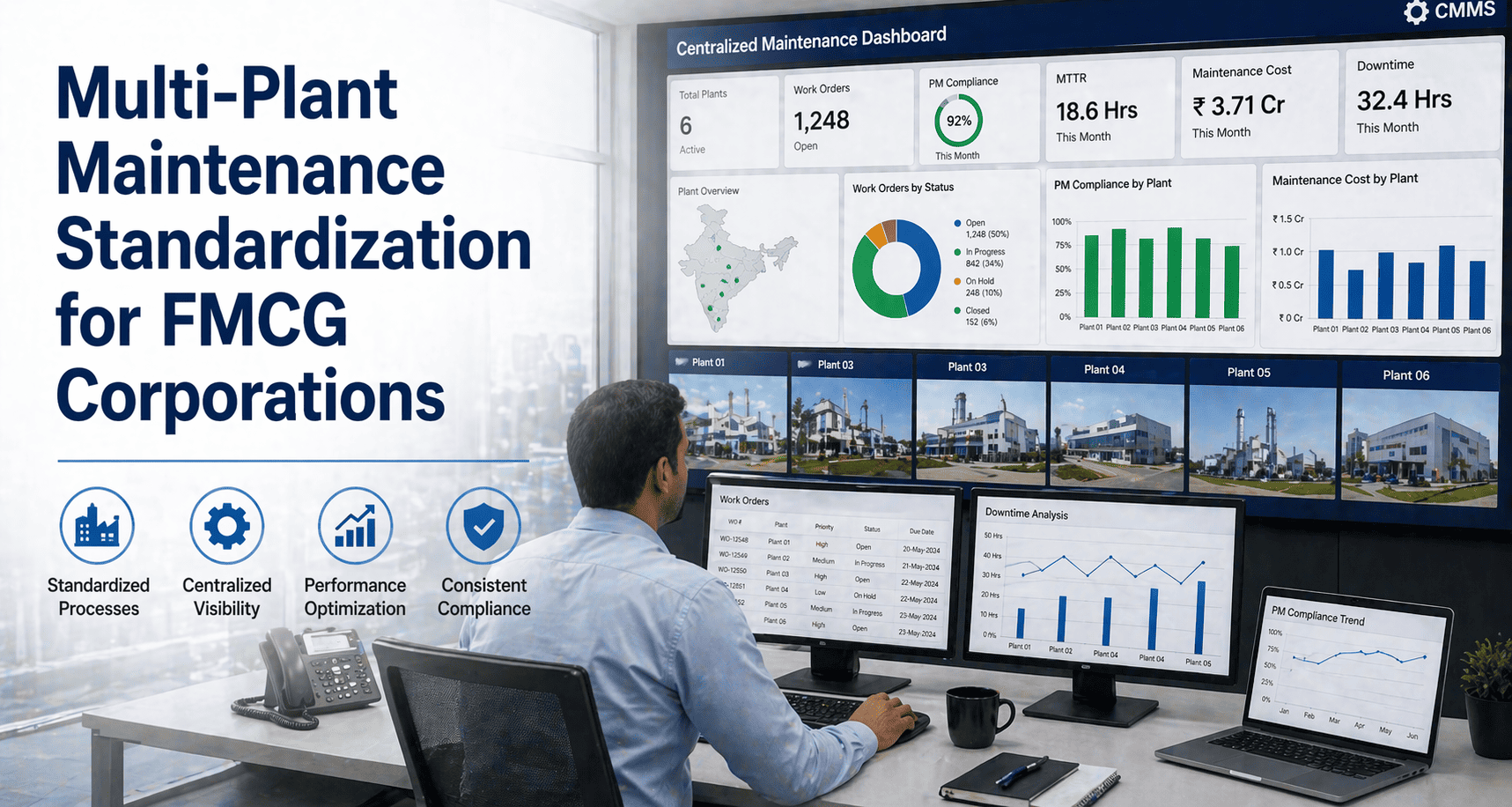
A food manufacturer running five plants with five different maintenance processes is not running a maintenance program — they are running five separate experiments, none of which can be compared, benchmarked, or scaled. The data confirms this: multi-site food operations with standardized CMMS processes achieve 28% lower maintenance costs per unit and 41% fewer unplanned downtime events than organizations where each plant operates independently. The difference is not better technicians or better equipment. It is unified processes, centralized visibility, and cross-plant benchmarking — all managed through a single CMMS platform. Start a free trial with Oxmaint and unify your multi-site maintenance operations on a single platform — or book a demo to see how centralized dashboards give portfolio-level maintenance visibility across every plant.
Multi-Site Operations · Centralized CMMS · Cross-Plant Benchmarking · Enterprise Maintenance
One Company. Multiple Plants.
One Standard.
Zero Excuses for Inconsistency.
Multi-site food manufacturers face a unique operational challenge: every plant must meet the same food safety standards while operating with different equipment fleets, workforce skill levels, and local conditions. Without a centralized maintenance platform, best practices stay trapped in individual plants, underperformers remain invisible, and corporate leadership makes portfolio decisions based on incomplete data. This guide shows how to standardize operations across every facility without killing local operational flexibility.
Oxmaint's multi-site CMMS gives corporate maintenance leaders a unified view across all plants — with standardized KPIs, cross-plant benchmarking, and portfolio-level reporting that makes every site visible and accountable.
28%
Lower Maintenance Cost
Multi-site food operations with standardized CMMS processes reduce maintenance cost per unit by 28% versus independently managed plants
41%
Fewer Unplanned Events
Centralized maintenance programs deliver 41% fewer unplanned downtime events by sharing failure pattern data across all facilities
67%
Faster Best Practice Spread
When one plant solves a recurring failure, unified CMMS platforms deploy the fix to all identical assets across the portfolio in days, not months
3-5x
Spare Parts Savings
Consolidated spare parts procurement across multiple sites delivers 3-5x better pricing and eliminates redundant inventory carrying costs
The Challenge
Why Multi-Site Food Manufacturing Maintenance Is Fundamentally Different
Running maintenance at a single food plant is a local problem. Running maintenance across five, ten, or fifty food plants is a systems problem — and systems problems require systems solutions. The challenge is not that individual plants cannot maintain their equipment. The challenge is that without standardization, corporate leadership has no reliable way to compare performance, allocate resources, identify underperformers, or scale improvements. Every plant becomes an island — and islands do not share knowledge, benchmark performance, or optimize collectively. Want to see what unified multi-site visibility looks like? Start a free trial and connect your first two plants to Oxmaint's centralized dashboard.
01
Data Silos Kill Visibility
Each plant running its own spreadsheets, paper systems, or disconnected CMMS instances means corporate has no unified view. OEE at Plant A is calculated differently than Plant B — making comparison meaningless and portfolio-level decisions blind.
02
Inconsistent PM Programs
The same filler machine at three different plants gets maintained on three different schedules using three different checklists. PM frequency is based on local habit, not data. One plant over-maintains. Another under-maintains. Neither is optimized.
03
Best Practices Stay Trapped
Plant C develops a bearing PM procedure that eliminates a recurring conveyor failure. Without a centralized platform to share this solution, Plants A, B, D, and E continue experiencing the same failure — wasting $40K-$80K per plant per year on a solved problem.
04
Audit Compliance Varies Wildly
Each plant prepares for GFSI audits independently, using different documentation formats and completeness standards. One plant passes with zero findings. Another receives a major non-conformance. Same company, same brand, different maintenance documentation quality.
Standardization Framework
The Six Pillars of Multi-Site Maintenance Standardization
Standardization does not mean every plant runs identically — equipment fleets differ, product lines differ, local regulations differ. Standardization means every plant operates within the same framework, reports the same KPIs, uses the same CMMS platform, and follows the same core processes. Local adaptation happens within the framework, not outside it. These six pillars create the structure that makes multi-site maintenance manageable, measurable, and improvable. If your organization is missing any of these pillars, the gap is costing you more than you realize — book a demo to discuss a standardization roadmap for your portfolio.
1
Unified CMMS Platform
All plants on the same CMMS, with centralized configuration, standardized work order types, unified asset hierarchies, and single-login portfolio dashboards. No more reconciling data from five different systems.
2
Standard Asset Taxonomy
Portfolio > Plant > Production Line > Equipment > Component. Every asset named, categorized, and coded consistently across all sites — enabling like-for-like comparison and fleet-wide reliability analysis.
3
Harmonized PM Programs
Master PM templates for each equipment class deployed across all sites with standardized frequencies, checklists, and completion criteria. Local adaptation allowed within defined parameters — not free-form deviation.
4
Unified KPI Definitions
OEE, MTTR, MTBF, PM compliance, and cost per unit all calculated using the same formula, from the same data sources, at every plant. When corporate says "OEE," every site measures it identically.
5
Centralized Spare Parts
Shared spare parts catalog with cross-site inventory visibility, consolidated procurement, and inter-plant transfer capability. Eliminates redundant stock, reduces carrying costs by 25-35%, and prevents stockout emergencies.
6
Cross-Plant Benchmarking
Automated performance comparison across sites — identifying which plants lead, which lag, and where improvement resources will deliver the highest portfolio-level ROI. Performance gaps become visible in days, not quarters.
Operational Comparison
Siloed Plant Operations vs. Standardized Multi-Site CMMS
| Operational Area |
Siloed Plant-by-Plant Approach |
Oxmaint Multi-Site Platform |
| Portfolio Visibility |
Monthly spreadsheet roll-ups — always outdated, often inconsistent |
Real-time dashboard showing all plant KPIs in a single view |
| PM Standardization |
Each plant creates its own PM schedules — wide variation in quality |
Master PM templates deployed fleet-wide with local customization controls |
| Failure Knowledge |
Solutions stay at the plant that discovered them — lost institutional knowledge |
Fleet-wide failure pattern sharing — one fix deployed across all identical assets |
| Spare Parts |
Redundant inventory at every site — no cross-site visibility or transfers |
Centralized catalog with cross-plant inventory and consolidated procurement |
| Audit Consistency |
Documentation quality varies — some plants pass clean, others fail |
Standardized digital documentation ensures uniform audit readiness |
| Resource Allocation |
Each plant fights for budget independently — no data-driven prioritization |
Portfolio-level analytics identify where investment delivers highest ROI |
Oxmaint Solution
How Oxmaint Delivers Enterprise-Grade Multi-Site Maintenance Management
Oxmaint is built for multi-site operations — not retrofitted from a single-plant tool. The asset hierarchy (Portfolio > Property > System > Asset > Component), role-based access, and centralized reporting architecture are designed from the ground up for food manufacturers managing multiple facilities. Deploy to your first two plants in a week. Scale to twenty without re-architecture. Start a free trial and see the multi-site architecture from day one.
Portfolio Dashboard
Enterprise-Level KPI Visibility
Single dashboard showing OEE, MTTR, PM compliance, and maintenance cost per unit across every plant. Drill down from portfolio view to plant view to individual asset view without switching systems. Corporate sees the forest. Plant managers see the trees.
Template Library
Master PM Template Deployment
Create master PM templates at the corporate level and deploy them to any combination of plants. Each site can add local customizations within defined parameters — ensuring standardization without rigidity. Template updates propagate automatically.
Cross-Plant Analytics
Automated Benchmarking Engine
Identical asset classes are automatically compared across sites. When Plant B achieves 40% better MTBF on the same filler model that Plant D struggles with, the system surfaces it — turning isolated excellence into enterprise-wide improvement.
Inventory Network
Cross-Site Spare Parts Visibility
See spare parts inventory across all plants from a single catalog. Before ordering an emergency part, check if another site has it on the shelf. Inter-plant transfers tracked automatically. Consolidated procurement drives 3-5x better vendor pricing.
Access Control
Role-Based Multi-Site Permissions
Plant technicians see their site. Plant managers see their plant with peer comparison. Regional directors see their group. VP of Operations sees everything. Data access matches organizational authority without separate logins or system instances.
Compliance Hub
Portfolio-Wide Audit Readiness
Generate compliance reports for any plant, any region, or the entire portfolio from a single interface. Standardized digital documentation ensures every site meets the same audit evidence quality — eliminating the "different standard at every plant" risk.
Enterprise ROI
The Financial Impact of Multi-Site Maintenance Standardization
28%
Maintenance Cost Reduction
Standardized PM programs, consolidated procurement, and cross-plant knowledge sharing reduce per-unit maintenance costs by 28% across the portfolio within 18 months
$2.1M
Annual Savings (5-Plant Network)
A five-plant food manufacturing network implementing standardized CMMS operations typically documents $2.1M in combined annual savings from reduced downtime, optimized inventory, and labor efficiency
85%
Faster Corporate Reporting
Automated portfolio-level rollups eliminate the weekly data collection, reconciliation, and formatting cycle that typically consumes 8-12 hours of regional management time
100%
Audit Consistency Across Sites
Standardized digital documentation ensures every plant produces the same audit evidence quality — eliminating the brand risk of inconsistent compliance performance across facilities
Expert FAQ
Multi-Site Food Manufacturing Maintenance — Common Questions
How long does a multi-site CMMS deployment typically take for food manufacturers?
Oxmaint deploys significantly faster than legacy enterprise CMMS platforms. A two-plant pilot can be live within 2-3 weeks, including asset registration, PM template configuration, and user training. Each additional plant typically takes 1-2 weeks to onboard using the templates and configurations established during the pilot. A ten-plant network can be fully operational within 3-4 months — compared to 12-18 months for traditional enterprise CMMS implementations. The key accelerator is Oxmaint's cloud-native architecture — no on-premise servers, no IT infrastructure projects, no plant-by-plant installation.
Book a demo to discuss your specific rollout timeline.
How do we standardize maintenance without removing local plant manager autonomy?
Standardization creates the framework — not the straightjacket. Corporate defines the master PM templates, KPI definitions, asset taxonomies, and reporting requirements. Plant managers retain authority over work order prioritization, technician assignment, shift scheduling, and local equipment-specific adaptations. Oxmaint supports this dual-authority model through template customization ranges: a PM frequency can be set at "weekly +/- 2 days" rather than rigidly locked, allowing local operational flexibility within corporate standards.
Start a free trial and explore the flexible template system.
Can we benchmark plants with different equipment fleets and product lines?
Direct OEE comparison between a dairy processing plant and a dry snack manufacturing plant is not useful. But comparing PM compliance rates, planned vs. reactive ratios, maintenance cost per unit produced, and work order backlog weeks is valid across any plant type — because these metrics reflect process maturity independent of product or equipment. Oxmaint enables both: like-for-like asset benchmarking across sites with identical equipment, and process maturity benchmarking across all sites regardless of product type.
Book a demo to see the benchmarking dashboard configured for mixed-product portfolios.
What is the best starting point for a multi-site standardization initiative?
Start with two plants — ideally one high-performer and one that needs improvement. Deploy the unified CMMS on both simultaneously. This creates immediate benchmarking data and demonstrates the value gap that standardization closes. Within 60-90 days, you will have concrete evidence of performance differences and specific process improvements to replicate. Use that data to build the business case for full portfolio rollout. Most enterprises that start with a two-plant pilot expand to their full network within 6-12 months.
Start free with your first two plants today.
Multi-Site CMMS · Cross-Plant Benchmarking · Enterprise Reporting · Free to Start
Your Plants Already Have the Data. Oxmaint Connects It.
Oxmaint's multi-site CMMS gives corporate maintenance leaders, regional directors, and plant managers a unified view of maintenance performance across every facility — with standardized KPIs, automated benchmarking, and portfolio-level reporting. Deploy to your first two plants in weeks. Scale without re-architecture. Start seeing the performance gaps you did not know existed.