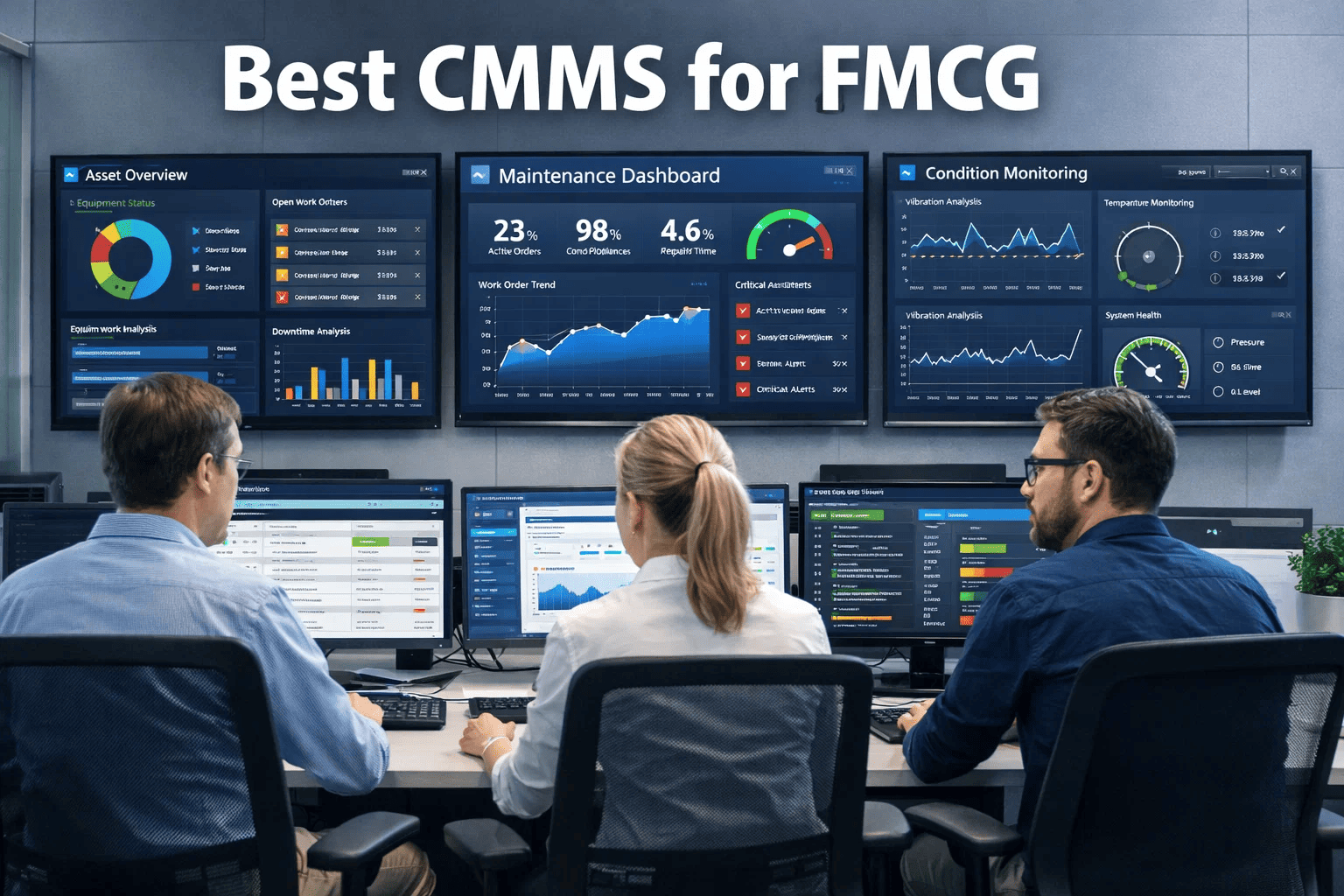
Choosing a CMMS for an FMCG manufacturing operation is not the same decision as choosing one for a commercial property portfolio or a single-site industrial plant. FMCG plants run 24/7, produce hundreds of SKUs, operate under GMP and food safety regulations, manage quality-critical inspection instruments alongside production equipment, and frequently operate across multiple sites with different line configurations and product mixes. The CMMS you choose needs to handle all of this — not just work order management and asset registers, but GMP-compliant digital inspection records, production-based maintenance triggers tied to cycle counts, OEE tracking at the individual line level, and audit-ready documentation that survives BRC, SQF, and retailer supplier audits. Most CMMS platforms built for general industrial use fall short on one or more of these requirements. Start a free trial of Oxmaint and see how it handles FMCG-specific maintenance requirements out of the box — or book a demo to walk through Oxmaint's FMCG capability set with a product specialist.
Best CMMS for FMCG Manufacturing 2026: Top Software Compared
A practical comparison guide for FMCG plant managers and operations directors evaluating CMMS platforms — covering GMP compliance, production-based triggers, quality instrument management, OEE tracking, and multi-site capability.
What Makes a CMMS Fit for FMCG Manufacturing
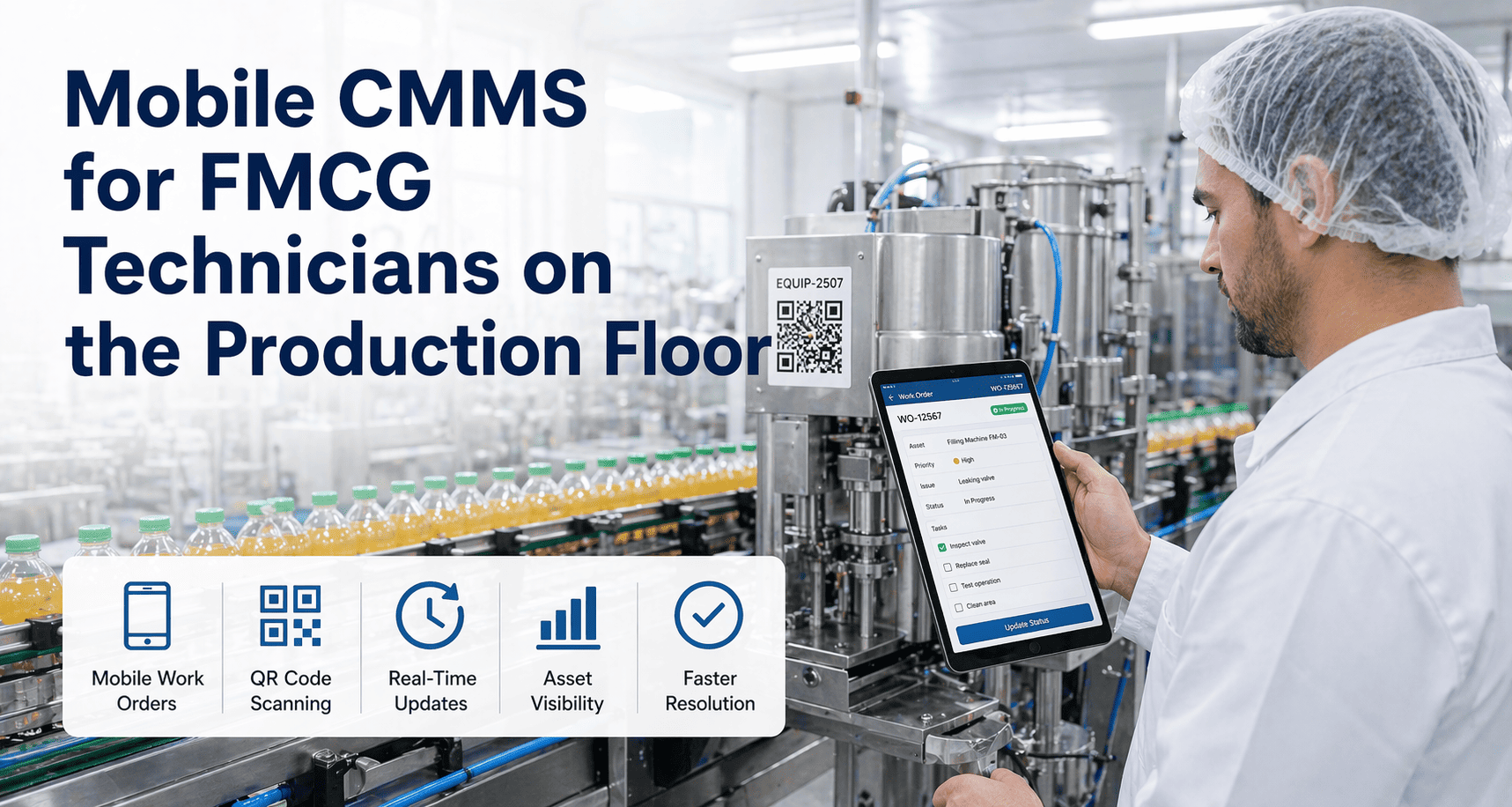
An FMCG-appropriate CMMS must solve problems that generic industrial platforms do not address. The eight capabilities that separate adequate from excellent in this sector are: GMP-compliant digital inspection records with digital signatures; production-based maintenance triggers using cycle counts and units produced, not just calendar dates; quality instrument calibration management integrated with production asset records; OEE tracking at the individual line level with downtime root cause classification; multi-site management with portfolio-level reporting; mobile-first technician interface for line-side work order completion; food safety audit documentation generation; and change management records for equipment modifications with sign-off workflows. Platforms that lack any of these capabilities require workarounds — separate spreadsheets, paper supplements, or manual data entry — that introduce the gaps and inconsistencies that create compliance risk. Start a free trial of Oxmaint to see all eight capabilities in a single platform — or book a demo to see Oxmaint configured for your specific FMCG production environment.
CMMS Feature Comparison: What FMCG Plants Actually Need vs What Platforms Deliver
| FMCG Requirement | Generic CMMS | Oxmaint |
|---|---|---|
| GMP-compliant digital inspection records | Basic work order notes — no digital signature chain, no GMP record format | Full digital signature, timestamp, operator ID — audit-ready GMP documentation out of the box |
| Production-based PM triggers (cycles, units) | Calendar-based triggers only — no integration with production counter data | PM triggers from cycle counts, units produced, runtime hours — direct connection to OEE and production data |
| Quality instrument calibration management | Instruments managed as simple assets with no calibration-specific fields or certificate tracking | Dedicated calibration management — certificate tracking, traceability chain, out-of-tolerance escalation workflows |
| OEE tracking at line level | No OEE calculation — downtime logged as work orders with no production efficiency linkage | Real-time OEE dashboards per line — availability, performance, quality metrics linked to maintenance events |
| Multi-site portfolio management | Single-site or weak multi-site with no portfolio-level reporting | Full portfolio hierarchy — compare maintenance performance, CapEx exposure, and OEE across all sites |
| BRC/SQF audit documentation export | Manual report assembly — no structured audit package generation | One-click audit report generation — complete inspection history, calibration records, CAPA evidence |
| CapEx forecasting from asset condition | No CapEx module — capital planning done separately in spreadsheets | Rolling 5–10 year CapEx forecasts from actual condition scores and maintenance history |
| Implementation timeline | 6–18 months typical — high professional services cost, long configuration cycles | 2–6 weeks to operational — no heavy implementation project, no professional services dependency |
Scroll horizontally to view full table on smaller screens
What Happens When FMCG Plants Deploy the Wrong CMMS
A generic CMMS produces work order records without GMP-compliant digital signatures or traceable audit trails. During a BRC or retailer audit, the quality team must supplement with paper records — and the gap between the CMMS record and the paper supplement is the non-conformance that costs the Grade AA.
A filler piston that runs 40 million cycles in a month should not have the same maintenance interval as one that runs 5 million. Calendar-based CMMS triggers either over-maintain low-usage equipment or under-maintain high-usage equipment — costing money on one side and causing failures on the other.
Quality instrument calibration managed in a separate system from production equipment maintenance means the checkweigher calibration status is invisible when releasing product. Production can be running on an out-of-calibration instrument with no alert — and the two systems never talk to each other.
Without CMMS-driven CapEx forecasting, capital expenditure planning for production line equipment is reactive — justified by emergency failure rather than by condition-based data. Finance receives unplanned capital requests rather than a rolling forecast, making FMCG capital planning structurally inefficient.
See How Oxmaint Handles FMCG Maintenance Requirements Out of the Box
Oxmaint is built for the FMCG production environment — GMP compliance, production-based triggers, quality instrument management, OEE dashboards, and multi-site CapEx forecasting in a single platform with a 2–6 week implementation timeline and no professional services dependency.
Oxmaint Capabilities Built for FMCG Manufacturing Operations
Every inspection form, work order completion, and quality record in Oxmaint is captured with operator ID, digital signature, GPS location, and timestamp. Audit-ready GMP documentation generated automatically — no paper supplements, no gaps.
Oxmaint triggers maintenance from cycle counts, units produced, operating hours, and temperature readings — not just calendar dates. High-volume production lines receive earlier maintenance; lower-volume lines are not over-maintained. PM intervals match actual equipment stress.
Checkweighers, vision systems, spectrophotometers, metal detectors, and pH meters managed as calibrated assets — with certificate tracking, calibration scheduling, out-of-tolerance escalation, and link to product release decisions in one unified system.
OEE calculated and displayed at the individual production line level — availability, performance, and quality components updated in real time. Downtime events linked to work orders and root cause classification for trend analysis and recurrence prevention.
Manage maintenance performance, CapEx exposure, OEE, and compliance status across all FMCG production sites in a single portfolio dashboard. Compare site performance, identify outliers, and allocate capital based on condition data — not politics.
No heavy professional services project. No 12-month implementation timeline. Oxmaint is designed for FMCG plant managers to configure and deploy — not IT departments. Most plants are operational in 2–6 weeks with full asset registry, PM schedules, and mobile technician access live.
Frequently Asked Questions
What CMMS features are most important for BRC/SQF compliance in FMCG?
The BRC GSFS Issue 9 and SQF Edition 9 standards require: documented evidence that PM programmes are executed on schedule, records of equipment cleaning and sanitisation verification, calibration records for all measuring and monitoring equipment with traceability to national standards, CAPA records with verified close-out, and records of any equipment modifications. The CMMS capabilities that directly support these requirements are: digital inspection records with operator sign-off, PM schedule compliance reporting, calibration management with certificate tracking, and CAPA workflow management. Oxmaint provides all of these natively — not as workarounds or add-ons. Start a free trial to see BRC-aligned record generation in practice.
How does Oxmaint handle production-based maintenance triggers for FMCG lines?
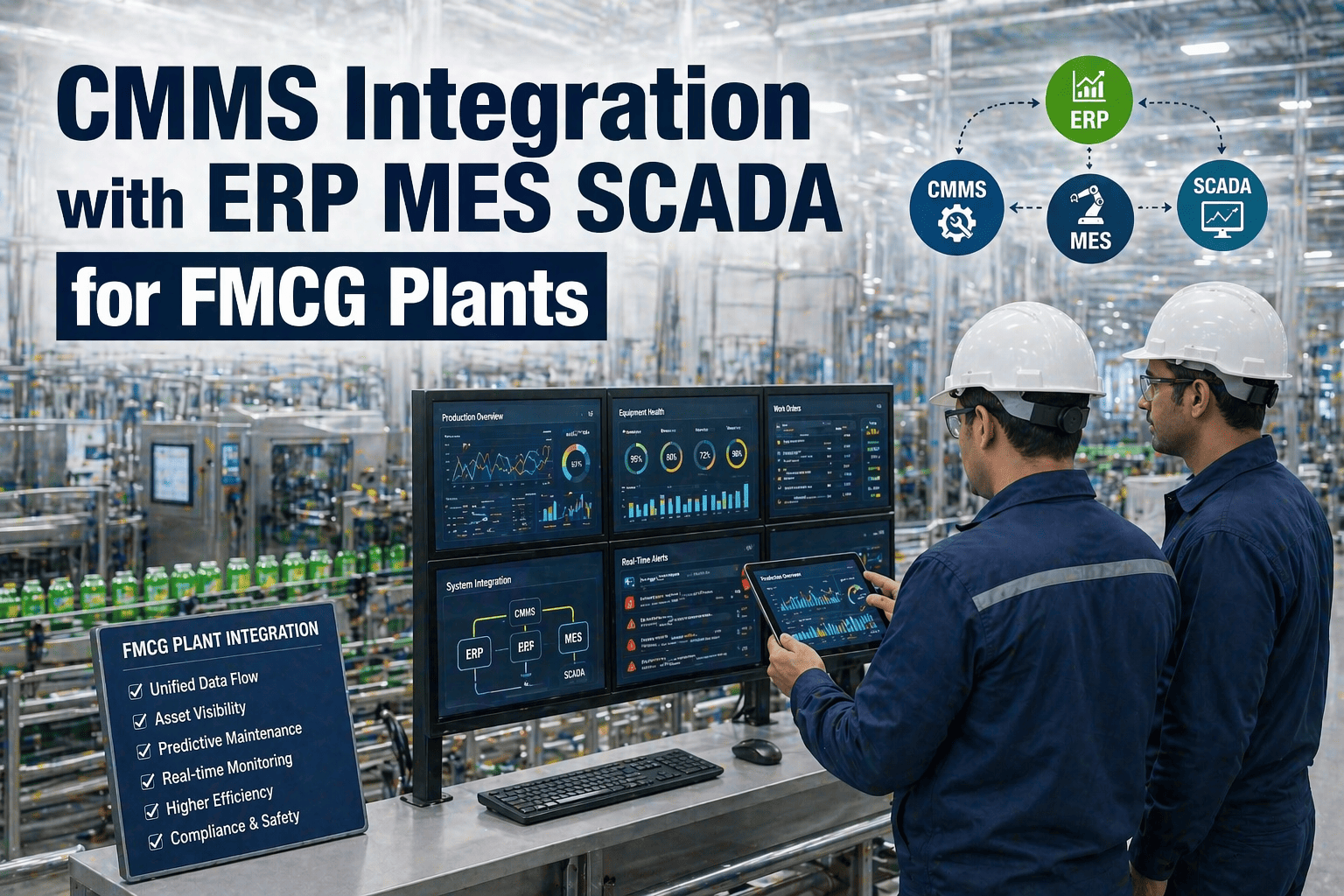
Oxmaint connects to production counters and line speed data via OPC-UA, MQTT, or structured API to receive units-produced and cycle count data per asset. PM schedules can be configured with multiple simultaneous triggers: calendar date (e.g., quarterly), cycle count (e.g., every 500,000 units), or operating hours (e.g., every 2,000 hours) — whichever fires first. This means a filler head that ran a summer campaign at double its normal volume receives maintenance at the right cycle count, not 3 months after it should have been serviced. Book a demo to see production-based trigger configuration for your specific equipment.
How long does Oxmaint take to implement in an FMCG manufacturing environment?
Most FMCG plants are fully operational on Oxmaint within 2–6 weeks. The implementation sequence is: asset register import (existing spreadsheet or previous CMMS data), PM schedule configuration per asset category, digital inspection form setup, mobile app deployment to technician team, and integration setup if required (OEE, ERP). Oxmaint's no-code configuration means plant engineers set up the system without IT projects or professional services engagement. There are no heavy implementation fees, no long onboarding timeline, and no minimum contract periods for the standard deployment. Start a free trial to begin your asset register today.
Can Oxmaint replace both the maintenance CMMS and the quality calibration management system?
Yes. Oxmaint manages production equipment assets (filling lines, packaging equipment, conveyors, utilities) and quality-critical instruments (checkweighers, vision systems, spectrophotometers, metal detectors) in the same platform. This means a single asset register, single PM schedule dashboard, single work order management system, and single compliance report covering both maintenance and quality instrument obligations — eliminating the integration gap between separate systems that creates the most common FMCG compliance failures. For FMCG plants currently running a separate CMMS and a separate LIMS or calibration tool, Oxmaint provides a single-platform alternative that reduces both cost and compliance risk. Book a demo to see the unified maintenance and quality instrument view.
Stop Patching Generic CMMS with FMCG Workarounds. Use a Platform Built for It.
Oxmaint is designed for the FMCG production environment — GMP compliance, production-based triggers, quality instrument management, OEE dashboards, and multi-site CapEx forecasting. 2–6 weeks to operational. No implementation project. No professional services. No paper supplements to make it BRC-ready.