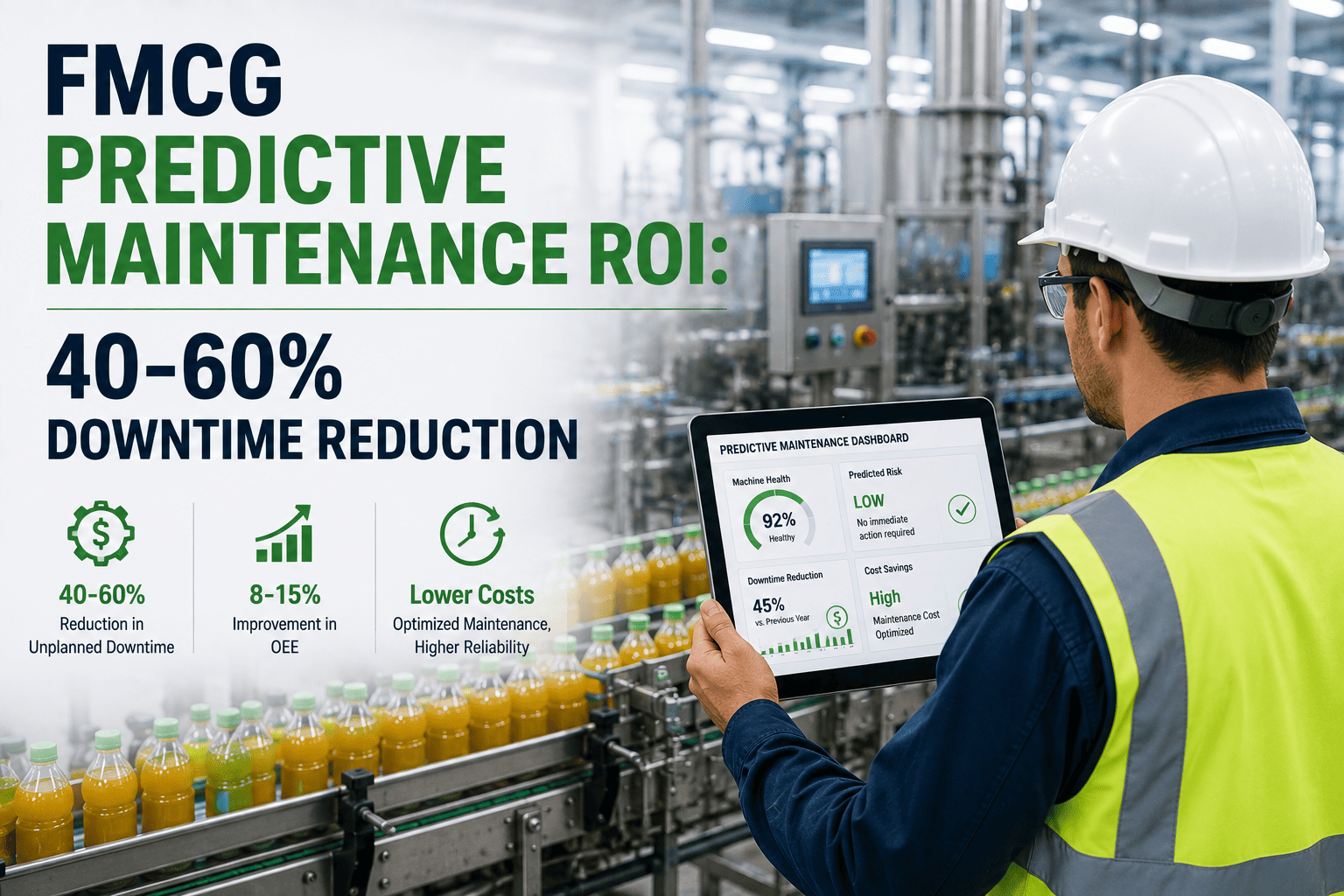
Every plant manager knows that maintenance costs money. What most cannot quickly quantify is how much more reactive maintenance costs compared to a planned, predictive approach. The numbers are not subtle. Emergency repairs in FMCG plants average 4.8x the cost of planned interventions. Unplanned downtime in food and beverage manufacturing ranges from $10,000 to $250,000 per hour depending on line output and product value. That single data point changes the entire ROI conversation. Predictive maintenance is not an IT project or a technology experiment — it is a financial decision with a measurable payback period. This guide breaks down exactly how to calculate that return, what inputs your business case needs, and what a realistic payback timeline looks like for an FMCG plant of any scale. Start a free trial and begin building your maintenance ROI baseline today, or book a demo to see Oxmaint's ROI reporting in action.
4.8x
Cost multiplier for emergency repairs vs. planned maintenance in FMCG plants
25–40%
Reduction in unplanned downtime achieved by FMCG plants using predictive maintenance
10:1
Average return on every $1 invested in predictive maintenance programs across manufacturing
8–14 mo
Typical payback period for FMCG plants implementing a full PdM program with CMMS
Build Your PdM Business Case With Real Data
Oxmaint tracks your downtime hours, repair costs, and maintenance frequency — giving you the inputs you need to calculate and present ROI to leadership.
What Is Predictive Maintenance ROI — and Why FMCG Plants Track It?
Predictive maintenance ROI quantifies the financial return from shifting your maintenance strategy from reactive (fix when broken) or preventive (fix on schedule) to predictive (fix when data tells you to). In FMCG, this distinction matters because production uptime is directly tied to revenue. A single unplanned stop on a high-speed packaging line can cost more than an entire year of condition monitoring technology. The ROI calculation compares what you spend on PdM infrastructure — sensors, CMMS software, technician training — against what you save through avoided downtime, reduced emergency repair costs, extended asset life, and lower spare parts consumption. Book a demo to see how Oxmaint calculates and reports your maintenance ROI automatically.
01
Downtime Cost Per Hour
Calculate your fully loaded cost of one hour of production line downtime. Include lost output value, labor standing idle, waste from spoiled product, and any contractual penalties. FMCG benchmarks range from $10K to $250K per hour.
Downtime Cost = (Output/hr x Margin) + Idle Labor + Spoilage
02
Annual Unplanned Downtime Hours
Pull your last 12 months of work order data. Count total hours of unplanned stops. Plants without a CMMS typically undercount this figure by 30–40% because verbal repairs are not logged. Use Oxmaint to capture every event.
Annual Loss = Downtime Hours x Cost Per Hour
03
PdM Reduction Factor
Industry benchmarks show PdM programs reduce unplanned downtime by 25–40% in year one. Conservative plants use 20%. Adjust based on your current maturity level. A plant already using PM schedules will see a smaller but still significant lift.
Avoidable Loss = Annual Loss x Reduction Factor
04
Total PdM Investment Cost
Include sensor hardware, CMMS subscription, integration costs, and staff training time. With modern CMMS platforms like Oxmaint, there are no heavy implementation fees. Most FMCG plants can deploy within 2–4 weeks without IT dependency.
ROI = (Avoidable Loss - Investment) / Investment x 100
The Hidden Costs Most FMCG Plants Do Not Measure
Direct downtime costs are visible. But the full cost of reactive maintenance is buried across multiple budget lines, and that is what makes the ROI case even stronger than most managers initially estimate. Start a free trial and let Oxmaint surface your hidden maintenance costs through automated cost tracking.
High Impact
Emergency Contractor Rates
Calling in specialists on short notice adds a 50–200% premium over standard rates. Weekends and overnight callouts multiply this further.
Significant
Expedited Spare Parts
Rush freight for critical parts can cost 5x the part's value. Predictive warning allows standard procurement at standard cost.
High Impact
Product Waste & Rework
Mid-run breakdowns create batches of out-of-spec product that must be regraded, reworked, or destroyed — all at full input material cost.
Significant
Secondary Equipment Damage
A failed bearing that runs to destruction damages the shaft, housing, and sometimes the motor windings — turning a $200 part into a $15,000 repair.
Compounding
Accelerated Asset Aging
Equipment managed reactively ages 30–40% faster than assets managed under a predictive program, shortening useful life and advancing CapEx decisions.
Compounding
Compliance & Audit Exposure
In FMCG, equipment failures during active production can trigger FDA, FSMA, or BRC investigation events that carry their own audit and remediation costs.
Reactive vs. Predictive: Side-by-Side Comparison
| Cost Category |
Reactive Maintenance |
Predictive Maintenance |
| Average downtime per event |
6–12 hours |
30–90 minutes (planned) |
| Repair labor cost per event |
Emergency rates, 1.5–3x standard |
Standard scheduled rates |
| Spare parts procurement |
Expedited freight, 2–5x cost |
Pre-ordered at standard lead time |
| Annual unplanned downtime events |
18–36 per line (typical FMCG) |
4–8 per line (industry benchmark) |
| OEE score |
55–68% (industry average) |
75–88% (top-quartile FMCG) |
| Asset useful life |
15–20% shorter than rated life |
At or above rated service life |
| Compliance documentation |
Manual, incomplete, inconsistent |
Automated, timestamped, audit-ready |
PdM ROI Results: What FMCG Plants Achieve
$280K
Average Annual Downtime Savings
Mid-size FMCG plant running 2 high-speed lines, 30% downtime reduction
35%
Reduction in Maintenance Spend
Shift from emergency to scheduled interventions, lower parts and labor cost
12 mo
Typical Full Payback Period
Including sensor hardware, CMMS setup, and training — all costs fully recovered in year one
3.2 yr
Extended Asset Service Life
PdM-managed equipment achieves longer useful life, delaying or eliminating CapEx events
How Oxmaint Builds Your PdM ROI Case Automatically
Most maintenance teams cannot present a PdM ROI case because they do not have the data to build one. Work orders are incomplete, downtime is undercounted, and repair costs are spread across multiple systems. Oxmaint centralizes all of this — and turns it into the reports your leadership team needs to approve the investment. Book a demo and let us show you what your current maintenance data actually reveals.
Asset Intelligence
Full Asset Registry with Condition Scoring
Every piece of equipment has a condition score based on maintenance history, age, and sensor data. Know exactly which assets are highest risk before they fail.
Cost Tracking
Work Order Cost Capture
Every work order logs labor hours, parts consumed, and contractor costs. Your ROI data builds automatically with every completed job — no manual reporting.
Downtime Analytics
Planned vs. Unplanned Downtime Reporting
Oxmaint splits your downtime data by type, asset, line, and cause. This is the foundational dataset your PdM business case requires.
CapEx Forecasting
5–10 Year Rolling CapEx Models
Based on asset condition and replacement cost data, Oxmaint projects your capital expenditure needs so leadership can plan budgets without surprises.
OEE Tracking
Per-Line OEE Real-Time Dashboards
Track availability, performance, and quality at the individual line level. Quantify the OEE improvement your PdM program delivers month over month.
Trigger Automation
Production-Based Maintenance Triggers
PMs trigger on cycles, hours, or units produced — not just calendar dates. This prevents over-maintaining and under-maintaining, cutting cost without cutting reliability.
Calculate What Your Plant Is Losing to Reactive Maintenance
Oxmaint gives you the data infrastructure to build a real PdM ROI case — and then hit the numbers you promised. Start with a free trial and have your first downtime cost report within the week.
Frequently Asked Questions
What is the average ROI of predictive maintenance in FMCG manufacturing?
Industry benchmarks report a 10:1 return on predictive maintenance investment across manufacturing sectors. In FMCG specifically, the return is often higher because downtime costs are amplified by product waste, food safety compliance risk, and the concentrated cost of high-speed production lines. A 30% reduction in unplanned downtime at a plant with even $50,000/hour production value generates $15M+ in annual uptime recovery.
How long does it take to see payback from a PdM investment?
Most FMCG plants achieve full payback within 8–14 months of implementing a PdM program with a CMMS. The timeline depends heavily on baseline downtime frequency and cost. Plants with frequent unplanned failures see payback faster. Oxmaint's no-implementation-fee model means you start building ROI from day one without significant upfront capital commitment.
What data do I need to build a PdM business case?
You need four key inputs: your cost per hour of unplanned downtime, your annual number of unplanned downtime events, your current annual maintenance spend split by reactive vs. preventive, and your expected PdM investment cost. Oxmaint can help you gather this data through its work order and asset history modules — even if you are starting without a CMMS today.
Does Oxmaint support OEE tracking as part of the PdM ROI framework?
Yes. Oxmaint tracks OEE (Overall Equipment Effectiveness) at the individual production line level in real time. This gives you a direct, quantified measure of how your PdM program is impacting availability, performance, and quality over time — which is the clearest metric for presenting in operational ROI reviews to leadership.