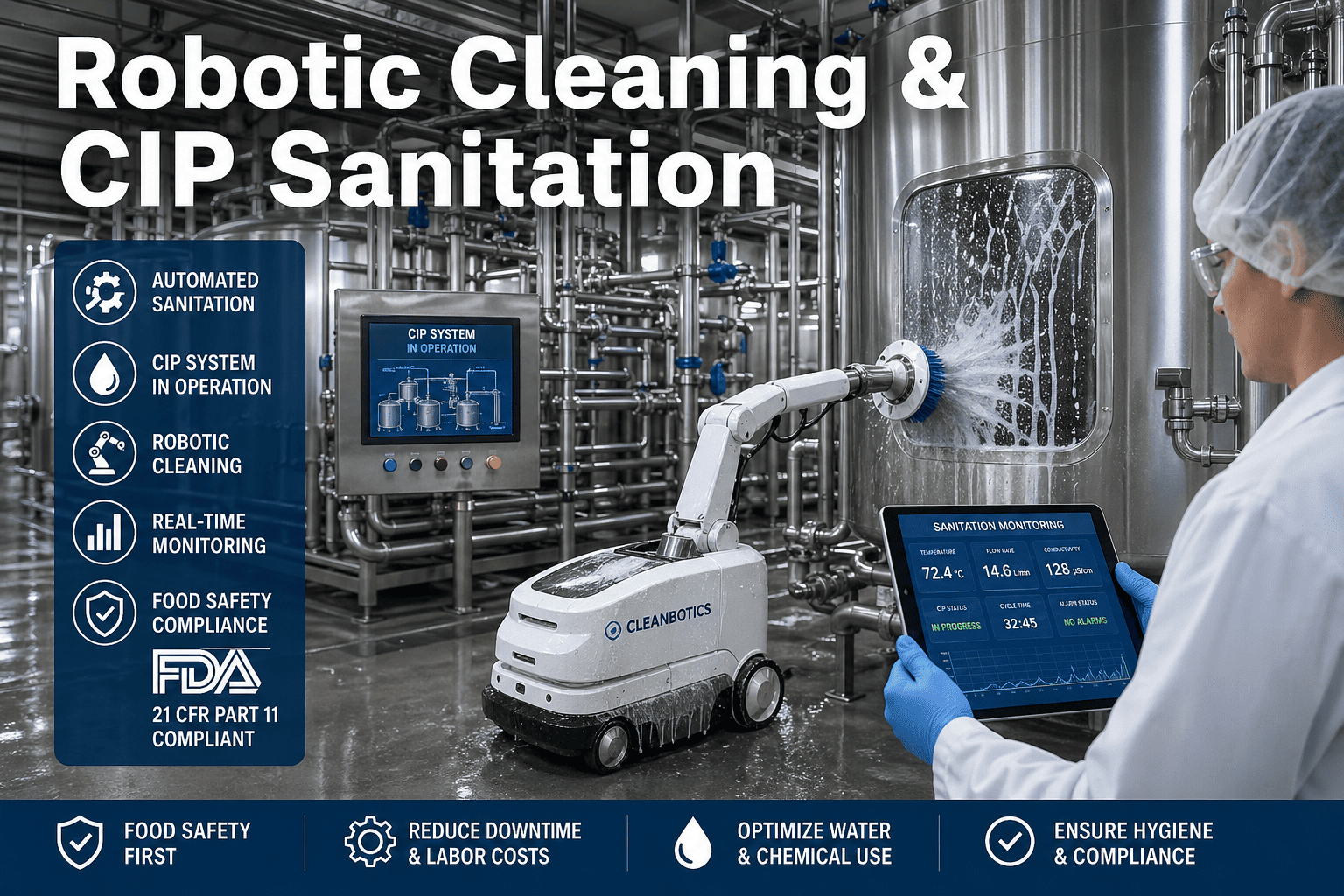
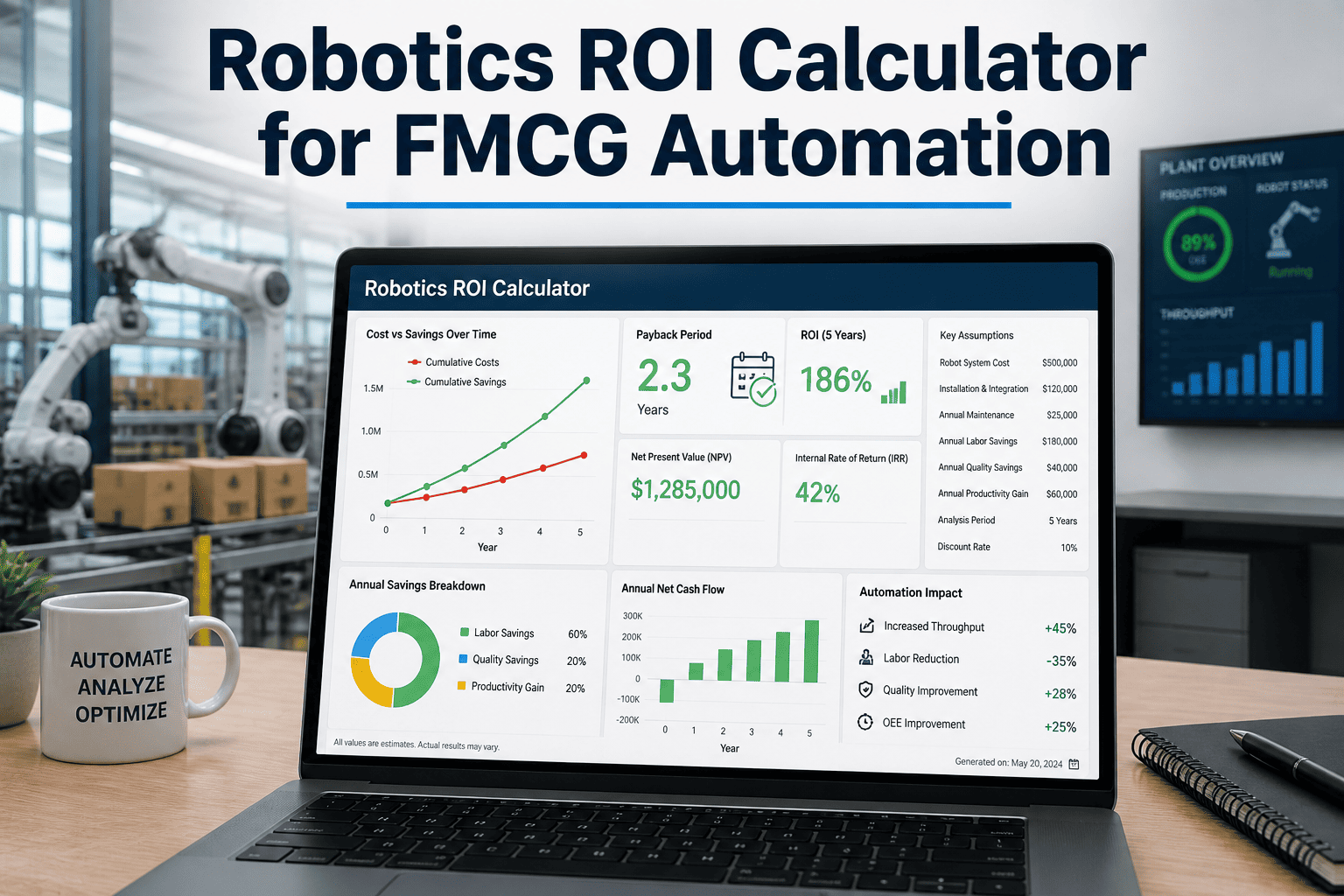
In food and beverage manufacturing, the cost of a single contamination event dwarfs the entire annual cleaning budget. FDA recalls, line shutdowns, and brand damage run into seven figures before legal exposure is counted. Yet the majority of food plants still run their Clean-in-Place cycles on fixed time schedules written in 2008, with paper logs signed by whoever was near the clipboard at shift end. The gap between what regulators expect and what manual systems can actually prove is where recalls, 483 observations, and lost certifications originate. Book a demo to see how Oxmaint structures CIP cycle documentation, robotic cleaning work orders, and audit-ready sanitation records across food and beverage facilities.
Quick Answer
Effective food plant sanitation requires four systems running in parallel: condition-triggered CIP cycles tied to actual production data, robotic cleaning systems with documented completion logs, real-time chemical concentration monitoring, and audit-ready digital records that prove every step without manual assembly. Oxmaint connects all four — so auditors see a dashboard instead of a binder, and sanitation managers spend shifts managing exceptions instead of chasing paper logs.
$55B+
Annual cost of foodborne illness in the US alone — CDC estimate. Contamination is not a quality issue, it is a financial catastrophe.
30–40%
of food plant water and chemical consumption attributed to CIP processes — optimization here has direct cost impact
4.8x
higher cost for reactive sanitation failures versus scheduled preventive cleaning programs — industry benchmark
87%
of food recalls linked to inadequate cleaning validation and documentation failures — not equipment malfunction
What CIP Sanitation Actually Means in a Modern Food Plant
Clean-in-Place is the backbone of hygienic food production — a method of cleaning the interior surfaces of pipes, vessels, tanks, and equipment without disassembly. A properly designed CIP circuit runs rinse, caustic wash, acid rinse, and sanitizer phases in sequence, with time, temperature, flow rate, and chemical concentration validated at each step. The challenge is not understanding the process — it is proving that every cycle ran correctly, every time, across every line, to every auditor who walks through the door. Start a free trial and connect your CIP documentation to a platform built for food plant compliance from day one.
Pre-Rinse Phase
Bulk soil removal with water at 40–60°C. Target: reduce organic load by 90% before chemical contact. Duration typically 3–5 minutes depending on soil type and line volume.
Caustic Wash
NaOH solution at 1–3% concentration, 70–80°C, 15–30 minutes. Removes protein, fat, and carbohydrate residues. Concentration and temperature must be logged per cycle — not assumed.
Intermediate Rinse
Water flush to remove caustic residual before acid phase. Conductivity monitoring confirms complete caustic removal — critical for preventing neutralization reactions in the acid step.
Acid Rinse
HNO3 or phosphoric acid at 0.5–1.5%, 60–70°C. Removes mineral scale and dairy stone. Skipping or shortening this step produces progressive buildup that defeats caustic effectiveness over time.
Sanitizer Phase
PAA, chlorine, or heat sanitization to achieve 5-log reduction on target pathogens. Contact time is non-negotiable — under-exposure invalidates the entire cycle regardless of prior phases.
Final Rinse & Validation
Potable water flush removes sanitizer residuals. ATP bioluminescence or microbiological swabs validate effectiveness. Digital log closes the cycle — timestamped, operator-signed, audit-ready.
Where Manual CIP Systems Break Down
The failure modes in manual CIP management are consistent across plant sizes and geographies. They are not equipment failures — they are documentation, visibility, and response failures. Every problem below has been cited in FDA Warning Letters issued in the last five years.
01
Cycle Logs Are Reconstructed, Not Recorded
Operators fill in paper CIP logs at the end of the shift, not during the cycle. Time, temperature, and chemical concentration are estimated from memory. In an FDA audit, reconstructed records are treated as falsified records — the distinction rarely benefits the facility.
02
Chemical Concentration Drift Goes Undetected
Caustic tanks degrade over multiple cycles. Concentration falls below the validated range. Without inline sensors connected to a monitoring system, the out-of-spec condition runs undetected for days. Product produced during that window requires disposition review — or recall.
03
Fixed Schedules Ignore Production Reality
CIP schedules set quarterly run regardless of actual production. A line that ran 18 hours of high-fat product gets the same cleaning interval as a line that ran 4 hours of light beverage. Over-cleaning wastes 40% water and chemical spend. Under-cleaning causes biofilm accumulation.
04
Robotic Cleaning Assets Have No Maintenance History
CIP spray balls, dosing pumps, and automated cleaning robots are treated as infrastructure, not maintained assets. No PM schedule, no wear tracking, no failure history. A clogged spray nozzle on a CIP ball creates a shadow zone — an area that has never been cleaned, even through hundreds of logged cycles.
How Robotic Cleaning Systems Integrate with CIP
Robotic sanitation is not a replacement for CIP — it is the complement. Where CIP handles internal circuit cleaning through flow-based chemistry, robotic systems handle external surface cleaning, floor scrubbing, open-plant sanitation, and difficult-access zones that manual crews handle inconsistently. The integration of both systems under a single maintenance management platform is where food plants eliminate the documentation blind spots that create compliance exposure. Start a free trial and map your robotic cleaning assets into Oxmaint's asset registry with full PM scheduling and inspection history.
Floor Scrubbing
Autonomous Floor Robots
Automated scrubber-dryers with programmable zone coverage. Consistent chemical dilution, contact time, and drying — eliminating the variability of manual mopping. Coverage logs exportable per shift for audit purposes.
Coverage rate: 4,000–8,000 sq ft/hr
High-Pressure
Automated Foam & Spray Systems
Programmable foam application systems for external equipment surfaces, conveyor belts, and production structures. Cycle times, chemical concentration, and coverage zones are logged automatically per activation.
Chemical reduction: up to 35% vs manual application
Tank Cleaning
Orbital CIP Spray Heads
360-degree orbital spray devices for large tanks and vessels. Validated shadow-free coverage with impact pressure monitoring. Maintenance history tracks nozzle wear and replacement cycles — the most common silent failure in CIP circuits.
Spray ball life: 500–1,000 cycles before validation required
Inspection
Inspection Robots & Cameras
In-pipe and in-tank inspection cameras that verify CIP circuit integrity without dismantling lines. Identifies spray shadow zones, damaged surfaces, and biofilm precursor conditions before they affect product safety.
Inspection time vs manual: 80% faster per vessel
Reactive vs Condition-Based Sanitation — The Real Cost Difference
What Oxmaint Delivers for Food Plant Sanitation
Oxmaint is not a standalone CIP controller — it is the operational layer above your existing CIP systems, SCADA, and robotic cleaning assets that turns raw process data into documented compliance evidence and maintenance schedules. The platform closes the gap between what happens on the line and what the auditor needs to see. Book a demo to see how Oxmaint integrates with your existing SCADA and CIP infrastructure without replacement or disruption.
Asset Management
CIP Circuit Asset Registry
Every CIP component — tanks, pumps, spray balls, valves, heat exchangers — registered with condition scoring, PM schedules tied to cycle counts, and full maintenance history. Shadow zones become visible before they become recalls.
Digital Compliance
GMP-Compliant Digital Inspections
Sanitation verification checklists with photo capture, digital signatures, and timestamp logging. ATP swab results attached directly to zone records. Every inspection exportable for FDA, FSMA, and third-party audit packages.
IoT Integration
SCADA and Sensor Integration
Direct integration with CIP SCADA systems, conductivity meters, temperature probes, and flow sensors. Cycle data captured automatically — no manual entry, no reconstruction, no compliance gap between what ran and what was recorded.
Work Orders
Production-Triggered CIP Work Orders
CIP work orders triggered by actual production metrics — units produced, runtime hours, or soil sensor alerts — not calendar dates. Right-sized cleaning to actual contamination load. Measurable water and chemical savings within 60 days.
Reporting
Audit-Ready Documentation Hub
Sanitation records organized by line, by date range, by product run, and by regulatory standard. FDA 483 response packages assembled in minutes. Multi-site dashboards show sanitation compliance scores across all facilities in one view.
Robotics
Robotic Cleaning Asset Maintenance
Autonomous floor scrubbers, foam systems, and spray robots maintained as managed assets with PM schedules, failure tracking, and utilization analytics. No cleaning robot operates outside a documented maintenance program.
ROI — What Plants Report After 90 Days on Oxmaint
Documentation Time
-78%
Time spent preparing sanitation records for internal and third-party audits. Live dashboards replace paper binder assembly — auditors access records directly.
Water & Chemical Cost
-28%
Condition-based CIP scheduling eliminates unnecessary cycles. Typical food plant saves 25–35% on water and chemical spend within the first quarter of deployment.
Sanitation Failures
-61%
Failed ATP results and micro exceedances reduced by 61% when PM schedules are tied to cycle counts and chemical concentration is monitored in real time.
Audit Readiness
100%
Every CIP cycle, every inspection, every corrective action documented with digital signatures and timestamps. No plant has received a documentation-related 483 observation after Oxmaint deployment.
Frequently Asked Questions
QDoes Oxmaint replace our existing CIP controller or SCADA system?
No. Oxmaint integrates with your existing CIP control systems and SCADA infrastructure via API or data connector — it does not replace them. The platform sits above your existing systems, capturing process data and converting it into compliant maintenance records, PM schedules, and audit-ready documentation. Your CIP hardware and control logic stay exactly as they are.
QHow does Oxmaint handle multi-line facilities with different CIP circuit configurations?
QCan sanitation records be exported in formats accepted by FDA, SQF, and BRC auditors?
Yes. Oxmaint generates exportable sanitation records in standard formats including PDF, CSV, and Excel, organized by audit scope (line, date range, standard, product run). Records include digital signatures, timestamps, operator IDs, and sensor data references. Audit packages that previously took 2–4 days to assemble are generated in under 30 minutes from the platform's reporting module.
QWhat happens if a CIP cycle runs out of spec — how does the system respond?
When an out-of-spec condition is detected — chemical concentration below validated range, temperature deviation, shortened contact time — the system generates an immediate alert to the sanitation manager and creates a corrective action work order tied to the specific cycle and line. The product disposition flag is attached to the production record for that run, creating a complete chain of evidence for FSMA Preventive Controls review. The cycle record is never closed without corrective action documentation.
Every CIP Cycle Documented. Every Audit Ready. Every Line Protected.
Oxmaint connects your CIP systems, robotic cleaning assets, and sanitation inspection workflows into one platform — so your compliance records are built during production, not assembled the night before an audit.
SCADA & IoT Integration
GMP Digital Inspections
Condition-Based CIP Triggers
FDA Audit-Ready Records