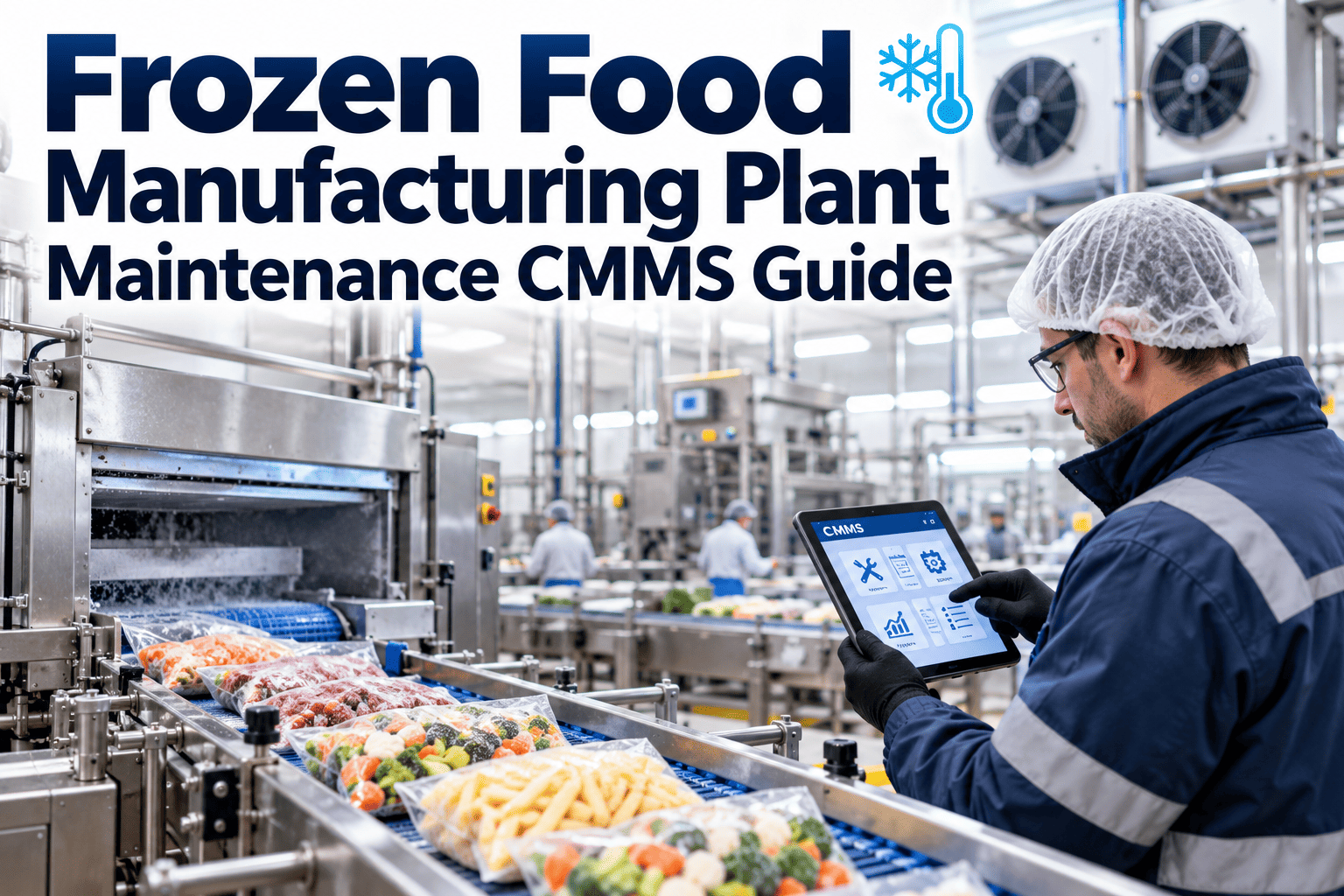
A frozen food plant has to hold product temperature while machines work in air cold enough to stiffen belts, thicken grease, and frost every coil. A blast freezer or IQF tunnel that loses capacity for a few hours can put product at risk, and a packaging line that stops in a cold room is hard to restart. Maintenance teams must protect equipment, food safety, and the cold chain together. This guide covers the main failure modes and PM priorities, and shows how Oxmaint CMMS software supports the work.
Frozen Food Manufacturing Plant Maintenance: Blast Freezers, IQF Tunnels, and CMMS
Keep freezing capacity, refrigeration systems, and cold-room packaging lines reliable with condition-based PM and complete maintenance records.
Prep and cooking
Ambient to warm
Pre-chill
Cool
Blast freezer or IQF
Very cold air, often around minus 30 to minus 40 C
Packing and cold store
Frozen storage, commonly minus 18 C or colder
Temperature ranges are typical examples. Your product specifications and design set the actual values.
Why cold environments change maintenance rules
Low temperature affects materials, lubricants, sensors, and people. Ordinary PM routines written for ambient plants often miss these effects.
Materials stiffen
Rubber seals, plastic belts, and cables lose flexibility and can crack or wear faster.
Lubricants thicken
Grease and oil chosen for ambient service can raise drive load and starve bearings.
Frost and ice build up
Evaporator coils, door seals, and conveyors collect ice that blocks airflow and motion.
Condensation appears
Moving equipment between cold and warm areas causes moisture in panels and sensors.
Access is harder
Technicians work in protective gear with limited time in the coldest zones.
Blast freezer maintenance
A blast freezer succeeds or fails on airflow, refrigeration capacity, and door integrity. Maintenance should watch all three.
| Component | What goes wrong | PM or inspection focus |
|---|---|---|
| Evaporator coils | Frost buildup, poor defrost, blocked fins | Frost pattern, defrost termination, drain heaters, coil condition |
| Fans and motors | Imbalance, ice on blades, bearing wear | Vibration, current draw, blade condition, guards |
| Doors and seals | Air leaks, ice at frames, damaged curtains | Seal condition, heaters, alignment, closing speed |
| Temperature sensors | Drift, moisture ingress, failed probes | Calibration checks against a reference |
| Racks and trolleys | Wheel wear, bent frames, ice on tracks | Visual checks and repair before use |
Warning signs to log as work orders
- Longer freezing time for the same product load.
- Rising fan motor current or new vibration.
- Frost patterns that look uneven across the coil face.
- Repeated high temperature alarms after defrost.
IQF tunnel maintenance
Individually quick frozen lines combine a moving belt, strong airflow, and refrigeration in one continuous process. Failures upstream or downstream stop the whole flow.
A
Infeed and belt
Check belt tracking, tension, wear, and cleanliness. Stiff belts in cold air need closer inspection than at ambient temperature.
B
Drive and gearbox
Use lubricants rated for the operating temperature and track motor current, which can reveal ice or drag.
C
Airflow and fans
Inspect fans, ducts, and baffles. Poor airflow reduces freezing quality even when the air looks cold enough.
D
Evaporators and defrost
Track differential pressure and defrost performance. Missed defrost is a frequent cause of sudden capacity loss.
E
Discharge and sanitation
Plan cleaning and maintenance together so washdown does not leave water to freeze in the next run.
Doors, docks, and the building envelope
Every air leak adds load to the refrigeration plant and feeds frost. The envelope is part of the maintenance scope.
Door seals
Inspect gaskets, brushes, and heaters at each round.
Fast doors
Check sensors, speed, and safety edges, since slow doors admit warm air.
Dock shelters
Repair torn seals and curtains that let humid air flow into cold areas.
Panels and floors
Look for damaged insulation, ice at joints, and floor heave risks.
Lighting and fixtures
Use cold-rated fittings and check for condensation inside units.
Power, monitoring, and cold-chain backup
A power or control failure can raise product temperature quickly. Backup systems must be tested, not assumed.
What to test and record
- Standby generator start and load tests on a fixed schedule.
- Temperature alarm notifications, including after-hours call-outs.
- Data logger battery condition and sensor calibration.
- Control panel heaters and ventilation in cold electrical rooms.
Response plan elements
- Clear limits for when a work order becomes an emergency.
- Contact list for refrigeration contractors and key spares.
- Steps for protecting product if a freezer is down.
- A post-event review that feeds back into PM tasks.
Protecting technicians who work in the cold
Safe, well-planned jobs are also faster jobs. Cold exposure reduces dexterity and attention.
- Plan tasks so tools, parts, and permits are ready before entry, which shortens time in the coldest zones.
- Follow site rules for protective clothing, work and rest periods, and working alone.
- Control slip hazards from ice, condensation, and washdown water at work sites.
- Use lockout and tagout on fans, conveyors, and defrost heaters before reaching into equipment.
- Make work order instructions short and visual, since writing and reading are harder in gloves.
Spare parts for refrigeration and cold-room equipment
| Part group | Why stock it | Stocking note |
|---|---|---|
| Evaporator fan motors and blades | Failure reduces airflow and freezing capacity | Hold at least one per common size |
| Defrost heaters and sensors | Failure leads to frost build-up | Keep a few of each type |
| Door seals and heaters | Frequent damage from traffic | Hold cut lengths by door type |
| Belts and wear strips | IQF and conveyor wear in cold air | Keep belts rated for the temperature |
| Compressor service kits | Planned service needs the right parts on time | Order against run-hour forecasts |
Planning defrost shutdowns and deep cleans
Plan
Agree on the shutdown window with production and quality.
Defrost and inspect
Complete coil, fan, belt, and drain inspections while the unit is warm.
Repair and clean
Fix findings, then sanitize and dry to stop ice forming at restart.
Verify and restart
Confirm temperature pull-down and record sign-off.
Restarting a unit with leftover moisture can create ice in the first hours of operation. Build a drying step into the work order.
Failure scenarios and how maintenance should respond
| Scenario | Likely early signs | Response and record |
|---|---|---|
| Evaporator fan failure | Longer freeze times, uneven product temperature | Isolate, replace, verify airflow, log product impact |
| Defrost heater or drain fault | Ice build-up, water pooling, repeated alarms | Test heaters and drains, clear ice, review defrost settings |
| Belt tracking or drive overload in an IQF tunnel | Rising motor current, belt edge damage | Stop safely, inspect tension and rollers, correct and record |
| Compressor trip | Pressure alarms, rising room temperature | Follow the restart procedure, check safeties, record cause |
| Door left open or damaged | Frost at the door, slow pull-down | Repair the seal or sensor, review door discipline |
Energy and maintenance move together
- Frosted coils, dirty condensers, and leaking doors all raise energy use before they cause a breakdown.
- Track compressor run hours and power use alongside work orders to spot degradation.
- Use PM results to prioritize repairs that cut both energy and failure risk.
Seasonal factors to plan for
- Hot weather raises condenser load, so schedule cleaning and fan checks ahead of summer.
- Peak production seasons shorten defrost and cleaning windows, so plan work earlier.
- Humid periods increase frost and condensation, so check door seals and drains more often.
Calibration and monitoring equipment in cold plants
Product temperature records are only as reliable as the probes and loggers behind them.
| Equipment | Risk when neglected | Maintenance action |
|---|---|---|
| Air and product temperature probes | Wrong readings, undetected excursions | Scheduled calibration against a reference |
| Data loggers and recorders | Missing records for audits | Battery, memory, and time sync checks |
| Metal detectors and X-ray units | Foreign material reaches customers | Test with certified pieces and record each result |
| Checkweighers | Incorrect pack weights | Verify at start-up and after cleaning |
| Alarm systems and dialers | Excursions go unnoticed after hours | Test alerts and contact lists regularly |
The first 60 days of a CMMS in a frozen food plant
- Weeks 1 to 2: list freezers, refrigeration plant, conveyors, and packaging equipment, and rank them by product risk.
- Weeks 3 to 4: load existing PM and calibration schedules, with cold-rated lubricant and procedure notes.
- Weeks 5 to 6: start mobile rounds for freezers and cold rooms, and test connectivity in each zone.
- Weeks 7 to 8: review frost, defrost, and door-related work orders, and tighten the tasks that repeat.
Cold-chain KPIs to review quarterly
- Freezer and tunnel availability against plan.
- Number and duration of temperature excursions, and their causes.
- PM and calibration completion on cold-chain critical assets.
- Unplanned work in refrigeration and freezing equipment.
Lubrication in low-temperature equipment
- Choose lubricants rated for the operating temperature and approved for food-processing use where contact is possible.
- Define quantity and frequency for each point, since over-greasing attracts ice and debris.
- Check gearbox oil condition and viscosity behavior after cold start-ups.
- Record lubricant type per asset so a technician never has to guess in a cold room.
- Use drip and leak checks as part of the daily round, because cold seals shrink and leak more easily.
Catch frost, drag, and drift before they stop freezing
Schedule condition-based PM for freezers, tunnels, and refrigeration equipment and keep every inspection on record.
Defrost cycles and refrigeration: the system behind the freezer
Most freezing problems start in the refrigeration plant or the defrost cycle, not in the tunnel itself.
Frost builds
Airflow and heat transfer decline.
Defrost starts
Coil temperature rises and ice melts.
Drain and terminate
Water leaves; heaters and drains must work.
Recovery
Temperature returns to setpoint.
Refrigeration equipment checks
- Compressors: oil level, vibration, suction and discharge pressure, and run hours.
- Condensers: fouling, fan condition, and control response.
- Valves and controls: operation, leak checks, and calibration.
- Safety devices: relief valves, alarms, and leak detection tested on schedule.
Ammonia refrigeration systems are subject to safety regulations in many countries, including process safety management rules for large inventories in the United States. Keep inspection, test, and change records, and follow your local requirements.
Packaging lines in cold environments
Packing areas sit at lower temperatures than normal and see more condensation. Small issues become stoppages quickly.
Film and seal quality
Cold film behaves differently. Sealing jaws and temperatures may need tighter control and inspection.
Moisture in electrical parts
Condensation affects sensors, panels, and connectors. Check enclosure seals and drains regularly.
Weighers and metal detectors
Temperature swings can affect readings. Verify and record checks as required.
Conveyors and lubrication
Use cold-rated lubricants and avoid over-greasing, which attracts ice and debris.
Pallet and wrap equipment
Check sensors, brakes, and guards for stiffness and ice.
Food safety and compliance records
Maintenance records support food safety audits as much as production reports.
What auditors often ask to see
- Calibration records for temperature probes and data loggers.
- Evidence that critical freezers and cold stores were maintained on schedule.
- Response records for temperature excursions and equipment faults.
- Controls for lubricants, tools, and temporary repairs near product.
How a CMMS helps
- Recurring calibration and inspection tasks with recorded results.
- Work orders linked to the asset, cause, and time of the event.
- History searchable by freezer, line, or date for audits.
- Reports that show PM completion and open corrective actions.
Condition-based triggers for cold plants
| Signal | What it can indicate | Possible CMMS action |
|---|---|---|
| Rising fan motor current | Ice, imbalance, or bearing drag | Create an inspection work order |
| Higher coil differential pressure | Frost blocking airflow | Check defrost settings and drains |
| Longer pull-down after door opens | Air leaks or capacity loss | Inspect doors, seals, and refrigeration |
| Frequent high temperature alarms | Sensor drift or real capacity problem | Verify the probe, then inspect the system |
| Rising compressor run hours | Service interval approaching | Trigger meter-based PM |
How Oxmaint supports a frozen food plant
- Asset management for freezers, compressors, evaporators, conveyors, and packaging equipment.
- Preventive and meter-based scheduling, plus mobile inspection checklists for cold areas.
- Work orders, parts inventory, and history tied to each asset.
- Dashboards for downtime, PM completion, and recurring cold-chain related faults.
A cold-plant PM checklist
Daily and weekly
- Check freezer temperature against setpoint and alarms.
- Inspect doors, curtains, and seals for ice and damage.
- Listen for unusual fan or compressor noise.
- Look for frost patterns and water at drains.
Monthly and quarterly
- Verify temperature probes against a reference.
- Check belt wear, tension, and tracking.
- Review vibration and current trends on fans and drives.
- Test alarms and safety devices and record the result.
Frozen food plant maintenance FAQs
Which assets deserve the closest PM focus?
Blast freezers, IQF tunnels, compressors, evaporators, and cold-room packaging lines carry the highest product and downtime risk.
How can we reduce frost-related stoppages?
Monitor defrost performance, door condition, and airflow, and act on trends before capacity drops.
Can technicians use a mobile CMMS in cold rooms?
Yes, with suitable devices and gloves. Test it in your zones with Oxmaint before wider rollout.
How do we document temperature excursions?
Link the alarm, response, and repair in one work order so the full record is easy to retrieve.
Where should we start?
Pilot one freezer line, then book a demo to plan the plant rollout.
Protect the cold chain with maintenance you can prove
Connect freezers, refrigeration, and packaging lines in one CMMS with schedules, inspections, and audit-ready history.