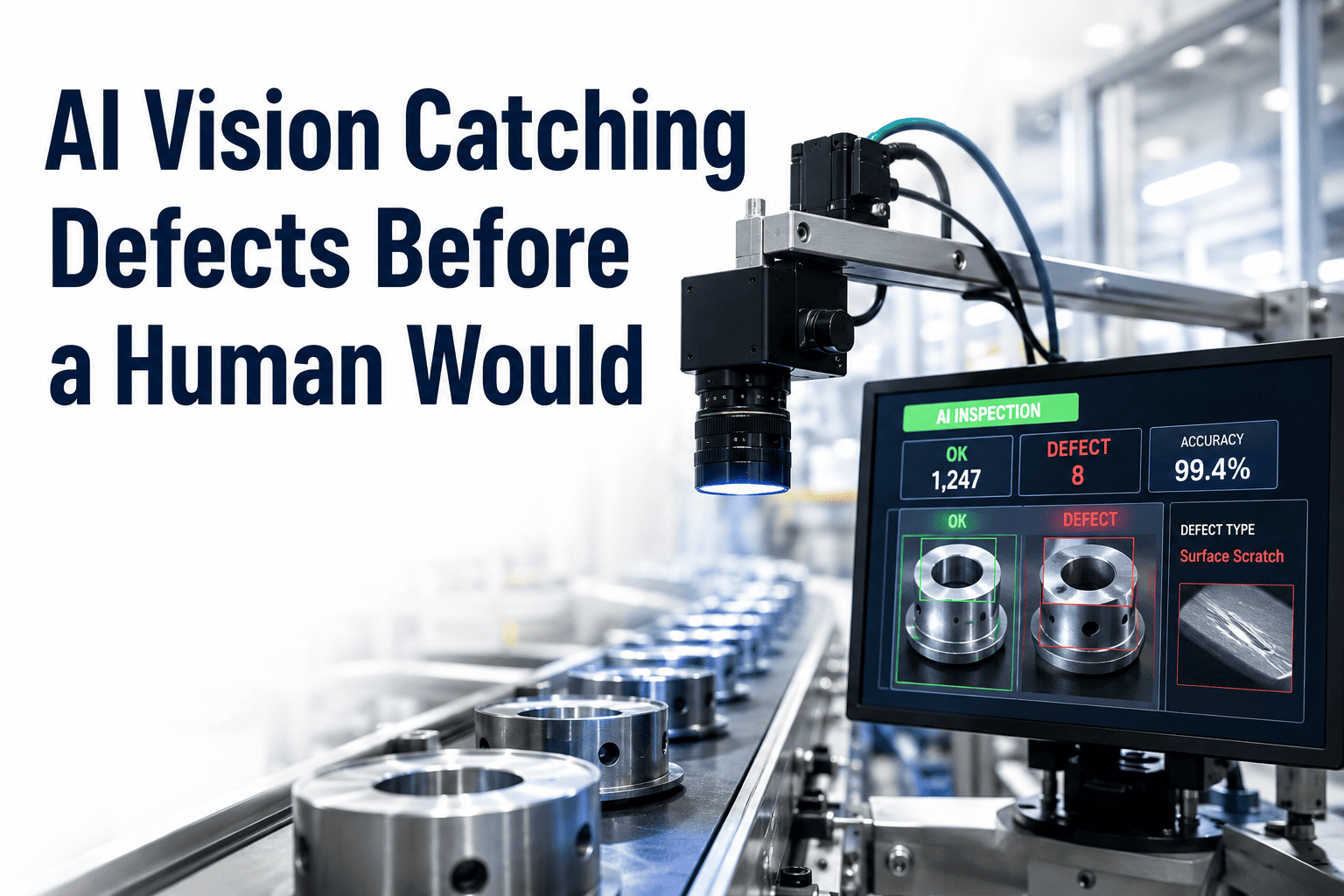
Food manufacturing facilities today face an unprecedented convergence of pressures: tighter regulatory scrutiny, escalating consumer expectations for safety and consistency, and the relentless economic burden of product waste. Traditional quality control methods — manual visual inspections, periodic sampling, paper-based checklists — were engineered for a different era. They are inherently limited by human perception, shift-to-shift variability, and their inability to operate continuously at production line speeds. Artificial Intelligence is rewriting this equation entirely. AI-powered quality control systems now deploy machine vision, sensor fusion, and real-time analytics to inspect every unit on every line, every shift, at speeds and accuracy levels no human team can sustain. Start your free trial and discover how AI quality monitoring transforms your production operation.
Why Traditional Quality Control Is No Longer Enough
A modern food processing facility running three shifts a day produces millions of individual units per week. Each unit must conform to strict dimensional, compositional, visual, and safety standards — standards that regulatory bodies like the FDA, USDA, and EFSA enforce with increasing rigor. Manual inspection regimes, even when staffed by experienced technicians, can realistically sample only a small fraction of total output. Statistical sampling provides a probabilistic assurance of quality, not a guarantee. And when a contamination event or defect cluster is identified through sampling, it is already a trailing indicator — the defective product has often already moved downstream in the supply chain.
Beyond compliance risk, the economic cost of poor quality in food manufacturing is staggering. Product recalls, rework labor, line stoppages for manual re-inspection, and the raw material embedded in every rejected unit represent a direct drag on operating margins. Industry estimates consistently place quality-related waste at five to fifteen percent of total production volume in facilities relying on conventional inspection methods. For a mid-scale manufacturer producing ten thousand units per hour, that is a significant and largely preventable loss. AI changes the fundamental economics of this problem by converting quality inspection from a periodic, labor-intensive audit into a continuous, automated, and data-driven operational discipline.
How Machine Vision Transforms Production Line Inspection
Machine vision is the sensory layer of AI-powered quality control. High-resolution cameras — positioned at critical inspection points along the production line — capture images or video streams of every product unit as it passes. These visual feeds are processed in real time by deep learning models trained on thousands or millions of labeled examples of conforming and non-conforming products. The result is an inspection system that can detect surface defects, dimensional deviations, color inconsistencies, labeling errors, fill level variations, and foreign object contamination with a precision and consistency that no human inspector can match across an extended production run.
Modern machine vision systems operating in food manufacturing environments go far beyond simple pass-fail classification. Multi-spectral imaging — combining standard visible light with near-infrared, X-ray, or hyperspectral channels — enables detection of internal defects, bone fragments in protein products, pest contamination, and chemical residue patterns invisible to the naked eye. AI models process these multi-channel data streams simultaneously, correlating visual signatures with known defect profiles to produce not just a reject decision, but a defect classification: what type of defect, which production input it likely traces to, and whether the pattern represents an isolated anomaly or an emerging process drift that requires upstream intervention.
Real-Time Analytics: From Inspection Data to Process Intelligence
The most significant operational advance AI brings to food manufacturing quality control is not the speed or accuracy of individual defect detection — it is the transformation of inspection data into actionable process intelligence. Every reject event, every defect classification, every measurement deviation is a data point. When aggregated across millions of units and analyzed by AI systems trained to identify causative patterns, this data becomes a window into the health and stability of the production process itself.
Statistical process control, which historically required manual data collection and periodic analysis by quality engineers, is now executed automatically and continuously by AI platforms. Control charts update in real time with every inspection result. When defect rates for a specific type begin trending upward — even before they breach the action threshold — the AI generates a process alert, linking the emerging pattern to the most probable upstream cause: a worn sealing die, a temperature excursion in a cooking stage, raw material variability from a specific supplier batch, or a newly installed equipment component that is performing outside its calibration window. This predictive, cause-linked intelligence enables quality engineers to intervene proactively, correcting process drift before it produces a defect surge, a line stoppage, or a quality hold. Explore the platform to see how real-time SPC analytics are built into the dashboard.
Foreign Object Detection and HACCP Compliance
Foreign object contamination represents one of the most serious and costly risk categories in food manufacturing. A single contaminated product reaching a consumer can trigger brand reputational damage, regulatory enforcement action, and class-action liability exposure that dwarfs any plausible investment in prevention technology. HACCP frameworks require facilities to establish critical control points for foreign object risk — but the monitoring and verification of these control points has historically depended on periodic manual audits and reactive metal detector rejection events rather than continuous automated surveillance. Book a demo to see how AI automates every HACCP critical control point in real time.
AI-integrated inspection systems transform HACCP compliance from a documentation exercise into a real-time operational reality. X-ray inspection systems operating at production line speed detect metal, bone, glass, dense plastic, and stone contaminants as small as 0.5 millimeters — automatically rejecting contaminated units and generating a timestamped event record linked to the specific production run, line segment, and upstream process stage. When integrated with CMMS platforms, these rejection events trigger automatic maintenance work orders for the upstream equipment most likely to be the contamination source, closing the loop between detection and root cause resolution. Every critical control point inspection generates an immutable compliance record, eliminating the documentation burden that HACCP audits traditionally impose on quality and regulatory affairs teams.
AI Quality Control vs. Traditional Inspection: A Direct Comparison
| Dimension | Traditional Inspection | AI-Driven Inspection |
|---|---|---|
| Coverage | Statistical sampling — fraction of total output | 100% inspection of every unit at full line speed |
| Defect Detection Speed | Hours to days after defect batch produced | Real-time — milliseconds per unit |
| Foreign Object Detection | Metal detection only; misses glass, bone, plastic | Multi-material detection via X-ray and spectral imaging |
| Process Intelligence | Retrospective analysis; reactive correction | Real-time SPC with predictive drift alerts |
| Compliance Documentation | Manual logs, spreadsheets, periodic audit prep | Automatic timestamped records per unit and per batch |
| Consistency | Variable — dependent on inspector fatigue and attention | Uniform — identical standards across all shifts and lines |
| Waste Reduction | Entire batches quarantined on defect discovery | Unit-level rejection; upstream correction before batch accumulates |
Reducing Food Waste Through Intelligent Defect Prevention
Food waste is not only an environmental imperative — it is a direct financial liability for manufacturers. Every kilogram of raw material, energy, labor, and packaging embedded in a rejected or recalled product represents destroyed value. Conventional quality regimes compound this waste by their structural delay: defects are identified after accumulation, meaning that a process excursion discovered through periodic sampling may already have contaminated an entire production batch before any corrective action is taken. Start your free trial and activate unit-level AI inspection to stop waste at the source. AI quality systems reverse this dynamic through continuous, unit-level inspection and real-time process feedback.
When an AI inspection system detects an emerging defect pattern — a gradual increase in seal failure rates on a packaging line, for example — it does not simply reject the affected units and continue. It generates an upstream process alert, correlating the defect signature with the specific production parameters active at the time of occurrence. Operators receive actionable guidance: which process variable to adjust, which equipment component to inspect, and which raw material lot may be implicated. This closes the intervention window from hours to minutes, containing the defect to a small fraction of the units that would have been affected under a conventional periodic inspection regime. The measurable result is a significant reduction in rework volume, raw material loss, and finished goods inventory held under quality investigation.
CMMS Integration: Connecting Quality Events to Maintenance Action
The operational value of AI quality control systems multiplies significantly when they are integrated with a Computerized Maintenance Management System. In isolation, an AI inspection platform can detect defects and classify them with high accuracy. Integrated with a CMMS, each defect event becomes a trigger for a coordinated maintenance response. When a machine vision system identifies an emerging pattern of packaging seal failures, the integrated CMMS automatically generates a work order for inspection of the sealing jaw assembly — pre-populated with the relevant equipment history, service procedure, required parts, and technician qualification requirements. The time between defect detection and maintenance intervention collapses from days to hours, and the documentation of the response is automatically preserved as a compliance record linked to both the quality event and the maintenance activity.
This integration also enables the predictive maintenance models running within the CMMS to be informed by quality data. Equipment degradation often manifests in product quality signatures before it produces mechanical failure symptoms. An extruder running with worn barrel components may produce dimensional deviations in the product profile days before any vibration or temperature sensor indicates a problem. By feeding AI inspection output back into the CMMS predictive maintenance engine, facilities create a bidirectional intelligence loop: quality data informs equipment health assessments, and equipment health predictions inform quality risk scoring. The result is a unified operational intelligence platform in which quality and maintenance are no longer managed as separate disciplines but as two facets of a single production performance system. Schedule a free walkthrough to see how CMMS and AI quality inspection work together in a live facility environment.