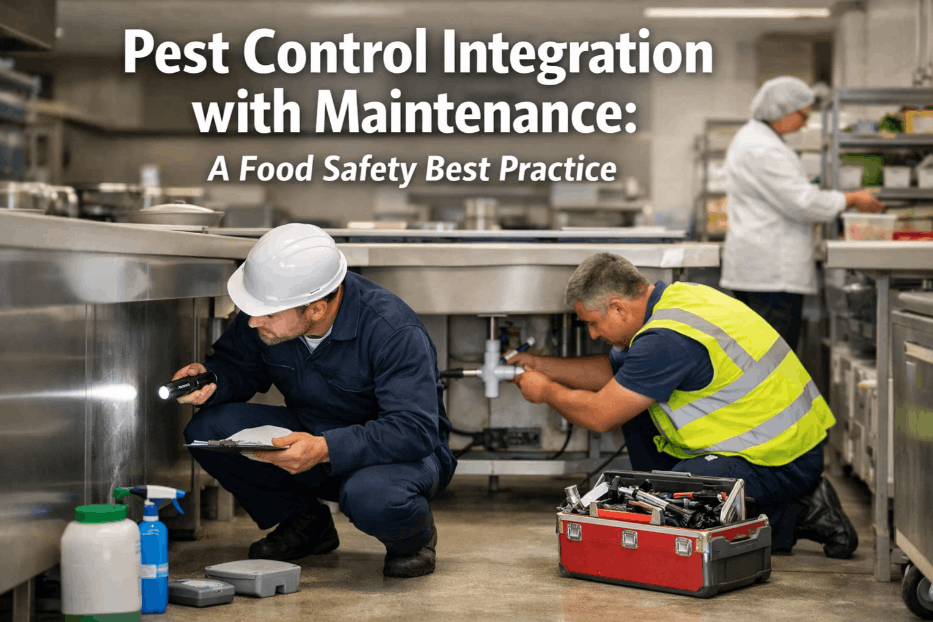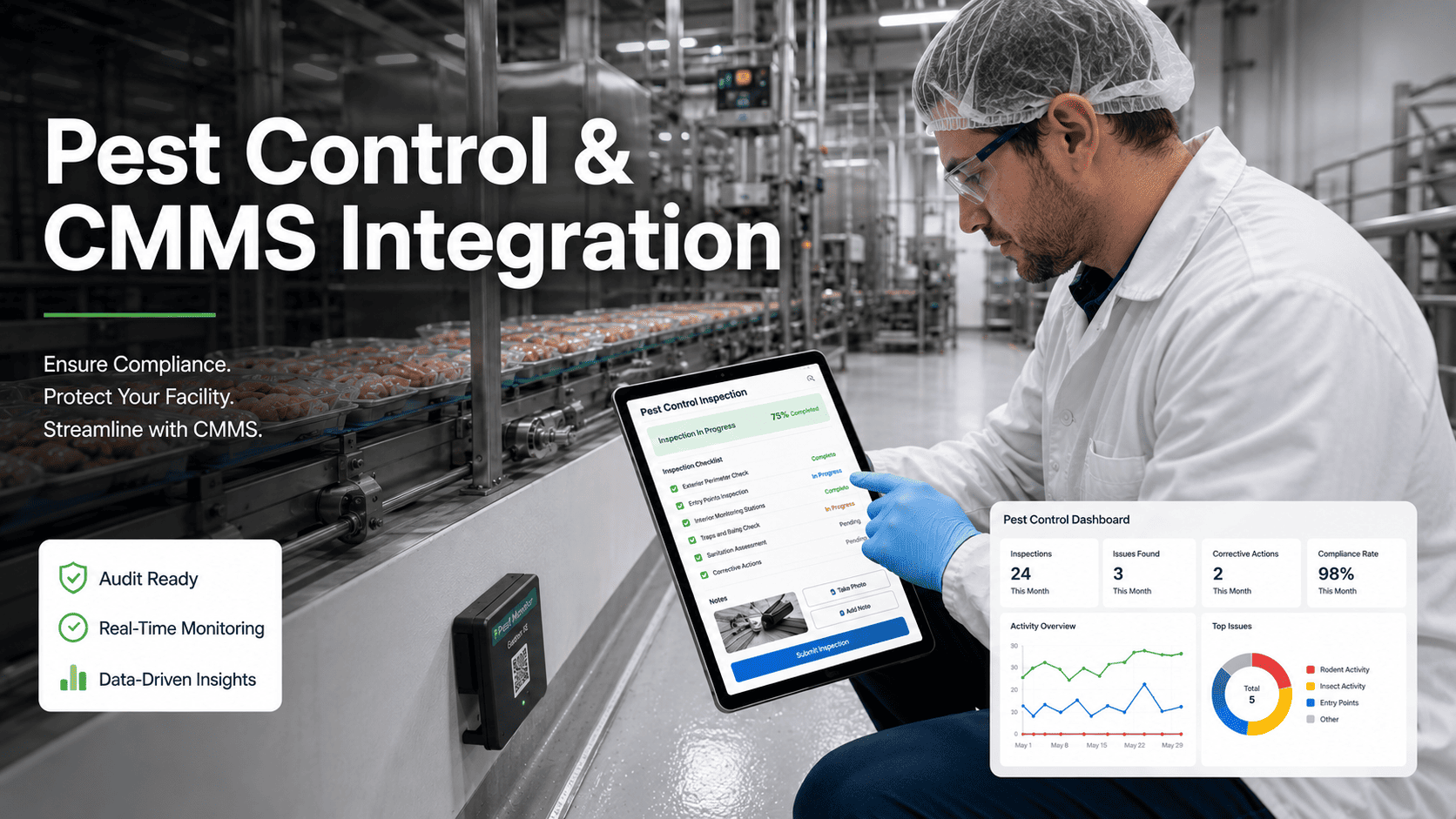
Pest control in food manufacturing is a maintenance function — and every IPM activity that isn't tracked in your CMMS is a compliance gap waiting to become an audit finding or a recall trigger.
Integrated Pest Management for Food Safety
See how Oxmaint integrates pest control and IPM documentation into your maintenance workflow — audit-ready, every day.
- Scheduled pest inspections auto-assigned to certified personnel
- Digital pest activity logs with photo documentation at every station
- GFSI-ready audit reports generated in under 60 seconds
Trusted by 1,000+ maintenance and food safety teams · FSMA, SQF, and BRC compliance built in
What Is Pest Control Integration with CMMS — and Why Does It Matter for Food Safety?
Pest control integration with CMMS means managing your Integrated Pest Management program inside the same platform you use for preventive maintenance, work orders, and inspections — not in a separate paper log or standalone spreadsheet. When pest monitoring, treatment activities, pest sightings, and corrective actions are tracked in a unified maintenance system, you have a complete, timestamped, audit-ready record that satisfies FSMA, SQF, BRC, and GFSI requirements.
The gap most food plants live with is structural: pest control sits between maintenance and quality assurance, owned by neither. External contractors visit monthly, leave a paper report, and the data disappears into a filing cabinet until an auditor asks for it. That siloed approach creates documentation gaps, delays corrective action, and leaves your facility exposed when a regulatory inspector arrives unannounced.
The answer is to treat pest control as a scheduled maintenance function — with assigned work orders, digital documentation, photo evidence, and corrective action workflows. Oxmaint's inspection management makes this practical for any food plant.
A pest activity log that lives in a paper binder isn't an audit trail. Inspectors want timestamped, searchable records — and they want them in under five minutes.
The 8 Core Components of CMMS-Integrated Pest Management
Every bait station, glue board, pheromone trap, and UV light trap is registered as an asset with a QR code. Technicians scan to log activity, captures, and condition — at the station, in real time.
Pest monitoring routes are built as recurring PM work orders — weekly, bi-weekly, or monthly — auto-assigned to the responsible person and escalated automatically if not completed on schedule.
Every finding is logged with a photo taken at the point of inspection. Images are geo-tagged, timestamped, and linked to the specific station asset — creating irrefutable documentary evidence.
When pest activity exceeds threshold, the CMMS auto-triggers a corrective action work order — assigned, prioritized, and tracked to closure. No manual follow-up, no dropped actions between shifts.
Pesticide application — product, concentration, applied area, applicator name — is captured digitally in the work order. Supports FIFRA compliance and SQF chemical log requirements simultaneously.
Pest entry points — gaps in seals, broken door sweeps, open conduit penetrations — are logged as structural maintenance work orders. Pest control and maintenance become one integrated process.
CMMS analytics surface pest activity trends by zone, season, and station. Hotspots are visible in the dashboard before they escalate — enabling proactive intervention rather than reactive infestation response.
SQF, BRC, and GFSI auditors can receive a complete pest control record export in under 60 seconds — covering inspection history, pest activity, corrective actions, and chemical applications for any date range.
The 4 Biggest Pest Control Documentation Failures in Food Plants
External pest control contractors leave a paper report after each visit. It gets filed, lost, or never entered into any system. When an FDA inspector asks for 12 months of pest records, you spend 2 hours searching filing cabinets.
A pest sighting is logged in the pest log. The structural gap that allowed entry is never fixed because maintenance never saw the report. Two months later, the same zone has another finding — and now it's a pattern, not an incident.
Pest station monitoring is scheduled monthly but nobody owns the follow-up. A station goes unchecked for 6 weeks. When activity is eventually found, there's no record to establish when it started — creating a food safety timeline gap.
Human pest inspection once a month leaves 29 days of unmonitored time. In a busy food plant, that's when infestations establish, grow, and reach product-contact areas before anyone notices.
If any of these sound familiar, your pest control program has documentation risk. Book a demo and we'll show you how Oxmaint closes every gap.
SQF and BRC auditors don't accept "we fixed it" — they need to see a documented corrective action, a root cause, and a verified closure. That requires a CMMS, not a paper log.
How Oxmaint Manages Pest Control as a Maintenance Function
Register every trap, bait station, and monitoring device as an Oxmaint asset. Floor staff or contractors scan the QR, log activity, add photos, and complete the inspection checklist — all in under 90 seconds per station.
Asset managementInspection routes are auto-scheduled as preventive maintenance work orders. Missed inspections trigger automatic escalation before they become documentation gaps. No manual follow-up required.
Preventive maintenance schedulingOxmaint's NVIDIA-powered AI Vision Camera monitors high-risk zones continuously — entry points, docks, production areas — flagging pest evidence or structural gaps in real time, auto-generating corrective work orders.
AI Vision CameraA pest finding in an inspection auto-creates a linked structural repair work order — gap sealing, door sweep replacement, conduit penetration repair. Pest control and maintenance teams work from one connected system.
Work order managementFull pest control audit packages — inspection records, activity trends, corrective action log, chemical applications — export in under 60 seconds for any date range. FSMA, SQF, BRC, and GFSI-ready.
Safety and complianceFor food manufacturers operating across multiple plants, Oxmaint surfaces pest activity trends by site, zone, and contractor — identifying systemic issues before they become cross-facility compliance problems.
Analytics and reportingPaper IPM Program vs. CMMS-Integrated Pest Management
| Requirement | Paper / Contractor-Only IPM | CMMS-Integrated IPM (Oxmaint) |
|---|---|---|
| Inspection record completeness | Depends on contractor; gaps common | Auto-verified — missed inspections escalate |
| Corrective action tracking | Manual follow-up; often dropped | Auto-linked work order; tracked to closure |
| Photo evidence capture | Rare; not linked to specific station | Mandatory at station via QR scan |
| Pest activity trend analysis | Not possible without manual analysis | Dashboard view by zone and season |
| Audit preparation time | Hours; manual search across files | Under 60 seconds — auto-export |
| Between-visit monitoring | None — blind between contractor visits | AI Vision Camera continuous monitoring |
| Structural gap work orders | Not linked to pest program | Auto-created from inspection findings |
| Chemical application records | Paper log; often incomplete | Digital capture at application point |
What a Fully-Documented Pest Control Program Delivers
If a GFSI auditor walked in tomorrow, could you produce 12 months of pest records in 60 seconds? Start a free trial and build that capability this week.
Frequently Asked Questions
How do you track pest control in a CMMS for food manufacturing?
What pest control documentation do SQF and BRC auditors require?
Should pest control be managed by maintenance or quality assurance in a food plant?
Can AI detect pest activity in a food plant automatically?
Ready to Make Your Pest Control Program Audit-Proof?
Stop Managing Pest Control in a Filing Cabinet
Every pest inspection, finding, corrective action, and chemical application should be a timestamped, searchable, photo-documented record — ready for any auditor, any day. Oxmaint makes that the default, not the exception.
- QR-tagged pest stations with photo-documented inspection records
- AI Vision Camera continuous monitoring between contractor visits
- GFSI-ready audit export in under 60 seconds for any date range
Trusted by 1,000+ teams in food manufacturing and compliance-driven industries · FSMA, SQF, BRC compliance built in