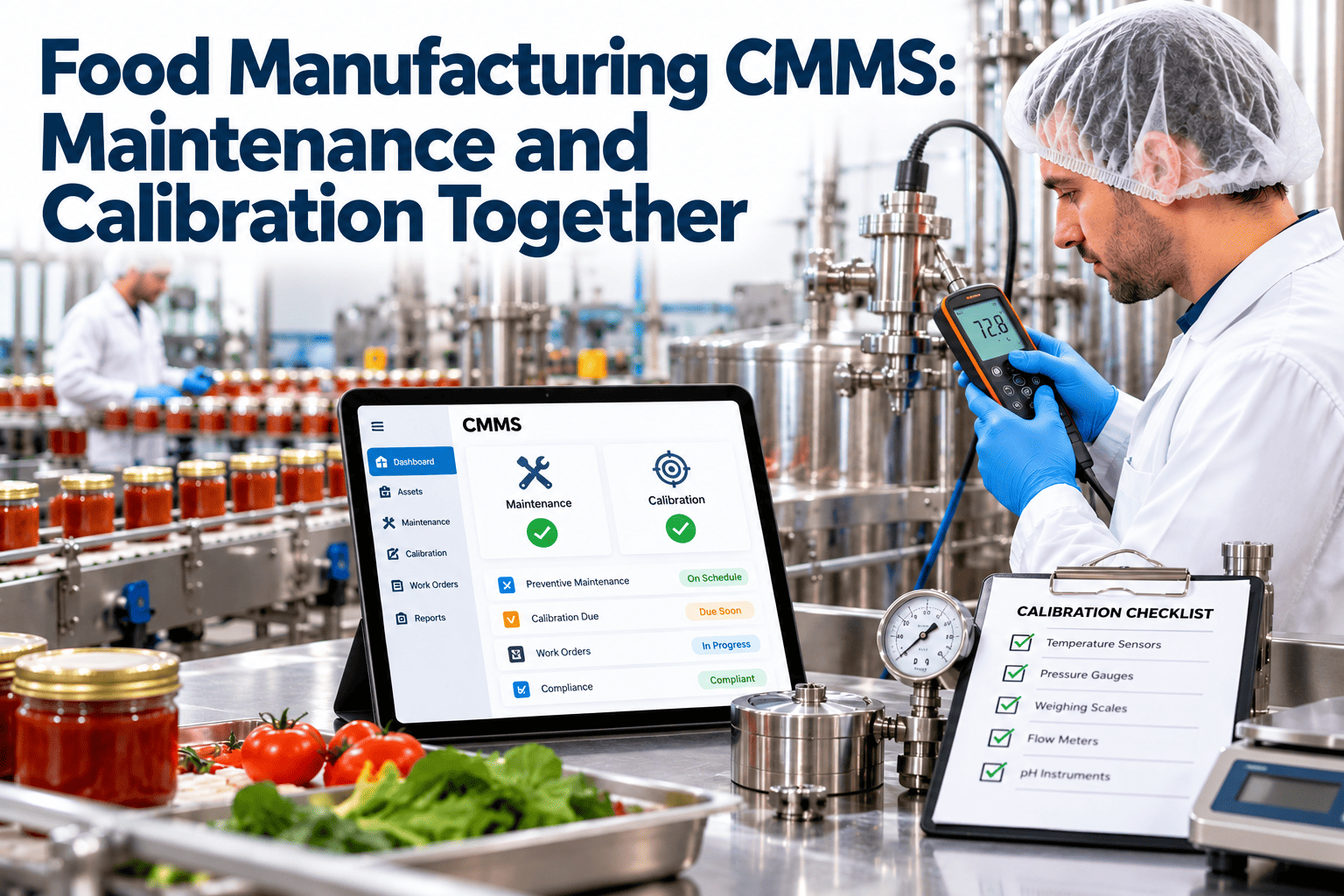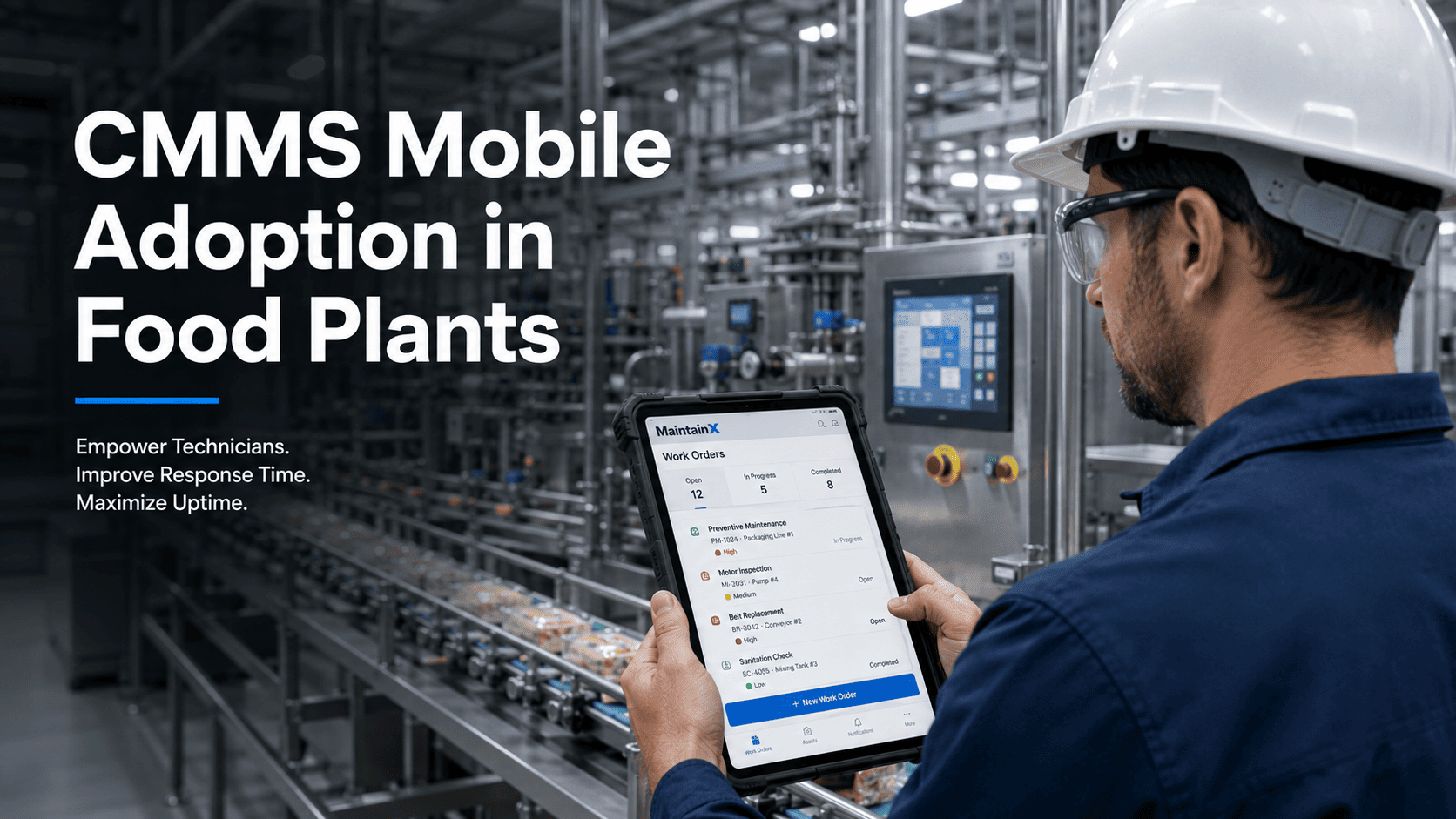
Food manufacturing maintenance teams are among the most process-disciplined workforces in industry — yet CMMS mobile adoption in food plants consistently trails every other industrial sector. The gap is not technology. It is human, operational, and organizational. Facilities that close it see 35–50% faster work order cycle times, near-zero paper records, and stronger GFSI audit outcomes within two cycles. Start a free trial on Oxmaint to see how a mobile-first CMMS is built for food plant technicians, or book a demo and walk through your rollout plan together.
CMMS Mobile Adoption Barriers in Food Manufacturing
Why food plant teams resist mobile CMMS — and what actually drives lasting technician engagement, digital work orders, and real operational change.
Why CMMS Mobile Rollouts Fail in Food Plants
Most CMMS mobile rollouts follow the same arc: enthusiastic leadership buy-in, a structured implementation, a training week — then a slow retreat to paper clipboards by month three. The platform is live. The licences are paid. The dashboards are empty.
The failure is almost never the software. It is the mismatch between how the system was designed and how food plant maintenance actually operates. Technicians work in cold rooms, wet environments, with gloved hands and time measured in minutes. A system that adds friction gets abandoned — not from stubbornness, but rational self-interest. Facilities that achieve lasting adoption treat it as a change management programme, not an IT deployment. Start a free trial to see how Oxmaint is structured around technician workflow, or book a demo to see how other food plants built adoption that stuck.
Only 39% of food plant CMMS deployments achieve more than 50% active technician adoption after a full year — making food manufacturing the lowest-adoption manufacturing vertical tracked by Limble CMMS (2023).
Food plants that treat CMMS rollout as an IT project fail. Those that treat it as a people programme succeed. The difference is always in how you design the first 30 days.
The 8 Core Barriers to Mobile CMMS Adoption
These barriers are drawn from documented rollout failures across food processing, dairy, beverage, and RTE manufacturing. Each is solvable — but only when named and addressed deliberately.
Food Manufacturing-Specific Pain Points
Beyond the general barriers, food plants carry industry-specific constraints that make mobile adoption harder than in any other manufacturing vertical. Start a free trial to see how these constraints are handled in Oxmaint.
Mobile devices entering high-care zones must meet contamination control requirements — dedicated zone devices, sanitisation logs, restricted entry. A generic rollout treating all floor areas equally creates a compliance conflict from day one under BRCGS or SQF. Device management must be integrated into zone entry procedure, not bolted on afterward.
A technician maintaining a blast freezer at -25°C wearing double-gloved nitrile cannot operate a capacitive touchscreen. Most CMMS interfaces are designed for office fingertips. Facilities that do not address this with compatible gloves, stylus options, or voice capture see immediate abandonment in cold-chain areas — precisely where compliance recording is highest.
Food plant technicians must document maintenance during live production runs — not after. Any interface requiring two-handed navigation or long text entry during an active intervention will be documented retrospectively from memory, defeating the purpose of real-time digital records entirely.
Food processing facilities routinely operate with maintenance teams whose primary language differs from the CMMS interface. English-only apps create a literacy barrier that surfaces as adoption resistance — technicians who can perform the task fluently but cannot navigate a form confidently revert to verbal reporting. Multi-language support is an adoption prerequisite.
Production supervisors — with more direct authority over technician behaviour than maintenance managers during active runs — frequently communicate that documentation is secondary to throughput. CMMS adoption in food plants requires explicit alignment at the production management level, not just maintenance management.
Food plant teams know records are reviewed by auditors who can trigger product holds and site suspensions. This creates anxiety around digital records — fear that an incomplete work order creates liability. Training must show technicians exactly what an auditor sees, confirming that partial records are recoverable unlike a lost paper form.
How Oxmaint Drives Real Mobile Adoption in Food Plants
Oxmaint is not a desktop CMMS with a mobile app added later. Every workflow was designed mobile-first, tested with food plant technicians, and optimised for food manufacturing constraints.
Scan any asset QR and the relevant checklist or work order opens instantly — no menu navigation, no hierarchy drilling. From scan to first entry in under 5 seconds. Large tap targets for gloved-hand use.
All functionality operates fully offline. Work orders captured, checklists completed, photos attached — stored locally and synced automatically on reconnection. Cold rooms, cleanrooms, and RF-shielded areas work identically to the main floor.
Technicians see only their assigned work orders and upcoming PMs. Managers see portfolio completion rates and overdue tasks. Same platform, fundamentally different interface — because the jobs are fundamentally different.
Ships with PM checklists aligned to BRCGS, SQF, and FSSC 22000 — AHU filter checks, CIP verification, lubrication schedules, seal inspections. Editable to match your equipment names and procedures from day one.
Every completed work order generates a timestamped, technician-attributed record exportable in BRCGS and SQF auditor-accepted format. 24 months of history for any asset in under 60 seconds. Showing this to technicians drives more adoption than any training session.
Asset import, QR code printing, first PM schedule, first mobile checklist — all on day one. No 6-month implementation. Technicians see real value before rollout momentum fades, which is the single most important adoption factor.
See your first digital work order completed within 48 hours — start a free trial now or book a demo to walk through your rollout plan step by step.
Paper-Based Operations vs. Oxmaint Mobile CMMS
The operational gap accumulates invisibly — in audit prep time, repeat failures, reactive costs, and the inability to demonstrate compliance on demand. Plants using Oxmaint recover an average of 4.2 working days per year previously spent assembling paper records.
| Area | Paper-Based / Low Adoption | Oxmaint Mobile CMMS |
|---|---|---|
| Work Order Speed | 4–8 hr lag; completed from memory post-shift | QR scan to close in 90 sec; timestamped at point of work |
| PM Visibility | Supervisor physically checks board or asks each technician | Live dashboard — overdue tasks flagged automatically |
| GFSI Audit Prep | 2–5 days assembling records from binders and spreadsheets | 24-month history exported in under 60 seconds |
| Documentation Time | 45–90 min/shift on paper logging and sign-off chasing | 8–12 min/shift equivalent; time returned to the floor |
| Repeat Failures | No repair history; same fault diagnosed 3–4x before root cause | Full history on QR scan; recurring patterns surfaced automatically |
| Multi-Site Oversight | Site records in disparate formats; consolidation takes days | Unified dashboard — compliance status across all sites in real time |
Mobile CMMS Adoption ROI — What Food Plants Measure
Mobile WO creation and closure reduces average cycle time by 35% vs. paper-based (Aberdeen Group)
Digital repair history at point of work reduces repeat fault diagnosis rate by 28% (SMRP benchmarking)
Food plants recover 4.2 working days/year previously spent assembling paper records before GFSI audits
Oxmaint deployments achieve first technician-completed digital WO within 48 hours of setup
Plants following Oxmaint's 30-day structured rollout achieve 92% active mobile adoption at 90 days
Oxmaint customers 12+ months post-deployment report zero major NCs on maintenance documentation
See measurable adoption results within your first 30 days — start a free trial or book a demo to model your ROI based on team size and site count.
Frequently Asked Questions
How long does it realistically take to achieve full technician adoption in a food plant?
Do food plant technicians need to be tech-savvy for mobile CMMS to work?
How do you handle mobile CMMS adoption across three shifts with different supervisors?
Will GFSI auditors accept digital maintenance records from a CMMS as equivalent to paper?
Stop Losing Ground to Paper Clipboards and Empty Dashboards
Turn your food plant maintenance team into a fully digital, audit-ready operation — without a 6-month implementation, without forcing technicians to fight the software, and without waiting for the next GFSI audit to find the gaps.
- Real-time work order visibility across every shift, zone, and site
- QR-code access designed for gloved hands in cold and wet environments
- GFSI-ready maintenance records generated automatically — zero admin overhead
No heavy implementation. Works across multi-site portfolios. Live in 48 hours.