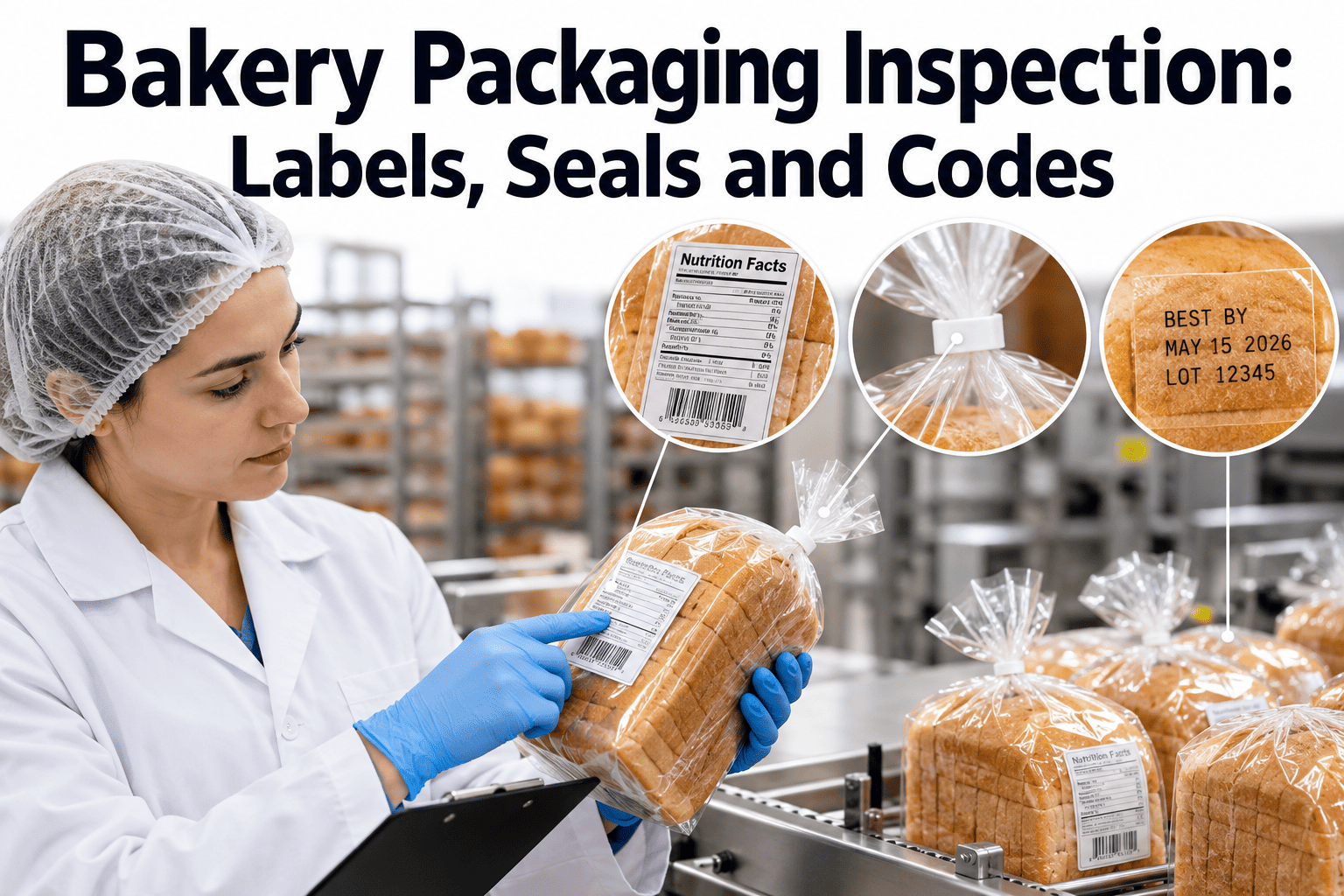
A loaf can be baked perfectly and still be a problem the moment it is bagged. A wrong date code, a label from the previous product, a smudged lot number or a weak seal can trigger customer complaints, retailer chargebacks, rework or, in the worst case, a recall for undeclared allergens. Packaging is the last control point before the product leaves your control, so inspection here must be fast and repeatable. This guide covers what to check, where to check it and how to keep equipment dependable with maintenance management software.
Bakery packaging inspection: labels, seals and codes
Verify the right label, a sound seal and a legible date code on every pack, using vision checks and clear manual routines to cut packaging errors and rework.
Small packaging errors, large consequences
Packaging mistakes are rarely dramatic. They are quiet, repeated and expensive, and they often start at changeover.
Safety and compliance
A wrong label can hide an allergen. A missing or incorrect date code removes the information customers rely on for freshness and traceability.
Product quality
A weak or contaminated seal lets air in, speeds staling and mold growth and causes leaking or crushed packs on the shelf.
Commercial cost
Retailers reject pallets with unreadable barcodes or wrong codes, and rework consumes labor, film and product.
What to verify on every pack: labels, seals and codes
Group inspection into three families. Each has its own failure modes, its own best method and its own owner.
- Correct product, size and variant for the run
- Allergen statement and ingredient list match the current recipe
- Label placed straight, fully attached and not wrinkled
- Barcode present and scannable
- Regulatory text and claims correct for the market
- Continuous seal with no gaps, channels or folds
- No product trapped in the seal area
- Crimp or clip secure on bags and closures
- Film tension and temperature within the set range
- No leaks, crushed packs or open corners
- Date and lot present on every pack
- Content matches the correct date for the batch and shift
- Characters legible, complete and in the correct position
- Format agrees with the specification and retailer rules
- Code is readable under normal handling and storage
Rank packaging defects by risk, not by annoyance
Not every defect deserves the same response. A severity grid helps operators decide quickly whether to stop the line, hold product or just adjust.
Define your own severity levels and responses in your quality system, and make sure they match customer and regulatory requirements.
Vision systems and manual checks: use each where it fits
Automated inspection is excellent at repetitive, high-speed checks. People are better at judgment, setup and unusual cases. Most bakeries need both.
| Check | Vision or sensor | Manual |
|---|---|---|
| Label presence and position | Camera confirms a label is present, aligned and in the correct place on every pack | Operator confirms the first pack after setup and spot checks at intervals |
| Label content | Optical character verification can compare printed text with the expected text for the job | Two-person check of artwork, allergens and recipe at changeover |
| Barcode quality | Scanner verifies readability and can grade the print | Handheld scan from a sample at start-up and after any printer service |
| Date and lot code | Vision confirms presence, legibility and content against the expected code | Operator compares the code with the production schedule and signs the record |
| Seal integrity | Cameras or sensors can spot gaps, wrinkles and trapped product in some formats | Visual and tactile check, leak or squeeze tests where suitable for the pack |
| Pack appearance | Inspection for crushed or misshapen packs on the conveyor | Periodic review of finished packs on the line and in the case |
Vision and sensor capabilities vary by supplier and by pack type. Confirm with your equipment supplier what each system can reliably detect.
Keep inspection records and line equipment under control
Schedule packaging checks, log defects and keep sealers, coders and cameras maintained in one Oxmaint workspace for your bakery.
Set up your first inspection routine in a short session
The first pack after every changeover decides the run
Most label and code errors are introduced at changeover, when film, labels, artwork and coder settings change together. A structured verification stops them before the first pallet is built.
Clear the line
Remove old film, labels, printed cartons and rework from the area. Confirm the line is clear with a second person.
Load and match
Load the new film and labels. Compare the packaging code, artwork version and allergen statement against the production order.
Set the codes
Enter the date, lot and format on the coder. Verify the printed code against the schedule, not against the previous run.
Run the first-off check
Inspect label, seal and code on first-off packs. Scan the barcode. Record the result with name and time.
Release and monitor
Quality or the supervisor approves release. Continue interval checks and re-verify after any stop, splice or reload.
Set an inspection rhythm that matches the risk
Frequency should reflect how often a problem could occur and how serious it would be. Document your rhythm in the quality plan and apply it consistently.
Why packaging errors keep recurring
Inspection finds defects, but the long-term fix is removing their causes. Many are equipment-related and visible in maintenance data.
| Defect pattern | Common equipment cause | Maintenance action |
|---|---|---|
| Weak or inconsistent seals | Worn or dirty sealing jaws, wrong temperature or dwell, uneven pressure | Inspect and clean jaws, verify temperature controls, replace worn Teflon covers and heaters |
| Product in the seal | Poor product spacing, worn belts, infeed timing drift | Check infeed alignment, belts and sensors, retune timing |
| Faded or incomplete date codes | Dirty or worn print head, low ink or ribbon, wrong print distance | Clean coder, replace consumables, set distance and verify print after each service |
| Skewed or missing labels | Worn applicator parts, sensor misreads, label web tension | Clean sensors, check rollers and tension, replace worn parts on a schedule |
| Vision false rejects or missed defects | Dirty lenses, moved cameras, failing lights, flour dust | Clean optics, check lighting and mounting, run test samples on a routine |
| Film tracking and wrinkles | Misaligned rollers, worn bearings, unequal tension | Align and lubricate rollers, check bearings, replace worn components |
What your inspection record should capture
Good records let you prove what was checked, and they make trends visible. Keep the form short enough for operators to complete at the line.
Protect the one label error that can harm a customer
Undeclared allergens are widely recognized as a leading reason for food recalls, and bakeries handle several allergens at once. Treat allergen labeling as a control, not a formality.
- Link each label version to the approved recipe and specification, and retire old versions as soon as a recipe changes.
- Store printed labels and packaging in controlled locations, separated by product, with clear identification.
- Issue only the quantity needed for a run, and reconcile used, wasted and returned labels at the end.
- Use a two-person verification at changeover, comparing the pack, the artwork and the production order.
- Re-verify after any film or label reload, because the roll on the machine may not be the roll you checked.
- Make clear who can authorize a label change, and record every change.
A clear hold and release path for suspect packs
Operators need to know exactly what to do when a check fails. The path below keeps decisions fast and traceable.
Check what each customer and market requires
Retailers and regulators set their own expectations for packaging information, so the same product may need different checks depending on where it ships.
- Date coding format, such as best before or use by, and where the code must appear on the pack.
- Barcode type, size, quality grade and placement for retail and for cases and pallets.
- Required label content, language, allergen emphasis, nutrition information and country-specific statements.
- Case and pallet labeling, including lot and quantity information used for receiving and traceability.
- Rules on how unreadable or incorrect codes are handled and what chargebacks may apply.
Always confirm current requirements with your regulator, your certification scheme and each customer.
Packaging inspection KPIs worth tracking
Track a few measures by line and by shift, and review them with production and maintenance together.
| Measure | What it shows | How to act on it |
|---|---|---|
| First-off pass rate after changeover | How well changeover steps prevent errors | Review the checklist and training where the rate is low |
| Defects by type per line | Whether seals, codes or labels cause most problems | Target the equipment or process behind the top defect |
| Rework and discard quantities | Cost of packaging errors in packs, film and labor | Prioritize fixes with the highest loss |
| Customer complaints on packaging | Errors that got past inspection | Strengthen the check that should have caught them |
| Packaging equipment downtime and repeat repairs | Reliability of sealers, coders and labelers | Adjust preventive tasks and spare parts |
| Inspection completion on time | Whether checks are actually happening | Fix ownership and prompts if checks are late |
Make the checks easy for the operator to do well
Inspection fails when it is slow, unclear or disconnected from what operators see at the line. A few practical measures make a large difference.
- Place a reference pack and a photo of an acceptable and an unacceptable seal, label and code at each station.
- Train operators to recognize early signs of equipment trouble, such as fading print, noisy jaws or label drift, and give them a fast way to report them.
- Rotate verification duties so the same person does not check their own changeover.
- Review recent defects at shift start, so lessons from the last run reach the next one.
- Confirm competence with short observed checks, not only with attendance records.
Linking inspection to equipment reliability
Oxmaint is maintenance management software. It supports the equipment side of packaging quality, and it can hold the recurring inspection tasks that sit beside it.
- Preventive maintenance for sealers, coders, labelers, conveyors and cameras, with scheduled cleaning, calibration and wear-part replacement.
- Inspection checklists on mobile devices for changeover verification and interval checks, completed at the line.
- Work orders raised straight from a failed check, so a faded code or weak seal becomes a tracked repair with an owner.
- Asset history showing which machines produce repeated defects and which parts keep failing.
- Reports and dashboards for overdue checks, repeat repairs and downtime by packaging line.
- Inventory for spare jaws, heaters, print heads and sensors, so repairs do not wait on parts.
Bakery packaging inspection: common questions
How often should date codes be checked?
At start-up, after every changeover or stop and at the intervals in your quality plan. Match the frequency to the risk and your customer requirements.
Do we need a vision system?
Not always. Slower or lower-volume lines may manage with disciplined manual checks, while high-speed lines benefit from automated verification of labels and codes.
What is the biggest label risk?
Wrong or missing allergen information after a changeover. Use a two-person check and verify the first-off pack before release.
How can maintenance reduce packaging errors?
By keeping sealing jaws, coders, sensors and cameras on a planned schedule. You can book a demo to see how this is set up.
Where should a bakery start?
Begin with changeover verification on the line with the most label complaints, then add equipment tasks. You can sign up and build the checklist today.
Send out packs that are right the first time
Combine clear inspection routines with dependable sealing, coding and labeling equipment, and reduce packaging errors, rework and complaints.
Bring your line, your checks and your questions