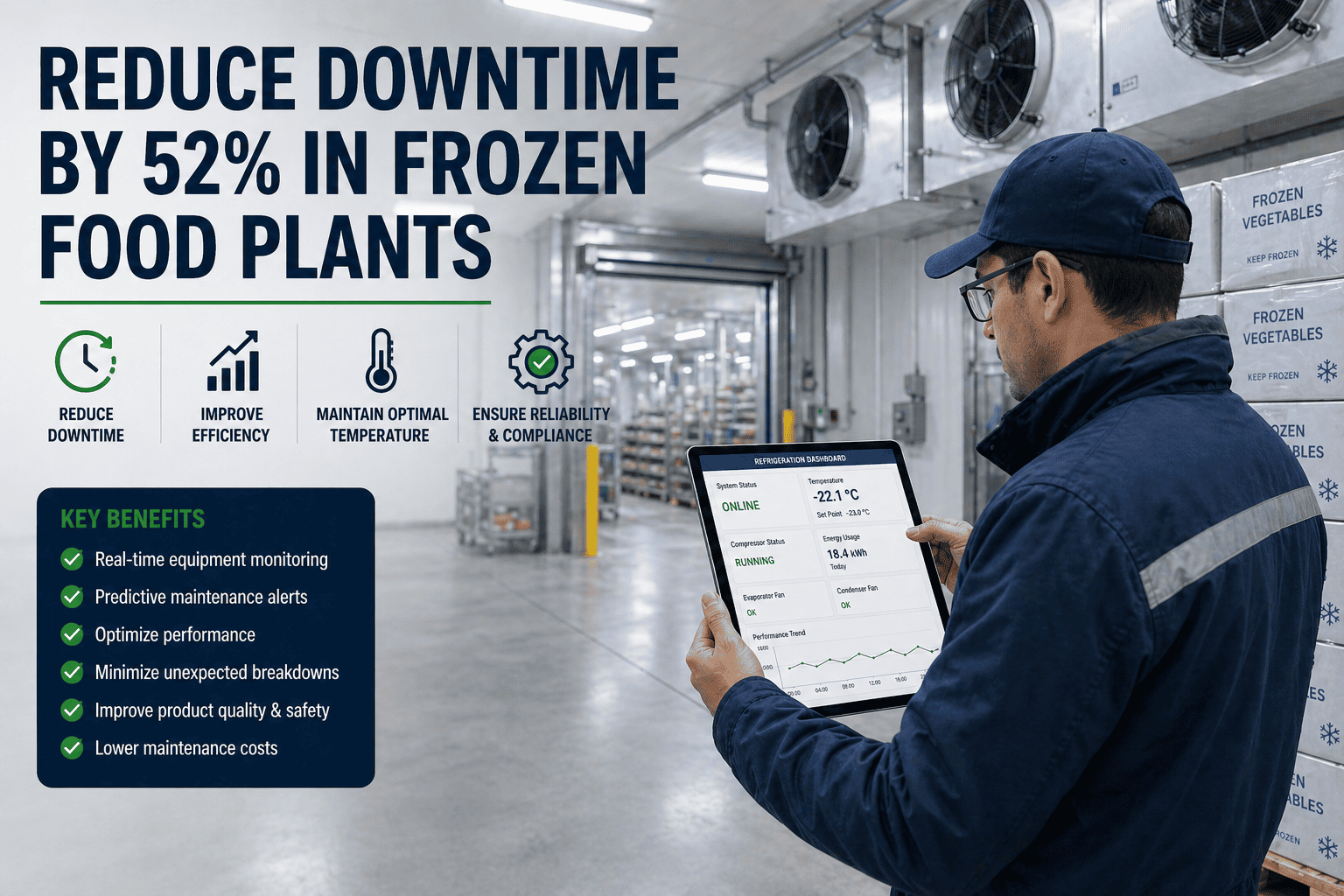
When a major frozen food processing plant in Wisconsin experienced their third unplanned refrigeration failure in six months—losing $340,000 in spoiled product and emergency repairs—leadership knew their reactive maintenance approach was failing. The 180,000 square foot facility processed 400,000 pounds of frozen vegetables daily across four production lines, with equipment ranging from industrial blast freezers operating at -40°F to high-speed packaging lines running 18 hours per day. Every hour of unplanned downtime cost $28,000 in lost production, and food safety regulations meant equipment failures risked more than just revenue—they threatened the facility's ability to operate.
Reducing Downtime in a Frozen Food Processing Plant
How AI-powered predictive maintenance transformed equipment reliability and eliminated costly unplanned failures.
The Challenge
The facility faced interconnected problems that reactive maintenance couldn't solve.
Critical Refrigeration Failures
Three major ammonia compressor failures in six months resulted in $340,000 in spoiled inventory. Temperature excursions triggered FDA documentation requirements and threatened facility certification.
Reactive Maintenance Trap
Maintenance team spent 78% of time responding to breakdowns, leaving minimal capacity for preventive work. Each emergency pulled technicians from scheduled maintenance, creating a cycle of deferred work.
Food Safety Risk
Temperature monitoring gaps during equipment transitions created HACCP documentation challenges. Auditors flagged inconsistent equipment maintenance records during annual inspections.
Rising Maintenance Costs
Emergency repairs cost 3-5× more than planned maintenance. Overtime for weekend breakdowns and expedited parts shipping consumed 40% of the maintenance budget.
Facility Profile
Facing Similar Challenges?
See how Oxmaint's AI predictive maintenance can transform your facility's equipment reliability.
The Solution
The facility implemented Oxmaint CMMS with AI predictive maintenance across all critical equipment, starting with refrigeration systems and expanding to packaging lines.
Sensor Deployment
Installed vibration sensors on 23 ammonia compressors, temperature monitoring across all cold storage zones, and current sensors on critical motors. Total deployment: 156 IoT sensors feeding real-time data to Oxmaint.
AI Model Training
Oxmaint's AI analyzed 18 months of historical failure data alongside real-time sensor feeds. Within 6 weeks, the system established baseline patterns and began generating failure predictions.
Predictive Work Orders
AI-generated maintenance recommendations automatically created work orders in Oxmaint. Technicians received prioritized tasks based on failure probability and production impact.
Continuous Optimization
Machine learning models improved with each maintenance event. Prediction accuracy increased from 67% in month one to 91% by month six as the system learned facility-specific patterns.
Critical Equipment Monitored
Oxmaint's predictive maintenance covered the facility's most failure-prone and production-critical equipment.
Ammonia Compressors
23 units providing refrigeration for blast freezers and cold storage. Vibration and temperature monitoring predicts bearing failures 3-4 weeks in advance.
Blast Freezers
8 tunnel freezers operating at -40°F. Fan motor monitoring and evaporator coil condition tracking prevent temperature excursions.
Packaging Lines
High-speed baggers and case packers running 18 hours daily. Servo motor and gearbox monitoring reduces mid-shift breakdowns.
Conveyor Systems
2.3 miles of conveyor belts moving product through processing. Motor current analysis detects belt tension and bearing issues.
Implementation Timeline
The facility achieved full deployment in 10 weeks with immediate results visible within the first month.
Discovery & Planning
Asset inventory, failure history analysis, and sensor placement planning. Identified 127 critical assets across refrigeration, processing, and packaging.
Sensor Installation
Deployed 156 IoT sensors during scheduled maintenance windows with zero production impact. Established connectivity to Oxmaint cloud platform.
AI Training & Baseline
AI models analyzed historical data and established normal operating patterns. First predictive alerts generated for two compressors showing early degradation.
Team Training
Maintenance technicians trained on Oxmaint mobile app, predictive alerts, and work order management. Shift supervisors trained on dashboard monitoring.
Full Production
System fully operational with predictive maintenance driving 60% of work orders. First major failure prevented: compressor bearing replacement completed before failure.
Results: Before vs. After
Measurable improvements across all key maintenance and production metrics within 12 months of implementation.
Ready to Transform Your Maintenance?
Join food processing facilities using Oxmaint to predict failures before they impact production.
Key Takeaways
Start with Critical Assets
Focusing initial deployment on refrigeration—the facility's highest-risk equipment—delivered immediate ROI and built organizational confidence for broader rollout.
AI Improves Over Time
Prediction accuracy increased from 67% to 91% as models learned facility-specific patterns. Patience during initial months pays dividends in long-term reliability.
Team Adoption is Critical
Technician training on mobile tools and supervisor dashboard access ensured predictions translated into completed maintenance before failures occurred.
Food Safety Benefits
Continuous temperature monitoring and equipment reliability documentation strengthened HACCP compliance and simplified annual audit preparation.
We went from dreading Monday morning breakdowns to actually trusting our equipment. The AI caught a compressor bearing issue three weeks before it would have failed during our busiest season. That single save paid for the entire system.
Frequently Asked Questions
Start Your Predictive Maintenance Journey
See how Oxmaint can reduce unplanned downtime and improve equipment reliability at your facility.