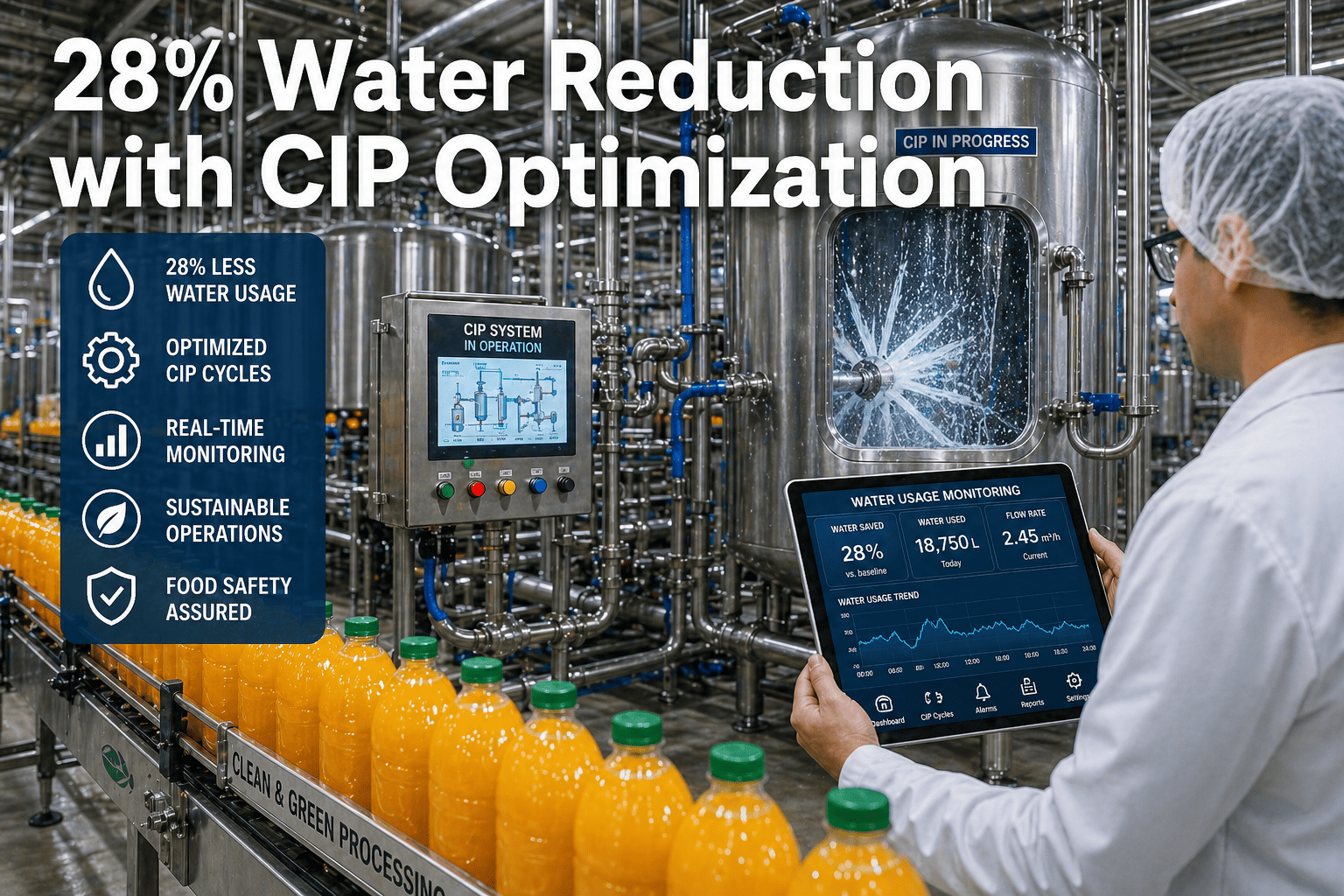
In juice processing, Clean-In-Place (CIP) systems are non-negotiable — but how they're run makes an enormous difference to operating costs, water consumption, and environmental footprint. When a mid-sized juice processing plant began tracking CIP cycle performance through Oxmaint's CMMS, what they discovered changed everything. Cycles were running longer than necessary. Chemical concentrations were inconsistent. Water was being consumed at rates the team had never actually measured. Within 12 months of optimizing through the platform, water usage dropped 28%. Here's the full story. Book a demo to see how Oxmaint tracks CIP performance and drives measurable water and chemical savings in food processing environments.
Food Processing · Sustainability · CIP Optimization
Juice Processing Plant Cuts Water Usage by 28% Through CMMS-Driven CIP Optimization
A juice processing facility managing 6 production lines identified systemic inefficiency in their Clean-In-Place cycles using Oxmaint. The result: 28% less water, lower chemical costs, improved GMP compliance, and a documented sustainability record — all without sacrificing hygiene standards.
28%
Water Usage Reduction
Annualized, all 6 production lines
34%
Chemical Cost Savings
Caustic and acid usage optimized
19%
CIP Cycle Time Reduction
Increased production availability
100%
GMP Audit Pass Rate
Digital CIP logs, full traceability
The Challenge
Why CIP Cycles Were Wasting Water Nobody Was Counting
CIP systems in juice processing run on recipes — sequences of pre-rinse, caustic wash, acid rinse, final rinse, and sanitizing steps. The problem isn't that the recipes were wrong. It's that they were never updated, never monitored, and never tied to actual production conditions. Fixed time-based cycles ran the same way whether a line had processed 2,000 litres or 12,000 litres. Water and chemicals were consumed at maximum rates regardless of what was needed.
01
No CIP Performance Data
Cycle completion was logged on paper. Duration, water volume, chemical concentration, and temperature were never recorded systematically. No data meant no baseline — and no way to identify waste.
02
Fixed Cycles Regardless of Production Load
CIP recipes set at maximum parameters to ensure compliance on worst-case days. Low-production shifts ran the same cycles as peak days — consuming the same water and chemicals regardless of actual soil load.
03
GMP Documentation Gaps
Auditors required proof that every CIP cycle completed to specification. Paper logs had gaps, inconsistent entries, and missing signatures. Each audit triggered a 2-day documentation scramble.
04
No Sustainability Metrics
Corporate sustainability reporting required water and energy usage data by process. The plant had no system to generate this. Estimates were submitted — inaccurate and unverifiable.
Understanding CIP Optimization
What CIP Optimization Actually Means in a Juice Plant
CIP optimization isn't about cutting corners on hygiene — it's about running each cycle at the right parameters for the actual conditions, not the worst-case assumption. Three variables drive the majority of water and chemical waste in food processing CIP systems:
T
Temperature Optimization
Caustic wash effectiveness increases with temperature — allowing shorter contact times at optimal heat. Under-heated cycles compensate with extended duration and higher chemical concentration, consuming more of both.
Proper temperature control: up to 22% reduction in caustic usage
F
Flow Rate Calibration
Turbulent flow velocity is the mechanical driver of soil removal. Excess flow wastes water and energy without improving cleaning. Under-flow leaves residues requiring extended rinse steps.
Calibrated flow velocity: 15–18% reduction in rinse water volume
C
Conductivity-Based Rinse Endpoints
Fixed-duration rinse cycles run longer than necessary on light-soil days. Conductivity monitoring ends the rinse when the water is clean — not when the timer expires.
Endpoint rinsing: 20–30% reduction in final rinse water consumption
P
Production-Matched Cycle Selection
Linking CIP cycle selection to actual production volume means a short run gets a shorter cycle. Heavy production days trigger full-parameter cycles. The system matches intensity to need.
Volume-matched cycles: 12–18% overall CIP resource reduction
Implementation
How Oxmaint Enabled Systematic CIP Optimization
Oxmaint was configured to track every CIP cycle across all 6 production lines — capturing duration, water volume, chemical concentrations, temperature, and completion sign-off against defined specifications. This created the data layer that made optimization possible. Start a free trial to see how CIP cycle tracking is configured in Oxmaint for food processing environments.
Step 1
CIP Asset Registry and Cycle Documentation
All CIP circuits, distribution lines, tanks, and associated process equipment registered as assets in Oxmaint. Existing CIP recipes documented as maintenance procedures with parameter specifications. Baseline established before any optimization changes were made.
Step 2
Performance Tracking — 8-Week Baseline Period
Operators logged every CIP cycle completion through Oxmaint mobile — recording actual duration, deviations from specification, and water meter readings. After 8 weeks, the data revealed patterns: 3 of 6 lines were running cycles 22–35% longer than specification. Chemical recovery was inconsistent on 2 lines.
Step 3
Recipe Optimization Based on Actual Data
Data from Step 2 informed targeted recipe modifications — reduced pre-rinse duration on low-soil days, temperature setpoint adjustments, and flow rate calibration. Changes documented in Oxmaint as new procedure versions with full change history.
Step 4
Digital GMP Compliance Documentation
Every CIP cycle logged with operator sign-off, timestamp, and parameter records in Oxmaint. Deviation flags raised automatically when actual performance falls outside specification. Audit packages generated in under 30 minutes — no paper assembly required.
Before vs. After
CIP Operations Before and After CMMS-Driven Optimization
| CIP Operational Area |
Before Oxmaint |
After Optimization |
| CIP cycle tracking |
Paper logs — incomplete and inconsistent |
Digital — every cycle, every parameter |
| Water usage monitoring |
Monthly utility bill only — no process-level data |
Per-cycle water metering, tracked by line |
| Cycle duration |
Fixed — same parameters every cycle, every shift |
Production-matched — parameters reflect actual load |
| Chemical management |
Manual dosing — inconsistent, often overdosed |
Verified concentration, chemical recovery tracked |
| GMP audit preparation |
2-day document scramble per audit |
Under 30 minutes — all records digital |
| Water usage (annual) |
Baseline (pre-optimization) |
28% reduction on same production volume |
| Chemical spend |
Untracked per cycle — only monthly invoice |
34% reduction — caustic and acid both down |
| Sustainability reporting |
Estimated figures — unverifiable |
Verified data from Oxmaint — audit-grade |
Results
Verified Outcomes — 12 Months Post-Implementation
Water
28%
Less Water Used
Same production volume. Measured per cycle, verified against utility billing.
Chemicals
34%
Chemical Cost Reduction
Caustic and acid usage both down significantly. Chemical recovery improved on 4 of 6 lines.
Efficiency
19%
Shorter CIP Cycles
Production availability increased — more time on line, less time cleaning on light-soil days.
Compliance
100%
Audit Pass Rate
Digital GMP records for every CIP cycle. Zero documentation gaps since deployment.
The 28% water reduction wasn't the result of a capital project or equipment replacement. It came from measuring what was happening, understanding why cycles were inefficient, and making targeted adjustments backed by data. Oxmaint provided the tracking system that made all of it visible. Book a demo to see how CIP cycle monitoring and optimization reporting is set up for juice and beverage processing plants.
FAQs
Frequently Asked Questions
Does Oxmaint integrate directly with CIP control systems or SCADA?
Oxmaint supports SCADA and IoT integration via standard protocols including MQTT and REST API. This allows sensor data — temperature, conductivity, flow rate, cycle status — to feed directly into the CMMS for automated logging. Where direct integration isn't implemented, operators log cycle completions and parameters via mobile work orders. Both approaches generate the data needed for optimization.
Start a free trial to explore integration options.
How long does it take to establish a meaningful CIP performance baseline?
The juice processing plant in this case study used an 8-week baseline period before making any optimization changes. For most food processing operations, 6–10 weeks of consistent data collection is sufficient to identify inefficiency patterns, seasonal variation, and line-specific performance differences. Optimization decisions made without baseline data risk creating new problems while solving visible ones.
Can CIP optimization compromise hygiene or GMP compliance?
Done correctly, no. Optimization targets parameters that are running in excess of what's required for effective cleaning — not parameters that are at or below effective thresholds. Every recipe change should be validated against microbiological swab data and ATP testing before full implementation. Oxmaint documents recipe versions and validation records, so the change history is fully traceable for GMP audits. The facility in this case study improved their audit pass rate alongside the resource reductions.
How does Oxmaint support sustainability reporting requirements from CIP data?
Oxmaint generates reports on water consumption and resource usage by line, shift, product type, and time period — derived from cycle-level data. For corporate sustainability reporting, these figures are verifiable and audit-grade, replacing estimated submissions with actual measured data. The juice plant used this capability to submit their first verified sustainability figures to corporate after deployment.
Book a demo to see the sustainability reporting module.
Start Measuring. Start Saving.
Water you can't measure, you can't reduce. The first step toward 28% savings is knowing where your CIP cycles are running inefficiently.
Oxmaint gives food processing operations the tracking layer they need to move from fixed CIP protocols to data-driven optimization — capturing every cycle, every parameter, and every deviation so your team can find savings without sacrificing hygiene standards.