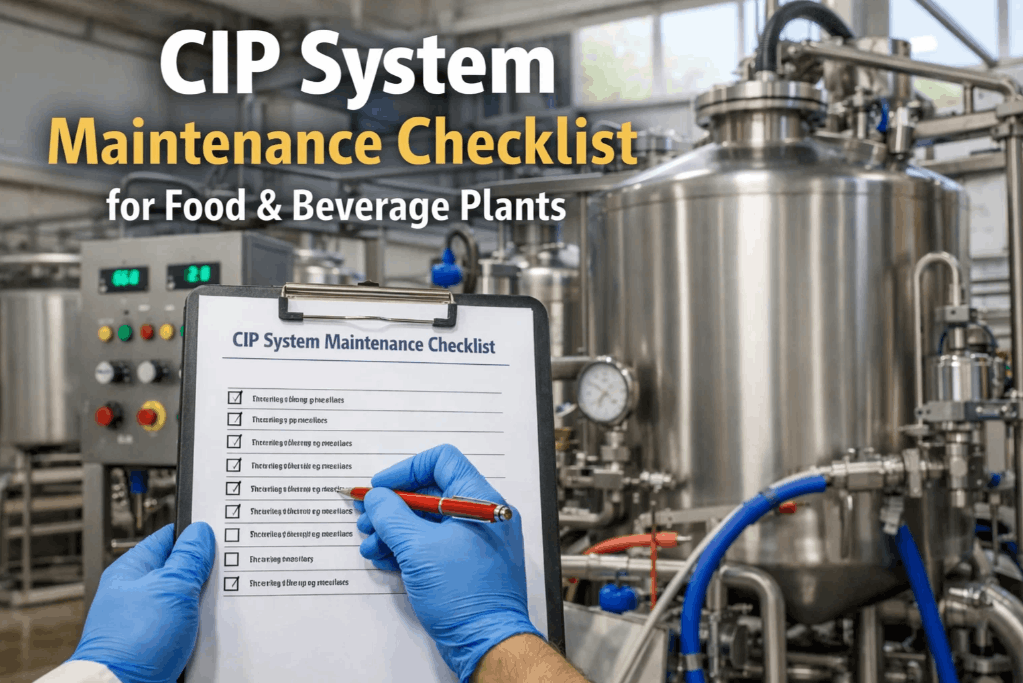
Clean-in-Place (CIP) systems are the circulatory system of food and beverage manufacturing — they clean product-contact surfaces automatically, without disassembly, and their performance directly determines whether your facility meets FDA, FSMA, SQF, and BRC requirements. A CIP system that isn't maintained with the same rigor as your production equipment will deliver inconsistent cleaning results, fail microbial audits, and create regulatory exposure that no food manufacturer can afford. Facilities that implement a documented CIP system maintenance checklist reduce sanitation non-conformances by up to 45% and extend system component life by 4–6 years. This checklist covers every critical CIP maintenance category: pumps, spray devices, valves, heat exchangers, chemical dosing, sensors, and full preventive maintenance cycles — with frequency, priority, and responsible party assigned to every task. Start a free trial to load this checklist directly into your food plant PM schedule and automate every CIP maintenance task.
Checklist 1: Daily CIP System Pre- and Post-Operation Inspection
Daily checks before and after each CIP cycle are the foundation of a reliable sanitation program. These tasks take under 20 minutes per shift and prevent the majority of CIP circuit failures, chemical overdoses, and incomplete cleaning events in food and beverage plants.
| Task | Frequency | Priority | Responsible |
|---|---|---|---|
| Verify CIP supply and return tank levels before cycle start — confirm caustic, acid, and rinse water tanks are filled to minimum operating levels; low levels cause incomplete cycles and under-dosed circuits | Daily (Pre-op) | Critical | CIP Operator |
| Confirm chemical concentration in caustic and acid tanks — test concentration using calibrated titration or conductivity meter before each cycle; out-of-spec chemistry is a critical sanitation non-conformance | Daily (Pre-op) | Critical | CIP Operator / QA |
| Check all CIP circuit valves for correct positioning before cycle start — verify manual isolation valves are fully open and no production valves are left in the wrong state that could redirect CIP solution into wrong circuits | Daily (Pre-op) | Critical | CIP Operator |
| Inspect CIP supply pump for leaks, seal weeps, and unusual noise — check mechanical seal faces for any moisture or chemical seepage prior to starting the pump; early seal failure allows CIP chemical contamination of product zones | Daily (Pre-op) | High | Maintenance Tech |
| Verify CIP cycle completion — check PLC cycle status screen — confirm each circuit reached required time, temperature, flow rate, and conductivity targets; incomplete cycles must be re-run before production resumes | Daily (Post-op) | Critical | CIP Operator / QA |
| Confirm final rinse conductivity meets potable water specification — verify conductivity reading at circuit return is within 10 µS/cm of incoming potable water; elevated readings indicate caustic or acid carryover into the product zone | Daily (Post-op) | Critical | QA Technician |
| Log cycle parameters — time, temperature, flow, and concentration — record all CIP cycle data in the equipment log or CMMS; FSMA requires 2-year retention of all sanitation records including CIP cycle logs | Daily (Post-op) | Critical | CIP Operator |
| Inspect spray device coverage visually through sight glasses or borescope — where site glasses are installed, confirm spray pattern is uniform with no dead zones; blocked nozzles create shadow zones that fail sanitation | Daily (Post-op) | High | CIP Operator |
| Log any alarms, deviations, or cycle aborts from the CIP PLC — record all alarm events with time stamps and corrective action taken; repeated alarm patterns are leading indicators of sensor or component failure | Ongoing | Ongoing | CIP Operator |
Checklist 2: CIP Pump Maintenance Checklist
CIP pumps are the heart of the cleaning circuit — they drive flow velocity, which is the mechanical energy that physically removes soil from product-contact surfaces. Under-maintained pumps deliver insufficient flow rates, creating cleaning failures that are invisible until a microbial audit or product recall. A structured pump maintenance program is non-negotiable in any food and beverage CIP program.
| Task | Frequency | Priority | Responsible |
|---|---|---|---|
| Inspect CIP supply pump mechanical seal for leakage or weeping — check seal faces after each shift for any chemical seepage; replace mechanical seals at the first sign of weeping to prevent CIP chemical ingress into product zones | Weekly | Critical | Maintenance Tech |
| Verify pump flow rate against design specification — measure actual flow with an in-line flow meter or portable clamp-on device; flow below 90% of design spec indicates impeller wear, seal leakage, or cavitation and must be investigated immediately | Weekly | Critical | Maintenance Tech |
| Check pump motor amperage draw at full CIP flow — record amp draw and compare to motor nameplate; an increase greater than 10% above baseline indicates mechanical drag from bearing wear or impeller interference | Weekly | High | Maintenance Tech |
| Lubricate pump bearings with food-grade NSF H1 grease — apply correct grease quantity per bearing OEM specification; do not over-grease as excess migrates into seal faces and contaminates the process side of the pump | Monthly | Critical | Maintenance Tech |
| Inspect pump casing, inlet, and outlet connections for corrosion or pitting — chemical cleaning solutions at elevated temperature accelerate corrosion in weld zones and heat-affected areas; any pitting deeper than 0.5mm must be assessed for food safety risk | Monthly | High | Maintenance Tech |
| Perform vibration analysis on pump drive-end and non-drive-end bearings — record RMS velocity readings at defined measurement points; readings 25% above baseline indicate bearing defect or imbalance requiring immediate investigation | Monthly | High | Reliability Tech |
| Inspect and replace pump impeller and wear ring on high-duty circuits — measure impeller-to-wear ring clearance; excessive clearance causes recirculation loss and reduced hydraulic efficiency that degrades CIP cleaning performance | Annual | High | Maintenance Tech |
| Verify all pump wetted parts are correct food-grade material specification — confirm seals, gaskets, impellers, and O-rings meet FDA food contact requirements; replacement parts sourced from non-OEM suppliers must be verified against material data sheets before installation | At each repair | Critical | Maintenance Tech / QA |
Checklist 3: Spray Ball and Spray Device Inspection Checklist
Spray balls and rotating spray heads are the most critical and most frequently neglected components in any CIP system. A single blocked nozzle orifice creates a cleaning shadow zone that survives every CIP cycle — accumulating biofilm, allergen residue, and microbiological contamination invisibly until a swab program or audit detects it. Spray device inspection must be scheduled, documented, and linked to sanitation verification.
| Task | Frequency | Priority | Responsible |
|---|---|---|---|
| Remove and inspect all spray balls for blocked or partially obstructed orifices — hold spray ball up to a light source and confirm all orifices are clear and round; any orifice showing encrustation, deformation, or partial blockage must be cleaned or replaced before the next CIP cycle | Weekly | Critical | Sanitation Tech |
| Verify spray ball free rotation and bearing condition on rotating heads — spin rotating spray heads by hand and confirm free, smooth rotation with no stiff spots; a spray head that stops rotating during a CIP cycle reduces coverage to a single fixed spray pattern | Weekly | Critical | Sanitation Tech |
| Measure spray ball supply pressure at the device inlet — record pressure at the spray device connection point; pressure below design specification (typically 1.5–2.5 bar) indicates line restriction, valve problem, or pump degradation | Weekly | High | CIP Operator |
| Perform spray coverage verification using riboflavin or UV-dye test — coat interior vessel surfaces with UV dye solution, run a CIP water-only cycle, and inspect under UV light; uncleaned areas confirm spray shadow zones requiring device repositioning or replacement | Monthly | Critical | QA / Sanitation |
| Inspect spray ball supply pipe and tri-clamp connections for scale buildup — disassemble supply pipe sections and check interior for mineral scale or product deposit accumulation that restricts flow to spray devices | Monthly | High | Sanitation Tech |
| Replace spray balls that show orifice wear, erosion, or deformation — worn orifices produce incorrect spray angle and droplet energy that reduce cleaning effectiveness; replace per OEM schedule or at first sign of orifice dimensional deviation | Per OEM schedule | High | Sanitation Tech |
| Document spray device inspection, cleaning, and replacement with asset-level traceability — log device ID, inspection result, and technician in CMMS; spray device maintenance history is required for FSMA preventive controls documentation | At each inspection | High | Sanitation Tech |
Checklist 4: CIP Valve Maintenance and Inspection Checklist
CIP valves — including pneumatic butterfly valves, diaphragm valves, and seat valves — control which circuits are cleaned, in what sequence, and with what chemical. A valve that fails to fully open restricts flow velocity below the cleaning threshold. A valve that fails to fully close allows CIP chemicals to cross-contaminate adjacent circuits or product zones. Valve integrity is not a peripheral maintenance task — it is a core food safety control.
| Task | Frequency | Priority | Responsible |
|---|---|---|---|
| Test all CIP circuit valves for full open and full close function from PLC — command each valve open and closed from the CIP control system and verify the position feedback signal matches the commanded state; position signal mismatch indicates actuator or limit switch failure | Weekly | Critical | Maintenance Tech |
| Inspect valve seat and diaphragm for signs of chemical attack or deformation — remove valve internals on a rotating inspection schedule and confirm elastomer seat and diaphragm show no swelling, cracking, or surface degradation from CIP chemical exposure | Monthly | Critical | Maintenance Tech |
| Verify valve leakage rate on critical isolation valves — perform a backpressure seat leakage test on valves that isolate CIP circuits from production zones; any detected leakage on product-CIP isolation valves is a critical non-conformance requiring immediate repair | Monthly | Critical | Maintenance Tech / QA |
| Inspect pneumatic actuator air supply and solenoid valves — check air supply pressure, filter condition, and solenoid valve response time; sluggish actuator response indicates low supply pressure, blocked filter, or failing solenoid coil | Monthly | High | Maintenance Tech |
| Replace valve seat gaskets and diaphragms per OEM service interval — do not extend diaphragm service life beyond the rated operating hours even in the absence of visible degradation; chemical fatigue is not visible until catastrophic failure occurs | Per OEM schedule | Critical | Maintenance Tech |
| Confirm all valve replacement elastomers are FDA-compliant material grade — verify elastomer type (EPDM, PTFE, silicone) against the chemical compatibility matrix for your specific CIP caustic and acid concentrations and temperatures; incompatible materials swell and contaminate the CIP circuit | At each replacement | Critical | Maintenance Tech / QA |
| Document valve service history with part number, material grade, and technician sign-off — log all valve maintenance events in the CMMS asset record; traceability of valve materials used is required for FDA audit and recall investigation scenarios | At each service | High | Maintenance Tech |
Checklist 5: Heat Exchanger Maintenance Checklist for CIP Systems
CIP heat exchangers bring cleaning solutions up to the required temperature — typically 70–85°C for caustic cycles. A fouled or under-performing heat exchanger delivers CIP solution below temperature, which is the single most common root cause of incomplete cleaning cycles in food processing plants. Temperature deviation during a CIP cycle is a critical process failure that cannot be corrected after the fact.
| Task | Frequency | Priority | Responsible |
|---|---|---|---|
| Verify CIP supply temperature at the heat exchanger outlet during active cycle — record actual temperature against the validated CIP cycle setpoint; any deviation greater than 3°C from the validated minimum must trigger a cycle abort and re-run after investigating the heat exchanger | Daily | Critical | CIP Operator |
| Inspect heat exchanger exterior for corrosion, gasket weeping, and connection integrity — check all gasketed plate connections and shell-and-tube end covers for any CIP chemical or steam condensate leakage; leaking connections allow cross-contamination between CIP chemical and heating medium | Weekly | High | Maintenance Tech |
| Monitor heat exchanger thermal efficiency — compare inlet/outlet temperature delta against baseline — a decreasing temperature differential across the exchanger at the same steam pressure indicates fouling of heat transfer surfaces; trend monthly and schedule cleaning before efficiency drops below 85% of baseline | Monthly | Critical | Reliability Tech |
| Inspect and replace heat exchanger gaskets on plate heat exchangers — remove plates and inspect gasket condition for compression set, chemical degradation, or edge cracking; replace gasket sets per OEM interval or at first sign of temperature performance degradation | Per OEM schedule | Critical | Maintenance Tech |
| Perform descaling of heat exchanger plates on hard water installations — circulate approved descaling acid through the heat exchanger at the defined concentration and temperature; mineral scale on plate surfaces acts as thermal insulation that directly reduces CIP solution temperature below validated cleaning thresholds | Quarterly | High | Maintenance Tech |
| Verify steam trap and condensate return system operation — check steam trap operation using an ultrasonic tester or IR thermometer; a failed open trap passes live steam into the condensate return, reducing heating capacity and increasing utility cost | Monthly | High | Maintenance Tech |
| Document heat exchanger thermal performance, gasket service, and descaling events — log in CMMS with before and after temperature efficiency data; performance trending data supports predictive maintenance scheduling and regulatory audit evidence for CIP validation | After each service | High | Maintenance Tech |
Checklist 6: Chemical Dosing System and Sensor Maintenance Checklist
The chemical dosing system and conductivity/pH sensor network are the intelligence layer of a CIP system — they control whether the correct chemistry reaches every circuit at the correct concentration. A mis-calibrated sensor or a failing dosing pump can produce CIP cycles that appear complete on the PLC screen while delivering zero effective cleaning. Sensor and dosing maintenance are among the highest-priority tasks in any food plant CIP program.
| Task | Frequency | Priority | Responsible |
|---|---|---|---|
| Calibrate inline conductivity sensors against certified reference solution — use NIST-traceable conductivity calibration standards; a drift of more than 5% from reference indicates fouled electrodes or failing sensor that must be cleaned or replaced before the next CIP cycle | Weekly | Critical | Calibration Tech / QA |
| Verify chemical dosing pump output volume against calibrated measurement — collect dosing pump output over a timed interval and compare against the programmed dose rate; a deviation greater than 5% indicates pump wear, check valve failure, or air lock in the chemical supply line | Weekly | Critical | CIP Operator |
| Inspect chemical dosing pump diaphragms and check valves — remove and inspect diaphragm for pinholes or stress cracks; inspect check valve balls and seats for chemical corrosion or debris that prevents complete check valve closure | Monthly | Critical | Maintenance Tech |
| Clean conductivity and pH sensor electrodes — remove sensors and clean electrode surfaces with approved electrode cleaning solution; fouled electrodes produce false low readings that cause the dosing system to overdose CIP chemicals into the circuit | Monthly | High | Calibration Tech |
| Verify chemical bulk storage tank level sensors and low-level alarms — simulate low-level condition and confirm PLC alarm activates before tank runs dry; a CIP cycle that runs out of chemical mid-cycle creates an incomplete cleaning event with no visible alarm on the CIP status screen | Monthly | High | Maintenance Tech |
| Inspect chemical supply line connections, tubing, and injection quills for leaks — concentrated caustic and acid CIP chemicals are highly corrosive; any leak at tubing connections, ferrule fittings, or injection quills creates a safety hazard and an uncontrolled dosing rate into the CIP circuit | Weekly | High | Maintenance Tech |
| Document all sensor calibration results with as-found and as-left readings — record calibration date, technician, reference solution lot number, and both as-found and as-left measurements in the CMMS calibration record; calibration history is required for FSMA process control documentation | At each calibration | Critical | Calibration Tech |
Checklist 7: Preventive Maintenance Schedule — Monthly, Quarterly, and Annual CIP System PM
Structured preventive maintenance at defined intervals is the foundation of a high-availability CIP system. Daily checks and weekly inspections catch acute failures — PM intervals address the accumulated wear and calibration drift that routine operation cannot detect. The tasks below represent the minimum PM scope required to maintain CIP system reliability, cleaning efficacy, and regulatory compliance documentation across food and beverage manufacturing facilities.
| Task | Frequency | Priority | Responsible |
|---|---|---|---|
| Full CIP circuit flow balance verification — measure and record flow at all branch circuits — verify actual flow rate at each circuit outlet against the hydraulic design specification; imbalanced circuits indicate blockage, valve restriction, or pipe scale buildup that prevents uniform cleaning performance across all circuits | Monthly | Critical | Reliability Tech |
| Review CIP cycle validation data against current validated parameters — compare actual cycle logs (time, temperature, concentration, flow) against the original CIP validation study; any parameter that consistently runs outside validated ranges triggers a re-validation requirement under FSMA preventive controls | Monthly | Critical | QA Manager |
| Inspect all CIP piping, tri-clamp gaskets, and hygienic fittings throughout the system — walk the complete CIP piping circuit and inspect every tri-clamp, ferrule, elbow, and tee for gasket extrusion, crevice corrosion, or surface pitting; pitted internal pipe surfaces harbor biofilm that survives CIP cycles | Monthly | High | Maintenance Tech |
| Perform thermographic scan of CIP control panel, VFDs, and pump motors — identify hot spots on motor windings, VFD heat sinks, and control panel terminals; heat concentration in electrical components indicates impending failure that can take the CIP system offline during a production run | Quarterly | High | Reliability Tech |
| Internal inspection of CIP supply and return tanks for pitting, weld defects, and coating integrity — enter tank (following confined space entry procedures) and inspect interior surfaces for corrosion, scale buildup, and any weld seam defects; corroded tank interior surfaces contaminate CIP solution and create ongoing microbial harborage | Quarterly | High | Maintenance Tech |
| Update CIP system P&ID drawings to reflect any equipment changes made during the year — confirm piping and instrumentation diagrams accurately reflect current installed configuration; inaccurate P&IDs result in incomplete CIP circuits being missed during sanitation, which is a critical food safety failure | Annual | Critical | Engineering / QA |
| Annual CIP system re-validation following any equipment change or product line addition — a change to vessel geometry, product type, circuit length, or CIP chemical supplier triggers a re-validation requirement; running a legacy validated CIP protocol on a modified system is a regulatory non-compliance under FSMA preventive controls | Annual / As needed | Critical | QA Manager / Validation |
| Update CMMS asset records with all PM findings, replacements, and calibration data — complete PM documentation is the foundation of FSMA, SQF Level 3, and BRC Issue 9 equipment maintenance audit evidence; gaps in records create regulatory exposure during FDA or scheme audits | After every PM | Critical | Maintenance Tech |
| Review CIP spare parts inventory against critical failure modes — confirm stock levels for pump seals, valve diaphragms, spray balls, conductivity sensors, dosing pump diaphragms, and heat exchanger gaskets meet minimum coverage for a 72-hour emergency repair scenario without halting production | Quarterly | Medium | Maintenance Manager |
CIP Maintenance Investment Analysis: Costs vs. Returns
A structured CIP system maintenance program is the most reliable food safety capital protection strategy available to food and beverage manufacturers. These figures represent typical investment and return outcomes for food plants running documented PM programs on CIP systems.
| Maintenance Investment | Annual Cost | Annual Savings / Risk Avoided | Payback |
|---|---|---|---|
| Spray Ball Inspection Program | $600 per CIP system | $20,000 avoided microbial non-conformance and production hold | Under 2 weeks |
| Pump and Valve PM Program | $900 per CIP system | $25,000 prevented unplanned downtime and emergency repair | Under 3 weeks |
| Sensor Calibration Program | $500 per CIP system | $15,000 avoided chemical overdose waste and cycle re-runs | Under 2 weeks |
| Heat Exchanger PM Program | $800 per CIP system | $18,000 prevented temperature deviation and product hold events | Under 3 weeks |
| CMMS-Automated CIP PM Scheduling | $1,200 per facility | $52,000 reduction in total reactive CIP maintenance spend | Under 3 weeks |
| Full Annual CIP System Overhaul | $4,000 per CIP system | $90,000 extended system life and avoided capital replacement | Under 6 weeks |



-system-maintenance-best-practices-for-food-and-beverage.png)

