Conveyor belt maintenance in food manufacturing is one of the most critical — and most overlooked — pillars of plant uptime, food safety compliance, and operational efficiency. Whether you are managing modular plastic belts on a poultry line, flat wire mesh belts in a baking application, or stainless steel slat conveyors in a ready-meal facility, the failure modes, sanitation demands, and preventive maintenance schedules differ substantially across belt types. A single unplanned conveyor failure during peak production can cost a food plant thousands of dollars per hour in downtime — and a hygiene breach from a damaged or improperly cleaned belt can trigger recalls, FDA inspections, and facility shutdowns. Sign up free with Oxmaint and bring structured PM scheduling, digital inspection logs, and automated work order management to every conveyor in your food processing facility.
Why Conveyor Belt Maintenance Failures Cost More in Food Plants
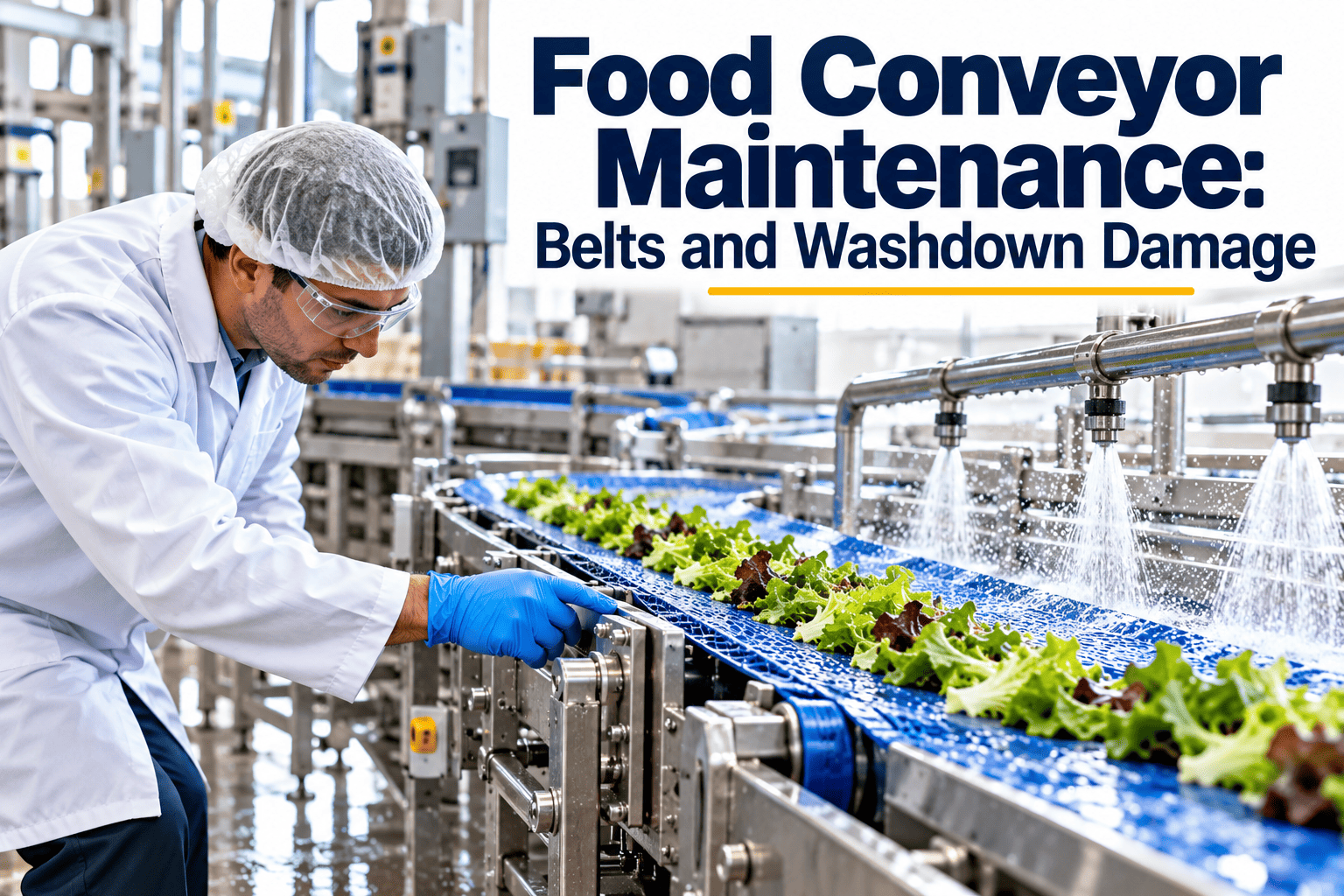
Food manufacturing environments impose demands on conveyor systems that general industrial settings do not. Aggressive daily washdowns with high-pressure hot water and caustic sanitizing chemicals accelerate belt wear, degrade fastener integrity, and promote corrosion at rates far beyond typical duty cycles. Temperature cycling between cold rooms and ambient processing areas causes belt materials to expand and contract, loosening tracking and creating tension irregularities. The regulatory overlay — FSMA, HACCP, SQF, BRC — means that a conveyor belt in poor condition is not merely a maintenance liability; it is a food safety risk with real audit consequences. Book a demo to see how Oxmaint helps food plants stay audit-ready with automated PM tracking.
The most effective food conveyor maintenance programs are built around three principles: belt-type-specific inspection criteria, sanitation-integrated PM workflows, and digital documentation that creates the traceable maintenance history required by food safety auditors.
Food Conveyor Belt Types: Maintenance Requirements by Material
The four belt types most common in food processing each have distinct failure modes, cleaning compatibilities, and PM intervals. Understanding how each degrades under plant conditions is the starting point for any structured maintenance program.
Common Conveyor Belt Failure Modes in Food Processing
Understanding root causes enables maintenance teams to shift from reactive repair cycles to condition-based interventions. These failure modes account for the majority of conveyor-related stoppages in food plants and are the primary targets in any structured PM program. Sign up free to start logging and tracking failure patterns across all your conveyor assets from a single platform.
| Failure Mode | Belt Types Affected | Root Cause | PM Intervention |
|---|---|---|---|
| Belt mistracking | All types | Uneven tension, worn pulleys, misaligned frames | Weekly tracking check, monthly pulley wear measurement |
| Hinge rod wear / failure | Modular plastic | Abrasion, chemical attack, overloading | Weekly hinge rod inspection, 500-hour replacement cycle |
| Wire fatigue fracture | Flat wire mesh | Cyclic stress at weld points, impact loading | Bi-weekly magnified weld inspection |
| Belt elongation / stretch | Chain, wire mesh | Cumulative load, inadequate lubrication | Elongation measurement every 250 hours |
| Surface delamination | Fabric / PVC | Chemical incompatibility, impact damage | Bi-weekly surface scan; immediate replacement on detection |
| Sprocket tooth wear | Modular plastic, chain | Belt slip, abrasive product, inadequate lubrication | Quarterly sprocket wear measurement against OEM tolerance |
| Corrosion / pitting | Wire mesh, slat chain | Incorrect sanitizer grade for steel specification | Monthly corrosion inspection; sanitizer chemistry audit |
| Belt slippage under load | Fabric, modular | Worn drive components, incorrect tension | Monthly tension measurement; drive roller inspection |
Conveyor Belt Sanitation Requirements for Food Plants
In food manufacturing, conveyor sanitation is not a separate function from maintenance — it is an integrated part of equipment management that determines belt service life, pathogen risk, and audit compliance simultaneously. Maintenance technicians need to understand how cleaning protocols affect belt materials and how inspection intervals should be aligned with sanitation schedules.
Sanitation Frequency and Belt Material Compatibility
High-care zones — raw meat, ready-to-eat lines, allergen-containing conveyors — typically require wet cleaning after every production shift, with full chemical sanitization at least once daily. The chemical compatibility of belt materials with the plant's sanitizer rotation must be formally documented. Modular acetal belts, for example, show documented degradation risk with hypochlorite above 200 ppm. Your CMMS should hold the OEM chemical compatibility spec for every belt in the facility, accessible to both maintenance and sanitation teams. Get started with Oxmaint to centralize belt specs, sanitizer compatibility records, and PM schedules in one place.
Harborage Point Elimination: The Maintenance Role in Food Safety
Mechanical wear creates harborage points — cracks, gaps, frayed edges, and surface breaches — that cleaning protocols cannot reliably reach. A cracked modular belt module, a frayed fabric edge, or a loose hinge rod creates a microbial harbor that persists through sanitation cycles and can contaminate product for days before detection. The maintenance team's role is to eliminate these conditions through proactive inspection. Document every identified harborage risk as a work order with defined closure timelines — this is part of your FSMA preventive controls record.
Preventive Maintenance Schedule for Food Conveyor Belts
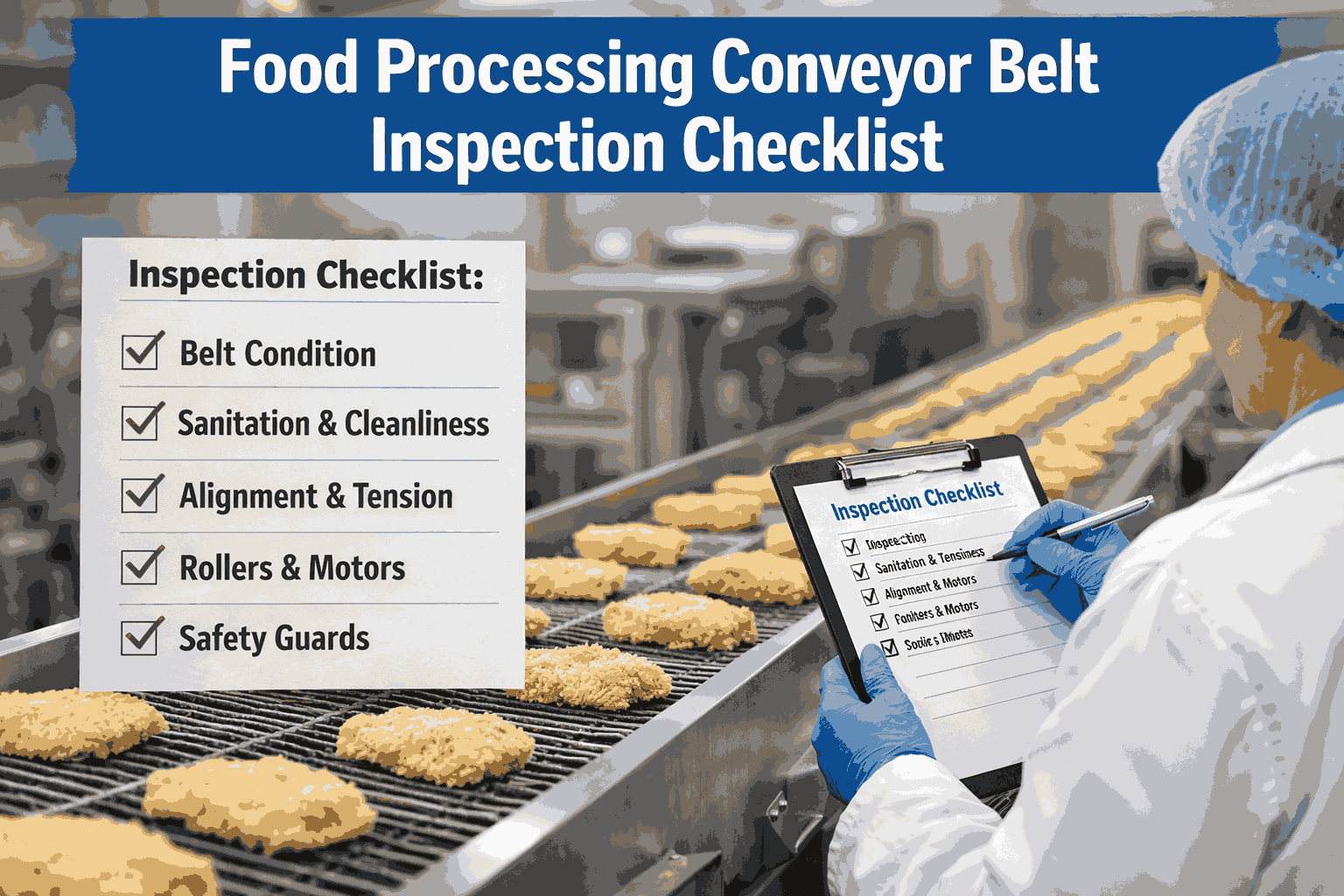
A defensible food conveyor PM schedule is built around defined inspection intervals, measurable condition criteria, and documented outcomes — not generalized checklists that technicians sign off without executing. The schedule below provides a frequency framework applicable across belt types, adaptable to OEM requirements and plant operating conditions.
Using CMMS for Food Conveyor Belt Maintenance Management
A CMMS is the operational backbone that makes structured PM execution and traceable documentation possible at scale. For food plants subject to FSMA, SQF, or BRC audits, manual systems cannot reliably deliver the inspection frequency, documentation completeness, and escalation speed that conveyor maintenance demands. Book a demo with Oxmaint to see how automated PM scheduling and mobile inspection workflows replace paper-based conveyor tracking across food manufacturing facilities.
What a CMMS Should Manage for Conveyor Maintenance
Your CMMS should centralize the full equipment register for every belt — belt type, material grade, OEM specs, chemical compatibility documentation, installation date, and full service history. PM work orders should auto-generate on defined intervals, assigned to certified technicians as step-by-step mobile checklists that capture measurement data and photos at the point of inspection. When a measurement exceeds a defined threshold — elongation at 2.5%, sprocket wear beyond OEM tolerance — the system should automatically escalate to a corrective work order with defined response timelines.
Audit-Ready Documentation for Food Safety Compliance
SQF Edition 9, BRC Global Standard Issue 9, and FSMA Preventive Controls all require documented evidence that maintenance has been performed, deficiencies corrected within appropriate timelines, and the program reviewed based on equipment performance data. A CMMS-driven program generates this evidence automatically — every completed PM, every measurement, every corrective action closed is timestamped and linked to the specific asset and technician. When an auditor asks for the conveyor maintenance history for Line 3 going back 12 months, your team should produce it in minutes.
Conveyor Belt Replacement: When to Repair vs. Replace
The repair-vs.-replace decision is one of the most consequential calls in food conveyor maintenance. Financial pressure to extend belt service life must be balanced against the increasing hygiene risk and reliability cost of operating a degraded belt. Formalize these as mandatory replacement triggers: any fabric or PVC belt with surface delamination or breach; any modular belt with two or more consecutive fractured modules in a row; any wire mesh section with three or more consecutive fractured wires; any chain belt with elongation exceeding 3%; or any belt where cleaning validation cannot be achieved.
When replacement is triggered, pre-stocked spare belt sections, hinge rods, and modules are the difference between a two-hour swap and a 12-hour production shutdown. Your CMMS should manage minimum stock levels for every critical belt consumable, with automated reorder triggers when inventory falls below threshold. All spare belt materials in stock should include food-contact certification documentation in the CMMS asset record. Sign up free with Oxmaint to manage spare parts inventory, reorder triggers, and replacement records in a single connected platform.