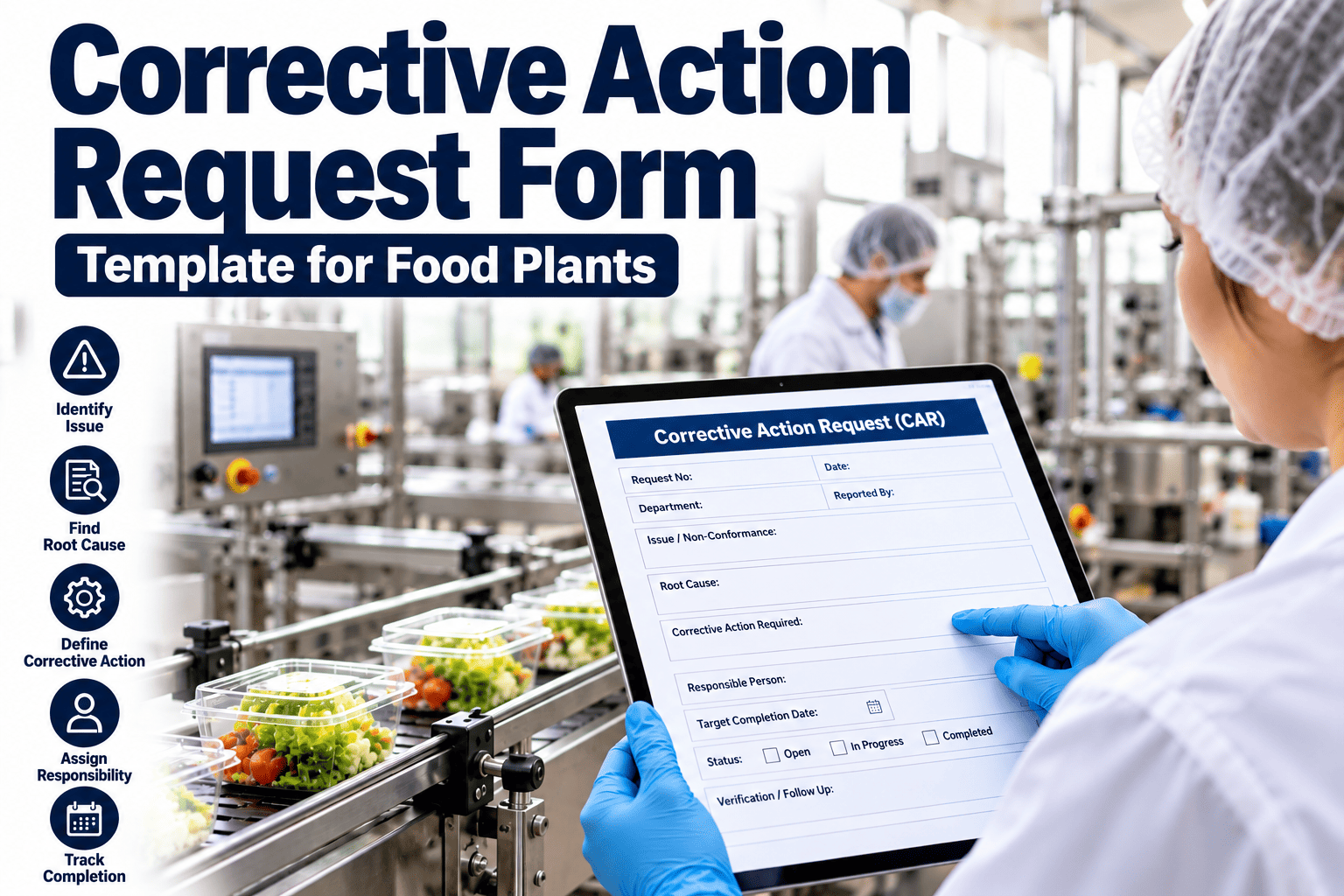
A finding raised in an audit, a customer complaint, or a failed inspection only improves the plant if someone owns it, fixes it, and proves the fix worked. Corrective actions fail quietly when they live in emails, notebooks, and meeting minutes. A corrective action request form captures the issue, owner, due date, root cause, and verification in one record, so nothing is lost between raising and closing. This page provides an editable form layout and shows how to track actions with Oxmaint work orders.
Corrective Action Request Form Template for Food Plants
Capture the issue, owner, due date, root cause, and verification so no corrective action is lost or left overdue.
Why Corrective Actions Go Overdue
- GFSI-benchmarked schemes and customer audits expect documented, timely corrective action
- Repeat findings usually mean the root cause was never addressed
- Overdue actions are a visible weakness in management review
The Corrective Action Request Form
Use this layout as a controlled document or spreadsheet. Each section should be completed before the request can close.
Writing Actions That Can Be Verified
Weak Wording
- Retrain staff
- Be more careful
- Improve maintenance
- Review the procedure
Verifiable Wording
- Retrain the night shift on the sanitation procedure and observe five tasks
- Replace worn conveyor guards and add them to monthly inspection
- Add a seal check to the PM and review results after one month
- Revise the procedure, approve it, and brief all operators
Setting Priority and Due Dates by Risk
Tie timeframes to risk, and write the rule into your procedure so due dates are consistent.
| Risk Level | Typical Examples | Response Approach |
|---|---|---|
| Critical | Failed critical limit, foreign material finding, unsafe product released | Immediate containment, short fixed deadline, management notified |
| Major | Repeated sanitation failure, missing monitoring records, overdue calibration | Defined deadline with owner and interim controls |
| Minor | Isolated documentation errors, cosmetic defects | Standard deadline and trend review |
Specific timeframes should come from your food safety system, scheme rules, and audit body requirements.
Stop Corrective Actions From Slipping Past Their Due Dates
Oxmaint turns each action into a tracked work order with an owner, a deadline, reminders, and a recorded completion.
Root Cause Analysis Made Practical
Signs You Stopped at a Symptom
- The cause names a person, such as operator error
- The same finding returns within a few audits
- The action is only cleaning, retraining, or reminding
When the Cause Is Equipment
Many food plant findings trace back to equipment condition, such as damaged guards, failing seals, or drifting instruments.
What Oxmaint Adds to the CAR Process
- Corrective work orders linked to the asset that caused the finding
- Assigned owners, due dates, and overdue escalation
- Preventive maintenance updates so the same failure does not return
- History by asset to reveal repeat findings
- Reports for audit review and management meetings
KPIs for Corrective Action Performance
Frequently Asked Questions
What is the difference between correction and corrective action?
Who should close a CAR?
Can one CAR cover several findings?
How do I track CARs digitally?
Does this form meet audit requirements?
Where Corrective Action Requests Come From
A CAR can be raised from many sources. Using one form and one register for all of them gives a complete picture.
Correction, Corrective Action, and Preventive Action Compared
| Term | Purpose | Example |
|---|---|---|
| Containment or correction | Deal with the immediate problem and protect product | Hold affected pallets and clean the contaminated area |
| Corrective action | Remove the root cause of a problem that has occurred | Replace the worn seal that caused the leak and add it to PM |
| Preventive action | Remove the cause of a potential problem before it occurs | Inspect similar seals on other lines and replace those worn |
Why the Distinction Matters
- Teams that stop at containment see the same finding return
- Corrective actions should be checked for effectiveness before closure
- Preventive thinking spreads a fix to similar equipment and areas
An Illustrative Completed Entry
The example below shows the level of detail that makes a CAR useful. Details are invented for demonstration.
Verifying That a Corrective Action Worked
Closing an action because the task was done is not the same as confirming the problem is solved.
- Check records or observe the area after enough time has passed for the problem to recur
- Look for the same finding in later audits, complaints, or inspections
- Confirm any new procedure is understood and followed on all shifts
- Verify that related preventive maintenance tasks were created and are being completed
- Have someone independent of the action owner perform the check
If Verification Fails
- Reopen the CAR and record why the action was not effective
- Revisit the root cause analysis, since the real cause may be deeper
- Set a new action with a new owner and due date
Escalation Rules for Overdue Actions
Rules for Extensions
- Require a written reason and a new date approved by quality
- Add interim controls when the risk remains while the action is pending
- Limit repeated extensions and escalate when they occur
Reviewing CARs in Management Meetings
A short, regular review keeps the register honest and visible to leadership.
Common Mistakes When Using a CAR Form
- Naming a team instead of one person as the owner
- Writing the root cause as a symptom, such as the guard was broken
- Setting the same due date for every finding regardless of risk
- Closing the action when the task is complete rather than when it is verified
- Keeping several registers so findings are scattered
- Failing to link equipment-related findings to maintenance work orders
Writing a Clear Problem Statement
A good CAR starts with a precise description. Without it, the root cause analysis wanders.
Unclear Statement
- Line 2 was dirty
- Scale not working
- Record problem found
Clear Statement
- Residue found on the underside of the Line 2 conveyor frame during pre-start inspection on a stated date
- Checkweigher on Line 4 read outside tolerance when tested with a test weight
- Three temperature log entries for one oven were missing on a stated shift
Elements of a Good Statement
- What was found, where, and when
- Which requirement, procedure, or limit it does not meet
- Evidence such as photos, records, or sample results
- The extent, meaning how many items, batches, or areas are affected
Using the 5 Whys Without Stopping Too Early
The 5 Whys method is simple, but it only works if each answer is supported by evidence.
- Check each answer against records, observation, or data, not opinion
- Stop when you reach a cause that management can control, such as a missing process
- If the answers branch, follow each branch separately
Connecting CARs to Audit and Certification Requirements
Food safety schemes and customers expect a managed process, not just forms.
- Show that every nonconformance has an owner, a root cause, and a timely action
- Demonstrate that corrective actions are verified and that effectiveness is reviewed
- Maintain a register that supports trend analysis across audits and complaints
- Use management review to confirm resources are available for overdue items
- Be ready to show the history for any finding, including what changed as a result
What Auditors Often Look For
- Evidence that the same finding does not keep returning
- Actions tied to the cause rather than the symptom
- Consistent due dates based on risk
- Approved closure with a named verifier
Trend Analysis: Finding the Patterns Behind the Forms
| Group By | What It Reveals | Possible Response |
|---|---|---|
| Area or line | Locations with the most findings | Targeted inspection and training |
| Equipment | Assets linked to repeated issues | Revise PM tasks or replace parts |
| Root cause category | Common causes such as training, procedure, or equipment | System-level improvements |
| Source | Whether audits, complaints, or monitoring find the most problems | Strengthen the weaker detection point |
| Time to close | Delays by owner, department, or risk level | Adjust resourcing and escalation rules |
Setting Up CARs as Work Orders in Oxmaint
- Attach photos, audit reports, and root cause worksheets to the record
- Link the request to the asset so the history shows repeated findings
- Add verification as a separate task that quality completes after the fix
- Generate reports for audits and management reviews
Roles in the Corrective Action Process
| Role | Responsibility |
|---|---|
| Person raising the request | Describes the issue clearly, attaches evidence, and records immediate containment |
| Action owner | Leads the root cause analysis, completes the action, and updates the record |
| Quality or food safety lead | Approves risk level, due dates, extensions, and closure |
| Maintenance supervisor | Completes equipment-related repairs and updates preventive tasks |
| Plant management | Provides resources and reviews overdue items and trends |
Keeping Responsibility Clear
- Name one accountable owner, even when several people contribute
- Record delegation in writing if the owner is absent
- Give owners authority to request help from other departments
- Review workloads so a single person does not hold too many open actions
Close Every Action With Proof It Worked
Give corrective actions owners, deadlines, and verification in one tracked workflow that is ready when auditors ask.