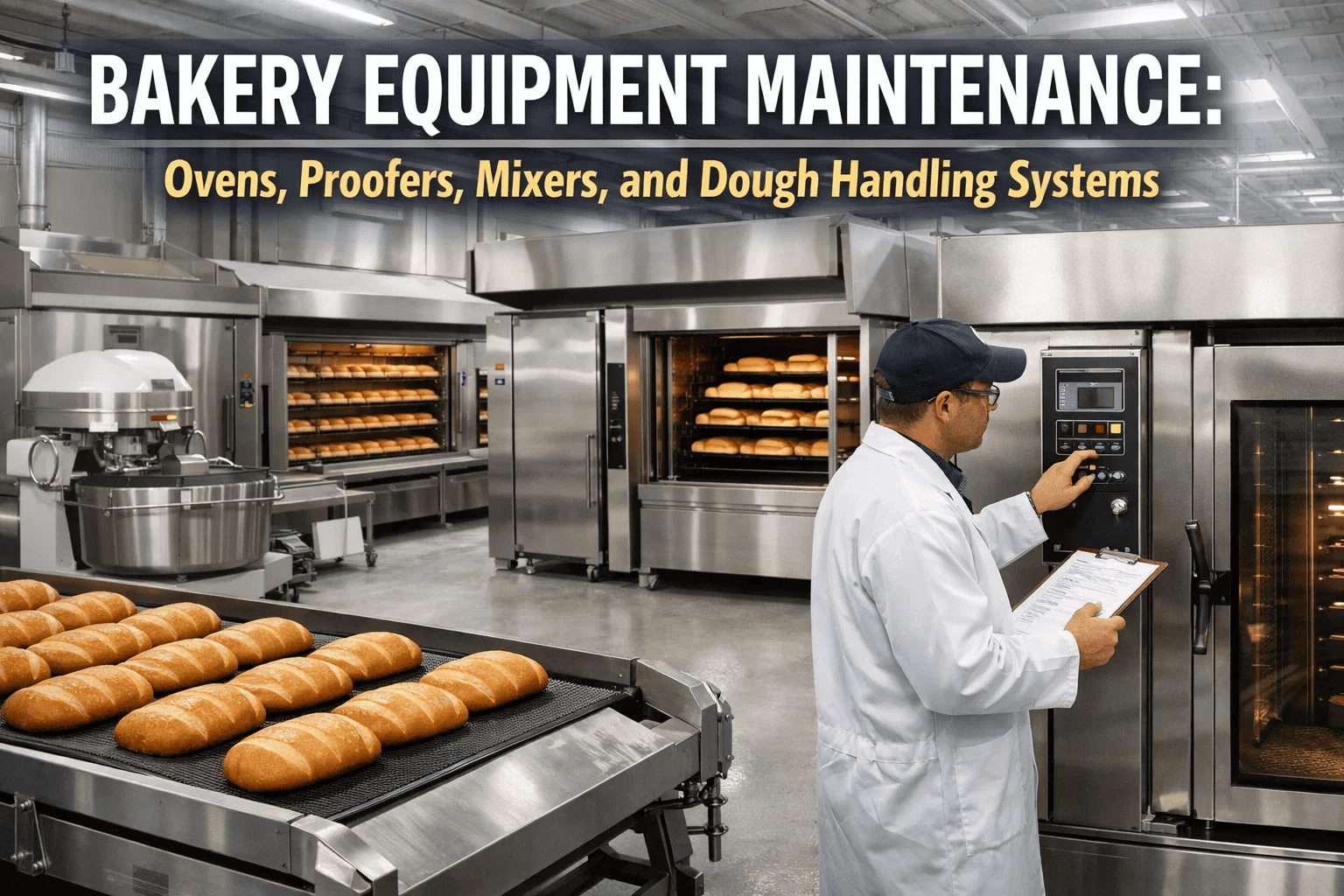
Proofing and Fermentation Equipment Maintenance for Bakeries

By John Snow on February 5, 2026

proofing-and-fermentation-equipment-maintenance-for-bakeries

The morning shift baker opened the retarder-proofer at 4:00 AM expecting 400 perfectly proofed baguette trays ready for the oven. Instead, every tray held flat, dense dough that hadn't risen overnight. The humidity system had failed sometime around midnight—a clogged steam generator nozzle starved the chamber of moisture, and without humidity the yeast activity stalled. The temperature readings looked fine on the controller, so no alarm triggered. But temperature without humidity is just a warm box, not a proofer. The bakery lost the entire overnight production run: 2,400 baguettes worth $4,800 in retail value, plus the raw material cost, plus the labor already invested in mixing and shaping. The morning crew scrambled to remix and reproof, but the baguettes didn't reach the retail cases until 11:00 AM instead of 6:00 AM—five hours late, with half the normal volume. A $15 steam nozzle, cleaned monthly, would have prevented the entire loss.

Proofing and fermentation equipment operates in a narrow window where small deviations produce outsized consequences. A proofer running 5°F too warm overproofs dough in 20 minutes; 10% low on humidity creates a skin that prevents proper oven spring. Unlike equipment failures that stop production visibly, proofer failures often produce subtle quality degradation that operators don't catch until product reaches the oven—or worse, the customer. Bakeries with structured proofing equipment maintenance programs report 94% proof consistency and reduce fermentation-related waste by 67%, turning one of bakery production's most variable processes into a predictable, controllable operation.

Maintenance Guide / Inspection & Maintenance Workflows
Proofing & Fermentation Equipment Maintenance
Systematic maintenance procedures for proofers, retarders, and fermentation chambers that ensure consistent dough quality and energy-efficient bakery operations.
94%
Proof Consistency Rate
67%
Reduction in Fermentation Waste
41%
Lower Energy Consumption
2.3×
equipment lifespan
Extended Service Life

Understanding Proofing and Fermentation Systems

Proofing and fermentation equipment create a controlled environment where yeast activity transforms shaped dough into ready-to-bake product. The equipment must simultaneously manage temperature, humidity, airflow, and timing—four variables that interact with each other and with the dough itself. Understanding these systems is essential to maintaining them effectively.

Temperature Control System
Maintains chamber temperature within ±1°F of setpoint throughout the proof cycle. Includes heating elements, refrigeration components (in retarder-proofers), temperature sensors, and PID controllers.
Typical Range: 75°F–115°F (proofing) / 34°F–40°F (retarding)
Critical tolerance: ±2°F — beyond this, proof timing shifts 15-25%
Humidity Control System
Delivers and maintains moisture levels that prevent dough skinning while avoiding condensation. Steam generators, atomizing nozzles, humidity sensors, and drain systems work together.
Typical Range: 75%–90% RH (proofing) / 70%–80% RH (retarding)
Critical tolerance: ±5% RH — low humidity skins dough, high humidity causes condensation drip
Airflow Distribution System
Circulates conditioned air evenly throughout the chamber so every rack position proofs at the same rate. Fans, ductwork, baffles, and dampers direct airflow without creating drying currents.
Goal: ±2°F uniformity across all rack positions
Critical factor: Dead spots create underproofed product; direct airflow skins exposed dough
Control and Programming System
Manages proof cycle timing, transitions between retard and proof modes, alarms for out-of-range conditions, and data logging for quality verification.
Functions: Multi-step programming, alarm management, data recording
Critical factor: Controller failure can go undetected overnight, ruining entire production batches

Common Failure Modes and Their Impact on Product Quality

Proofing equipment failures affect product quality before they affect equipment operation. Understanding these failure modes helps maintenance teams prioritize interventions that protect product first:

Critical
Humidity System Failure
Clogged steam nozzles, failed steam generator, broken atomizer, water supply interruption, humidity sensor drift
Product Impact: Dough develops dry skin within 15-30 minutes. Skin prevents proper expansion, resulting in poor oven spring, cracked crust, dense crumb structure, and reduced volume. The entire proof batch may be unsalvageable.
Detection: Visual inspection of dough surface (matte vs. moist appearance), humidity sensor reading, condensation on chamber walls
Prevention: Weekly nozzle cleaning, monthly sensor calibration, quarterly steam generator descaling
Critical
Temperature Control Failure (High)
Failed thermostat, stuck heating contactor, sensor failure reading low, controller malfunction
Product Impact: Overproofing—dough rises too fast, developing weak gluten structure. Product collapses in oven, has coarse uneven crumb, and may have alcohol off-flavors from excessive yeast activity. Timing windows shrink dramatically.
Detection: Proof time shorter than expected, dough appears fragile or bubbly, independent temperature verification
Prevention: Monthly sensor calibration, quarterly contactor inspection, independent high-temperature alarm
High Priority
Temperature Control Failure (Low)
Failed heating element, tripped thermal fuse, sensor failure reading high, insufficient insulation
Product Impact: Underproofing—yeast activity slows, dough doesn't reach target volume. Product is dense, heavy, with tight crumb and poor flavor development. May be recoverable with extended proof time if caught early.
Detection: Extended proof times, dough not reaching expected volume, independent temperature check
Prevention: Monthly element resistance check, quarterly thermal fuse testing, sensor calibration
High Priority
Retard-to-Proof Transition Failure
Controller programming error, timer battery failure, mode switch malfunction, compressor won't shut off
Product Impact: Dough remains retarded past scheduled proof start—arrives at oven cold and underproofed, delaying entire production schedule by 2-4 hours. Or transitions too early, overproofing before bakers arrive.
Detection: Morning temperature check before loading ovens, proof verification before baking
Prevention: Weekly program verification, annual battery replacement, backup alarm system
Moderate
Airflow Distribution Failure
Fan motor failure, blocked ductwork, damaged baffles, dirty fan blades, failed damper actuator
Product Impact: Uneven proofing across rack positions—top racks overproof while bottom racks underproof. Creates an inconsistent product that bakers must sort and manage, reducing throughput and increasing labor.
Detection: Multi-point temperature mapping, visual comparison of proof levels across rack positions
Prevention: Monthly fan inspection, quarterly duct cleaning, semi-annual temperature mapping
Moderate
Door Seal Deterioration
Gasket wear, physical damage, grease/dough buildup, hinge misalignment, latch wear
Product Impact: Humidity loss at door perimeter creates cold spots and skinning on nearest racks. Energy consumption increases significantly. Condensation forms outside chamber near leak points.
Detection: Visual gasket inspection, paper test for seal, condensation near door frame, energy consumption trending
Prevention: Weekly gasket cleaning, monthly seal check, annual gasket replacement
Automate Your Proofing Equipment Maintenance

Track PM schedules, calibration records, and proof quality data across every proofer and fermentation chamber in your bakery—with automated alerts before small issues become production losses.

Humidity System Maintenance: The Most Critical Subsystem

Humidity control is the most failure-prone and most impactful system in proofing equipment. A proofer without humidity is just a warm cabinet—and dough knows the difference immediately. Humidity system maintenance deserves dedicated attention:

Steam Generator Maintenance
Scale Buildup
Mineral deposits from water reduce heating efficiency and eventually block steam output. Hard water areas may require bi-weekly descaling.
Action: Descale monthly using food-safe descaling solution. Drain and flush completely. Inspect heating element for scale accumulation. Consider water softener installation if hardness exceeds 7 grains per gallon.
Low Water Level / Float Valve Failure
Float valve controls water level in generator. Sticking or mineral-clogged valve causes dry operation (element burnout) or overfill (water carryover into steam).
Action: Monthly inspection of float valve operation. Clean valve seat and float mechanism. Verify low-water cutoff switch functions correctly.
Nozzle and Distribution Maintenance
Nozzle Clogging
Mineral deposits, flour dust, and biological growth restrict nozzle openings. Partially clogged nozzles create uneven humidity distribution.
Action: Weekly removal and soaking in vinegar solution or food-safe descaler. Use nozzle cleaning wire for stubborn deposits. Replace nozzles that cannot be fully cleared.
Distribution Pipe Corrosion
Steam distribution pipes corrode internally over time, releasing rust particles and developing leaks that waste steam and create drip points.
Action: Quarterly visual inspection of all steam piping. Check for rust-colored staining on chamber walls near pipe runs. Replace corroded sections with stainless steel.
Humidity Sensor Maintenance
Sensor Drift
Humidity sensors lose accuracy over time, especially in the warm, moist, flour-dust environment of a proofer. Drift of 5-10% RH is common within 6 months without maintenance.
Action: Monthly calibration check against reference hygrometer. Clean sensor element weekly to remove flour dust coating. Replace sensor annually or when calibration cannot be maintained.
Sensor Placement Issues
Sensors mounted near steam injection points read high; sensors near door seals read low. Sensor location determines what the controller "sees" and responds to.
Action: Verify sensor is in representative location (mid-chamber, away from direct steam). Validate reading against independent measurement at product level.
Water Quality Impacts on Humidity Systems
Hardness >7 gpg
Accelerated scale buildup in generators and nozzles. Consider water softener.
Chlorine >2 ppm
Accelerates corrosion of copper and brass components. Use activated carbon filter.
TDS >500 ppm
Mineral deposits on heating elements reduce efficiency. Monitor descaling frequency.
Iron >0.3 ppm
Rust-colored staining on dough and chamber surfaces. Install iron removal filter.

Temperature System Maintenance

Temperature control in proofing equipment must be precise—every degree matters when managing yeast activity. Heating, cooling, and sensing components all require systematic maintenance:

Heating System
Heating Elements: Inspect monthly for corrosion, discoloration, or signs of overheating. Check element resistance with multimeter—should be within 10% of nameplate rating. Corroded elements reduce heat output before they fail completely.
Contactors/Relays: Inspect quarterly for pitted contacts, signs of arcing, or chattering. Contacts that stick closed cause continuous heating; contacts that stick open prevent heating. Both conditions may go undetected by controllers.
Thermal Safety Devices: Test monthly. High-limit thermostats and thermal fuses protect against runaway heating. A failed safety device means the next controller malfunction could damage equipment or create a fire hazard.
Refrigeration System (Retarder-Proofers)
Condenser Coils: Clean monthly. Flour dust, cardboard fibers, and ambient grease clog condenser coils faster in bakery environments than typical commercial refrigeration. Dirty condensers cause high head pressure, reduced capacity, and compressor overheating.
Evaporator Coils: Inspect quarterly for ice buildup, corrosion, and fin damage. Verify defrost cycle operates correctly and drain pan heater functions. Iced coils block airflow and reduce cooling capacity.
Compressor: Monitor operating pressures quarterly. Check oil level, listen for unusual sounds, and verify amp draw is within nameplate rating. Address unusual readings immediately—compressor replacement is the most expensive proofer repair.
Sensors and Controls
Temperature Sensors (RTDs/Thermocouples): Calibrate monthly against NIST-traceable reference. Sensors in proofing environments accumulate moisture and flour dust that cause reading drift. A sensor reading 3°F high makes the controller keep the chamber 3°F cold.
PID Controllers: Verify tuning parameters quarterly. Poorly tuned controllers cause temperature cycling (oscillation) that subjects dough to alternating warm and cool periods. Proper tuning maintains ±1°F stability.
Data Loggers: Verify recording function monthly. Review logged data for patterns indicating developing problems—gradually increasing cycle times, wider temperature swings, or longer recovery times after door openings.
Track Every Calibration, Every Cleaning, Every Inspection

Oxmaint's maintenance workflows automate PM scheduling, capture calibration data, and alert you when proofing equipment maintenance is due—before proof quality tells you something is wrong.

Troubleshooting Guide

When proofing problems occur, systematic troubleshooting identifies root causes quickly. Start with the symptom and work through possible causes:

Dough Not Rising (Underproofed)
1
Check temperature: Verify actual chamber temperature with independent thermometer. If low, check heating element, contactor, sensor, and thermal fuse.
2
Check humidity: Low humidity causes surface skinning that restricts rise. Verify steam system operation, nozzle condition, and water supply.
3
Check retard-to-proof transition: For retarder-proofers, verify controller executed mode change. Check timer, programming, and battery.
4
Check door seal: Poor seal allows heat and moisture escape. Run paper test on all four sides of door gasket.
Dough Overproofed / Collapsed
1
Check temperature: Verify actual vs. displayed temperature. If running high, check for stuck contactor, failed sensor reading low, or controller fault.
2
Check timer/programming: Proof time may be set too long, or retard phase may have been too short. Verify complete cycle programming.
3
Check high-limit safety: If high-temperature cutoff is not functioning, a controller fault could drive temperatures well above setpoint.
Uneven Proof Across Rack Positions
1
Check airflow: Place temperature loggers at multiple positions. Verify fans are operating, baffles are intact, and ductwork is not obstructed.
2
Check door seal: Leaks near bottom or sides create cold zones on adjacent racks. Inspect gasket compression and door alignment.
3
Check heating element location: Direct radiant heat from exposed elements can overproof nearby product. Verify heat shields and baffles are in place.
Dough Surface Skinning
1
Check humidity level: Below 75% RH, most doughs begin to skin. Verify steam system output, sensor accuracy, and nozzle condition.
2
Check airflow velocity: Excessive fan speed or direct air on product surfaces causes drying. Verify fan speed setting and baffle positioning.
3
Check door seal: Leaks create local dry spots. Inspect gasket condition and door closure mechanism.
Excessive Condensation / Dripping
1
Check humidity level: Above 90% RH, condensation becomes excessive. Verify humidity sensor calibration and controller setpoint.
2
Check insulation: Cold spots on walls or ceiling from damaged insulation cause localized condensation. Inspect panel joints and vapor barrier.
3
Check drain system: Blocked drains allow condensate to pool and create humidity feedback. Clear drains and verify gravity flow.
High Energy Consumption
1
Check door seals: The most common cause. Even small gaps cause the system to work continuously to maintain conditions.
2
Check insulation: Damaged or wet insulation loses R-value dramatically. Inspect for moisture intrusion and panel damage.
3
Check condenser coils: Dirty coils force compressor to work harder. Clean monthly in bakery environments.

Energy Efficiency Through Maintenance

Proofing equipment runs continuously during production—often 16-20 hours per day. Maintenance-related energy waste compounds into significant costs:

Door Seal Leakage
15–30% energy increase
Replace gaskets when paper test shows gaps. Check door hinges and latches for proper alignment. Verify door closes completely without effort.
Dirty Condenser Coils
20–35% cooling efficiency loss
Clean monthly in bakery environments. Install condenser filters if available. Ensure adequate clearance for airflow around condenser unit.
Scaled Steam Generator
10–25% heating efficiency loss
Descale monthly (bi-weekly in hard water areas). Monitor element amperage as efficiency indicator. Consider water treatment.
Damaged Insulation
10–40% heat/cool loss at damage site
Inspect panels quarterly for dents, moisture, and vapor barrier breach. Repair immediately—wet insulation loses nearly all R-value.
Sensor Drift (Overcooling/Overheating)
5–15% wasted energy per °F drift
Monthly calibration catches drift early. A sensor reading 3°F high causes the system to overcool by 3°F—wasting energy and affecting product.
Fan Motor Bearing Wear
10–20% increased motor energy draw
Lubricate per manufacturer schedule. Replace bearings at first sign of noise or elevated temperature. Worn bearings also reduce airflow.

Best Practices for Proofing Equipment Maintenance

1
Always Verify with Independent Instruments
Never trust the proofer's built-in display without periodic verification. Maintain calibrated reference thermometers and hygrometers. Place them at product level—not near sensors—to measure what the dough actually experiences. The controller display may say 85°F/80% RH while the product is experiencing 82°F/72% RH.
2
Address Water Quality Proactively
Water quality is the number one controllable factor affecting humidity system lifespan. Test your supply water annually for hardness, chlorine, TDS, and iron. Install appropriate treatment equipment before problems develop. The cost of a water softener is a fraction of annual steam generator maintenance and replacement.
3
Track Proof Quality Alongside Equipment Data
Connect maintenance records with proof quality outcomes. When quality drifts—inconsistent volume, skinning, slow proof times—correlate with equipment data. This creates a feedback loop where quality problems trigger maintenance investigations and maintenance improvements show up in quality metrics.
4
Perform Temperature Mapping Quarterly
Place data loggers at multiple rack positions and run a standard proof cycle. Map temperature uniformity across the entire chamber. This reveals developing airflow problems, insulation defects, and heating distribution issues before they produce noticeable product variation. Maintain maps over time to identify trends.
5
Maintain Backup Controller Settings
Document every controller program and keep written copies secured outside the equipment. Controller memory loss from power outages, battery failure, or hardware faults erases all programming. Recovery from undocumented programming requires hours of trial-and-error testing that disrupts production.
6
Train Bakers to Be First-Line Inspectors
Bakers interact with proofing equipment every shift. Train them to recognize early warning signs: unusual sounds, unexpected proof times, dough surface changes, condensation patterns, and temperature discrepancies. A baker's observation at 4:00 AM can trigger a maintenance response before the entire day's production is affected.

Frequently Asked Questions

How often should I calibrate proofer temperature and humidity sensors?
Monthly calibration checks are the minimum recommended frequency. Compare proofer readings against calibrated reference instruments (NIST-traceable thermometer and hygrometer) placed at product level. In flour-dust environments, humidity sensors may need more frequent attention—clean sensor elements weekly and recalibrate whenever readings drift more than 2°F or 5% RH from reference. Document all calibrations with date, reference instrument ID, as-found reading, adjusted reading, and technician signature.
What causes a retarder-proofer to not transition from retard to proof mode?
The most common causes are controller timer battery failure (backup battery dies and clock resets), programming errors (accidental changes to transition time or day), and controller hardware faults. Less common causes include a stuck refrigeration contactor that prevents switching to heating mode, or a failed mode-switch relay. As preventive measures, replace controller batteries annually, verify programming weekly (especially after power outages), and test mode transition monthly by observing a programmed changeover.
How do I know when to replace vs. repair a steam generator?
Replace the steam generator when descaling no longer restores full output, heating element resistance deviates more than 20% from specification, the tank body shows corrosion pitting or leaks, or the unit requires service more than monthly. For most commercial bakery proofers, steam generators last 3-5 years with proper maintenance (monthly descaling, proper water quality). If your water is very hard (above 10 gpg) and untreated, expect 1-2 year generator life. The cost of a replacement generator is typically far less than the production losses from unreliable humidity control.
What temperature uniformity is acceptable inside a proofer?
Target ±2°F uniformity across all rack positions during steady-state operation (after initial warm-up). Temperature uniformity beyond ±3°F produces noticeable proof variation between rack positions, requiring bakers to rotate racks or accept inconsistent product. Perform quarterly temperature mapping using data loggers at 6-8 positions (corners, center, top, bottom) over a full proof cycle. If uniformity exceeds ±3°F, investigate fan operation, baffle positioning, duct condition, and insulation integrity.
How do I prevent mold growth in my proofing equipment?
Weekly deep cleaning with a food-safe fungicidal sanitizer is the primary defense. Focus on ceiling areas where condensation collects, door gasket crevices, fan housings, and any hard-to-reach corners. Between cleanings, ensure the proofer drains completely when not in use—standing water promotes growth. Maintain proper humidity levels (don't oversaturate), and consider running the proofer empty with the door open for 30 minutes after daily production to dry interior surfaces. If mold establishes despite regular cleaning, investigate hidden moisture sources like insulation leaks or condensation behind panels.
What spare parts should we keep on hand for proofing equipment?
Stock these items for rapid response to common failures: door gasket set (most common replacement), steam nozzles or atomizer heads (clog frequently), humidity sensor (drift is inevitable), temperature sensor/RTD (for swap-and-verify troubleshooting), heating element (for each proofer model), contactor/relay for heating circuit, controller backup battery, water supply filter cartridge, and fan motor (if shared across models). For retarder-proofers, also stock a run capacitor and defrost timer. Having these parts on hand reduces a 2-day repair (waiting for parts) to a 2-hour repair.
Consistent Proofs Start with Consistent Maintenance
Oxmaint helps bakeries manage proofing equipment maintenance with automated PM scheduling, calibration tracking, and proof quality data integration—ensuring every batch proofs perfectly, every time.


Share This Story, Choose Your Platform!