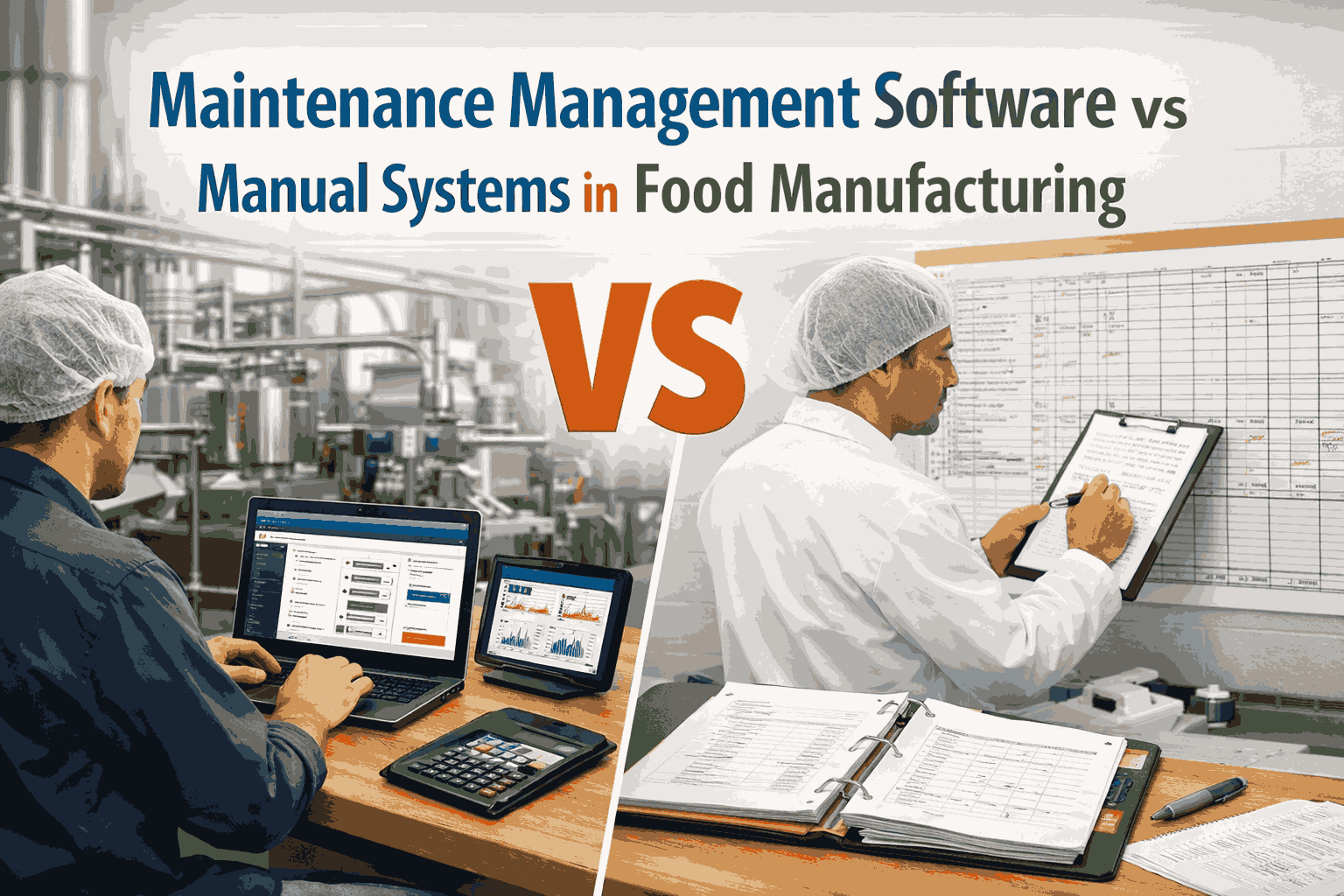
The Real Cost of ‘Spreadsheet Maintenance’ in Food Manufacturing

By Emith Will on February 27, 2026

spreadsheet-maintenance-risk-food-manufacturing

In food manufacturing, spreadsheet maintenance presents hidden and significant costs that impact operations far beyond the initial investment in software. While spreadsheets appear cost-effective, the real price comes in the form of labor, errors, compliance risks, and missed opportunities. The manual labor associated with data entry, reconciliation, and formula corrections can consume 25–40% of a worker's week — time that could be spent on process optimization and innovation. Compliance with industry standards like FSMA or HACCP requires meticulous record-keeping, and spreadsheets consistently fail in this regard, exposing plants to audit failures and regulatory action that dwarf any cost savings from avoiding software. The manufacturers shifting away from spreadsheets are not doing it out of preference — they are doing it because the data on downtime, recall exposure, and compliance gaps makes the case impossible to ignore.

Maintenance Modernization · Food Manufacturing · 2026

Your Spreadsheet Is Costing You More Than You Think

Food manufacturers still running maintenance on Excel are silently bleeding money, failing audits, and risking shutdowns. Here is what the data actually says — and what the switch to a real CMMS changes.

$260K
Average cost per hour of unplanned downtime in food manufacturing
$50B
Lost annually across food and beverage to unplanned equipment failures
48%
Of food manufacturers still using spreadsheets as primary maintenance tool
40%
Of total production cost in reactive plants goes to maintenance alone
The Real Problem

The Spreadsheet Nobody Talks About — Until Audit Day

Walk into almost any food manufacturing plant and you will find the same thing: a maintenance manager manually updating a 47-tab Excel file, trying to remember when the filler line was last serviced. That spreadsheet feels like control. It is not. Spreadsheets were designed for accounting, not for managing critical equipment in a regulated, high-speed production environment. Yet nearly half of food manufacturers still rely on them as their primary maintenance tracking tool. Every day that continues, risk compounds quietly in the background — and the gap between your actual compliance posture and your perceived compliance posture grows wider.

01
PM Task Missed
Someone updates the wrong row. Lubrication gets skipped. Spreadsheet still shows completed.

02
Wear Builds Silently
Bearing friction increases for weeks. No alert. No flag. Production runs at full speed toward failure.

03
Equipment Fails Mid-Shift
Line stops. Emergency maintenance called. Parts sourced overnight. 8 hours of production at $260K/hr.

04
FDA Audit Fails
Inspector requests logs. Two conflicting versions exist. Timestamping inconsistent. Plant fails audit.
Where the Money Goes

Four Ways Spreadsheet Maintenance Is Draining Your Plant Right Now

These are not hypothetical risks. These are recurring, measurable costs that spreadsheet-dependent food plants absorb every year — often without ever attributing them to the maintenance tracking method that caused them.


Unplanned Downtime

$260,000 per hour

When equipment fails without warning, every minute compounds. Lost product, idle labor, emergency parts, and missed orders stack up within hours. Facilities running reactive maintenance experience 2–3× more unplanned failures than those running structured PM programs through CMMS. A single avoided emergency typically pays for 6–12 months of platform cost.


Audit Failures and Regulatory Exposure

FDA fines + forced shutdowns

Inspectors do not accept "the spreadsheet crashed" as an audit trail. Missing or inconsistent maintenance records are among the top reasons food plants fail FDA, FSMA, and GFSI inspections. The cost of a single failed audit — including remediation, re-inspection fees, and production pauses — routinely exceeds $100,000. Repeat failures invite consent decrees and import alerts that can take years to lift.


Reactive Repair Cycles

15–40% of total production cost

Plants running reactive maintenance spend 15 to 40 percent of total production costs on maintenance alone — versus 12–18% for well-run preventive programs. That gap represents pure waste: labor costs at 1.5–2× planned rates, premium parts pricing, extended downtime from poor spare parts availability, and the opportunity cost of production lost while waiting for repairs. Structured PM scheduling eliminates the conditions that create this cycle.


Contamination and Recall Risk

Recalls average $10M+ in direct costs

Poorly maintained equipment directly increases contamination exposure. A pasteurizer running outside calibration, a filler with worn seals, or a conveyor with degraded lubricant barriers can trigger product holds and full recalls that cost millions and destroy customer trust. The FDA's FSMA framework makes inadequate maintenance documentation one of the clearest pathways to enforcement action — and one that spreadsheets structurally cannot close.

Every day of spreadsheet maintenance is another day of compounding risk.
Oxmaint gets food plants live in 48 hours — no IT team, no months of implementation.
Direct Comparison

Spreadsheet vs. Oxmaint CMMS — A Straight Comparison

Stop guessing which is better. Here is exactly what changes when you make the switch across every dimension that matters to food manufacturing operations and compliance.

Capability
Spreadsheet
Oxmaint CMMS
Automated PM Scheduling
Manual — missed often
Auto-scheduled with mobile alerts
Audit-Ready Records
Inconsistent, version chaos
Digital logs, timestamped, tamper-evident
Real-Time Visibility
Always a day behind
Live dashboards, instant alerts
Work Order Management
Email chains and paper forms
Assigned, tracked, closed digitally
FSMA / HACCP Compliance
Manual cross-referencing
Built-in compliance workflows
Mobile Technician Access
Desktop only — logged from memory
Any smartphone, real-time, offline-capable
Multi-Site Management
Impossible at scale
Centralized across all locations
Shift Handoff Documentation
Verbal or completely absent
Structured digital handoffs, 98%+ complete
Reporting Time
Hours of manual compilation
One-click export in under 60 seconds
Predictive Failure Detection
None — reactive by design
AI trend detection, alerts before failure
The Failure Timeline

How a Single Missed Spreadsheet Entry Becomes a Plant-Wide Crisis

This is not a worst-case scenario. This is the documented pattern that follows a missed PM entry in a spreadsheet-based maintenance program. It plays out in food plants every week.


Day 1

PM Task Is Overlooked

Technician updates the wrong row in the shared spreadsheet. Conveyor belt lubrication gets skipped. The file shows "completed." Nobody notices. Production runs normally.


Week 2

Wear Accelerates Silently

Bearing friction increases. No sensor. No alert. The spreadsheet still shows the last logged date as compliant. The maintenance team has no signal that anything is developing. Production runs at full speed.


Week 4

Equipment Fails Mid-Shift

The line stops. Emergency maintenance is called. Parts must be sourced overnight at premium pricing. 8 hours of production is lost. At $260,000 per hour, that is $2 million in a single event. Emergency labor costs run at 1.5–2× normal rate.


Week 6

FDA Audit Arrives

The inspector requests maintenance logs on the failed equipment. The spreadsheet has conflicting dates. Two different versions exist across different team members' laptops. Timestamps are inconsistent and cannot be verified as contemporaneous. The plant fails the audit.


Month 3

The Real Bill Arrives

Regulatory fines, mandatory re-inspection fees, emergency repair costs, recall investigation exposure, corrective action documentation burden, brand damage, and lost customer contracts. A missed spreadsheet entry that would have cost nothing to fix in a CMMS has now cost everything. This is the hidden cost timeline nobody shows you when they decide to keep using Excel.

Four Risks Every Manager Knows But Underestimates

These failures repeat across the industry. You may already recognize them.

01
Version Control Chaos

Multiple people editing the same spreadsheet creates conflicting data that nobody can reconcile under pressure. During an audit, which version is the official record? When two technicians updated the same row on the same day, which entry is authoritative? Nobody can answer with confidence — and regulators do not accept uncertainty.

02
Zero Mobile Access

Your technician is standing in front of the equipment that needs attention. The spreadsheet is on a desktop in the maintenance office. Tasks get logged from memory hours later — or not at all. Real-time data entry from the point of action is not possible with spreadsheets, and memory-based logging is one of the primary sources of inaccurate maintenance records in FDA investigations.

03
Knowledge Walks Out the Door

When your senior maintenance technician retires, everything they know about your equipment leaves with them. There is no structured history in a spreadsheet — just cells, initials, and abbreviations nobody else understands. The institutional knowledge gap that follows a key retirement in a spreadsheet-based plant typically produces a significant spike in reactive failures and audit vulnerabilities within 6–12 months.

04
No Predictive Capability — Ever

Spreadsheets tell you what happened. They never warn you what is about to happen. Food plants need prediction, not post-mortems. A bearing running hot for three weeks before failure leaves a clear data trail in any system that is actively monitoring and trending. A spreadsheet records the failure date and nothing before it. The entire predictive maintenance capability — the one that prevents the $2M events — is structurally inaccessible in a spreadsheet environment regardless of how well it is maintained.

Measurable Outcomes

What Switches to Digital CMMS Actually Deliver

Not theory. These are documented, measurable outcomes from food manufacturing plants that moved from spreadsheets to structured CMMS programs. Each bar represents industry-benchmarked improvement data.

Reduction in unplanned downtime events after CMMS adoption
40% reduction
PM task completion rate — digital CMMS vs. spreadsheet
94%+ vs. 58–65%
Audit pass rate improvement with digital maintenance records
85%+ pass rate
Total maintenance cost reduction — planned vs. reactive
Up to 35%
Technician documentation time recovery (paperwork eliminated)
22% of shift recovered
Mean time to repair (MTTR) improvement with structured history
20% faster repairs
Sources: MaintainX 2024 State of Maintenance, Aberdeen Research, Food Engineering Magazine, FDA enforcement data benchmarks
How Oxmaint Solves This

Built Specifically for Food Manufacturing Operations Teams

Oxmaint is not generic maintenance software with a food industry template added on. It is built from the ground up for operations teams who need compliance-grade documentation, mobile-first technician tools, and structured PM scheduling — without the complexity or cost of enterprise platforms.


Preventive Maintenance Automation

Schedule PMs by time, usage, or condition trigger. Every technician gets notified on their phone when a task is due. Automatic escalation when tasks are overdue. No manual reminders, no missed tasks, no spreadsheet rows to update.


Digital Audit Trails

Every maintenance action is timestamped, technician-signed, and stored in a tamper-evident format ready for FDA, FSMA, HACCP, and GFSI audits. Audit reports generated in under 60 seconds for any date range, any asset, any inspection type.


Mobile-First Work Orders

Technicians complete and close work orders from the floor using any smartphone — no paper, no desktop return, no memory-based logging. Data enters the system in real time. Offline mode ensures tasks are never lost due to connectivity issues.


Asset Lifecycle Tracking

Know the full maintenance, repair, and calibration history of every piece of equipment. Identify recurring failure patterns, calculate actual cost-per-asset, and make data-driven decisions on repair versus replace — backed by years of operational data, not memory.


AI Trend Detection and Predictive Alerts

Oxmaint's AI layer analyses cycle data, sensor readings, and maintenance history across assets to identify developing failure signatures — weeks before any individual cycle breaches a threshold. Technicians receive targeted alerts to investigate specific assets before failures occur.


Sanitation and Compliance Checklists

Built-in sanitation logs, GMP checklists, CIP cycle documentation, and regulatory workflows ensure your plant stays compliant between audits — not just during them. Every checklist completion is timestamped and attached to the relevant asset record automatically.

Self-Assessment

Is Your Plant Audit-Ready Right Now? Answer These 7 Questions.

Answer honestly. If you answer "no" or "not sure" to more than two of these, your spreadsheet is already creating compliance exposure that a motivated FDA inspector will find.


Can you pull up a complete maintenance history for any asset within 60 seconds — right now, without advance preparation?


Do you know exactly which PMs are currently overdue across all equipment and all lines without opening any file?


Can your technicians log completed tasks from the floor in real time without returning to a desktop computer?


Are your sanitation and CIP cycle logs digitally timestamped, technician-signed, and tamper-evident under FSMA requirements?


Is there a single authoritative source of truth for work orders — no parallel paper logs, no email chains, no memory-based entries?


Could you onboard a new maintenance manager tomorrow without losing critical equipment knowledge currently held by one person?


Do you receive automated alerts before equipment is due for service — not after it is overdue and already a risk?

If your answers reveal gaps, Oxmaint closes every one of them — without disrupting operations or requiring an IT team.

Sign Up  Book  Demo
No credit card. No IT team. No months of implementation.
Most food plants are live and running PM schedules on Oxmaint within 48 hours of signup.
Detailed FAQ

What Food Manufacturing Teams Ask Before Making the Switch

How long does it actually take to migrate from spreadsheets to Oxmaint?
Most food manufacturing plants are fully operational on Oxmaint within 24 to 48 hours of beginning setup. The onboarding process involves importing your existing asset list (which Oxmaint accepts from any spreadsheet format), configuring your PM schedules, and inviting your technician team. Our onboarding team handles the technical configuration — you do not need an IT department, a systems integrator, or months of implementation planning. The first shift your team uses Oxmaint on mobile is typically the same week they sign up. Historical spreadsheet data, if needed for compliance continuity, can be imported as part of onboarding as well. Sign up for Oxmaint to see the onboarding flow today.
Will Oxmaint work on the plant floor without reliable internet connectivity?
Yes. Oxmaint is designed with offline-first capability specifically because food plant floors — cold rooms, processing areas, and facilities with metal shielding — frequently have poor or absent Wi-Fi coverage. Technicians can receive their task assignments, complete inspections, and log work orders entirely offline. All data syncs automatically when the device reconnects to any network. No task is ever lost due to signal issues. This is one of the most significant limitations of any web-based spreadsheet system: when connectivity fails on the floor, the entire workflow breaks. Oxmaint's offline mode closes this gap entirely.
Can Oxmaint generate documentation that satisfies FSMA, FDA, and HACCP inspection requirements?
Yes — and this is one of the most operationally critical capabilities Oxmaint provides. The platform maintains a complete, tamper-evident digital audit trail for every maintenance activity: the specific task performed, the asset it was performed on, the technician who performed it, the timestamp of completion, any observations recorded, and any corrective actions triggered. Reports covering any date range, any asset, or any inspection type can be generated in under 60 seconds and formatted for FSMA preventive controls documentation, HACCP prerequisite programs, GMP compliance reviews, and third-party GFSI scheme audits including SQF, BRC, and FSSC 22000. The timestamp integrity of digital records — collected at the point of action, not entered from memory later — is specifically what distinguishes compliant documentation from the type that generates findings under FDA's data integrity guidance.
What if we have multiple production facilities — does Oxmaint scale across sites?
Oxmaint is built for multi-site food manufacturing operations. All locations are managed from a single dashboard with centralized visibility into open work orders, overdue PMs, equipment status, and compliance records across every site simultaneously. You can standardize PM schedules and compliance checklists across facilities while allowing site-specific customization where your operations require it. Performance benchmarking between plants is automatic — you can see which facilities are outperforming on PM compliance, which have higher reactive failure rates, and where to focus improvement resources. For corporate quality and compliance teams, Oxmaint provides the unified view that is impossible with distributed spreadsheets maintained independently at each site.
Is there a significant learning curve for maintenance technicians who have never used a CMMS?
No — and this is a deliberate design priority. Oxmaint is built to be intuitive enough that a technician with no prior CMMS experience can complete their first work order on their first shift with minimal instruction. The mobile interface follows familiar smartphone patterns: receive a task notification, open the work order, complete the checklist, record observations, confirm completion. Most teams are fully self-sufficient within the first week of use. We provide guided onboarding sessions and ongoing support as part of every plan. The more significant observation from plants that have made the transition is that technician adoption is typically faster and easier than management expects — because the platform reduces the paperwork and memory burden that technicians have always found frustrating, rather than adding to it.
What happens to our existing maintenance history stored in spreadsheets — is that data lost?
Your existing maintenance history is not lost during the transition. Oxmaint supports import of historical maintenance records from spreadsheet formats, allowing you to bring existing asset history, PM completion records, and equipment specifications into the platform as part of onboarding. For regulatory continuity, having historical data accessible within the same platform as new records simplifies the response to audit requests that span the transition period. In practice, even plants with years of spreadsheet history find that the most operationally useful data — asset baselines, PM intervals, and calibration history — is the easiest to import and the most immediately valuable once it is in a structured digital format that Oxmaint can analyse and act on. Book a demo to discuss your specific data migration situation.
What is the ROI of switching from spreadsheets to Oxmaint — and how quickly does it appear?
ROI from switching to Oxmaint typically appears across three timescales. Immediately (first 30 days): Documentation time recovery. Technicians typically recover 1.5–2 hours per person per day from eliminating manual paperwork and memory-based logging. At average food manufacturing maintenance technician compensation of $46/hour, that is $2,500–$3,700 per technician per month in recovered productive capacity — from day one. In the first 1–3 months: PM completion rate improvement reduces the reactive failures caused by missed maintenance. Each avoided reactive failure saves an average of 4–8 hours of emergency labor plus repair costs, typically $3,000–$15,000 per event. Preventing two events per month produces $6,000–$30,000 in monthly savings that directly offset platform cost. By month 6 and beyond: Predictive trend detection prevents the high-value failures — the $50,000 to $260,000 downtime events — that were structurally invisible in spreadsheet programs. Most food plants recover full platform investment within 60–90 days. Typical first-year ROI is 6–10× investment, with ongoing compounding benefits as the AI layer builds more asset history to analyse.
How does Oxmaint handle corrective action tracking when a maintenance issue is found during an inspection?
Corrective action management is one of the capabilities where the gap between spreadsheets and CMMS is most operationally significant. In a spreadsheet environment, when an audit finding or maintenance observation generates a corrective action, that action is typically recorded in an email, added to a separate tracking document, or written on a whiteboard — and frequently falls through the cracks during shift changes or busy production periods. In Oxmaint, when any observation is logged during an inspection, the system automatically generates a corrective action work order, assigns it to the appropriate technician with a configurable deadline, and escalates automatically to supervisors if it is not closed within the defined window. Every corrective action has a complete record: who created it, who was assigned, when it was completed, what was done, and who signed off. This closed-loop documentation is precisely what FDA inspectors look for when evaluating whether a facility's corrective action system is effective — and what spreadsheet-based plants consistently cannot demonstrate.
The Decision Every Food Plant Manager Has to Make

Stop Letting a Spreadsheet Run Your Plant

The food manufacturers winning right now are not working harder than you are. They are working with better systems. Oxmaint gives your team the compliance documentation, real-time visibility, and predictive maintenance capability that spreadsheets structurally cannot provide — and it takes 48 hours to get live, not 6 months.
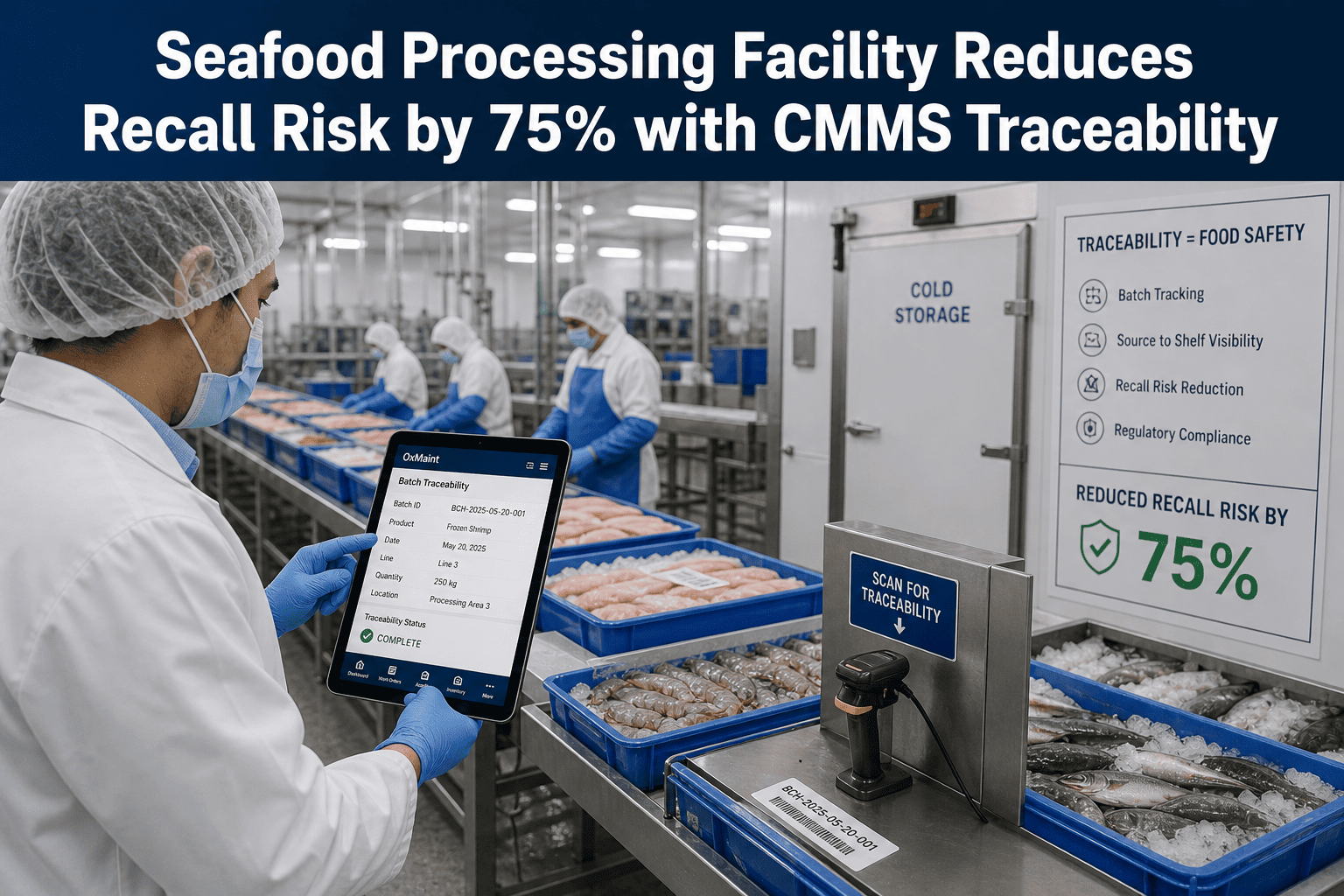
48 hrs
Time to go live

94%+
PM task completion

40%
Less downtime

6–10×
First-year ROI
No contracts. No credit card required. Purpose-built for food manufacturing teams.

Share This Story, Choose Your Platform!