Bond financing for public works capital projects is the primary way municipalities fund the big-ticket infrastructure — water mains, treatment plants, roads, bridges, public buildings — that annual operating budgets simply cannot cover. Roughly 70–80% of large public works capital in the United States is funded through municipal bonds, and the interest rate a city pays on that debt hinges on one thing: how credible its asset management story looks to credit rating agencies and bondholders. This guide explains how bond financing for infrastructure works, the bond types and disclosure rules that matter, and why documented facility and asset condition data — the kind a CMMS produces automatically — can be the difference between an AA rating and an A rating worth millions in interest. If your team is preparing a capital program, Start Free Trial and see how OxMaint turns maintenance records into bond-ready evidence.
How much is your bond rating really costing you?
A single notch on a 30-year, $50M general obligation bond can swing total interest by $3M–$6M. Rating agencies now weigh documented asset condition and capital planning as core credit factors — and most public works departments can't produce that evidence on demand.
What is bond financing for public works capital projects?
Bond financing lets a public entity borrow against future revenue to build or renew infrastructure today, repaying investors over 20–30 years. It is the backbone of infrastructure capital bonds in the public sector: instead of saving for decades, a city issues debt, builds the $40M water treatment upgrade now, and spreads repayment across the generations who benefit. The four structures below account for the vast majority of public works bond financing.
General Obligation (GO) Bonds
Backed by the issuer's full faith and credit — typically property taxing power. GO bonds usually carry the lowest rates (often 3–4.5% in recent cycles) but frequently require voter approval. Common for roads, public buildings, parks and fleet facilities.
Revenue Bonds
Repaid from a dedicated income stream — water, sewer or stormwater utility fees, tolls, lease revenues. No voter approval needed in most states, but investors scrutinize rate covenants and the condition of the revenue-producing assets themselves.
Certificates of Participation & Lease Bonds
A financing vehicle where investors buy a share of lease payments on a facility. Faster to issue and useful for equipment-heavy projects, though typically priced 10–40 basis points above comparable GO debt.
Green & Sustainability Bonds
A fast-growing slice of municipal infrastructure bonds — proceeds earmarked for resilient, energy-efficient or water projects. They attract ESG-mandated investors but demand rigorous, auditable reporting on asset performance and outcomes.
How bond ratings shape the cost of infrastructure capital
Moody's, S&P and Fitch explicitly evaluate management quality, asset condition and capital planning when rating municipal debt. The spread between rating tiers is not abstract — it compounds for decades.
| Rating Tier | Typical 30-Yr Rate | Interest on $50M Bond | What Raters Expect to See |
|---|---|---|---|
| AAA / AA | 3.2% – 3.8% | $28M – $34M | Documented asset inventories, funded capital improvement plans, multi-year maintenance histories |
| A | 3.9% – 4.4% | $35M – $40M | Basic capital plans; gaps in condition data raise questions about deferred maintenance |
| BBB | 4.6% – 5.3% | $42M – $50M | Visible deferred maintenance backlogs, reactive spending patterns, weak reserve policies |
| Below investment grade | 6%+ | $58M+ | Structural imbalance; infrastructure risk treated as credit risk |
Worked example: a mid-sized city issuing $50M in public works bonds at AA (3.6%) pays roughly $32M in total interest. The same issue at A (4.3%) pays about $39M — a $7M penalty, more than the annual maintenance budget of many entire public works departments, caused largely by an inability to demonstrate asset stewardship.
The 6-stage path from capital plan to bond closing
A well-run municipal bond infrastructure issuance typically takes 6–12 months from project identification to closing. Every stage below runs smoother — and cheaper — when asset condition and maintenance data are already organized.
Capital Needs Assessment
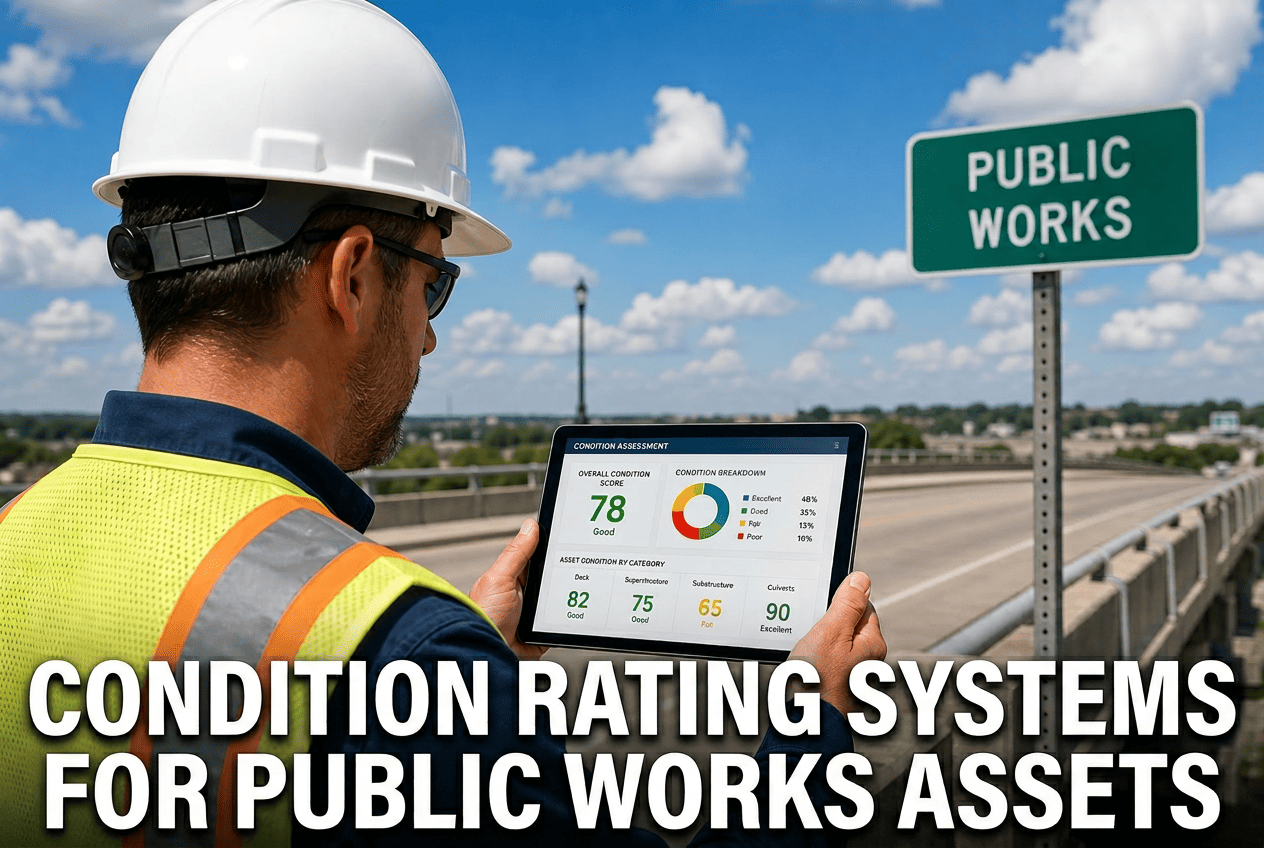
Inventory assets, score condition (typically 1–5 or FCI-based), and estimate remaining useful life. This is where most agencies stall — spreadsheets and tribal knowledge don't survive rating-agency scrutiny.
Capital Improvement Plan (CIP)
Prioritize projects into a 5–10 year funded plan. Raters look for a CIP that is actually funded and updated annually, not a wish list revised once a decade.
Authorization & Approval
Council resolutions, and for GO bonds often a voter referendum. Campaigns pass at higher rates when officials can show taxpayers exactly which assets are failing and what happens if work is deferred.
Rating Agency Presentation
Analysts probe management practices: maintenance funding levels, deferred backlog size, data quality. Agencies with CMMS-generated condition trends answer in minutes; others answer in caveats.
Pricing & Sale
Underwriters price the bonds against the rating and market. Even 15 basis points on $50M is roughly $1.5M over the life of the issue — the payoff for a credible data story.
Continuing Disclosure
SEC Rule 15c2-12 requires annual financial and operating disclosures plus material-event notices. Missed or sloppy filings can trigger downgrades and raise costs on every future issuance.
The deferred maintenance problem — and what raters actually ask
The ASCE estimates a multi-trillion-dollar U.S. infrastructure investment gap, and rating agencies have learned that unquantified deferred maintenance is hidden leverage. Expect these questions in any rating review for bond financing government issuers:
"What is your deferred maintenance backlog, in dollars?"
A defensible answer requires asset-level condition scores and costed work histories. "We think it's manageable" reads as a red flag; a trend line showing the backlog shrinking 8% year-over-year reads as management strength.
"How do you prioritize capital vs. maintenance spending?"
Raters reward risk-based prioritization — criticality scores, failure consequence, remaining life — over squeaky-wheel budgeting. ISO 55000-aligned asset management frameworks are increasingly cited in rating reports.
"What happens to the assets this bond funds after construction?"
New infrastructure without a funded preventive maintenance plan becomes tomorrow's backlog. Showing a PM schedule already loaded for the new facility is a genuine differentiator.
"Can you evidence regulatory compliance?"
EPA consent decrees, state inspection mandates and OSHA findings all surface in credit analysis. Time-stamped, audit-ready maintenance records convert compliance from a liability into proof of control.
Turn maintenance records into bond-ready evidence with OxMaint
OxMaint's AI-powered CMMS/EAM gives public works teams the documented asset story that rating agencies, underwriters and bondholders want to see — without adding headcount.
Asset Registry & Condition Scoring
A complete, living inventory of every facility, vehicle and linear asset with condition grades, photos and remaining-life estimates — the foundation of a defensible capital needs assessment and CIP.
Preventive Maintenance Automation
Schedule, assign and close PMs from one dashboard. Agencies using structured PM programs typically cut unplanned downtime 30–50% and can prove to raters that new bond-funded assets will be maintained from day one.
Deferred Backlog & Cost Analytics
Real-time dashboards quantify the maintenance backlog in dollars, track it against targets, and export board- and rater-ready reports in minutes instead of weeks of spreadsheet archaeology.
Audit-Ready Work Order History
Every work order is time-stamped with labor, parts and cost — satisfying continuing-disclosure expectations and making regulatory audits a retrieval exercise, not a reconstruction project.
See your asset data the way a rating analyst would
Book a 30-minute demo and we'll walk through a bond-ready capital planning dashboard built on your own asset classes.
Bond financing for public works: common questions
What is bond financing for public works capital projects?
It is long-term borrowing — typically 20–30 years — where a municipality sells bonds to investors to fund infrastructure like water systems, roads and public buildings, then repays principal plus interest from taxes or dedicated revenues. It funds roughly 70–80% of major U.S. public works capital because pay-as-you-go budgets can't absorb $10M–$100M projects.
What's the difference between GO bonds and revenue bonds?
General obligation bonds are backed by the issuer's taxing power and usually need voter approval, earning the lowest rates. Revenue bonds are repaid from a specific income stream — utility fees, tolls — and skip the ballot but face deeper scrutiny of the underlying assets' condition and the rate covenant's strength.
How does a bond rating affect infrastructure project cost?
Directly and massively: each rating notch typically moves the interest rate 20–60 basis points. On a $50M, 30-year issue, dropping from AA to A can add $5M–$7M in total interest — money that never builds a single foot of pipe. Book a Demo to see how documented asset management supports a stronger rating presentation.
Why do rating agencies care about maintenance records?
Because deferred maintenance is hidden debt. Moody's, S&P and Fitch all assess management quality and capital planning; an issuer that can quantify its backlog, show funded PM programs and produce multi-year condition trends demonstrates control, while one that can't gets priced as a risk.
What continuing disclosure is required after bonds are issued?
Under SEC Rule 15c2-12, issuers must file annual financial and operating information plus prompt notice of material events (rating changes, defaults, covenant breaches). Organized, CMMS-maintained asset and financial data makes these filings routine — Start Free Trial and keep every record audit-ready year-round.
Build the asset story your next bond issue deserves
OxMaint gives public works teams the condition data, PM discipline and audit-ready records that protect ratings and cut borrowing costs.
Free 14-day trial · No credit card · Set up in an afternoon