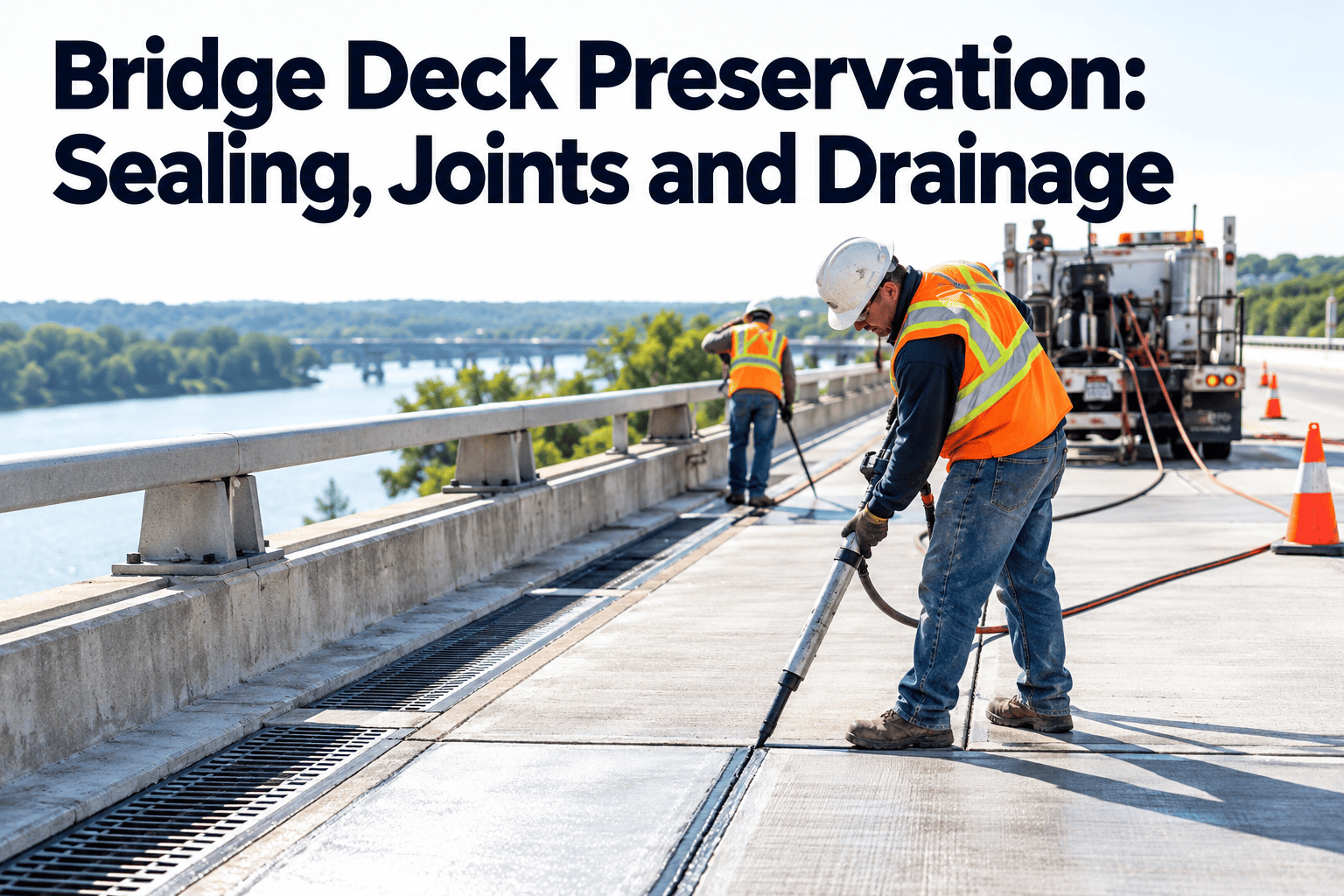
Most bridge decks do not fail because of one dramatic event. They fail slowly, as water and deicing salts find a path through cracks, leaking joints and clogged drains, then attack the steel and concrete below. Bridge deck preservation interrupts that path with small, scheduled tasks: sweeping and washing, joint cleaning and sealing, crack and surface sealing, and drain cleaning. This guide explains how each task works, when to schedule it, what to record and how to keep the whole program visible. Teams that want a single place to plan and track the cycle can start with Oxmaint and build the first schedule around their own bridge list.
Bridge Deck Preservation: Sealing, Joints and Drainage
Stop the water path before it reaches the beams. Plan washing, joint work, sealing and drain cleaning as a repeatable program, and keep proof that each task was done.
Where the water goes, and where a preservation task stops it
Every preservation task has one job: remove a way for water or chlorides to reach a vulnerable part of the structure. Seeing the chain makes it easier to explain the work to budget holders.
The four core tasks at a glance
| Task | What it prevents | Typical timing | What to record |
|---|---|---|---|
| Sweeping and washing | Chloride and debris build-up that holds moisture against concrete and joints | After winter, and again before sealing | Date, method, areas washed, runoff handling |
| Joint cleaning and repair | Leakage onto bearings, beam ends and substructure | Annual cleaning, repair when seals fail | Joint ID, leak status, seal condition, photos |
| Crack and deck sealing | Chloride entry into concrete and reinforcing steel | Per condition and product guidance | Product, area covered, weather, cure notes |
| Drain and scupper cleaning | Ponding, overflow and staining of supports | Annual flushing, extra passes in leaf season | Drain ID, blockage found, flow check |
A seasonal calendar that fits maintenance reality
Timing depends on climate, traffic and crew availability, so use the layout below as a starting point and adjust it for your region and your structures.
Spring
- Sweep deck and approaches
- Wash away winter salts
- Clean and inspect joints
- Flush drains and downspouts
Summer
- Seal cracks in dry weather
- Apply deck sealer on prepared decks
- Repair or replace failed joint seals
- Patch isolated spalls
Fall
- Clear leaves from drains
- Re-check joints before freeze
- Verify drain outlets are free
- Confirm winter readiness
Winter
- Report leaks and icing patterns
- Log spalls and debris in joints
- Plan next year's cycle
- Order sealers and joint materials
Put the whole preservation cycle on one schedule
Oxmaint can generate recurring preservation work orders by bridge and component, assign crews from the field and keep photos and notes attached to each structure.
Washing and sweeping: the cheapest step that is often skipped
Washing removes salt and debris so they stop working on the deck. State research on preservation treatments recommends sweeping decks annually and flushing the deck before any sealer goes on.
Do
- Sweep first, so debris does not clog drains during washing
- Wash the deck, curbs, joints and the areas around drains
- Plan traffic control and runoff handling before the crew arrives
- Record the bridge, date, method and any problems discovered
Watch for
- Water directed onto bearings or underneath the bridge without a plan
- Local rules on runoff near streams, wetlands or protected areas
- Washing that is done but never logged, which leaves no proof
- Skipping bridges because they are hard to reach
Joints: where small leaks turn into expensive substructure repairs
A leaking joint sends salty water directly onto bearings, beam ends and bent caps. Cleaning is routine, but repair decisions need inspection input and a clear escalation path.
Debris in the joint
Clean and flush. Log the joint and record that the gland or seal appeared intact.
Minor leakage or staining below
Schedule seal repair. Photograph staining on beam ends and bearings for comparison.
Torn, missing or loose components
Plan replacement, coordinate traffic control and notify the bridge inspector.
Safety hazard to traffic or structure
Raise an urgent work order, protect the area and involve the responsible engineer.
Sealing: timing, preparation and documentation
Sealing slows chloride entry into concrete. Research programs have recommended crack sealing and penetrating sealers such as silanes for suitable decks, but product choice, deck condition and application rules vary by agency.
Drains and downspouts: the small task with large consequences
When drains are ignored
- Water ponds along the curb and freezes
- Overflow stains piers and abutments
- Debris is discovered only during an inspection
- Fixing damage requires lane closures
When drains are scheduled
- Flow is checked every year and after major storms
- Blockage trends point to trees, litter or design problems
- Crews fix the cause, not only the symptom
- Inspection reports show completed drain work
Condition-triggered decisions: when to go beyond the routine
| Observation | Likely response | Escalate to engineer when |
|---|---|---|
| Salt crust and debris on deck | Sweep and wash on the next cycle | Heavy build-up appears again soon after washing |
| New transverse cracks | Log, photograph and schedule sealing | Cracks widen, connect or show rust staining |
| Joint leakage after rain | Clean, inspect and plan seal repair | Beam ends or bearings show corrosion or section loss |
| Ponding near drains | Flush drains and check outlets | Water still collects after cleaning |
| Spalls or exposed steel | Mark, protect traffic and record location | Always, because structural capacity may be affected |
Plan the program in six moves
Inventory
List every bridge with deck type, joints, drains and exposure to salt.
Set cycles
Define task frequencies by condition, traffic and winter severity.
Bundle by route
Group nearby bridges to save travel time and traffic control cost.
Assign crews
Match tasks to trained crews, equipment and available work windows.
Track completion
Record each task with photos, notes and the bridge it belongs to.
Feed back
Compare inspection results with preservation history and adjust cycles.
Measures that show whether the program is working
Preservation results take years to show in condition ratings, so report completion and finding trends first, then link them to inspection outcomes as the history grows.
Safety and access need to be in the work order
Plan before the crew leaves the yard
- Traffic control plan and permits for each bridge
- Fall protection and access equipment for work near edges and under decks
- Water, sweeper and sealer logistics
- Environmental restrictions for runoff and materials
Capture during and after work
- Before and after photos for each component
- Unexpected defects, with a link to a follow-up work order
- Materials used and quantity, for cost tracking
- Sign-off by the crew lead or supervisor
What a leak reveals about the structure below
Preservation crews are often the first people to see early distress. Train them to notice and report patterns, and make it easy to turn an observation into a work order.
Rust, debris or restricted movement
Often linked to a leaking joint above. Record the pier or abutment, take photos and flag for the inspector.
Staining, flaking coating or section loss
Water and salt collect at ends. Note the extent, and repeat the photo from the same position each year.
Efflorescence, cracks or wet patches
Check whether a drain outlet or joint is discharging onto the cap, and add cleaning or repair to the plan.
Impact damage or loose posts
Treat as a safety item. Log the location, protect traffic and schedule repair quickly.
Why preservation is a budget conversation, not only an engineering one
Preservation tasks are small, frequent and easy to postpone because nothing appears to break when they are skipped. Make the trade-off visible to the people who approve funding.
If preservation is deferred
- Repairs shift from planned work to urgent work
- Traffic control and lane closures cost more and affect more drivers
- Deck and joint replacement arrives earlier than planned
- Inspection findings repeat year after year
If preservation is funded and tracked
- Crews work from a schedule and can plan materials and traffic control
- Completion records show owners that the work is being done
- Trend data supports requests for deck rehabilitation or replacement
- Agencies can compare cost per bridge and prioritize intelligently
Use your own cost history when presenting this to decision makers. A documented local example is more convincing than any general claim about savings.
What every preservation work order should capture
Common mistakes that weaken a preservation program
Treating every bridge the same
Heavily salted routes and older decks usually need shorter cycles than low-exposure bridges.
Sealing a dirty deck
Poor surface preparation wastes material and hides the problem the sealer was meant to protect against.
Cleaning without recording
Work that is not logged cannot be proven to inspectors, auditors or funding agencies.
Ignoring the drainage outlet
A clean inlet with a blocked pipe or discharge point simply moves the water problem elsewhere.
Leaving findings in the inspection report
Deficiencies need owners and due dates, or they will reappear in next year's report.
Skipping crew feedback
Field staff see leaks, ponding and debris patterns first, and their notes should shape the next cycle.
Connect preservation to the inspection cycle
Routine bridge inspections and preservation work should inform each other. Findings tell crews where to focus, and crew observations tell inspectors where conditions are changing between formal inspections.
When both teams use the same structure records, an inspector can see exactly what was cleaned, sealed or repaired since the last visit, and crews can see which findings are still waiting for action.
How Oxmaint supports a bridge preservation program
Workflows that match the tasks above
- Asset management for bridges and their components, such as joints, drains and bearings
- Preventive maintenance schedules for washing, joint cleaning, sealing and drain flushing
- Mobile work orders and inspections with photos, notes and timestamps
- Corrective work orders raised directly from inspection findings
- Reports on completion, backlog and cost by structure to support budgets and funding requests
The software organizes the work and the evidence. Engineering decisions about structural condition and repair methods stay with qualified bridge inspectors and engineers.
Frequently asked questions
What does bridge deck preservation include?
It covers sweeping and washing, joint cleaning and repair, crack and deck sealing, and drain cleaning. The goal is to keep water and chlorides away from the structure.
How often should decks and joints be cleaned?
Many programs clean decks, joints and drains at least once a year, with extra passes where debris or salt use is heavy. You can book a demo to build a schedule by bridge.
When is sealing appropriate?
It depends on deck condition, age and your agency's criteria, so confirm with the bridge inspector. Prepared, dry surfaces and documented application are essential.
How do we prove preservation work was done?
Attach dated photos, notes and materials to a work order for each bridge. You can sign up to test this workflow on a few structures.
Does preservation replace repair or replacement?
No. It slows deterioration and delays costly work, but decks with serious damage still need engineered repair or replacement.
Protect your bridges before the water does the damage
Schedule the small tasks, record the proof and track the trends. Oxmaint helps bridge maintenance teams run preservation as a program, not a list of good intentions.