A snowplow that fails at 2 a.m. during a Level 3 snow event does not just delay one route — it triggers a cascade of reassignments, overtime, and public complaints that no operations supervisor wants to manage in -20°C. Canadian public works fleets lose an estimated 22% of winter operational uptime to equipment failures that preventive maintenance would have caught before the season started. OxMaint gives municipal fleet teams a structured winter readiness programme covering snowplows, salt spreaders, loaders, and support equipment — with PM schedules, pre-season inspections, parts inventory, and a real-time readiness dashboard. Book a demo to see how Canadian public works teams are using OxMaint to hit 95%+ fleet readiness on opening night.
Checklist · Winter Operations · Fleet Maintenance · Canadian Public Works
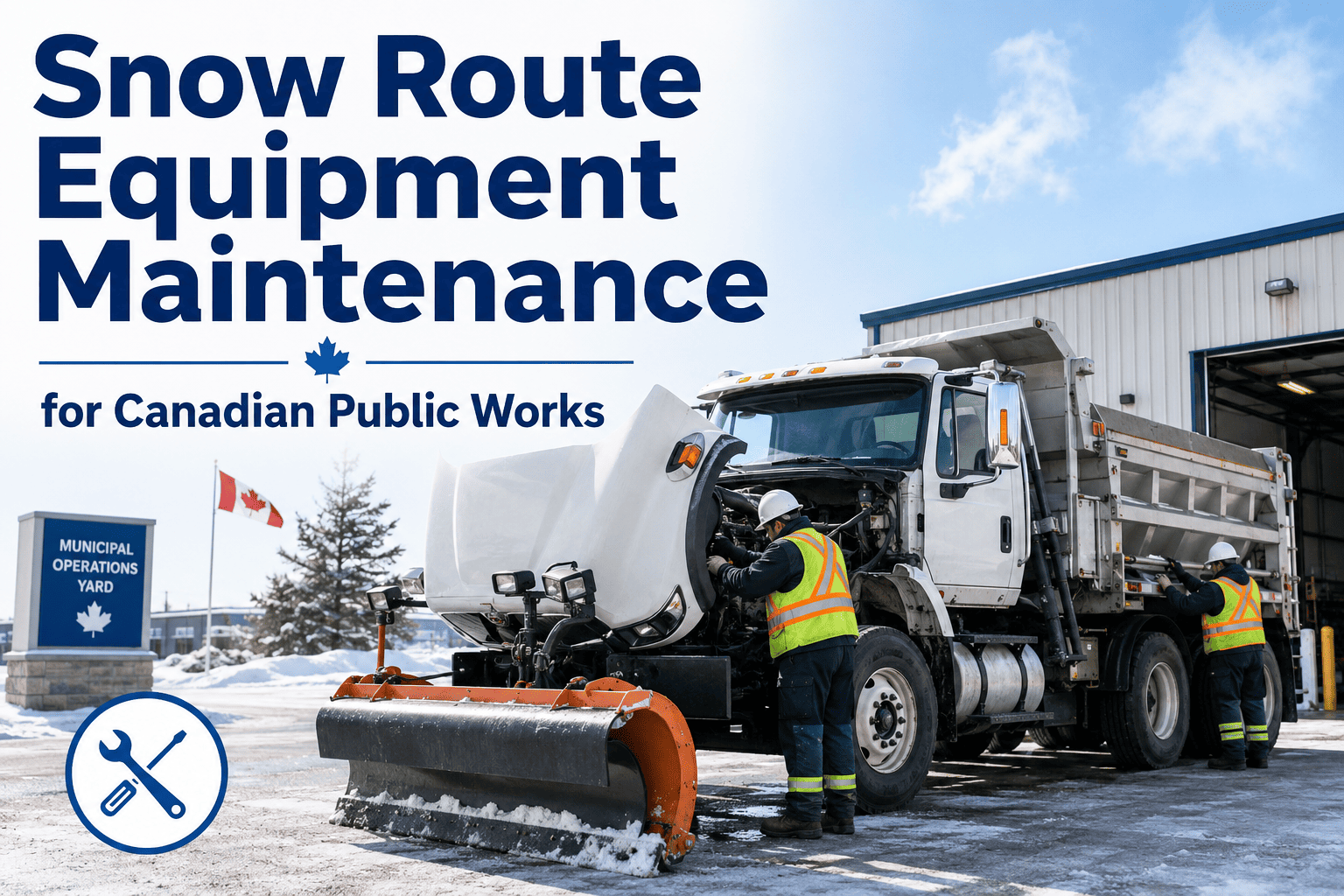
Snow Route Equipment Maintenance for Canadian Public Works
Pre-season readiness, in-season PM, parts inventory, and fleet dashboards — a complete winter operations maintenance programme for municipal snowplow, salt spreader, and loader fleets.
22%
average winter operational uptime lost to unplanned equipment failures in Canadian municipal fleets
$18K
average cost of a mid-event plow breakdown including parts, labour, overtime, and service delays
6 wks
minimum pre-season window needed to complete full readiness checks across a 10-unit fleet
95%+
fleet readiness target achievable with structured pre-season PM and parts pre-positioning
Pre-Season Checklist
The Complete Pre-Season Winter Equipment Readiness Checklist
Snowplow Units
01Plow blade edge wear — replace if under 1 in. remaining
02Hydraulic fluid level and line condition
03Trip springs — tension and fracture inspection
04Plow frame mounting bolts — torque check
05Wing plow hydraulic cylinders — stroke and seal
06Amber strobe and work lights — bulb and lens
07Backup camera and proximity sensor function
08Engine coolant, air filter, belts — cold-start readiness
Salt & Sand Spreaders
01Spinner disc and paddles — wear and corrosion
02Conveyor chain tension and lubrication
03Hopper corrosion — inside and structural welds
04Vibrator function — clump prevention test
05Spread rate calibration — g/m² check against spec
06Pre-wet system nozzles — clog and flow rate
07Brine tank and pump — seal integrity and priming
08Controller unit — communication and display test
Loaders & Graders
01Bucket cutting edge — replace if worn to wear indicator
02Hydraulic boom pins and bushings — play check
03Tire chain condition and mounting hardware
04Cab heater and defroster function
05Wheel loader brake and transmission fluid
06Grader blade lift cylinder seals
07Engine block heater — plug and element test
08Ballast weight configuration — record by unit
In-Season PM Schedule
In-Season Maintenance Intervals by Equipment Type
| PM Task |
Equipment |
Interval |
Failure Risk if Skipped |
OxMaint Trigger |
| Hydraulic fluid check |
Plow, Loader |
Every 40 hrs / weekly |
Cylinder seal failure — plow drops |
Recurring WO by engine hours |
| Blade edge wear measure |
Plow, Grader |
Every 8 hrs operational |
Pavement scuffing, reduced efficiency |
After each route or shift |
| Conveyor chain lube |
Spreader |
Every 50 hrs |
Chain snap mid-spread |
Engine-hour meter WO |
| Spread rate calibration |
Spreader |
Bi-weekly or after repair |
Under/over-salting, compliance risk |
Scheduled recurring WO |
| Strobe and light check |
All units |
Weekly pre-shift |
Highway safety violation |
Pre-shift mobile checklist |
| Block heater plug inspect |
Plow, Loader |
Weekly below -15°C |
No-start event on cold dispatch |
Temperature-threshold WO trigger |
| Corrosion rinse (undercarriage) |
All units |
After each salt event |
Accelerated frame rust, $40K+ repair |
Post-route checklist item |
Parts & Inventory
Critical Spare Parts Every Winter Fleet Depot Must Pre-Position
Plow cutting edges (2 per unit per season)
Hydraulic cylinder seals — plow and spreader
Spreader conveyor chain (1 spare per chain size in fleet)
Spinner disc and paddle sets
Amber strobe bulbs and LED bars
Block heater cords and elements
Trip spring sets by plow model
Brine pump seals and pre-wet nozzles
OxMaint tracks minimum stock levels and auto-generates purchase requests when parts drop below threshold — so you never discover a stockout at midnight.
Book a Demo
Expert Review
Canadian Fleet Supervisors on Winter Operations Maintenance
5 / 5
We had a spreader conveyor chain failure at 3 a.m. during a Level 2 event — six routes went from salted to unsalted coverage mid-storm because we had no spare chain on the shelf and the part had to come from the city 90 minutes away. After that season we inventoried every critical spare in OxMaint and set minimum stock alerts. The following winter we had zero stockout events across the entire fleet, even with higher event frequency. The parts inventory module alone justified the platform for our operations manager.
GF
Glenn Ferris
Fleet Supervisor, Ontario Municipal Works Depot · 20 yrs winter fleet operations
5 / 5
Pre-season inspection used to be a paper form filled out by whoever was in the shop that day — no standardization, no photo evidence, no sign-off hierarchy. With OxMaint we assigned each unit a digital asset record and the pre-season checklist is a structured work order with photos required for blade wear and hydraulic condition. Three seasons in, we have never had a plow enter service with a blade below spec because the system will not close the WO without the measurement recorded. That is exactly the discipline that prevents the 2 a.m. failure call.
MV
Michelle Vachon
Public Works Operations Manager, Quebec Municipality · 15 yrs fleet and roads management
4 / 5
The readiness dashboard was the feature that changed how I report to council. Every November I used to show up to the operations committee with a summary of which units were ready and hope they did not ask too many questions. Now I open OxMaint on a tablet during the meeting and every unit's readiness status, PM completion percentage, and outstanding repair work order is visible in real time. Council approved our equipment replacement request for two aging plows in 20 minutes because the condition trend data made the case without needing a lengthy report.
RD
Rob Dallaire, C.E.T.
Director of Infrastructure Services, BC Regional District · 17 yrs public works leadership
Frequently Asked Questions
Snow Route Equipment Maintenance — Common Questions
When should pre-season winter equipment checks start for Canadian municipal fleets?
Most Canadian municipalities should begin structured pre-season inspections in September — six to eight weeks before the expected first-call date in their region. This window allows time to order parts with standard lead times, complete repairs on any unit requiring shop time, and still run a final readiness check in late October before the seasonal dispatch window opens. Waiting until October typically leaves insufficient time to address hydraulic or structural repairs without emergency expedite costs.
OxMaint includes pre-season PM templates pre-loaded with equipment category and inspection items you can deploy immediately.
How does OxMaint handle spread rate calibration records for regulatory compliance?
Spread rate calibration is a scheduled recurring work order in OxMaint, with required fields for tested rate in grams per square metre, weather conditions at time of calibration, technician ID, and comparison to the municipality's application rate policy. Completed calibration records are stored on the spreader asset record and can be exported for regulatory review, insurance audit, or contract verification. Most provincial road authority contracts and Ministry of Transportation agreements require evidence of calibrated spread rates — OxMaint makes this auditable by default rather than something to reconstruct after the fact.
Book a demo to see the calibration workflow.
What is the typical lifecycle for plow cutting edges, and how does OxMaint track wear?
Cutting edge lifecycle varies by material — standard carbon steel edges typically last one to two seasons depending on route type and pavement abrasiveness, while carbide-embedded edges can last two to three seasons. OxMaint tracks each edge as an inventory item attached to the plow asset record, with wear measurements logged on each in-season inspection work order. When measured wear approaches the replacement threshold, OxMaint triggers a parts request automatically. Across a 10-unit fleet this typically reduces blade-related downtime by capturing wear progression rather than discovering worn edges at the start of a shift. Visit the
free trial to configure your edge wear thresholds.
Can OxMaint manage a mixed fleet of owned and contracted winter equipment?
Yes. OxMaint's asset register supports both owned and contracted equipment with separate work order flows, inspection requirements, and reporting visibility. Municipal-owned units carry full PM history and parts records, while contracted units can be tracked with inspection-only records and contractor compliance documentation. This is particularly useful for municipalities that own the primary fleet and contract supplemental loaders or graders during high-event periods — council and operations managers see a single readiness dashboard covering both.
Book a demo to see how the mixed fleet configuration works.
OxMaint Winter Fleet · Canadian Public Works
Enter Every Winter Season With 95%+ Fleet Readiness — Not Hope
OxMaint converts your pre-season checklist, in-season PM schedule, parts inventory, and readiness reporting into a single mobile-first workflow. Every unit. Every inspection. Every part. Tracked and ready before the first storm rolls in.