City Streetlight Outage Repair Routing With Mobile CMMS

By James Smith on June 5, 2026

city-streetlight-outage-repair-routing-mobile-cmms

A broken streetlight is more than a nuisance — it is a documented public safety hazard and a liability exposure that begins the moment a citizen submits a report. Most city public works departments struggle to route crews efficiently, track repair status, and prove completion — because they are managing outage requests through spreadsheets, phone calls, and email. OxMaint AI replaces that fragmented workflow with a mobile CMMS that converts citizen requests into routed, tracked, photo-verified work orders automatically.

Public Works — Urban Infrastructure

City Streetlight Outage Repair Routing With Mobile CMMS

From citizen report to crew dispatch to verified repair — manage every streetlight outage in one mobile-first system. No spreadsheets. No phone tag. No missed repairs.

4.2x
faster crew dispatch with mobile work order routing vs phone-based dispatch
91%
reduction in duplicate outage reports when citizens receive automated status updates
0 hrs
manual data entry — OxMaint auto-generates work orders from incoming requests
100%
photo-verified repair closure — every completed job has time-stamped proof
How It Works

The Complete Streetlight Outage Workflow in OxMaint


Step 1
Outage Reported
Citizen submits report via web portal, QR scan, or phone. OxMaint auto-creates a work order with location, asset ID, and priority classification — no manual input from office staff.

Step 2
Work Order Prioritized
OxMaint scores each outage by location risk — school zone, intersection, high-crime area, or highway — and queues work orders for crew assignment accordingly. High-risk outages are flagged for same-day dispatch.

Step 3
Crew Routed by Location
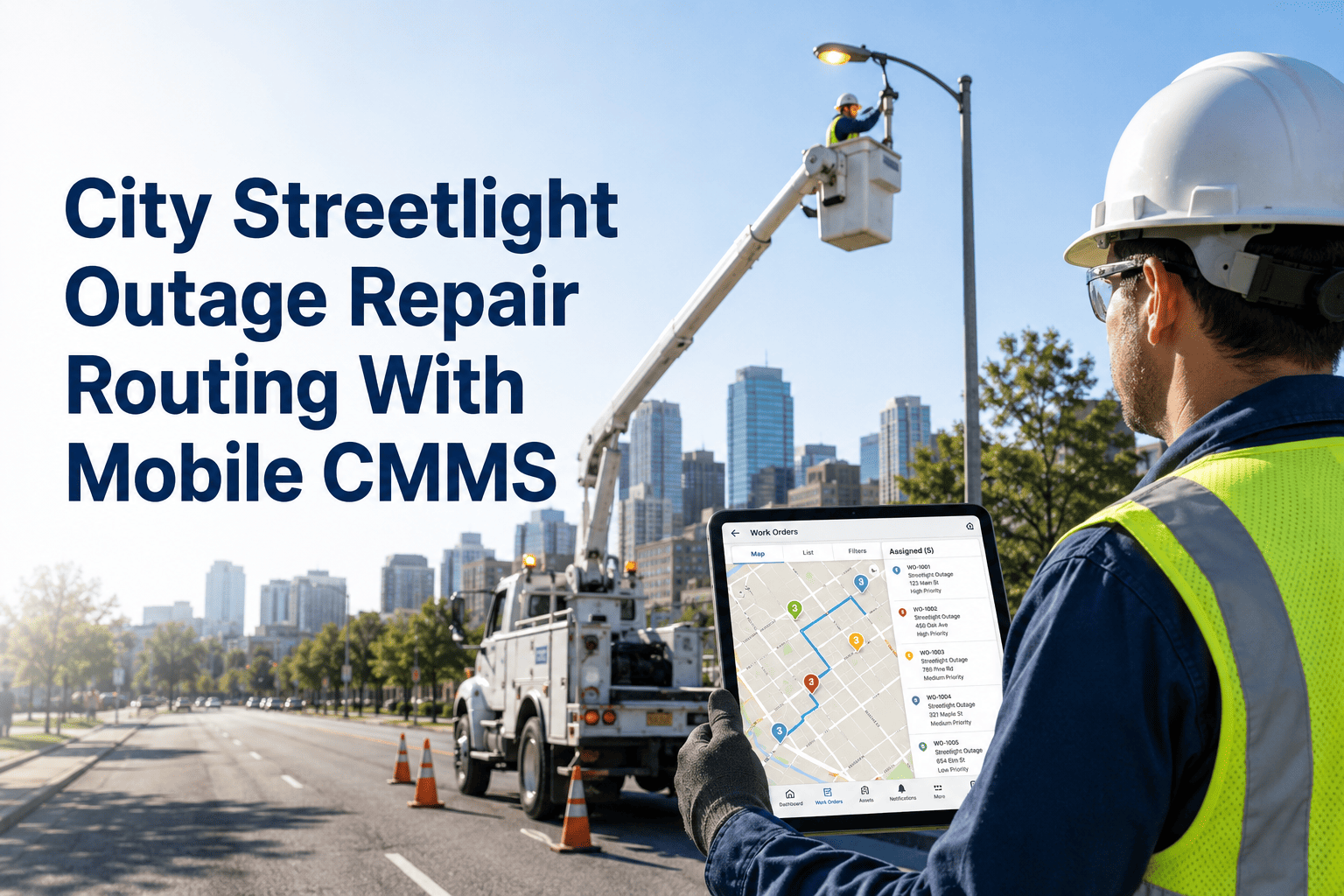
The mobile app groups outages by geographic zone and assigns the nearest available crew. Technicians see their full day's route with asset addresses, pole IDs, and job notes — no supervisor calls needed.

Step 4
Repair Completed On Mobile
Technician closes the work order on-site with a photo, parts used, and repair notes. GPS and timestamp are locked — no back-office editing. The asset record updates instantly.
Step 5
Status Closed & Reportable
The supervisor dashboard updates in real time. Council reports, response time analytics, and cost-per-repair summaries are available with one click — no manual compilation required.
Priority Framework

How OxMaint Classifies Streetlight Outage Priority

P1 — Critical
Same Day Dispatch
Major intersection or crossing
School zone or playground perimeter
Reported safety incident nearby
Highway on/off ramp lighting
P2 — High
Within 48 Hours
Residential collector road
Commercial zone after-hours safety
Multiple consecutive outages on block
Active citizen complaint on file
P3 — Standard
Within 7 Days
Low-traffic residential cul-de-sac
Redundant coverage area
Parks pathway (non-active hours)
Daytime-only-impact location
Performance Data

Response Time & Operational Metrics — Before vs After

Metric Phone / Spreadsheet OxMaint Mobile CMMS Change
Avg time from report to crew dispatch 4.6 hours 41 minutes -85%
Duplicate outage reports per month 28 avg 3 -89%
Crew travel time per outage route Unoptimized Zone-grouped routing 31% less driving
Repair photo documentation rate 12% 100% Full coverage
Council report preparation time 3–5 hours/month Under 5 minutes 98% reduction
Open outages older than 14 days 22% of backlog Under 2% -91%
OxMaint AI — Public Works CMMS

Every day a streetlight stays dark is a day of liability exposure. OxMaint routes your crews faster, closes work orders with photo proof, and gives city leadership the reporting they need.

Expert Perspective

Streetlight maintenance sits at the intersection of public safety, citizen satisfaction, and municipal liability. When a pedestrian is injured on a dark street and the city cannot produce a repair record, the legal exposure is significant. The second problem is operational: crews driving unoptimized routes between scattered outage locations waste 20 to 30 percent of their productive time daily. A mobile CMMS that geographically clusters work orders and requires photo-verified closure changes both equations simultaneously — it reduces cost per repair while building the documentation record that protects the city legally.

Public Works Operations Director
Municipal Street & Lighting Division — 22 Years Field and Management Experience
FAQ

Frequently Asked Questions

Yes. OxMaint supports a public-facing request submission portal where residents can report streetlight outages with a location description or address. Submissions automatically generate a work order in the maintenance queue, visible to supervisors in real time. The citizen receives an automated acknowledgment and can optionally receive a status update when the repair is completed — which significantly reduces follow-up calls to the public works office. Book a demo to see the citizen request portal in action.
OxMaint supports coordinate import from GIS platforms, so each streetlight pole asset can carry its precise geolocation from day one. When a work order is created, the asset coordinates automatically appear on the technician's mobile map view. Completed repair data — including GPS-verified job location, technician ID, and timestamp — can be exported back to your GIS system for spatial analysis and asset lifecycle planning. Start your free trial and test the GIS import pathway with a sample asset export from your current system.
Every work order in OxMaint includes a parts and labor cost entry. When a technician completes a repair — bulb replacement, ballast swap, photocell change, or pole repair — they log parts used from the inventory catalog. The cost is automatically calculated and associated with the individual asset record. This means your department can generate per-asset lifecycle cost reports, identify which pole types consume the most maintenance budget, and make evidence-based capital replacement decisions. See a live cost reporting demo.
OxMaint scales from small towns managing 500 streetlights to large cities with 50,000-plus poles. Asset import is done via CSV — your GIS or asset register export populates the entire inventory in one upload, with QR codes generated automatically for each asset. Field crews can begin scanning and closing work orders within the first week of onboarding. Most departments are fully operational in 7 to 10 business days from kickoff. Start your free trial and import your first district's streetlight inventory today.

Stop routing streetlight crews by phone and tracking repairs on spreadsheets. OxMaint puts every outage, every crew, and every repair on one mobile platform — with the reporting city leadership demands.

Mobile work orders. Geographic routing. Photo-verified closure. GIS integration. Built for city lighting operations.

Share This Story, Choose Your Platform!